Bio Final
 Studied by 5 people
 Call Kai
 Learn
Learn Practice Test
 Spaced Repetition
 Match
Match Flashcards
 Knowt Play
1/11

There's no tags or description
Looks like no tags are added yet.
Name | Mastery | Learn | Test | Matching | Spaced |
|---|
No study sessions yet.
12 Terms
DNA Replications
Enzymes and Strands
DNA replication is the process by which a cell makes an exact copy of its DNA before it divides. Several enzymes help with this process, and the DNA strands play important roles.
Enzymes
Helicase: Unwinds and separates the two strands of the DNA double helix and creates a replication fork
2. DNA Polymerase: This enzyme adds new DNA nucleotides to the exposed strands, building a new complementary strand for each original strand.
3. Primase: Makes a short RNA primer that gives DNA polymerase a starting point to begin adding DNA nucleotides.
4. Ligase: This enzyme joins small fragments of DNA on the lagging strand to make a continuous strand.
Strand
- Leading strand: This strand is copied continuously in the same direction as the replication fork moves.
- Lagging strand: This strand is copied in small pieces because it runs in the opposite direction of the replication fork.
What are 3 of Mendel’s Limitations?
Co-dominancy (Blood type), how genes are effected by the environment, and linkage genes
What are Mendel’s principles?
Segregation - The alleles segregate and only take one.
Independent assortment - All the alleles are linked independently and not together
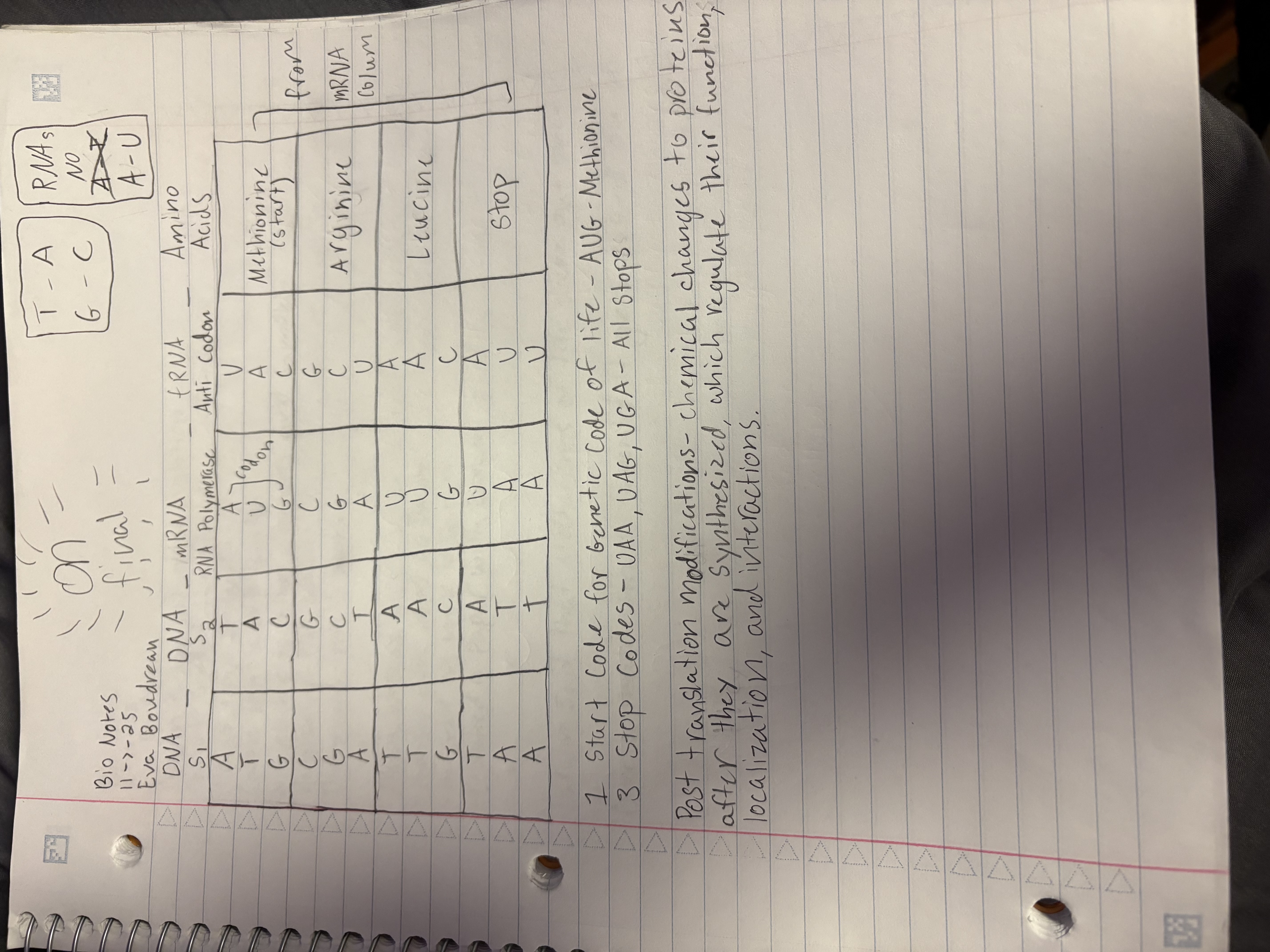
Genetic Code Table
G - C
A - T
What is Malaria?
A disease caused by a parasite that is spread to people through the bites of infected mosquitoes. It causes symptoms like fever, chills, and flu-like illness. Malaria is most common in tropical and subtropical regions of the world.
What is RNA splicing, posted modification, exons, introns, transcription, and translation
RNA splicing: a process where the cell removes introns (non coding) from the RNA copy of a gene and joins exons (coding) together to make a continuous sequence that can be used to make a protein.
Post-transcriptional modification: Changes made to the RNA molecule after it is created from DNA.
Exons: Parts of a gene that code for proteins and are kept in the RNA after splicing.
Introns: The non-coding parts of a gene that are removed from the RNA during splicing.
Transcription: The process where DNA is copied into RNA inside the cell.
Translation: The process where the RNA code is used to build a protein by linking amino acids in the correct order.
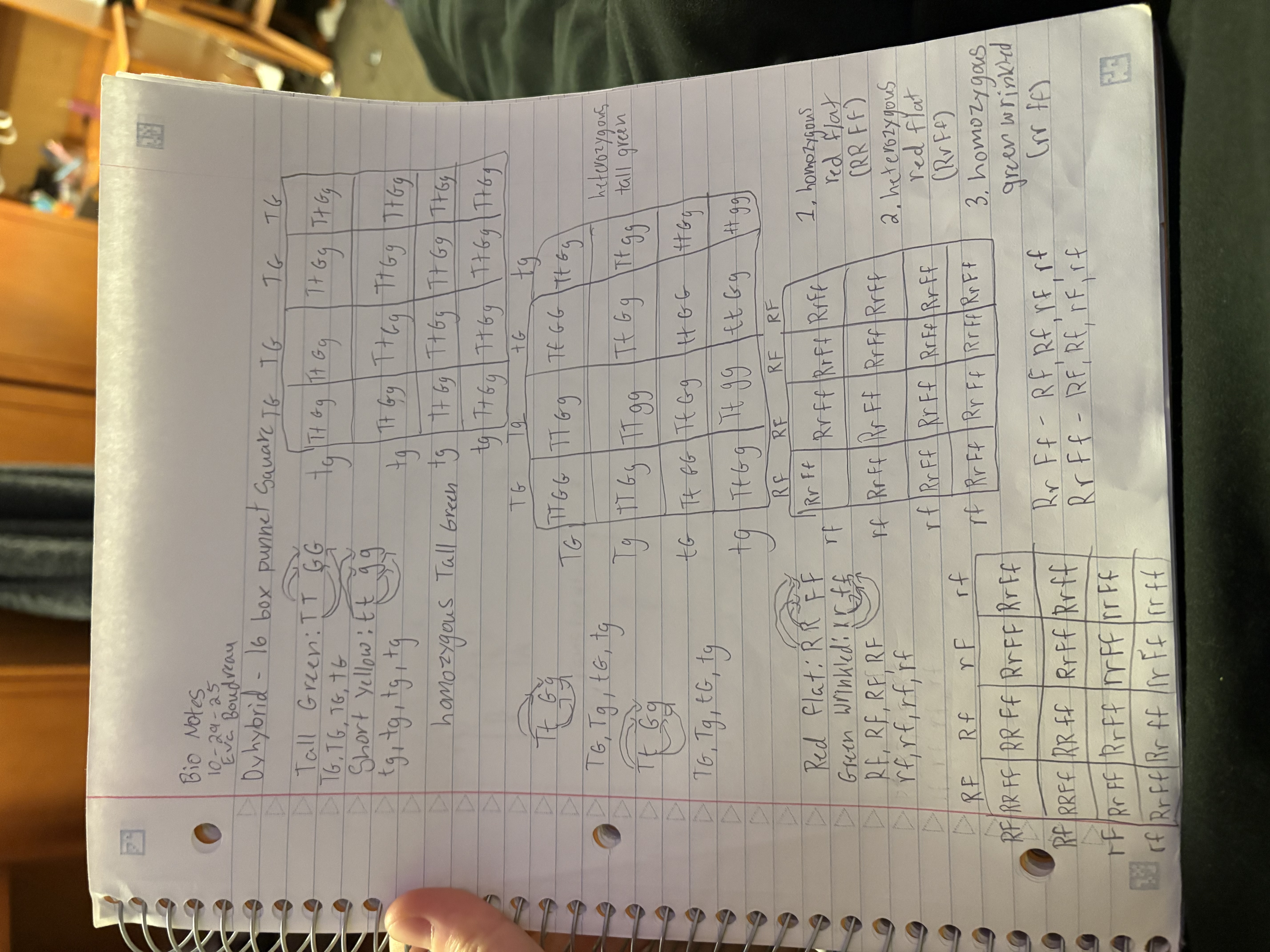
Mendel Dyhybrid
16 Boxes
Gene expression for the lactose bacteria
The process where bacteria turns on specific genes to produce proteins that help them break down and use lactose as food and when lactose is present, the bacteria make enzymes. When lactose is absent, these genes are turned off.
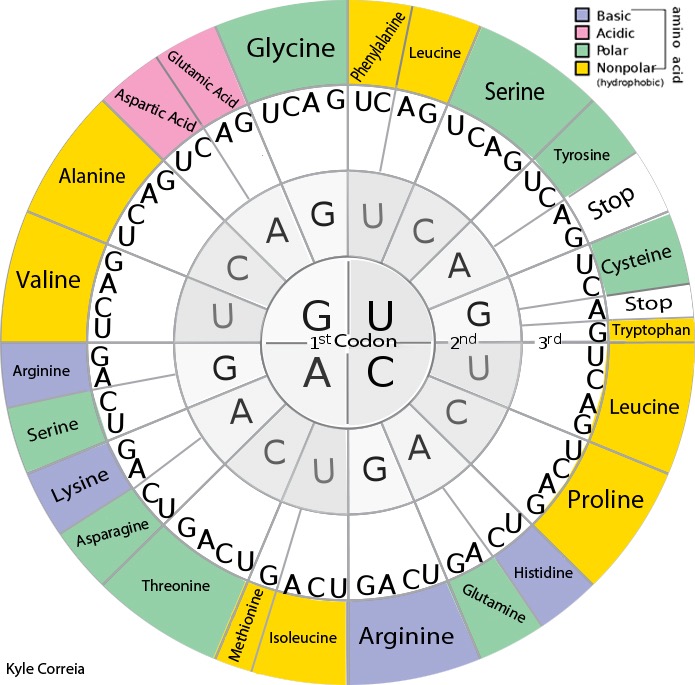
DNA, RNA, and Amino Acid table
Essay on Genetic disease
Extra points for gene name and chromosome number
Sickle cell anemia
- Sickle cell disease is a genetic disorder caused by a mutation in the HBB gene.
- The HBB gene is located on chromosome 11.
- This gene codes for hemoglobin, the protein in red blood cells that carries oxygen.
- The mutation leads to the production of abnormal hemoglobin called hemoglobin S.
- Hemoglobin S causes red blood cells to become sickle-shaped and rigid.
- Sickled cells can block blood flow, causing pain, organ damage, and increased infection risk.
- Sickle cell disease is inherited in an autosomal recessive pattern (two mutated gene copies needed).
- Symptoms include anemia, pain crises, and fatigue.
- Treatment focuses on symptom management and preventing complications.
- Research aims to develop better therapies and possible cures by targeting the HBB gene and its effects.
Essay on Charles Darwin
- Father of evolution
- Charles Darwin was a 19th-century naturalist and scientist.
- He is best known for developing the theory of evolution by natural selection.
- Darwin traveled on the HMS Beagle, studying plants, animals, and fossils around the world.
- His observations, especially on the Galápagos Islands, helped him understand how species change over time.
- Darwin’s book "On the Origin of Species" (1859) explained how natural selection drives evolution.
- Natural selection means that organisms best adapted to their environment are more likely to survive and reproduce.
- His theory challenged traditional beliefs and transformed biology.
- Darwin’s work laid the foundation for modern evolutionary science.
Essay on Central Dogma.
Include translation, number of chromosomes does not express the complicity of it, transcription, RNA splicing, exons and introns, different proteins, translation of code, post translation modification, location, and how our complicity comes from the number of proteins we make not the number of genes we have
- Central Dogma explains the flow of genetic information: DNA → RNA → Protein.
- Transcription occurs in the nucleus, where DNA is copied into messenger RNA (mRNA).
- mRNA contains exons (coding regions) and introns (non-coding regions).
- RNA splicing removes introns and joins exons to create mature mRNA.
- This splicing allows one gene to produce multiple different proteins.
- Translation happens in the cytoplasm, where ribosomes read the mRNA code to build proteins.
- The genetic code translates RNA sequences into specific amino acids.
- After translation, proteins often undergo post-translational modifications that affect their function.
- Humans have 23 pairs of chromosomes, but the complexity of life is not due to the number of chromosomes or genes.
- Our biological complexity comes from the variety of proteins made, thanks to processes like RNA splicing and protein modification.