Organismal Biology Final Exam
 Call Kai
 Learn
Learn Practice Test
 Spaced Repetition
 Match
Match Flashcards
 Knowt Play
1/99

There's no tags or description
Looks like no tags are added yet.
Name | Mastery | Learn | Test | Matching | Spaced | Call with Kai | Chat |
|---|
No analytics yet
Send a link to your students to track their progress
100 Terms
plants: cell wall (structural support), chloroplast (photosynthesis), digestive process in vacuoles, central vacuole (water concentration)
animals: centrosome and centrioles, lysosomes (garbage disposal/ digestion)
cell structure: compare and contrast the cellular structures of plants and animals, focusing on organelles unique to each. how do these differences reflect their respective lifestyles?
advantages: larger = fend off predators; longer life span (keep living when individual cells die); more efficient adaptations to the environment (increased chance of survival); increased genetic diversity; perform more functions (ex: mobility)
disadvantages: greater mass requires more energy; increased waste products = need specialized cellular components/organs to process toxic waste; malfunctions like organ failure are catastrophic; maturity takes longer (juveniles are vulnerable); cells can’t function independently; sexual reproduction = more energy required to reproduce
multicellularity: explain the advantages and disadvantages of multicellularity and an example of how plants and animals deal with at least one of those disadvantages.
the first law of thermodynamics is that energy cannot be created or destroyed, it can only change form or be transferred from one object to another. plants convert sunlight into chemical energy stored in organic molecules. you transform chemical energy into kinetic energy when you walk, breathe, etc.
the second law is that every energy transfer or transformation causes an amount of energy to be converted to a form that’s unusable, often as heat, increasing the entropy of he universe (disorder) and reducing the amount of usable energy to do work. when you walk, you’re generating kinetic energy from chemical energy, but also releasing heat - metabolic activity releases heat
energy transformations: how do the first two laws of thermodynamics impact our understanding of energy balance in living organisms?
plants obtain energy from the sun through photosynthesis. they turn light energy into glucose that can be turned into ATP during cellular respiration to conduct work.
animals obtain energy by eating plants or animals and collecting their glucose to use in cellular respiration to generate ATP
energy acquisition: discuss how plants and animals obtain energy. compare photosynthesis in plants to cellular respiration in animals.
animals: energy intensive, need ATP for heartbeat and contractions; faster movement (need lots of ATP), more easily controlled (vasoconstriction); closed circulatory system
phloem: active transport with ATP; slower movement, influenced by environment (stomata opening); closed system; driven by positive hydrostatic turgor pressure generated by loading and removal of sugars
xylem: ATP required for generation of root pressure in the xylem; transpiration stream of water and mineral movement is mostly passive; slower movement, influenced by environment (stomata opening); closed system; driven by negative pressure from transpiration
nutrient transport: compare the vascular system of plants (xylem and phloem) to the circulatory systems of animals. be sure to explain the forces responsible for bulk flow in both systems.
ohm’s law: the electric current in an electrical circuit is directly proportional to the voltage and inversely proportional to the resistance (higher voltage = more current through, higher resistance = restricted current); voltage = current X resistance
blood flow is equal to the pressure gradient divided by resistance; pressure difference drives flow against resistance (vascular resistance determined by vessel diameter)
Poiseuille’s law: flow rate (Q) depends on fluid viscosity, pipe length, pipe radius, and pressure difference (radius important; more pressure = more flow; thicker = slower; longer pipes reduce flow)
a vessel with twice the length of another vessel (each with the same diameter) will have twice the resistance to flow; if blood viscosity increased 2x, resistance to flow will increase 2x; increase in diameter decreases resistance to the 4th power (2x increase = 16x reduction)
flow down gradients: explain how Ohm’s law and Poiseuille’s law apply to the physiological principles governing the mammalian cardiovascular system.
law of partial pressures: the total pressure exerted by a mixture of gases is equal to the sum of the partial pressures of the gases in the mixture
gas exchange: compare the mechanisms of gas exchanges in plants (stomata) and animals (lungs or gills). be sure to include information regarding the law of partial pressures.
plants: waxy cuticle prevents dehydration; exchange oxygen and CO2 through stomata - guard cell behavior regulated by abscisic acid; long-term drought = allow leaves and stems to die in localized regions (regulated by ethylene hormone)
animals: evaporation of sweat; muscle contractions causing shivering; goose bumps - muscles cause small hairs to stand up to increase body temp; vasodilation (more blood and heat to body surface = radiation and evaporative heat loss); vasoconstriction (reduce blood flow in peripheral vessels, forcing to core and vital organs; behavioral changes like burrowing or basking
homeostasis: how do plants and animals maintain homeostasis in response to environmental stress, such as drought or temperature changes?
food (source of energy), water, light, shelter/space, mates
evolutionary adaptation: provide an example of a universal challenge that all organisms must deal with, and then compare the strategies that plants and animals use to deal with that challenge.
plants: slower
animals: faster
hormonal regulation: compare the roles of plant hormones (ex: auxins, gibberellins) to animal hormones (ex: insulin, adrenaline) in regulating physiological processes.
membrane potentials: explain the role of selective permeability to charged ions, chemical gradients, electrical gradients, diffusion, and osmosis in the production and the maintenance of resting membrane potentials as well as the production of action potentials in both plants and animals.
mitochondria: double-membrane structure (outer, inner folds); inner membrane folds increase surface area for ATP production; innermost matrix with enzymes for the Krebs cycle, mitochondrial DNA, and ribosomes; functions in ATP synthesis
chloroplast: double-membrane structure; light reactions happen in thylakoids (contain chlorophyll); Calvin cycle occurs in stroma fluid; green chlorophyll pigments capture light
chlorophyll in thylakoids captures sunlight, thylakoids light energy splits water, producing oxygen, ATP, and NADPH
in stroma- ATP and NADPH power conversion of CO2 into glucose for food
structure and function: explain how structure is connected to function when it comes to both mitochondria and chloroplasts.
adapt: alter morphology (deep roots, waxy leaves); physiology (stomatal closure, osmolytes); life cycles (dormancy, early flowering)
maximize water conservation, uptake, and survival
osmolyte = small organic molecules cells accumulate to manage water balance, regulate osmotic pressure, and protect proteins and membranes from stress (dehydration, high salt)
environmental stress: a plant species is suddenly exposed to a prolonged drought. predict and explain how this might affect the plant’s stomatal behavior, photosynthesis, and overall growth. how could the plant adapt or compensate for the stress?
symbiosis: a scientist discovers a new species of plant that thrives in nutrient-poor soil by forming a relationship with nitrogen-fixing bacteria. explain how this relationship benefits the plant and the bacteria. compare this relationship to a similar animal symbiosis.
significant reduction in photosynthesis rate - chlorophyll are green and reflect green wavelengths of light, absorbing other wavelengths to convert into usable energy resources.
animals wouldn’t be significantly impacted beyond red/green confusion
photosynthesis and light wavelengths: a plant is exposed to only green light in a laboratory. predict how this might affect its rate of photosynthesis and why. would this have the same effect on an animal in a similar experiment involving visual perception?
increased breathing rate to compensate for lower oxygen
long-term changes would include increased red blood cells and pulmonary artery pressure
respiration and altitude: consider an animal species moving from sea level to a high-altitude environment. predict and explain changes in its respiratory system to adapt to the reduced oxygen availability.
the plant would have a reduced rate of photosynthesis and decreased survivability in low-light conditions. it likely needs a light source with many different wavelengths to ensure the missing pigment isn’t the primary wavelength available
mutation impact: a mutation occurs in a plant’s chloroplast DNA, rendering one of the pigments involved in light absorption nonfunctional. predict how this would affect the plant’s energy production and its ability to survive in low-light conditions.
ectotherm: metabolic rate decreases as biochemical reactions slow down causing body temperature to drop; seek warmth (basking, burrowing), reducing activity and metabolism, potentially entering dormancy to conserve energy and survive
endotherm: increase metabolism to maintain stable internal temperatures; raising fur or feathers to trap an insulating layer of air; burn more fuel to produce extra heat
temperature stress: an ectothermic animal experiences a sudden drop in environmental temperature. predict how this might impact its metabolic rate and behavior. compare this to how an endothermic animal might respond.
adaptations to salinity: a freshwater plant species is transplanted to a saltwater environment. predict and explain the physiological challenges it would face and possible mechanisms it might use to survive.
desert adaptations: a desert-dwelling animal suddenly experiences a significant increase in seasonal rainfall. predict how this change might affect its physiological adaptations and interactions with its environment.
pollution and cellular function: a chemical pollutant disrupts the function of mitochondria in animal cells. predict how this disruption would affect the overall energy balance or an organism. then, compare the effects on animals to how a similar disruption in chloroplasts would affect plants.
extreme environments: both plants and animals have evolved to survive in extreme environments, such as the Arctic tundra. compare how a plant might conserve water and nutrients with how much an animal might conserve heat and energy. propose a hypothetical hybrid adaptation that could benefit an organism living in such conditions.
cell theory
all living organisms are made from cell
cell
an organism’s basic unit of structure and function; the smallest unit of organization that can perform all activities required for life
all enclosed by a membrane that regulates the passage of materials between the cell and its environment
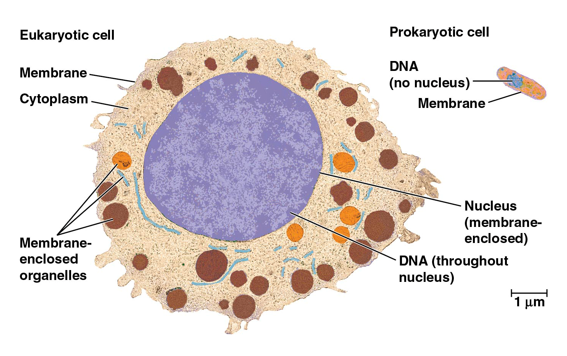
eukaryotic cell
contains membrane-enclosed organelles, the largest of which is usually the nucleus
benefit of compartmentalization
prokaryotic cell
a simpler, smaller cell-type that doesn’t contain a nucleus or other membrane-enclosed organelles
nutritional mode
all living things must obtain energy and carbon from the environment to grow, survive, and reproduce
plants are autotrophs (photosynthesis; inorganic sources of carbon) - broad leaf surfaces enhance light capture
animals are heterotrophs (energy + carbon from food) - a bobcat relies on stealth, speed, and sharp claws to hunt
absorption
organisms need to absorb nutrients
plant root hairs and vertebrate villi projections in the intestines increase the available surface area
surface area to volume ratio
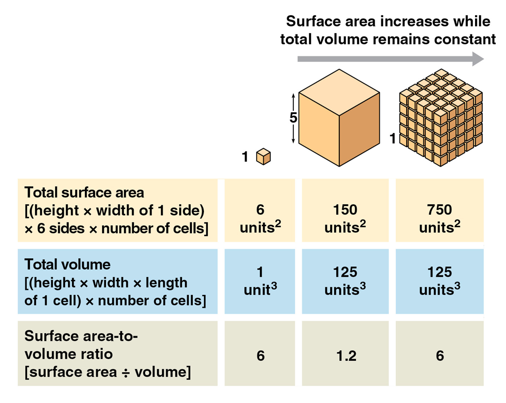
a cube with sides of 5 units has a surface area that increases while the total volume remains constant as it is divided into smaller cubes with sides of 1 unit. each face of the larger cube is 5×5
gene expression
the process of converting information from gene to cellular product
use info encoded in a gene to synthesize a functional protein
central dogma
DNA is transcribed into RNA, which is then translated into a protein
DNA
the genetic material for all living organisms
molecular structure to store information
2 long chains arranged in a double helix
chains made of nucleotides (AGCT)
theory
broader in scope than a hypothesis
general enough to lead to many new, testable hypotheses
supported by a large body of evidence in comparison to a hypothesis
diffusion
passive transport of solute particles so they spread out evenly into the available space
cross evenly at equal rates in both directions at dynamic equilibrium
down concentration gradient (differences in density high to low)
only efficient over small distances because the time it takes to diffuse is proportional to the square of the distance
osmosis
the diffusion of free water (water molecules not clustered around another substance) across a selectively permeable membrane
from the region of lower solute concentration to the region of higher solute concentration (until equal)
gradient
a difference in chemical concentration, charge, temperature, or pressure between two points
matter and energy tend to flow down this
ex: blood flows from a place of higher pressure to a place of lower pressure
movement “up/opposite” requires spending metabolic energy
membrane potential
voltage across a membrane created by differences in the distribution of (+) and (-) ions
inside negative relative to outside = favors passive transport of cations (+) into and anions (-) out of the cell
electrochemical gradient
two combined forces drive diffusion of ions across a membrane
chemical force = ion concentration gradient
electrical force = effect of the membrane potential on the ion’s movement
selective permeability
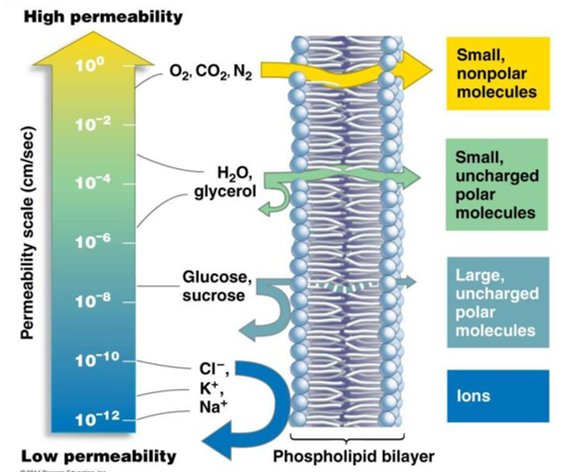
some substances can cross membranes more easily than others
plasma membrane controls the exchange of materials between the cell and its surroundings
hydrophobic (nonpolar) molecules dissolve in the lipid bilayer and pass rapidly (ex: hydrocarbons, CO2, and O2)
hydrophobic interior of the membrane impedes the passage of hydrophilic (polar) molecules (ex: sugars, water, ions)
fluid mosaic model explains membranes regulating molecular traffic across the membrane
tonicity
the ability of a surrounding solution to cause a cell to gain or lose water
depends on the concentration of solutes in the solution that cannot cross the membrane, relative to that inside the cell
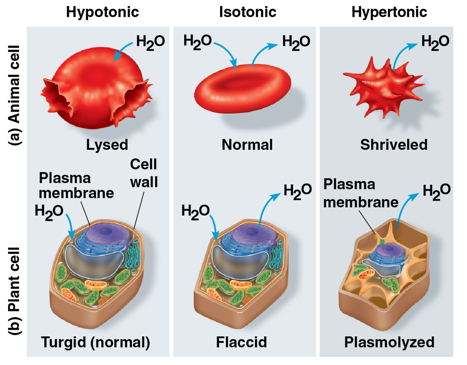
if a solution has a higher concentration of solutes than inside the cell, water will tend to leave the cell, and vice versa
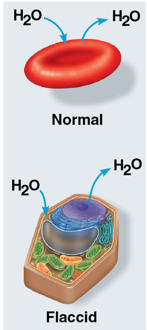
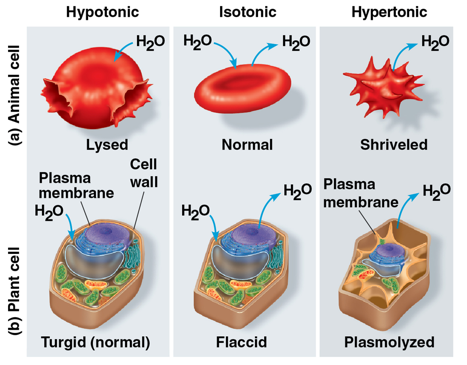
isotonic solution
solute concentration is same as that inside the cell
water diffuses across the membrane at the same rate in both directions
no net movement of water across the membrane
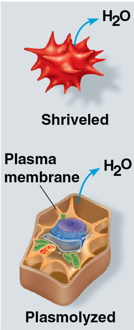
hypertonic solution
solute concentration is greater than that inside the cell
net diffusion of water form inside the cell to the surrounding solution
cells without walls will lose water, shrivel, and likely die
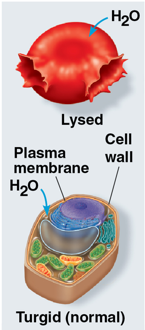
hypotonic solution
solute concentration is less than that inside the cell
net diffusion of water from the surrounding solution to the inside of the cell
cells without walls gain water, swell, and lyse (burst)
osmoregulation
a method of controlling solute concentration and water balance
necessary for cells without walls in hypotonic or hypertonic environments (animal cells do best in isotonic solutions)
ex: Paramecium live in a hypotonic environment and have contractile vacuole to pump excess water out of the cell
plant cells and tonicity
hypotonic solution: takes up water and swells until the inelastic wall exerts back turgor pressure on the cell = turgid (firm) and healthy cell
isotonic solution: no net movement of water into cell; becomes flaccid (limp) and wilts
hypertonic solution: lose water; shrivels and membrane pulls away from cell wall in multiple locations (plasmolysis)
passive transport
some small molecules move across the cell membrane without input of energy; may require transport proteins
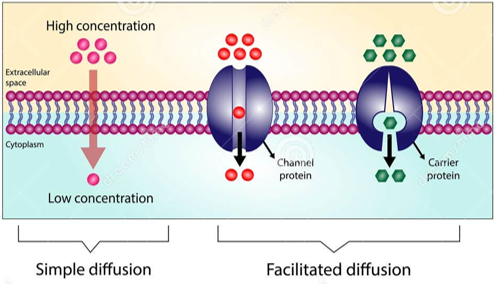
active transport
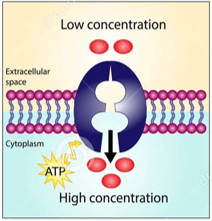
some small molecules move across the cell membrane with energy and a transport protein
requires energy, usually in the form of ATP hydrolysis, to move substances against their concentration gradients
all proteins involved are carrier proteins
allows cells to maintain solute concentrations that differ from the environment
bulk transport
large molecules move in and out of a cell membrane this way, through endocytosis (in) or exocytosis (out)
endocytosis - large molecules secreted when a vesicle fuses with the plasma membrane
exocytosis - large molecules taken in when the plasma membrane pinches molecules
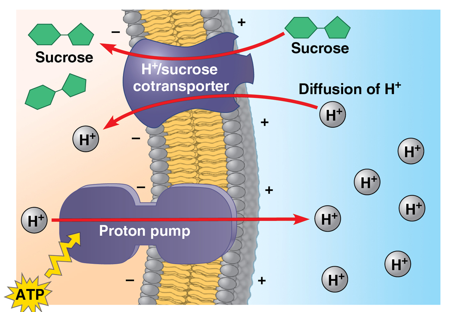
cotransport
when active transport of a solute indirectly drives transport of other substances
downhill solute diffusion coupled to uphill transport of a second substance against its own concentration gradient
ex: plant cells use proton pumps to generate an H+ gradient across cell membrane; cotransporter couples movement of H+ back down concentration gradient to the active transport of sucrose into the cell = how plants load sucrose into their veins for transport around plant body
sodium-potassium pump
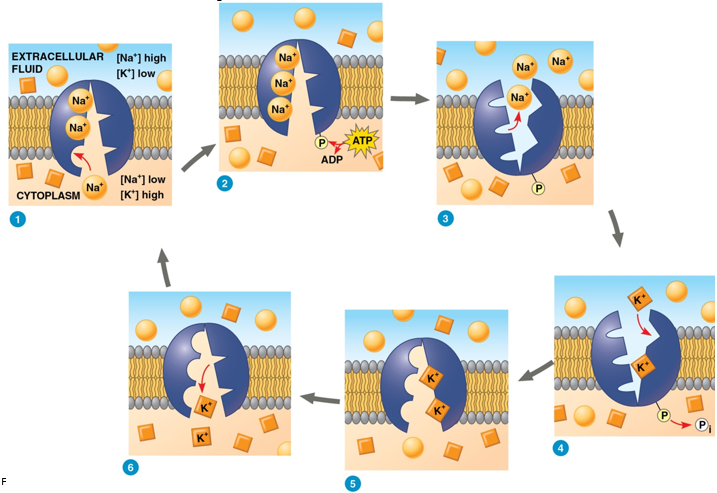
active transport of potassium ions (K+) into and sodium ions (Na+) out of the cell
potassium ions higher inside, sodium ions higher outside
cytoplasmic Na+ bind with carrier protein, stimulating phosphorylation by ATP = phosphate group from ATP to carrier protein leaves ADP in cytoplasm
phosphorylation changes protein shape, reducing affinity for Na+, which are released outside the cell
new shape = high affinity for K+, 2 K+ bind to protein on extracellular side = release of phosphate group inside cell
loss of phosphate group restores shape = low affinity for K+ ions
2 K+ ions released inside cell; affinity for Na+ ions high again
challenges of multicellularity
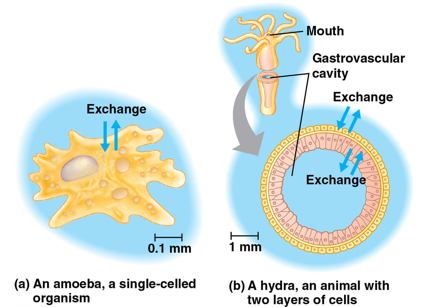
organization only works if every cell has access to a suitable aqueous environment
organisms with a saclike body plan have body walls that are 2 cells thick, facilitating diffusion of materials
nutrients, waste products, and gases must be exchanged across the plasma membranes of animal cells
exchange rate proportional to a cell’s surface area; amount of material that must be exchanged is proportional to a cell’s volume
evolutionary adaptations such as specialized, extensively branched, or folded structures enable sufficient exchange with the environment
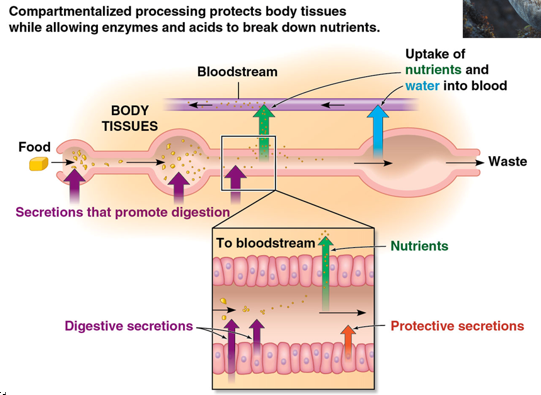
An animal digests food using compartmentalized processing in a tube-like system. The compartmentalized processing protects body tissues while allowing enzymes and acids to break down nutrients. Food goes into the system and secretions that promote digestion break it down. Nutrients are transported through epithelial cells and absorbed into the bloodstream. Digestive secretions catalyze breakdown of food and release of nutrients. Protective secretions help separate body cells from digestive activity. Waste goes out the end of the tube.
How can animals extract the nutrients they need from food while not digesting their own tissues?
mammalian cardiovascular system (long description)
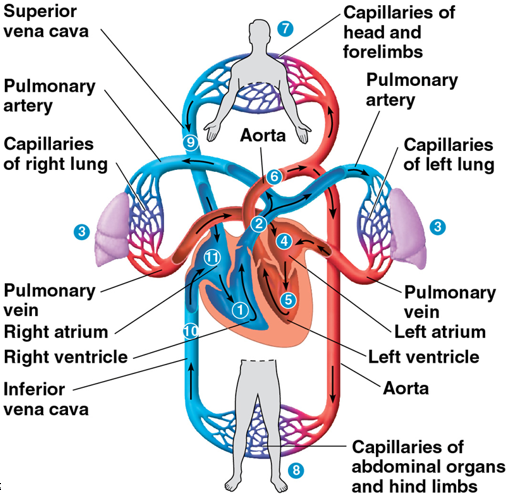
right ventricle contraction → blood to lungs via pulmonary arteries → blood through capillary beds in left and right lungs, loads oxygen, unloads CO2 → O2 rich blood returns from lungs via pulmonary veins to left atrium of the heart → O2 rich blood flows to left ventricle and is pumped out to body tissues through the system circuit → leaves via aorta to arteries leading out to the body → coronary arteries supply the heart muscle → further branches lead to capillary beds in abdominal organs and hind limbs → O2 from blood to tissues and CO2 from tissues to blood → capillaries rejoin (form venules) and convey blood to veins → O2 poor blood from head, neck, and forelimbs to superior vena cava → O2 poor blood from trunk and hind limbs → 2 venae cavae empty into right atrium → O2 poor blood goes into right ventricle starting the pulmonary circuit
mammalian cardiovascular system (short description)
right ventricle (O2 poor) → pulmonary arteries (O2 poor) → lung capillaries (O2 poor becomes O2 rich) → pulmonary veins (O2 rich) → left atrium (O2 rich) → left ventricle (O2 rich) → aorta (O2 rich) → capillary beds in head and forelimbs (O2 rich becomes O2 poor) → capillaries of abdominal organs and hind limbs (O2 rich becomes O2 poor) → blood from head, neck, and forelimbs to superior vena cava (O2 poor) & from trunk and hind limbs to inferior vena cava (O2 poor) → both to right atrium (O2 poor) → right ventricle (O2 poor)
vascular tissue
transport of materials; mechanical support
xylem and phloem
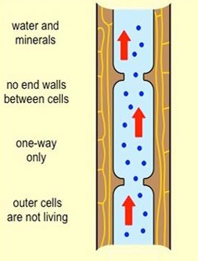
xylem
transports water and minerals upward from roots into the shoots
cells functionally dead at maturity (no selectively permeable membrane)
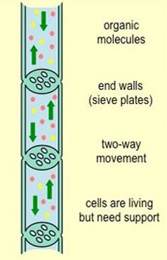
phloem
transports sugars from where they are made (leaves) to actively growing parts of the plant or storage structures
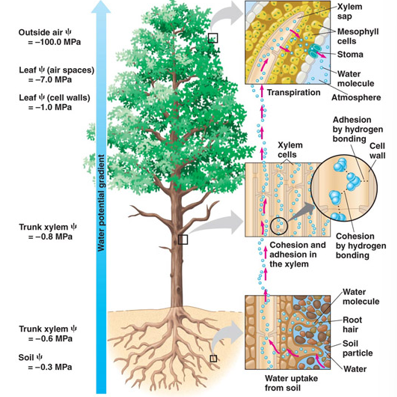
transpiration
drives transport of water and minerals from roots to shoots via xylem
generates negative pressure to generate bulk flow (pressure causes molecules to move based on water potential gradients not influenced by solute concentration)
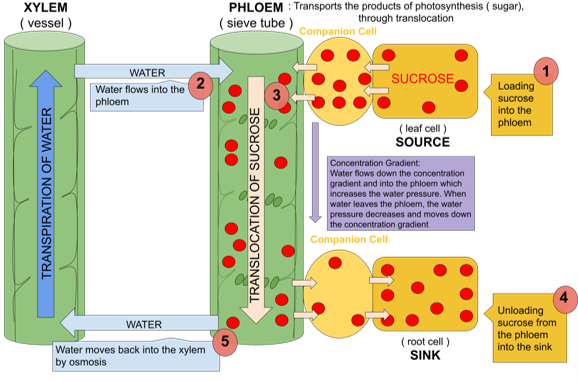
translocation
process in which products of photosynthesis are transported through phloem
in angiosperms (flowering plants), phloem sap, an aqueous solution high in sucrose, travels from a sugar source to a sugar sink through sieve-tube elements
moves to sieve-tube elements via symplastic or apoplastic pathways
cation exchange in soil
more clay and organic matter in soil = greater cation exchange capacity
roots acidify the soil solution by releasing CO2 from respiration and pumping H+ into the soil
CO2 reacts with H2O in the soil solution to form H2CO3, releasing H+ upon dissociation
H+ in soil solution neutralize the negative charge of soil particles = release of mineral cations (C2+, Mg2+, K+)
roots absorb released cations
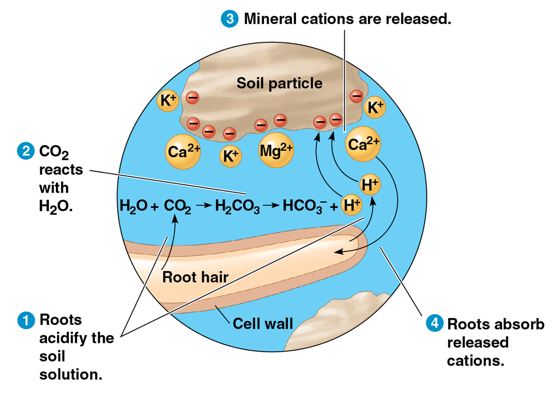
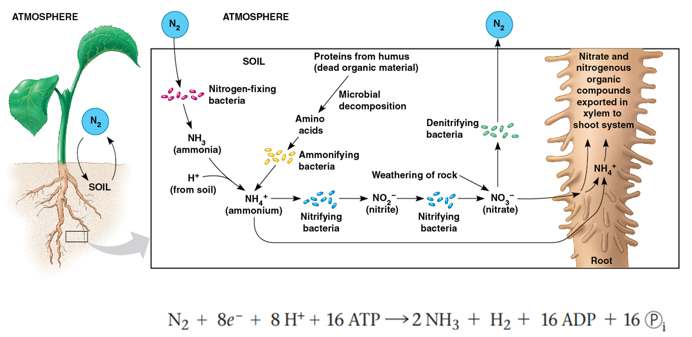
plant nitrogen nutrition
nitrogen deficiency can be the most limiting to plant growth (required in large amounts to produce proteins and nucleic acids)
absorb NO3 (nitrate) or NH4+ (ammonium)
most nitrogen from soil bacteria activity (some from inorganic solutes)
nitrification- oxidize ammonia to nitrate OR nitrite to nitrate
plant enzymes convert nitrate to ammonium
nitrogen-fixing bacteria convert N2 to NH3, NH3 picks up H+ = NH4+
ammonifying bacteria break down dead organic compounds and release NH4+
triple bond in N2 prevents plants from collecting gaseous nitrogen
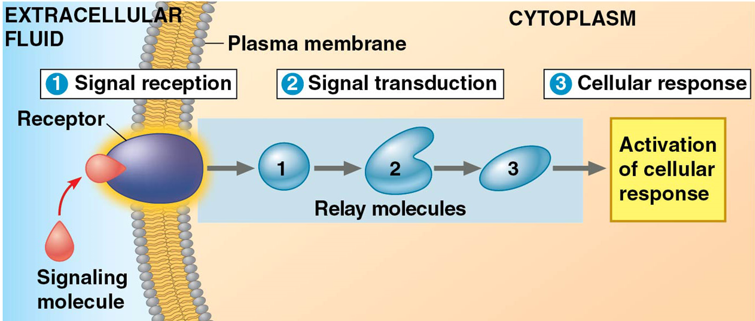
cell signaling
signal reception - target cell detects a signaling molecule in the extracellular fluid that binds to a receptor protein on the cell surface/ plasma membrane
signal transduction - binding of a signaling molecule alters the receptor and initiates a signal transduction pathway (series of steps)
cellular response - transduced signal triggers a specific response in the target cell
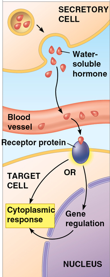
water-soluble hormones
secreted by a secretory cell → diffuses into blood vessel where it can travel → diffuses out of blood vessel and binds to a receptor protein on the surface of a target cell → cytoplasmic response directly or gene regulation in the nucleus to then trigger a cytoplasmic response
lipid-soluble hormones
secreted by a secretory cell → travel into blood vessel with transport proteins bound → leave blood → diffuses into a target cell → binds to a receptor protein in the nucleus → triggering gene regulation and then a cytoplasmic response
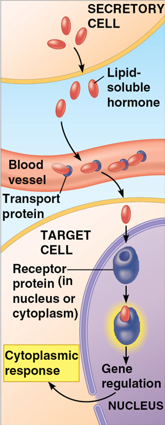
signal transduction
chain of events that converts the chemical signal to an intracellular response
response ex: enzyme activation, change in uptake/secretion of a certain molecule, or cytoskeleton rearrangement
may cause changes in transcription of certain genes
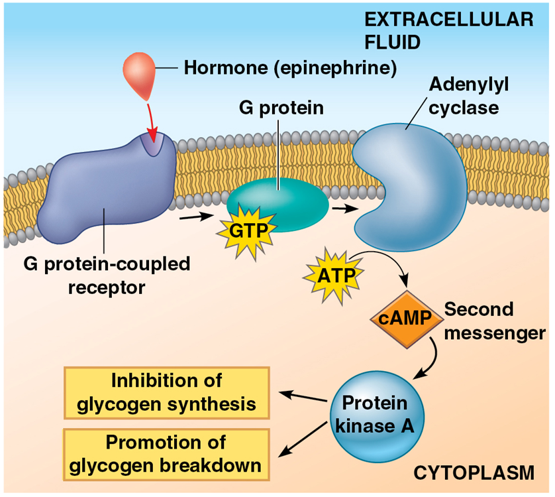
epinephrine & G protein-coupled receptor
regulates many organs in response to stressful situations
on extracellular fluid side, binds to G protein-coupled receptor in target cell membrane
using GTP, G protein interacts with adenylyl cyclase in the cell membrane to create cyclic AMP (cAMP) using ATP
cAMP activates protein kinase A = inhibits glycogen synthesis, promotes glycogen breakdown
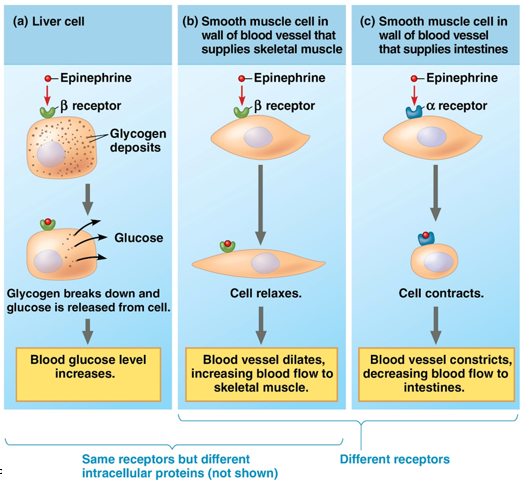
epinephrine & other receptors
a. binds to beta receptor on surface of liver cell (contains glycogen deposits) = breakdown of glycogen into glucose, which is then released from the cell = blood glucose levels increase
b. smooth muscle cells in wall of blood vessel supplying skeletal muscle: binds to beta receptor on cell surface = cell relaxes = blood vessel dilates = increased flow to skeletal muscle
c. smooth muscle cell in wall of blood vessel supplying intestines: binds to alpha receptor on cell surface = cell contracts = blood vessel constricts = decreased flow to intestines
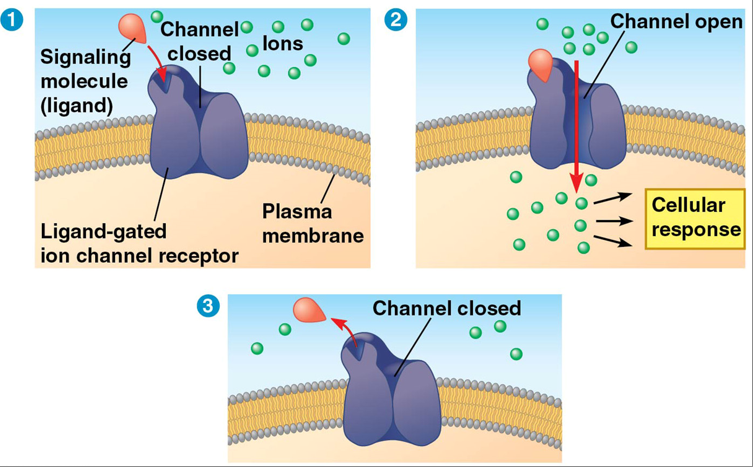
ligand-gated ion channel
cell-surface transmembrane receptor acts as a gate that opens and closes when it changes shape
signal molecule binds → opens channel → gate allows specific ions (Na+ or Ca+) through → change concentration rapidly → change in cell activity → ligand dissociates → channel closes
intracellular receptors
proteins found in the cytoplasm or nucleus of target cells
small or hydrophobic chemical messengers (ex: steroid & thyroid hormones) can readily cross the membrane and activate receptors
activated hormone-receptor complexes = transcription factor (turn on/off specific genes)
slow, but long-lasting process (hours to days to complete)
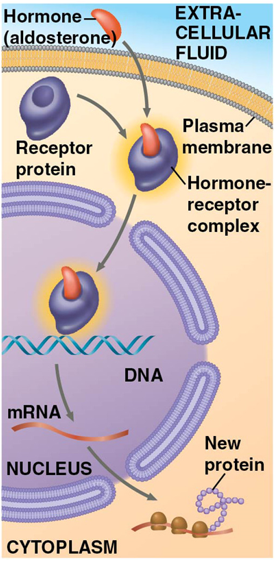
steroid hormone & intracellular receptor
aldosterone passes through plasma membrane
binds to receptor protein in cytoplasm, activating it
hormone-receptor complex enters the nucleus and binds to specific genes
bound protein acts as a transcription factor = stimulates transcription of the gene into mRNA
mRNA translated into a specific protein
first law of thermodynamics
the energy of the universe is constant
energy can be transferred and transformed, but it cannot be created or destroyed
principle of conservation of energy
during every energy transfer or transformation, some energy is converted to thermal energy and lost as heat, becoming unavailable to do work
second law of thermodynamics
every energy transfer or transformation increases the entropy of the universe
entropy is a measure of molecular disorder or randomness
living organisms increase disorder of surroundings through metabolism (ex: breakdown of food releases heat and small molecules like CO2)
processes that increase entropy can occur spontaneously without energy input
processes that decrease energy are nonspontaneous and need energy input
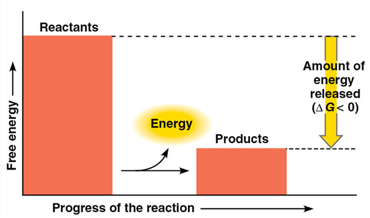
exergonic reaction
(“energy outward”)
proceeds with a net release of free energy to the surroundings
products store less free energy than reactants
deltaG is negative = reaction occurs spontaneously
deltaG magnitude determines max amount of work the reaction can perform
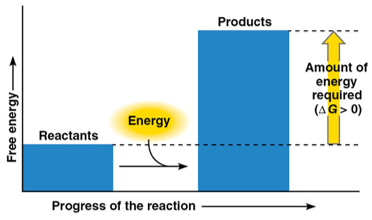
endergonic reaction
(“energy inward”)
absorbs free energy from the surroundings
products store more free energy than reactants
deltaG is positive = non-spontaneous reaction
deltaG magnitude determines quantity of energy required to drive the reaction
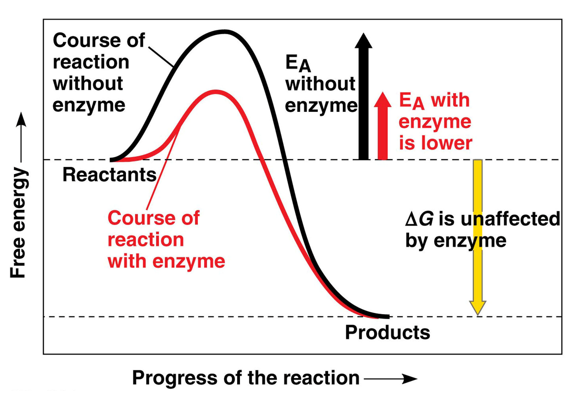
catalysis
process by which a catalyst selectively speeds up a reaction without itself being consumed
enzyme lowers the activation energy (Ea) barrier enough for a reaction to occur at moderate temperatures - can’t change deltaG, only speeds up a reaction that would occur eventually anyway
feedback inhibition
the end product of a metabolic pathway shuts down the pathway
prevents a cell from wasting chemical resources by synthesizing more product than is needed
energy coupling with ATP hydrolysis
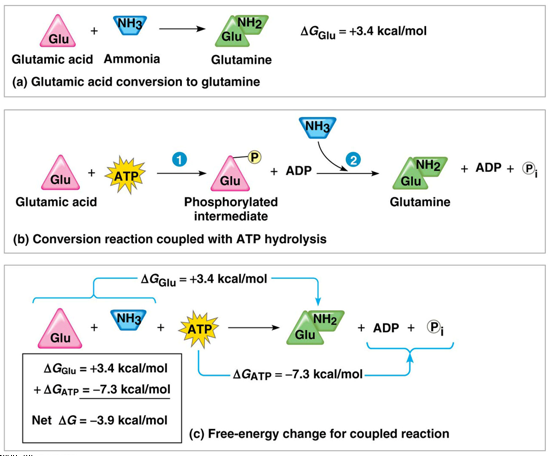
a. glutamine synthesis from glutamic acid (Glu) by itself is endergonic (positive deltaG) = nonspontaneous; Glu + ammonia (NH3) goes to glutamine (Glu bonded to NH2); deltaGglu = +3.4kcal/mole
b. glutamine synthesis occurs in 2 steps, coupled by a phosphorylated intermediate; ATP phosphorylates glutamic acid = less stable + more free energy; ammonia displaces the phosphate group = glutamine. Glu + ATP goes to phosphorylated intermediate (Glu with phosphate group covalently bonded) + ADP → NH3 added = glutamine (Glu NH2) + ADP + inorganic phosphate (circlePi)
c. deltaG for glutamic acid conversion to glutamine (+3.4kcal/mol) + deltaG for ATP hydrolysis (-7.3kcal/mol) gives the free energy change for the overall reaction (-3.9kcal/mol). Overall exergonic (-deltaG) = occurs spontaneously
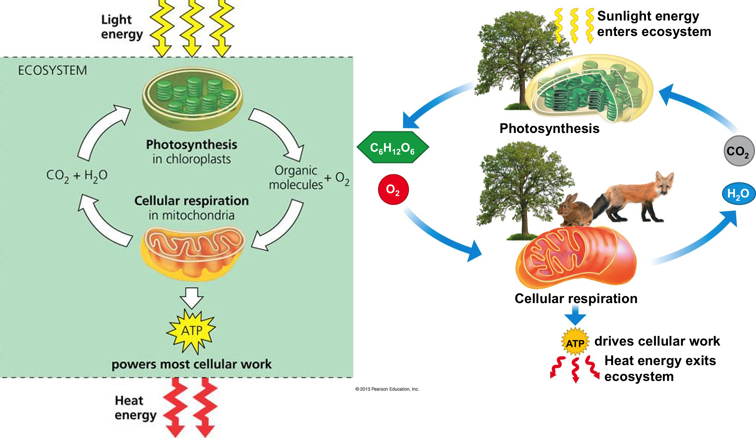
photosynthesis
uses CO2 and H2O to make organic molecules and O2
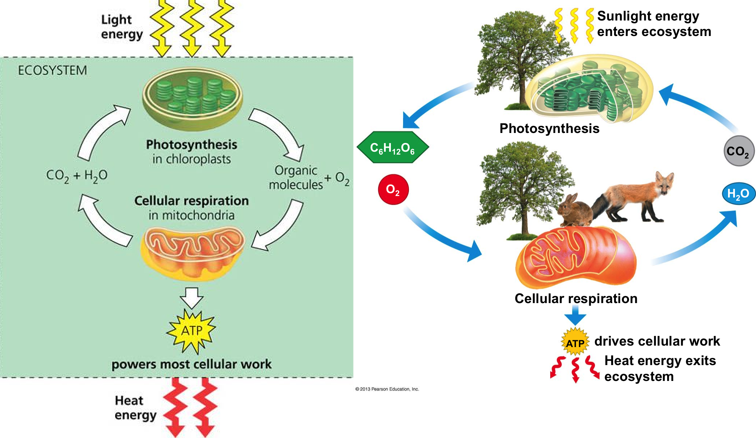
cellular respiration
uses O2 and organic molecules to make ATP, and CO2 and H2O are produced as byproducts
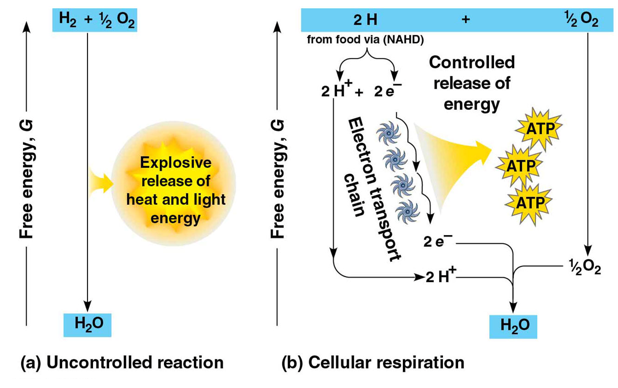
electron transport chain
used in cellular respiration to break the fall of electrons to O2 into several energy releasing steps to prevent an explosive reaction
NADH passes electrons to the chain where they’re transferred in redox reactions (each release a little energy)
O2, final electron acceptor, captures electrons and H+ = H2O
energy yielded used to generate ATP
oxidative phosphorylation
process that generates almost 90% of ATP
electron-transport and chemiosmosis
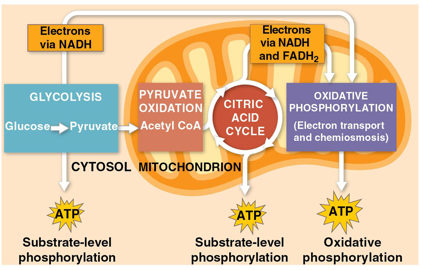
substrate-level phosphorylation
some ATP is formed in glycolysis and the citric acid cycle by this process
when an enzyme transfers a phosphate group directly from a substrate to ADP
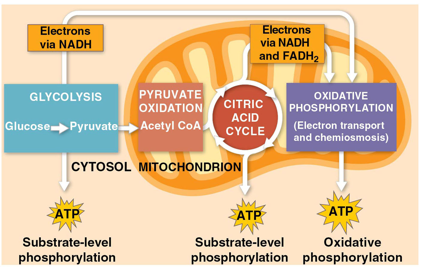
chemiosmosis
couples the electron transport chain to ATP synthesis
inner mitochondrial membrane separates mitochondrial matrix from intermembrane space
NADH carries electrons from food to electron transport chain
electrons passed through Complex 1 + a proton is pumped into intermembrane space
electrons passed down to Q, then complex 3 = proton pumped into intermembrane space
electrons pass through Cyt c and Complex 4 = proton pumped out + electrons join 2 H+ and ½ O2 to form H2O
electrons from FADH2 can also join at Q
chemiosmosis: ATP synthase powered by flow of H+ across inner mitochondrial membrane= ATP; protons pumped into space during chain fall back down concentration gradient through ATP synthase in the membrane = inorganic phosphate added to ADP = ATP
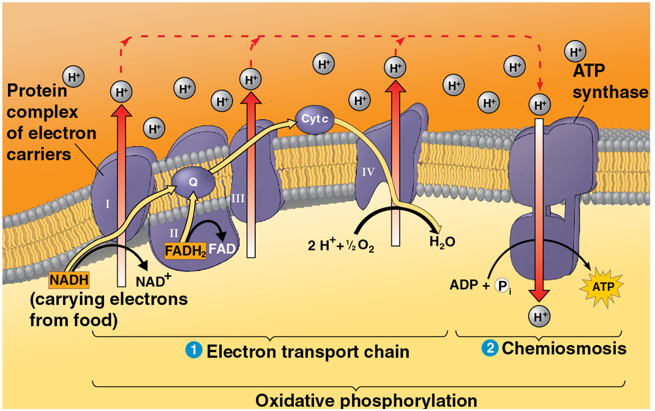
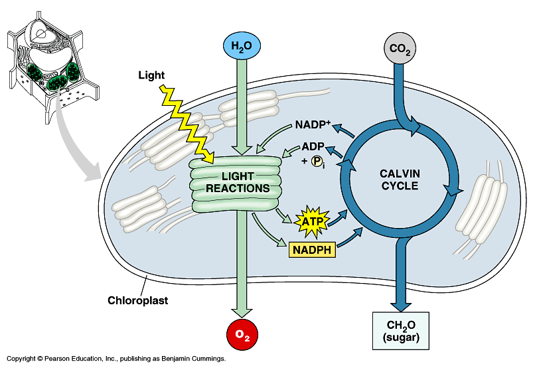
light + Calvin cycle
light reactions convert light energy into chemical energy
Calvin cycle responsible for carbon fixation - converts CO2 into sugars that can be used for fuel
respiration at the organ level
gas exchange through the respiratory surface (air or water)
transport of gas through the circulatory system
internal exchange of gas at the body cells
cellular respiration = production of ATP
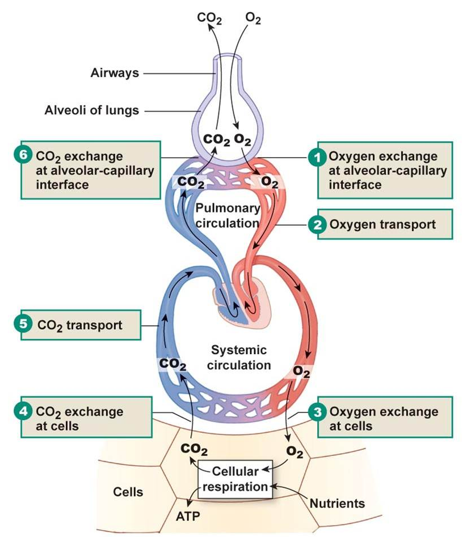
interstitial fluid
fills the space between animal cells, linking exchange surfaces to body cells
as oxygen travels in the blood in circulatory system vessels, exchange occurs with the body cells across this fluid (uptake oxygen, release CO2)
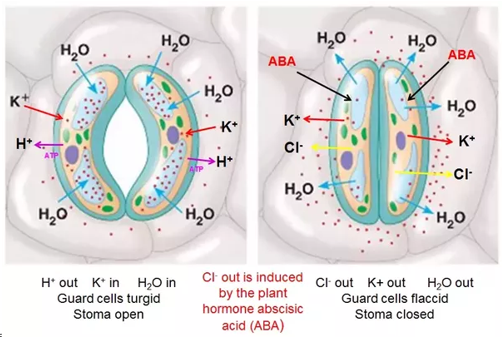
stomatal opening/closing
changes in turgor pressure open and close stomata
turgid = guard cells bow outward and pore between them opens; K+ and water absorption cause
flaccid = guard cells become less bowed and the pore closes; K+ and water loss cause
result from absorption and loss of K+ by the guard cells
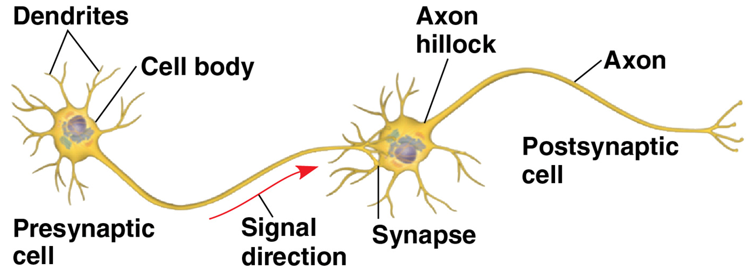
nervous tissue
functions in receipt, processing, and transmission of information
contains: neurons (transmit nerve impulses) and glial cells (support cells)
endocrine system
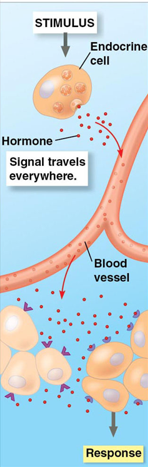
releases signaling molecules that are carried to all locations in the body
broadcasts hormone signaling molecules
well-adapted for coordinating gradual changes that affect the entire body
signaling maintains homeostasis, mediates responses to stimuli, regulates growth and development, and triggers changes underlying sexual maturity and reproduction
1 of 2 major systems for coordinating and controlling responses to stimuli in animals
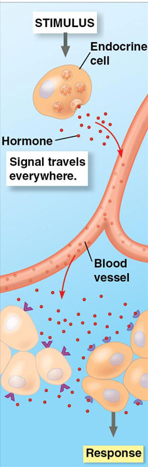
hormone
a secreted signaling molecule that circulates through the body in the endocrine system (through blood) and stimulates specific cells
may remain in the bloodstream for minutes to hours
different ones cause distinct effects and may affect a single location or sites throughout the body
reach all parts of the body but only target cells have receptors for it
nervous system
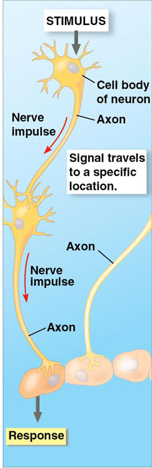
transmits information along dedicated routes, connecting specific locations in the body
network of specialized cells (neurons)
suited for directing immediate and rapid responses to the environment
transmit nerve impulses to specific target cells along communication lines of mainly axons (fast, fraction of second)
1 of 2 major systems for coordinating and controlling responses to stimuli in animals
adrenal glands
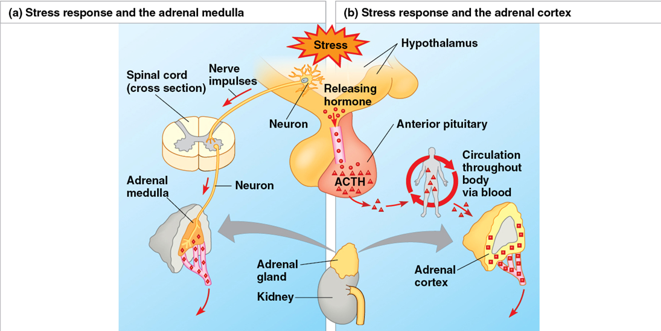
glands adopt the kidneys involved in stress-response
adrenal medulla (inner portion) - secretes epinephrine and norepinephrine
adrenal cortex (outer portion) - secretes corticosteroids in response to hormonal signals related to stressful conditions (ex: low blood sugar, decreased blood volume and pressure, and shock)
ephinephrine and norepinephrine
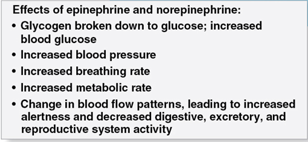
catecholamine compounds released by the adrenal medulla for the “fight-or-flight” stress response
increase the rate of glycogen breakdown in liver cells
trigger the release of glucose and fatty acids into the blood
raise the rate of oxygen delivery to body cells
direct blood toward heart, brain, and skeletal muscles and away from skin, digestive system, and kidneys
corticosteroids
a family of steroids produced and secreted by the adrenal cortex in response to stressful situations (ex: low blood sugar, decreased blood volume and pressure, and shock)
glucocorticoids - influence glucose metabolism and the immune system (ex: cortisol)
mineralocorticoids - affect salt and water balance (ex: aldosterone)
short-term stress response
stressful stimuli = hypothalamus activates adrenal medulla via nerve impulses
nerve impulses travel along neurons through spinal cord to adrenal medulla
adrenal medulla (on kidney) secretes epinephrine and norepinephrine
glycogen broken down to glucose → increased blood glucose
increased blood pressure, breathing rate, and metabolic rate; change in blood flow patterns = increased alertness and decreased digestive, excretory, and reproductive system activity
long-term stress response
stressful stimuli = hypothalamus activates adrenal cortex via hormonal signals
hormones travel to anterior pituitary via blood vessels
ACTH is activated and travels via blood vessel to adrenal cortex (on kidney)
adrenal cortex secretes mineralocorticoids and glucocorticoids
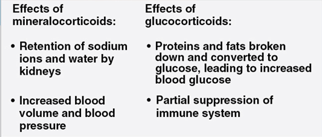
mineralocorticoids = retention of Na+ and water by kidneys; increased blood volume and blood pressure
glucocorticoids = proteins and fats broken down and converted to glucose = increased blood glucose; partial suppression of immune system
generation of action potential
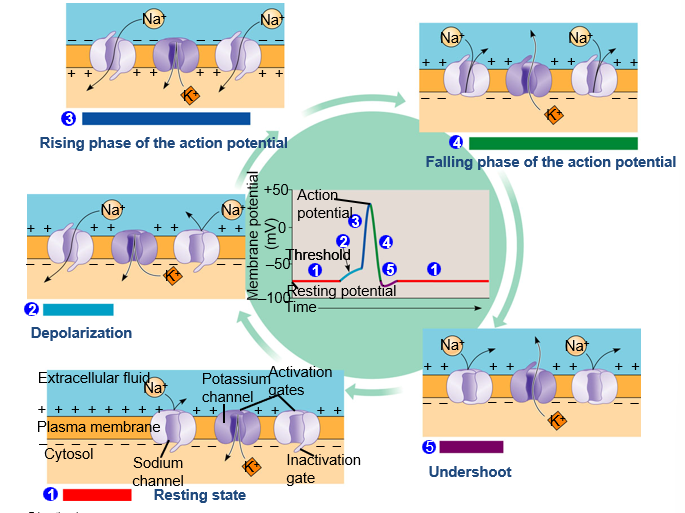
at resting, most voltage gated sodium and potassium channels are closed, only potassium leak channels are open
action potential generated = voltage-gated Na+ channels open and Na+ flows into the cell = depolarization (strong depolarization = action potential)
rising phase of action potential = equilibrium potential increases to that of Na+ (+40)
falling phase = voltage gated Na+ channels become inactivated, voltage gated K+ channels open and K+ flows out of the cell = inside negative again
undershoot phase = membrane permeability to K+ at first higher than at rest because both leak and voltage-gated channels are still open
voltage-gated K+ channels close and resting potential is restored
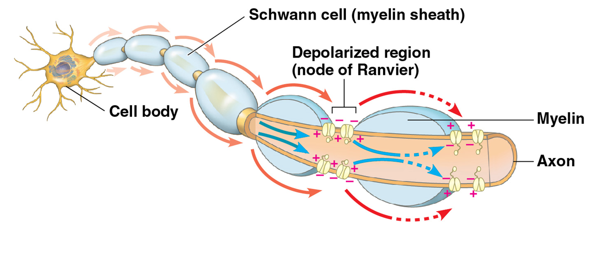
nodes of Ranvier
gaps in the myelin sheath that house voltage-gated sodium channels
action potentials in myelinated axons jump between them in saltatory conduction
electrical synapse
the electrical current flows from one neuron to another through gap junctions
chemical synapse
a chemical neurotransmitter carries information between neurons
most synapses