C - DIFFERENTIAL EQUATIONS
 Call Kai
 Learn
Learn Practice Test
 Spaced Repetition
 Match
Match Flashcards
 Knowt Play
1/8

There's no tags or description
Looks like no tags are added yet.
Name | Mastery | Learn | Test | Matching | Spaced | Call with Kai | Chat |
|---|
No analytics yet
Send a link to your students to track their progress
9 Terms
What is the degree of the differential equation: [1 + (dy/dx)^2]^(3/2) = d^2y/dx^2 ?
A. 1
B. 2
C. 3
D. 4
B
Explanation:
To find the degree, the equation must be cleared of fractional exponents or radicals. Squaring both sides yields [1 + (dy/dx)^2]^3 = (d^2y/dx^2)^2. The highest order derivative is the 2nd derivative (order = 2), and its power is 2. Thus, the degree is 2.
An ordinary differential equation is classified as NON-LINEAR if it violates which of the following conditions?
A. The dependent variable and all its derivatives are of the first degree.
B. No products of the dependent variable and/or its derivatives occur.
C. No transcendental functions (like sin, cos, e^y, ln) of the dependent variable occur.
D. All of the above are required for an equation to be linear.
D
Explanation:
In linearity, the dependent variable (y) and all its derivatives must strictly be to the first power, cannot be multiplied together, and cannot be inside transcendental functions (e.g., sin(y), ln(y)).
How many arbitrary constants are present in the PARTICULAR solution of a 3rd-order linear ordinary differential equation?
A. 0
B. 1
C. 3
D. Infinite
A
Explanation:
By definition, a particular solution has specific numerical values assigned to the constants to satisfy a set of initial or boundary conditions. Therefore, it contains exactly ZERO arbitrary constants. (The general solution would contain 3 constants).
For the standard first-order linear differential equation dy/dx + P(x)y = Q(x), what is the formula for the integrating factor (I.F.)?
A. e^( \int P(x) dx )
B. \int e^( P(x) ) dx
C. e^( \int Q(x) dx )
D. e^( -\int P(x) dx )
A
What is the necessary and sufficient condition for the differential equation M(x,y)dx + N(x,y)dy = 0 to be classified as an EXACT differential equation?
A. dM/dx = dN/dy
B. dM/dy = dN/dx (partial derivatives)
C. dM/dy + dN/dx = 0
D. (dM/dx) * (dN/dy) = 1
B
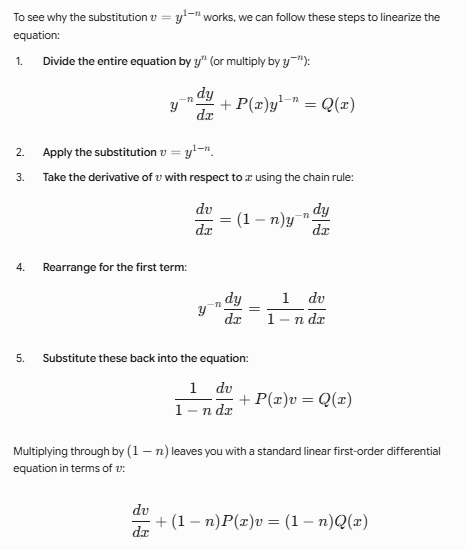
The differential equation dy/dx + P(x)y = Q(x)y^n is known as Bernoulli's equation. To transform this equation into a standard linear first-order differential equation, which substitution variable 'v' must be used?
A. v = y^(1 - n)
B. v = y^(n - 1)
C. v = y^(-n)
D. v = y^n
B
Explanation:
If the roots of the auxiliary (characteristic) equation of a homogeneous linear differential equation with constant coefficients are real and repeated (m1 = m2 = m), what is the general form of the complementary function?
A. y = C1*e^(mt) + C2*e^(-mt)
B. y = (C1 + C2*t) * e^(mt)
C. y = C1*cos(mt) + C2*sin(mt)
D. y = C1*e^(m1*t) + C2*e^(m2*t)
B
If a family of curves has a differential equation given by dy/dx = f(x,y), which of the following expressions represents the differential equation of its ORTHOGONAL TRAJECTORIES?
A. dy/dx = f(x,y)
B. dy/dx = -1 / f(x,y)
C. dx/dy = f(x,y)
D. dy/dx = -f(x,y)
B
Explanation:
Orthogonal trajectories intersect the original family of curves at right angles (90 degrees). Therefore, their slopes are negative reciprocals of each other (m1 * m2 = -1).
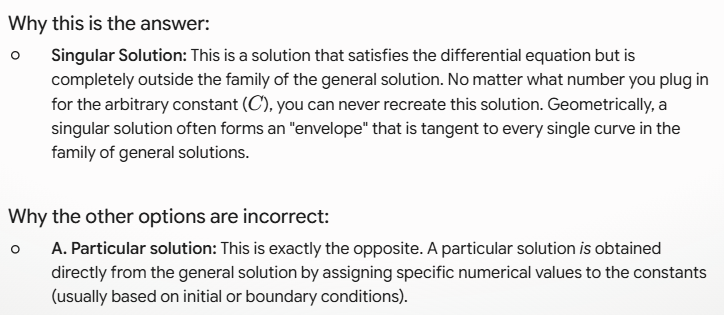
What type of solution to a differential equation satisfies the equation but CANNOT be obtained from the general solution by assigning specific numerical values to the arbitrary constants?
A. Particular solution
B. Singular solution
C. Boundary solution
D. Complementary solution
B
Explanation: