Anesthesia: Exam 1 Intro Lecture & Anesthesia Machines/Equipment
 Call Kai
 Learn
Learn Practice Test
 Spaced Repetition
 Match
Match Flashcards
 Knowt Play
1/119

There's no tags or description
Looks like no tags are added yet.
Name | Mastery | Learn | Test | Matching | Spaced | Call with Kai | Chat |
|---|
No analytics yet
Send a link to your students to track their progress
120 Terms
therapeutic index
Anesthesia has a low _____ _____; balancing act between too much & too little medication.
Anesthesiology
Study & discipline of the use of anesthetic agents & production of the state of anesthesia
Anesthesia
Reversible loss of sensation to all or part of the body
*Drug induced depression of CNS & PNS
Spinal cord
Primary site where anesthetics act to inhibit purposeful responses
General
Anesthesia that's drug-induced with controlled, reversible loss of consciousness & sensation
*Either injectable/inhalational agents/combo
No
With general anesthesia, is the patient arousable by physical stimulation?
Tranquilization
A state of tranquility & calmness in which the animal is awake, relaxed, and unconcerned about its surroundings
-Animal is easily arousable & will respond to painful stimuli
Sedation
CNS depression in which the animal is awake, sleepy, but still able to be aroused by stimulation
-Minor manipulations can be performed, & aggressive animals may be easier to handle
Sedation
Is tranquilization or sedation a more significant/stronger CNS depression?
No, yes, yes
Is an animal under general anesthesia arousable by physical stimuli? Under tranquilization? Under sedation?
Dissociative anesthesia
General anesthesia where the animal is unaware of external stimuli with some muscle rigidity (catalepsy), open eyes with palpebral reflexes, & somewhat intact swallowing reflexes
thalamocortical, limbic
Dissociative anesthetic agents interrupt neurotransmission between the _____________ and _________ areas of the CNS
Yes
Do animals under dissociative anesthesia have palpebral & swallowing reflexes?
No
Is an animal unconscious under local anesthesia?
Regional anesthesia
Local anesthesia in which specific nerve blocks are performed to desensitize a certain part of the body
Local anesthesia
Administration of a local anesthetic agent to desensitize part of the body
-Chemical/manual restraint is necessary to perform this technique
Conscious, unconcious
Analgesia:
- Patient has diminished pain perception if _____.
-Patient has reduced autonomic responses to noxious stimuli if ______.
Preventive analgesia
Use of analgesic drugs & techniques before, during, & after pain begins
-Administering pre-medications before surgery allows less drugs to be used overall (& therefore less side effects)
-Prevents plastic wind up of pain pathways
Nociception
Activation of nociceptors by a noxious stimuli
Nociceptors
Specialized sensory nerves that detect & transmit noxious sensations to higher centers in the spinal cord & brain
Pain
Unpleasant sensory & emotional experience associated with actual/potential tissue damage
Conscious, nociception
Pain is a _____ awareness & response to _____.
Unconsciousness
Loss of individual awareness which occurs when the brain's ability to integrate info is blocked/disrupted
-Block interactions between brain regions & reduce cortical activity patterns
Spontaneous righting reflex
What reflex is lost to indicate that an animal is unconscious?
*In humans: loss of response to spoken command
Amnesia, Analgesia
5 Components of the Anesthetic State:
- Unconsciousness
- _____ = loss of memories
- _____ (more accurately, antinociception)
- Immobility (dose dependent)
-Attenuation of autonomic responses to noxious stimuli
False (consciousness = subjective experience/awareness, responsiveness = spontaneous/goal directed movement)
True or False: Unresponsiveness is the same thing as unconsciousness.
Ligand gated ion
Most anesthetics work on a subcellular target/receptor with a synaptic function via ___ ____ ___ channels.
NMDA (N-methyl-D-aspartate) antagonists, GABA (Gamma aminobutyric acid) agonists
Subcellular Receptors:
-____ = receptor that dissociatives (Ex: ketamine) act on
-______ = receptor that inhalants & most hypnotic injectables act on
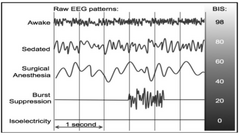
ECG (evaluates brain electrical activity)
What diagnostic tool can be used to define loss of consciousness?
Awake
Based on this ECG, is the patient awake or deeply anesthetized?
-Low voltage amplitude, many high frequency components (fast), "desynchronized"
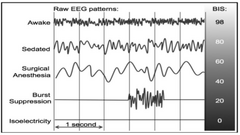
Deeply anesthetized
Based on this ECG, is the patient awake or deeply anesthetized?
-High voltage, slow oscillations, "synchronized", dose dependent
spinal activity
Non-purposeful movement during anesthesia is due to ____________, not consciousness.
Memory & awareness in the patient is lost at < ___% of the anesthesia concentration that it takes to cease movement.
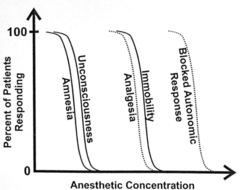
Amnesia
Does anesthesia first cause amnesia or analgesia?
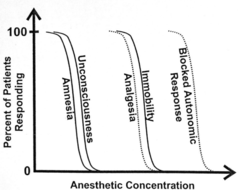
True (at the level of the brainstem or spinal cord, cerebral cortex connection NOT required)
True or false: Unconscious animals can produce complex movements
Yes (respond autonomically & reflexively to noxious stimuli but they are not feeling the pain)
Will an anesthetized animal respond to noxious stimuli?
Cerebral cortex
Where in the brain does conscious integration of nociceptor input have to occur in order to create the sensation of pain?
False
True or false: Anesthetized animals feel pain
Stages 1-3
What stages of anesthesia can be demonstrated in both induction to anesthesia & during recovery?
Amnesia, voluntary movement, analgesia (at deeper levels)
What are the 3 characteristics of Stage 1 of Anesthesia?
*Hint: AVMA is #1
Delirium or involuntary excitement
What characterizes Stage 2 of Anesthesia?
*Want to quickly induce & get out of this stage ASAP & stay in stage 3 for as long as possible
Surgical anesthesia
What is Stage 3 of Anesthesia?
cardiovascular/pulmonary collapse
What is Stage 4 of Anesthesia?
Preanesthetic, maintenance
Sequence of the Perianesthetic Period:
1) _____ = patient eval (history, PE, labwork, patient ID), prep, & medication
2) Induction of anesthesia = transition from consciousness to anesthetized
3) Anesthetic _____ (during surgery)
4) Recovery period (24 hrs)
24
The recovery phase is a ___ hour period after awakening from general anesthesia
Evaluation, preparation
An anesthetic care plan consists of patient ____ & patient _____.
Patient evaluation
Assesses patient demeanor & baseline health status
-Includes PE, patient identification (body weight, signalment), history, & any laboratory date
Patient preparation
Part of the anesthetic care plan that includes:
-1) the nature of the procedure to be performed
-2) a means to monitor the patient
-3) knowledge of potential complications associated with both the procedure & anesthetic procedure
-4) a means to treat any complications which arise
False (these tests fail to uncover pathologic conditions/abnormalities that don't necessarily improve patient care/outcome)
True or false: Extensive pre-anesthetic lab screening has been shown to improve patient outcome.
physical exam, history
Pre-anesthetic lab tests should be chosen based on ___________ _____ & patient ______
PCV (packed cell volume), TP (total protein)
What is the minimum lab work that should be done pre-surgery for a young, healthy animal that will be anesthetized for an elective procedure?
ASA (American Society of Anesthesiologists) classification system
System created to assess risk of anesthesia before anesthetizing the animal
-Based on patient physical status (PE, history, signalment)
No systemic disease (normal, healthy patient)
What is ASA class 1?
Class 1 (healthy animal + elective procedures = class 1)
A healthy dog is coming in for a spay. What ASA class is this?
Mild compensated systemic disease
What is ASA class 2?
-Ex: Uncomplicated orthopedic injury, localized/controlled infection, mild obesity, mild airway problems
Class 2
What ASA status do all brachiocephalic dogs automatically fall under?
Moderate/severe systemic disease that's ongoing but compensated (stable vital signs)
What is ASA class 3?
-Some functional limitations exist that increase anesthesia risk
*Ex: Animal with significant fractures/hemorrhage, CHG with clinical signs of reduced cardiac reserve, moderate hypovolemia, azotemia, diabetes mellitus, severe obesity
Serious, decompensated systemic disease
What is ASA class 4?
-Disease is a constant threat to life = High anesthetic risk because vital body systems are involved (Heart, lungs, CNS)
*Ex: Acute GDV, life threatening hemorrhage, severe toxemia/icterus, severe colic
Moribund, requires intensive life support
What is ASA class 5?
-Patient not expected to live > 24 hrs with or without surgery
-Ex: Colic, torsions, sometimes GDVs
Brain dead
What is ASA class 6 (used on in human medicine for donor purposes)?
Emergency (surgery must be done regardless of physical status)
What is the E component of ASA?
*can be added to any of the 5 ASA classes
False (Age in the absence of disease is not an adequate reason, should not assume that geriatric patients are automatically higher risk)
True or False: Age alone is an adequate reason to increase anesthetic risk assignment.
2 (mild systemic disease, well compensated)
A dog comes in with a torn ACL and mild obesity; this is ASA class __
2 (brachycephalic = mild systemic disease, well compensated)
A bulldog comes in for surgery; this is ASA class __
3 (moderate systemic disease that is ongoing but compensated)
A dog comes in with controlled diabetes; this is ASA class __
3 (moderate systemic disease that is ongoing but compensated)
A dog comes in with congestive heart failure with minor clinical signs of reduced cardiac reserve; this is ASA class __
4 (severe systemic disease that is a constant threat to life, uncompensated disease, or vital body system involved)
A hit by car dog comes in with severe hemorrhage and needs a blood transfusion; this is ASA class __
4 (severe systemic disease that is a constant threat to life, uncompensated disease, or vital body system involved)
A dog comes in with acute gastric dilation volvulus (GDV); this is ASA class __
5
A horse comes in with severe colic and is not expected to live 24 hours with or without surgery; this is ASA risk __
True
True or False: Fasting prior to surgery has been shown to decrease aspiration risk, improve abdominal access, & improve ventilatory function.
4-6 hours
How long should monogastric animals be fasted prior to surgery per recent studies?
> 12 hours
Fasting for longer than ____ hours has been shown to decrease stomach pH & increase gastric volume/risk of regurgitation.
Pocket pets (tiny dogs, birds, pediatrics), horses
What animals have the shortest recommended fasting period (0-4 hrs) prior to anesthesia?
Dogs/cats
What animals should be fasted for 4-6 hours prior to anesthesia but withholding water is not necessary?
24-48 hours
How long should Ruminants be fasted before surgery?
Analgesics +/- tranquilizers
What medications are typically used for pre-anesthetic pain control?
*AKA what meds are used as premeds
Autonomic response (patient is unconscious and cannot feel pain BUT can still have autonomic responses to nociception)
Your surgery dog has been stable under general anesthesia. When the ovarian pedicle is stretched, your dog's HR and RR increases. Is this a sign of pain or an autonomic response?
Depends on the pain of the procedure (Sedated animals are awake, sleepy, and able to be aroused by noxious stimuli)
Medicine wishes to "sedate" a dog for percutaneous liver biopsy. Will sedation be sufficient to perform this procedure? Why or why not?
General anesthesia
You want a dog to be unconscious, relaxed, analgesic, and nonresponsive to surgical stimulation for a percutaneous liver biopsy. What term would best describe this?
Blood, electrolyte, & fluid deficits (*BEF = before anesthetics)
What types of deficits should be corrected prior to the administration of anesthetic drugs?
All of the above
Which of the following are the minimum PE findings that the anesthetist should be familiar with before administering anesthetic drugs?
A) Auscultate heart/lungs & note any abnormal cardiac rhythms/murmurs and lung sounds
B) Palpate pulses
C) Record HR, RR, MM color, CRT, & hydration status
D) Observe mentation/behavior
All of the above
Which of the following information is necessary to formulate an anesthetic care plan?
A) Patient ID
B) Patient history
C) Physical exam findings
D) Laboratory data
E) Physical status classification (ASA)
No (patient has lost consciousness)
Is an animal in Stage 2 of anesthesia consciously aware of its environment?
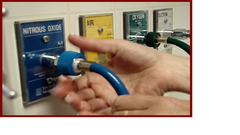
Pipelines
Central gas supply that transports carrier gases (O2, nitrous oxide, or air) from 1 part of the hospital to the anesthesia machine
*Different adaptors & colored hoses prevent giving the patient the wrong gas
Cylinders
Portable, compressed gas containers
*Can be used as a gas source in anesthesia machines instead of central (pipeline) sources
*Different colors depict different gases (Nitrous oxide = Blue, CO2 = Grey)
Green
What color are the oxygen cylinders in the US?
-White in Canada, Europe, & Australia
Counterclockwise (to the left)
What direction do you turn the cylinder wrench to open the cylinder?
Crack valve briefly
What should you do to a gas cylinder prior to mounting it on the yoke to clear debris?
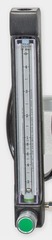
Flowmeter
Measures the flow of gases into the patient breathing circuit
-Units: Liters/min
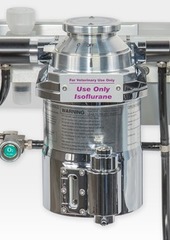
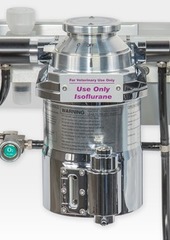
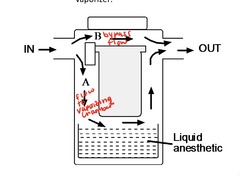
Vaporizer
Converts liquid anesthetic agents (Ex: isoflurane) into a gas mixture in a controlled manner
Latent heat of vaporization
Amount of heated needed to convert liquid anesthetic agents into a vapor at a constant temperature
Copper, stainless steel
Overtime, temperature & thus anesthetic vapor pressure will decrease in vaporizers. What substances with high specific heat & thermal conductivity are added to help vaporizers with this problem?
Precision vaporizer
Delivers a precise concentration of anesthetic to the patient
-Temperature & flow compensated
-High resistance & agent specific
*Can be manual or automatic
O2 flush valve
What valve bypasses the vaporizer to deliver large volumes of pure O2 to the breathing circuit (35-75 L/min)?
Barotrauma, death (always disconnect patient 1st)
What can happen if you push the O2 flush valve while it is connected to your patient?
Rebreathing systems
AKA circle systems, breathing circuit for adults, pediatrics, & large animals
-Unidirectional gas flow with 1 way valves
Rebreathing systems
Do rebreathing or nonrebreathing systems use less gas & cause slower changes in the anesthetic plane?
-Can be used in all patients > 5kg
Nonrebreathing systems
Breathing system that provides high O2 flow to minimize rebreathing of CO2 in small patients (< 5 kg)
-Bypasses 1 way valves & CO2 absorbent canisters to minimize resistance in circuit
Bain circuit (modified mapleson D)
Nonrebreathing system with an inner tube that delivers fresh gas & an outer tube that carries away exhaled gases to the scavenger
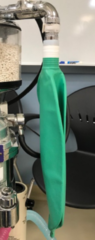
Rebreathing/reservoir bag
Rubber bag that supplies peak inspiratory demands in both types of breathing systems
-Can ventilate patient & monitor ventilation rate with it