Oral Bio - Dental Plaque Biofilms Lecture 6
 Call Kai
 Learn
Learn Practice Test
 Spaced Repetition
 Match
Match Flashcards
 Knowt Play
1/89

There's no tags or description
Looks like no tags are added yet.
Name | Mastery | Learn | Test | Matching | Spaced | Call with Kai | Chat |
|---|
No analytics yet
Send a link to your students to track their progress
90 Terms
What is a biofilm?
A community of microbes adhering to each other and a solid surface, and encased in a sticky exo-polysaccharide (EPS) matrix.
What type of surfaces do biofilms form on?
Non-shedding, fluid coated surface, in a non-sterile environment
What is an example of a non-shedding, fluid coated, and non-sterile environment in the human body?
Teeth
Is algae on a rock considered a biofilm?
Yes
Is dental plaque considered a biofilm?
Yes
Dental plaque is an oral biofilm composed of _______ bacteria per _____________.
10^8
miligram
Supragingival plaque forms ____________ gumline
above
Subgingival plaque forms ____________ gumline
below
What is calculus?
Plaque that becomes calcified
Calculus is _____% mineralized material and _____% organic material
- 80%
- 20%
Where do the minerals from calcified plaque come from?
Saliva
Formation of plaque is associated with __________ diseases
oral
What oral disease is associated with supra-gingival plaque
Caries
Supra-gingival plaque is exposed to ________________ that can be fermented and cause caries.
Carbohydrates
What oral disease is associated with sub-gingival plaque?
Gum disease
Sub-gingival plaque is exposed to more Gram ____________ bacteria, which have ________________, and cause the inflammation of Gum disease.
- Negative
- Endotoxins
Who was the first person to observe microbes and dental plaque?
Anton Van Leeuwenhoek
When was microbes first observed?
1600s
What did Anton Van Leeuwenhoek call microbes?
Animalcules
What was Van Leeuwenhoek describing in this quote:"a little white matter, which is as thick as if 'twere batter."
Dental plaque
What was Van Leeuwenhoek describing in this quote: "I then most always saw, with great wonder, that in the said matter there were many very little living animalcules, very prettily a-moving.
The biggest sort. . . had a very strong and swift motion, and shot through the water (or spittle) like a pike does through the water. The second sort. . . oft-times spun round like a top. . . and these were far more in number."
Healthy plaque
What was Van Leeuwenhoek describing in this quote: "an unbelievably great company of living animalcules, a-swimming more nimbly than any I had ever seen up to this time. The biggest sort. . . bent their body into curves in going forwards. . . Moreover, the other animalcules were in such enormous numbers, that all the water. . . seemed to be alive."
Two old men who had never cleaned their teeth in their lives
Bacterial complexes create biofilms on the tooth in a(n) _____________________ fashion
orderly
Do bacterial species always stay the same in a biofilm?
No, bacterial species change over time.
How long does it take for mature biofilms to develop?
weeks to months
Does the composition of mature plaque influence health?
Yes
What happens if dental plaque stays sitting on your teeth for a long period of time?
More and more bacteria add on to each other to make a more complex and unhealthy biofilm.
What are the five stages of Biofilm?
1. Initial adhesion
2. Colonization (stable adhesion)
3. Accumulation (co-aggregation & growth)
4. Mature Biofilm (community interactions)
5. Dispersion
Initial Adhesion brings what two things together?
Bacteria and Surfaces
What are the five characteristics of Initial Adhesion?
1. Non-specific, reversible binding
2. Attraction to a surface
3. Hydrogen bonds
4. Van der Waals forces
5. Long range-adhesins
Can bacteria stick anywhere on the pellicle?
No, certain bacteria look for certain properties in the pellicle to bind to.
Stable adhesion is required for _____________ formation
biofilm
What type of bonds are involved in stable adhesion?
- Covalent bonds
- Ionic bonds
- Hydrophobic bonds
In stable adhesion, there are ________________ adhesin types acting at the same time
multiple
The multiple adhesin types _____________ specific host receptors and provides _____________ and ________________.
- Recognize
- Specificity and permanency
What are the 6 bacterial adhesins?
1. Fimbriae
2. Pili
3. Fibrils
4. Lectins
5. Lipo-teichoic acid
6. Extracellular polymers - capsule
What are hair like surface appendages
Fimbriae
What are tube-like surface appendages
Pili
What are short surface proteins (short fimbriae)
Fibrils
What are proteins that bind sugar
Lectins
What is found in Gram (+) outer membranes, and is a glycolipid?
Lipo-teichoic acid
What is a capsule an example of?
Extracellular polymers
How do bacterial adhesins aid in competition?
Bacterial adhesins are specific to binding to certain environments, allowing more fit bacteria to outcompete other bactera.
How long does it take for the pellicle to form on a clean tooth?
seconds
The pellicle is made up of ______________ from saliva and provides specific ___________ for early colonizers
- proteins
- receptors
What are the 3 different pellicle adhesions and examples of each?
Proline-rich proteins
- S. gordonii
- A. naeslundii
Statherin
- F. nucleatum
Mucins
- S. gordonii
- S. oralis
- S. mitis
- S. sanguinis
What are the two phases of Accumulation?
1. Growth
2. Co-aggregation
The growth phase of accumulation consists of __________ ____________ bacterium and is defined by what two characteristics?
pioneer/early colonizer;
1. adhesion to the tooth surface
2. binary fission
The co-aggregation phase of accumulation consists of __________ ____________ bacterium and is characterized by what two characteristics?
middle/late colonizer;
1. Bacteria that adhere to pioneers
2. Adhesins used to recognize other bacteria
The receptors of oral bacteria have specific receptors that perform which two functions and provide an overall __________ nature to plaque formation
1. adhere to certain molecules
2. co-aggregate with specific bacteria
3. temporal
The co-aggregation assay is a useful qualitative test to determine what?
what pairs of bacteria will co-aggregate
______________ are adhesin-receptor interactions between bacteria that allow the plaque biofilm to mature
Co-aggregation
What are the pioneer bacteria of human oral biofilms (plaque)?
Streptococci
What are the "bridge" bacteria of human oral biofilms (plaque)? What makes them a "bridge"?
Fusobacterium nucleatum; can co-aggregate with pioneers and almost all other oral bacteria acting as a link
________ and _______________ are structures found in dental plaque, formed by co-aggregation of bacteria
Corncobs; Bristle-brushes
What other structures formed by co-aggregation?
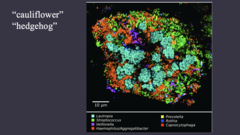
How do mature biofilm communities interact?
A. Food webs-bacteria cooperate in the breakdown of nutrients
B. Protection-exopolysaccharide, metabolism
C. Gene transfer-share antibiotic resistance genes
D. Quorum sensing-bacterial coordination
E. Antagonism-bacteriocins, pH
Why are biofilms useful in breakdown of nutrients within the plaque community?
Different genera and species specialize in the breakdown of different metabolites to efficiently produce the monomers needed for growth
From what six sources do biofilms provide protection from?
1. Bacteriophage
2. Phagocytes
3. Antibodies
4. Desiccation
5. Mechanical stress
6. Toxic molecules
Is the outer environment and inner biofilm environment the same?
No, biofilm environment can be completely different from outer environmnet
_________________ is a biofilm matrix/"slime" secreted to form a cohesive, protective layer around bacteria
Exopolysaccharide (EPS)
EPS is made of _______________ ___ that allows ______ _________ to create a unique environment suitable for the biofilm bacteria
polysaccharide gel; slow diffusion
_____ bacteria are early colonizers that change the oral environment in what three ways?
Bridge;
1. Reduce Oxygen
2. Begin breaking down food
3. Provide binding sites for later colonizers
______ _________ are late colonizers of the oral cavity that do not grow in the prescence of ______ or toxic byproducts, and primarily utilize ____ __________ for nutrients
Strict Anaerobes; oxygen; food byproducts
How do early pioneers change the local environment?
Uses oxygen, resulting in an anaerobic environment
What happens to the oxygen content of dental plaque over time?
It becomes more anaerobic
True or False? Antibiotic resistant bacteria can protect non-resistant bacteria from certain drugs
True
How do antibiotic resistant bacteria protect others?
secrete enzymes to destroy drugs
When different bacteria come into close contact, they may share DNA in a process called ____ ________.
Gene exchange
What are the two most common properties conferred by bacterial gene exchange?
1. Antibiotic resistance (ex: Prevotella spp. = share tetracycline resistance genes in biofilms)
2. Metabolic capabilities
(ex: Carbohydrate metabolism)
What are the three forms of DNA exchange between bacteria?
1. transformation - uptake of DNA from environment
2. conjugation - genetic material transferred between bacteria via sex pilus
3. transduction - bacteriophage transfers genetic material between bacterium
______ _______ is the ability of bacteria to coordinate activities by producing small signaling molecules
Quorum Sensing
Quorum sensing serves what three functions by biofilm bacteria
1. Detect # of bacteria
2. Detect type of bacteria
3. Auto-inducers
_____________ regulate bacterial interactions by controlling gene expression
Auto-inducers
What are the five most commonly auto-induced bacterial traits
1. Adherence
2. Biofilm structure
3. EPS production
4. Gene exchange
5. Antagonism
__________ is the production of compounds to inhibit the growth of other organisms
Antagonism
What are three forms of antagonism that biofilms can have?
1. Acids
2. Hydrogen peroxide
3. Bacteriocins - small proteins that poke a hole in the membrane of other bacteria
Name an organism that shows two forms of biofilm antagonism and what methods they use
Streptococcus mutans
▪ produces acids, to lower pH to ~5.5
▪ Produces bacteriocins that kill other Streptococcus spp.
Biofilm dispersion can occur either _______ or ________
Actively; passively
The three forms of active biofilm dispersion are
1. Erosion - Continuous release of cells
2. Sloughing - Detachment of large sections of mature biofilm
3. Seeding - Sudden release of single cells
What are the three methods of passive biofilm dispersion
1. Fluid sheer
2. Abrasion
3. Mechanical
What are the two classes of bacteria that live in the oral cavity
1. Biofilm
2. Planktonic
What are the three characteristics of Biofilm bacteria?
1. Attach to a site
2. express slowed metabolisms
3. exhibit Community behavior
What four properties does community behavior confer to biofilm bacteria
1. Symbiosis (food webs)
2. Extended habitat ranges (Oxygen, pH)
3. Increased virulence (gene transfer)
4. Group protection (chemicals, host defense)
Are laboratory cultures of bacteria grown in a biofilm or planktonically?
Planktonically
What are the three characteristics of Planktonic bacteria?
1. May swim or diffuse
2. Grows and divides rapidly
3. Each cell acts independently
True or false? Planktonic bacteria are more susceptible to antibiotics and the immune system
True
In clinical environments, on which two surfaces do biofilms usually form? Give an example of each
1. Human tissues (ex: Teeth, soft tissue)
2. Medical/dental devices (Dental Unit Water Lines)
Due to the resilient nature of biofilms, they are often hard to remove. What three mechanisms can be used to remove them from the human body?
1. Immune system mechanisms
2. Antibiotics or disinfecting agents
3. Require mechanical or surgical removal
What are the two types of infections and what type of bacteria cause them?
1. Acute - planktonic bacteria
2. Chronic - biofilm bacteria.