GD1
 Call Kai
 Learn
Learn Practice Test
 Spaced Repetition
 Match
Match Flashcards
 Knowt Play
1/86

There's no tags or description
Looks like no tags are added yet.
Name | Mastery | Learn | Test | Matching | Spaced | Call with Kai | Chat |
|---|
No analytics yet
Send a link to your students to track their progress
87 Terms
Pierre Fauchard
Father of modern dentistry (physician)
-invented the "dental drill" to fill teeth
-1st to claim that sugar/plaque is responsible for decay
Greene Vardiman Black (G.V. Black)
-Father of operative dentistry
-created the first amalgam formula
In 2030
-older patients (baby boomers)
-emphasis on appearance + "smile"
-aimed to improve quality of life
-use of tech + AI
Importance of Dental Work
aside from oral health
*necessary for nutrition + phonetics (speaking/pronunciation)
Caries
cavities/ tooth decay
**infectious bacterial disease that dissolves + destroys calcified tissue
malocclusions
abnormalities in the bite (bad bite)
-orthodontic treatment
periodontist
a "gum" specialist
endodontist
operating within the tooth (root canal specialist)
Prosthodontist
prosthetic ( artificial appliances to restore + maintain oral function)
-dentures
Dental radiologists
interprets X-rays, CAT scans, cone-beam CT
Operative Dentistry
describe restorations (restoring back to function + aesthetic)
Mouth
Oral Cavity
Teeth
Dentitions
Maxilla
upper jaw/teeth
Mandible
lower jaw/teeth
Periodontium
soft/hard tissue around the teeth
Alveolus
bony socket in which the tooth fits
Oral mucosa
internal lining tissues (cheeks, floor of mouth, etc)
TMJ
temporomandibular joint
-connects jawbone to skull (ball-socket joint)
Baby Teeth
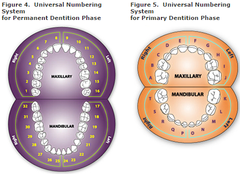
20 primary (deciduous) teeth
-numbers A and T
4 Classes of Teeth
incisors, canines, premolars, molars
Incisors
front teeth
(also known as eye-teeth)
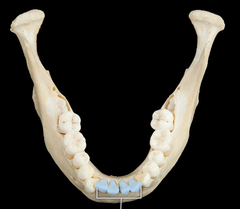
Adult Teeth
32 permanent teeth
-number 1-32
*28 teeth after wisdom teeth removal
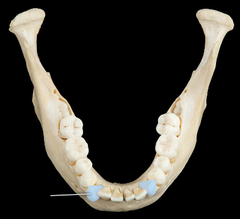
Canines
Corner teeth
(also known as cuspids)
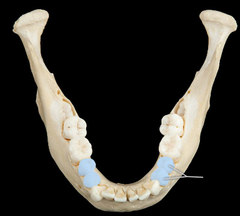
Premolars
The teeth immediately behind the canines; used in chewing/ grinding food (bicuspid teeth)
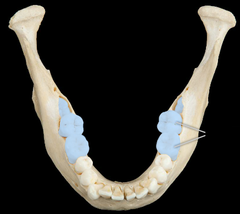
Molars
Back teeth (3 total)
**no baby predecessors
gingiva
gum tissue
Tooth Numbering
Start from the upper right with #1 and count to the left, drop down to the left side to the lower teeth and continue counting (with 17) until you get to the lower right corner. (32)
If a pt does not have wisdom teeth, start with #2, etc (In this case #1 is missing etc) 1,16,32,17-all wisdom teeth.
crown
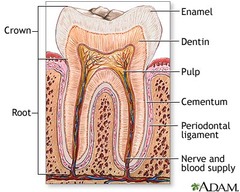
Visible part of the tooth (covered in enamel)
*Coronal direction if going upwards
Tooth Root
the part of a tooth that is embedded in the jaw and serves as support
radicular
CEJ
Cemento-enamel junction, where enamel meets cementum.
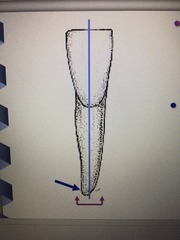
Root Apex
Apical direction
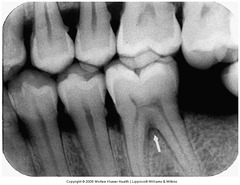
Furcation
dividing point of a multi-rooted tooth
Cusps
High point on the chewing surface of posterior premolars and molars (posterior only)
Fossa
low points of tooth
Height of Contour
widest part of tooth
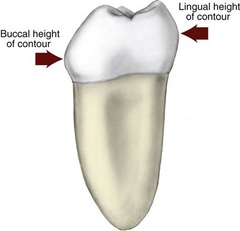
Contact Point
The exact spot at which the teeth actually touch each other.
Coalesced Groove
the normal depression where enamel development joined successfully (found in all posterior teeth)
-teld to collect plaque --> tooth caries
Non-Coalesced Pits/Fissures
Deeper defect caused by incomplete coalescence of enamel --> form pits
**big problems for caries (food is unremoval)
Typodont
artificial model of teeth used for teaching
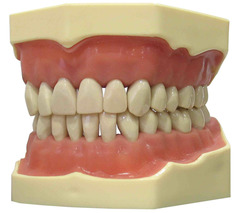
Ivorine
material of fake teeth
Lingual
pertaining to the tongue
Buccal
the side facing the cheek (used for posterior teeth)
labial
towards lip/face (for front teeth)
mesial
towards midline/center of mouth
occlusal
the chewing surface of posterior teeth (ex. cusps, grooves, pits/fissures)
Incisal
the cutting edge of anterior teeth, especially incisors and canines.
Gingival
towards the gums
Embrasures
"space" (the V-shaped spaces around the contact area between two neighboring teeth)
**usually 4 V-shapes
Radiopaque
Metallic (mineralized will appear white on x-rays )
ex. silver filings
Radiolucent
black color
ex. pulp
X-ray
Radiograph
**gingiva soft tissue not visible on radiograph
MIP
maximum inter-cuspal position
*the lower + upper jaw meet at comfortable position
Mastication
chewing
Excursive movements
movements of the mandible away from its normal biting position (ex. left-right-forward)
TMJ Condyle
the rounded end of the mandible that forms the lower part of the joint
TMJ Fossa
he shallow depression in the temporal bone where the condyle sits
Enamel
-translucent (influence by the dentin color before )
-about 2mm thick
-protects against wear/tear
-hard + strong
Tetracycline
-can cause severe discoloration if taken when tooth is still developing
-affects dentin
-horizontal band
Properties of Enamel
Hardness tissue in body (resistant)
-fracture resistance
-slightly permaeble
-acellular (good thermal/electrical insulator)
-no ability to respond (like glass)
Attrition
teeth-teeth wear
Elasticity of Enamel
Very stiff/rigid
(opposite of dentin) - supported by resilient dentin (unsupported becomes very weak/cracks)
Enamel Surface
constantly demineralizing (acidic) + remineralizing (basic)
pH
pH> 5.5 --> alkaline solution
Enamel's Life
-finished forming before it erupts into moutb
-starts thick, hard, and tough
*tooth decay + acids can dissolve it
**can not grow back
Cavitation
Forms a hole
Dentin
Most of tooth is dentin!
-resilient support for enamel + restorations
-sensitive + conductive (pulp has lots of sensory nerves)
-very porous
-very dynamic (it responds)
Pulp
has blood supply
-connect back to the nerves/brain
DEJ
Dentino-enamel joint
*when decay reaches dentin --> it spreads much faster (dentin is very permeable)
Class I restoration
on the surface of tooth (caries on pits/fissures)
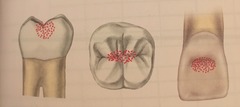
Class II restoration
caries on the mesial/distal surfaces of tooth
Prophylaxis
professional dental cleaning done to prevent oral disease
Class III
Decay on the proximal surface of an anterior tooth without involving the incisal edge
Class IV
Decay on the proximal surface of an anterior tooth that involves the incisal edge
Primary caries
Brand new cavity
Secondary caries
caries around existing dental work
Saliva's role
-supports "normal" oral flora
-flushing effect (1-1.5 L/day)
-antibacterial enzymes
-remineralization
Diastema
Naturally occurring space between teeth
Aciduric bacteria
"acid loving" --> can continue to survive in acidic pH
Plaque
biofilm / population
Commonly Known Bacteria
1. Mutans strep
2. Lactobacilli
Sugar Substitute
Xylitol
Starches
ex. potato chips
-breaks down right away into carbohydrates by amlyase in saliva
**actually better to eat sugar all at once and not nibble at it all day
Vasoconstrictors
Most anesthetic contains this (epinephrine)
-blood vessel constricts
*DO NOT give cardiovascular pt this
Topical anesthetic
-will not work on skin BUT mucosa
-helps numb the area before injection
Injecting Into Vein
Anesthetic will not work, instead goes to heart
-with epinephrine --> rapid heartbeat (tachycardia)
-toxicity risk
**should aspirate to verify before injecting
Infiltration Injections
injecting into the apex of the target tooth (maxillary teeth)
** maxillary root is very porous --> reach to cranial nerve
Block Injections
-works better for mandible teeth (lower jaw is denser)
-inject near nerve trunk (all nerves from bottom teeth leaves to the brain through hole) --> larger quadrant is anesthetized