CSET Earth and Space Science: General Science Domain 4
 Call Kai
 Learn
Learn Practice Test
 Spaced Repetition
 Match
Match Flashcards
 Knowt Play
1/21

There's no tags or description
Looks like no tags are added yet.
Name | Mastery | Learn | Test | Matching | Spaced | Call with Kai | Chat |
|---|
No analytics yet
Send a link to your students to track their progress
22 Terms
Big Bang & Evidence
Big Bang Theory
The universe began in an extremely hot, dense state and has been expanding.
Cosmic Expansion
Galaxies are generally moving away from each other.
Hubble’s Law
Cosmic Microwave Background (CMB)
Leftover radiation from the early universe.
The leftover heat from the big bang
Redshift
Light from distant galaxies is shifted toward longer wavelengths (red), showing they are moving away from us.
Astronomy & Astronomical Instruments
Astronomy is the study of objects and phenomena in space.
Telescope
Collects electromagnetic radiation to observe distant objects.
Optical Telescope
Detects visible light.
Radio Telescope
Detects radio waves.
Space Telescope
Observes from above Earth's atmosphere, avoiding atmospheric interference.
Spectroscope / Spectrometer
Separates light into its wavelengths to study stellar spectra.
Stars
A massive ball of hot gas/plasma that produces energy and light.
The Core is where nuclear fusion occurs.
A star’s mass determines its temperature, brightness, lifespan, and evolution.
More massive stars → hotter, brighter, shorter-lived.
Less massive stars → cooler, dimmer, longer-lived.
Star Life Cycle:
Nebula → A giant cloud of gas and dust in space where gravity starts to pull particles together.
Protostar → A dense, hot ball formed as the gas collapses, but before nuclear reactions start.
Main Sequence → The longest, most stable phase in a star’s lifetime
Deep inside the core, extreme heat and pressure force tiny hydrogen atoms together to make helium.
It releases a huge amount of energy as light and heat.
Stellar Spectra
Spectrum → range of wavelengths of light.
Spectral lines → specific wavelengths absorbed or emitted by elements.
Each element has a unique spectral fingerprint.
Scientists use spectra to determine a star’s:
Composition
Temperature
Motion
Redshift → spectral lines shift toward red → object moving away.
Blueshift → spectral lines shift toward blue → object moving toward.
Solar System
Solar system → the Sun and all objects that orbit it.
Gravity keeps planets and other objects in orbit around the Sun.
Orbit is the path an object follows around another object.
The Sun is a star and contains most of the solar system's mass.
Inner planets: Mercury, Venus, Earth, Mars → small and rocky.
Outer planets: Jupiter, Saturn, Uranus, Neptune → much larger.
Planets orbit the Sun and rotate on their axes.
Rotation → day/night
The side facing the Sun receives sunlight → day
The side facing away from the Sun is in darkness → night
One full orbit around Sun = year
Milky Way
Galaxy
A huge collection of stars, gas, dust, and other matter held together by gravity.
The Milky Way is the galaxy that contains our solar system.
Spiral galaxy = a galaxy with a central region and curved spiral arms.
The Milky Way is a spiral galaxy.
Our solar system is located in one of those spiral arms.
The Milky Way is much larger than our solar system.
Universe → Galaxy → Solar System → Earth
Formation/History of Earth
Phase 1: The Solar Nebula (Solar System Formation)
The Cloud: A massive cloud of gas and dust (solar nebula) collapses due to gravity.
The Sun: Gravity pulls 99% of the material to the center, igniting the Sun.
The Disk: The remaining 1% of material flattens into a spinning protoplanetary disk.
Phase 2: Accretion and Differentiation (Earth Formation)
Accretion: About 4.6 billion years ago, dust and rocks collided and stuck together, growing into Earth.
Melting: Continuous space collisions and radioactive decay generated extreme heat, melting early Earth.
Differentiation: Gravity separates the molten Earth by density. Heavy metals (iron, nickel) sink to form the core; lighter rocks float to form the mantle and crust.
Cooling: Earth slowly cools, forming a solid crust and allowing water vapor to condense into oceans.
Uniformitarianism vs. Catastrophism
Uniformitarianism
The idea that the same geological processes happening today also happened in the past.
Example:
erosion slowly shaping land today → erosion also shaped land in the past
Catastrophism
The idea that sudden, major events can cause large changes to Earth.
Examples:
asteroid impacts, volcanic eruptions, earthquakes.
Seasons, Eclipses, and Tides
Seasons
Earth’s axis is tilted 23.5°.
As Earth orbits the Sun, that tilt causes each hemisphere to receive different amounts and angles of sunlight.
Tilted toward Sun → summer (more direct sunlight + longer days)
Tilted away → winter (less direct sunlight + shorter days)
Northern and Southern Hemisphere seasons are opposite.
Eclipses
Occurs when one celestial body moves into the shadow of another.
Solar eclipse = Moon between Sun and Earth → Moon's shadow falls on Earth.
Lunar eclipse = Earth between Sun and Moon → Earth's shadow falls on Moon.
Tides
The regular rise and fall of ocean levels, caused mainly by the Moon's gravity.
The Moon's gravity pulls on Earth's oceans, creating high and low tides.
Seismic Waves
Waves of energy produced by earthquakes or other movements in Earth's crust.
P-waves (primary)
Fastest seismic waves; compressional; can travel through solids and liquids.
P-waves arrive first because they travel faster.
S-waves (secondary)
Slower than P-waves; transverse/shearing; can travel through solids only.
S-waves arrive second.
Scientists use the behavior of P- and S-waves to learn about Earth's interior.
S-waves cannot travel through Earth's liquid outer core, which provides evidence that the outer core is liquid.
Minerals
Naturally occurring: forms through natural processes, not manufactured by humans.
Inorganic: not made by living organisms or derived from living matter.
Solid: has a definite solid form.
Definite chemical composition: made of specific elements in a specific chemical ratio.
Ordered crystalline structure: atoms are arranged in an organized, repeating pattern.
Minerals can be identified using physical properties:
Color → what it looks like, but not always reliable.
Streak → color of the mineral’s powder.
Luster → how the surface reflects light (metallic, glassy, dull, etc.).
Hardness → resistance to scratching.
Measured using the Mohs hardness scale (1–10).
Talc = 1, diamond = 10.
Rocks
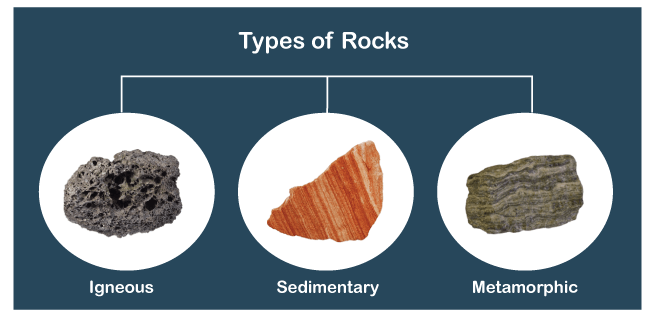
A naturally occurring solid made of one or more minerals.
Unlike minerals, rocks do not necessarily have a specific chemical composition.
1. Igneous
Form when magma or lava cools and solidifies.
Intrusive → cools underground → slow cooling → larger crystals.
Extrusive → cools at Earth's surface → fast cooling → smaller crystals.
2. Sedimentary
Form when sediments are deposited, compacted, and cemented.
Often form in layers.
Can contain fossils.
Example: sandstone, limestone.
3. Metamorphic
Existing rock changed by heat, pressure, or chemically active fluids.
Does not completely melt.
Example: limestone → marble; shale → slate.
Weathering
The breakdown of rocks at or near Earth's surface.
Mechanical (Physical) Weathering
Breaks rock into smaller pieces without changing its chemical composition.
Examples:
Ice wedging: water enters cracks, freezes, expands, and breaks rock.
Abrasion: rocks/sediment scrape against each other.
Temperature changes: repeated heating/cooling causes expansion and contraction.
Plant roots: roots grow into cracks and force them wider.
Rock gets smaller, but stays chemically the same.
Chemical Weathering
Changes the chemical composition of the minerals in a rock.
Examples:
Water dissolving minerals
Acid rain reacting with rock
Oxidation — oxygen reacts with minerals, like iron rusting
Erosion & Deposition
Erosion
The natural process where earth, rock, and soil are worn away and moved to new places by forces like water, wind, or ice
Causes of Erosion
Water → rivers, streams, waves, runoff
Wind → moves sand and small particles
Ice → glaciers move rocks and sediment
Gravity → causes landslides and rockfalls
Deposition
When transported sediment is dropped/settles in a new location
Weathering → Erosion → Deposition
Relative Dating
Relative Dating
Determines whether something is older or younger than something else.
Tells you the order of geological events, not the exact age.
Law of Superposition
In undisturbed rock layers, oldest layers are on the bottom and youngest are on top.
Original Horizontality
Sedimentary layers are originally deposited horizontally.
Cross-cutting relationships
A rock or fault that cuts through another rock is younger than the rock it cuts.
Inclusions
Pieces of rock contained inside another rock are older than the rock containing them.
Faunal succession
Scientists use fossil patterns to identify and compare the ages of rock layers.
Absolute Dating
Absolute Dating:
Determines an actual numerical age of a rock, fossil, or event.
Radiometric Dating:
A type of absolute dating that determines the absolute age of a rock or fossil by measuring the predictable decay of radioactive isotopes.
Use of Isotopes:
A radioactive parent isotope naturally decays into a daughter isotope at a known rate (half-life).
Using the isotope's known half-life, they calculate the age of the sample.
Carbon 14:
Living things continually exchange carbon with the environment, so while alive their C-14/C-12 ratio is approximately the same as the environment.
Scientists can measure that ratio in living organisms today and use it as the starting point.
Comparing the current C-14/C-12 ratio to the known starting ratio tells scientists how much C-14 has decayed → therefore, how long ago it died.
Geologic time
The enormous span of Earth's history, from Earth's formation about 4.6 billion years ago to today.
Eon → Era → Period → Epoch
Major Eras
Paleozoic
"Ancient life"
Marine life became abundant
Plants and animals began colonizing land
Ends with the Permian mass extinction
Mesozoic
"Middle life"
Often called the Age of Reptiles
Dinosaurs were dominant
Ends with the mass extinction that eliminated non-avian dinosaurs
Cenozoic
"Recent life"
Mammals became much more prominent
Includes the period in which humans evolved
Earth’s Energy Systems
Solar energy
Energy from the Sun
Drives weather, climate, evaporation, water cycle, photosynthesis.
.
Geothermal energy
Heat from inside Earth; drives many geological processes.
Drives plate tectonics, earthquakes, volcanoes, mountains.
Evidence for Plate Tectonics
Continental fit → continents like South America and Africa appear to fit together.
Matching fossils → same fossils found on continents now separated by oceans.
Matching rocks & mountain ranges → similar rock formations occur on different continents.
Seafloor spreading → new oceanic crust forms at mid-ocean ridges.
Magnetic stripes → symmetrical magnetic patterns on both sides of mid-ocean ridges show that new crust formed and moved outward.
Earthquake & volcano patterns → they occur in predictable zones that correspond to plate boundaries.
Plate Boundaries
Divergent:
Plates move apart → magma rises → magma cools → new crust forms
Example: mid-ocean ridges
Convergent
Two plates move toward each other
Oceanic + Continental → subduction
The denser oceanic plate sinks underneath the continental plate.
This can cause earthquakes and volcanoes.
Example: Andes Mountains.
Oceanic + Oceanic → subduction
One oceanic plate sinks beneath the other.
Forms volcanoes and deep ocean trenches.
Continental + Continental → collision
Neither plate easily sinks because both are relatively buoyant.
They crumple and push upward, forming mountains.
Example: Himalayas.
Transform
Plates slide past each other
The plates don't move smoothly all the time because friction causes them to get stuck. As the plates keep trying to move, stress builds up in the rocks.
Eventually, the rocks break/slip suddenly, releasing the stored energy as seismic waves → causes an earthquake.
Example: San Andreas Fault
Earthquakes
Earthquake
Sudden release of stored energy when rocks break or slip along a fault.
Fault
A fracture in Earth’s crust where rocks move.
Focus (hypocenter)
The point inside Earth where the earthquake starts.
Epicenter
The point on Earth’s surface directly above the focus.
Volcanoes and Magma
Magma: Molten rock below Earth's surface.
Lava: Magma that reaches Earth's surface.
Volcano: An opening where magma, gases, and ash reach the surface.
Types of Volcanoes
Shield Volcano
Broad, gently sloping sides.
Runny, low-viscosity basaltic lava.
Less explosive.
Composite Volcano (stratovolcano)
Tall, steep-sided cone.
Layers of lava, ash, and rock.
Viscous magma → more explosive.
Cinder Cone
Small, steep-sided volcano.
throw cinders/ash into the air
Usually forms around a single vent.
Magma Types
More silica → thicker/more viscous magma → more explosive
Less silica → runnier magma → less explosive