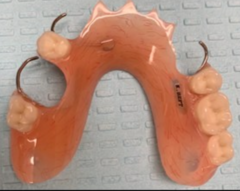
RPD 01 - Removable Prosthodontics Intro and Terminology (Quiz 1)
 Call Kai
 Learn
Learn Practice Test
 Spaced Repetition
 Match
Match Flashcards
 Knowt Play
1/89

There's no tags or description
Looks like no tags are added yet.
Name | Mastery | Learn | Test | Matching | Spaced | Call with Kai | Chat |
|---|
No analytics yet
Send a link to your students to track their progress
90 Terms
removable prosthodontics
Define the following:
The branch of Prosthodontics concerned with the replacement of teeth and contiguous structures for edentulous or partially edentulous patients by artificial substitutes that are readily removable from the mouth by the patient.
removable denture
What replaces some teeth in partially edentulous arch?
true
T/F: The removable denture can be readily inserted and removed from the mouth by the patient
- Wooden RPD base with carved ivory teeth
- Ivory RPD
- Swaged RPD with gold framework and porcelain teeth
- Swaged silver framework
- Vulcanite base with porcelain teeth
What were some RPD in the past?
- Fixed partial denture
- Implant prosthesis
What are two fixed prostheses?
- Removable complete prosthesis
- Removable partial prosthesis
What are two removable prostheses?
True
T/F: RPDs have been shown to be very effective and are considered an appropriate treatment modality for a wide variety of patient situations when multiple teeth are missing.
people live longer
Why is there an increase in demand for RPDs?
All of the above!
Which of the following are indications for RPDs?
A) Replacement of missing teeth when a fixed partial denture is not possible
B) No teeth for posterior support
C) Long span edentulous area
D) Reduced periodontal support
E) Excessive bone loss within residual ridge
F) Esthetics
G) Immediate need to replace extracted teeth
H) Patient desires
- Maintain or Enhance Quality of Life
- Function (Proper speech, mastication, and swallow)
- Comfort (No pain or discomfort during speaking, chewing, and swallowing)
- Esthetics (Functioning in society without embarrassment)
What are the 4 objectives of dental prothesis?
retention
Define the following:
Resistance against vertical dislodging forces
Direct retainers (clasps) engaging an undercut on the abutment tooth
What provides the primary retention in a removable partial denture (RPD)?
support
Define the following:
Resistance against forces directed towards the tissue
stability
Define the following:
Resistance against horizontal or lateral forces
removable partial denture
Define the following:
A removable denture that replaces some teeth in a partially edentulous arch; the removable partial denture can be readily inserted and removed from the mouth by the patient.
interim prosthesis
Define the following:
- A fixed or removable dental prosthesis, or maxillofacial prosthesis, designed to enhance esthetics, stabilization, and/or function for a short period of time, after which it is to be replaced by a definitive dental or maxillofacial prosthesis
- Often such prostheses are used to assist in determination of the therapeutic effectiveness of a specific treatment plan or the form and function of the planned for definitive prosthesis
interim/provisional RPD
Define the following:
A partial denture used for a short period for reasons of esthetics, chewing, occlusal support, and for psychological reasons; usually made of acrylic resin.
abutment
Define the following:
1. The part of a structure that directly receives thrust or pressure; an anchorage
2. A tooth, a portion of a tooth, or that portion of a dental implant that serves to support and/or retain a prosthesis.
height of contour
Define the following:
A line encircling a tooth and designating its greatest circumference at a selected axial position determined by a dental surveyor; a line encircling a body designating its greatest circumference in a specified plane; syn, SURVEY LINE

undercut
Define the following:
1) the portion of the surface of an object that is below the height of contour in relationship to the path of placement
(2) the contour of a cross-sectional portion of a residual ridge or dental arch that prevents the insertion of a dental prosthesis
(3) any irregularity in the wall of a prepared tooth that prevents the withdraw or seating of a wax pattern or indirect restoration
(4) to create areas that provide mechanical retention for dental materials placement
guiding planes
Define the following:
Two or more vertically parallel surfaces on abutment teeth and/or fixed dental prostheses oriented so as to contribute to the direction of the path of placement and removal of a removable partial denture, maxillofacial prosthesis, and overdenture. Can be natural or created.
direct retainer
Define the following:
The component of a removable partial denture used to retain and prevent dislodgment, consisting of a clasp assembly or precision attachment
clasp assembly
Define the following:
The part of a removable partial denture that acts as a direct retainer and/or stabilizer for a prosthesis by partially encompassing or contacting an abutment tooth. Components include the retentive clasp, reciprocal clasp, cingulum, incisal, or occlusal rests and a minor connector
clasp
Define the following:
The component of the clasp assembly that engages a portion of the tooth surface and either enters an undercut for retention or remains entirely above the height of contour to act as a reciprocating element; generally it is used to stabilize and retain a removable partial denture
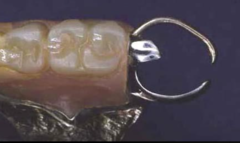
circumferential clasp
Define the following:
A retainer that encircles a tooth by more than 180 degrees, including opposite angles, and which generally contacts the tooth throughout the extent of the clasp, with at least one terminal located in an undercut area
bar clasp
Define the following:
A clasp retainer whose body extends from a major connector or denture base, passing adjacent to the soft tissue and approaching the tooth from a gingiva-occlusal direction
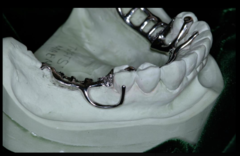
indirect retainer
Define the following:
The component of a removable partial denture that assists the direct retainer(s) in preventing displacement of the distal-extension denture base by functioning through lever action on the opposite side of the fulcrum line when the denture base attempts to move away from the tissues in pure rotation around the fulcrum line
Rest
Define the following:
A rigid extension of a removable partial denture that contacts the occlusal, incisal, cingulum, or lingual surface of a tooth or restoration, the surface of which is commonly prepared to receive it
rest seat
Define the following:
The prepared recess in a tooth or restoration developed to receive the occlusal, incisal, cingulum, or lingual rest
indirect retainer
What is 1?
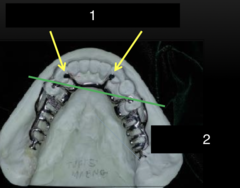
fulcrum line
What is 2 (green line)?

Rest
What is 1?
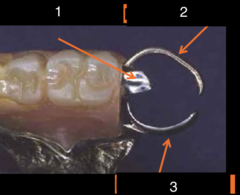
Retentive arm
What is 2?
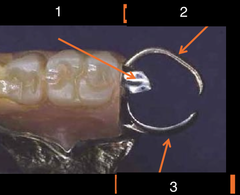
reciprocal arm
What is 3?
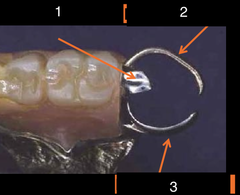
major connector
Define the following:
The part of a removable partial denture that joins the components on one side of the arch to those on the opposite side
minor connector
Define the following:
The connecting link between the major connector of a base of a partial denture and other units of the prosthesis, such as the clasp assembly, indirect retainers, and rests
denture base
Define the following:
The part of a denture which rests on the oral mucosa and to which teeth are attached
major connector
What is A?

Minor connector
What is B?
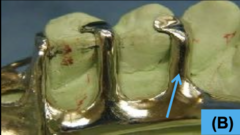
denture base
What is C?

residual/edentulous ridge
Define the following:
The portion of the alveolar ridge and its soft tissue covering which remains after the alveoli have disappeared from the alveolar process following the removal of teeth
basal seat/denture foundation area
Define the following:
Oral tissues covered by the denture base
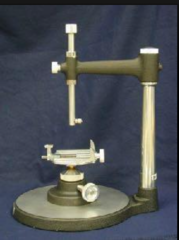
dental surveyor
Define the following:
An instrument used in removable partial denture construction to locate and delineate the contours and relative positions of abutment teeth and associated structures
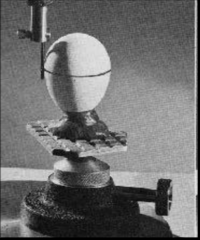
suprabulge
Define the following:
Portion of the crown of a tooth which converges towards the occlusal surface of the tooth
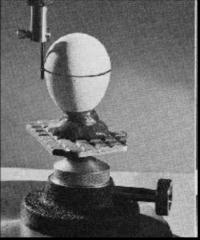
infrabulge
Define the following:
Portion of the crown of a tooth gingival to survey line, or height of contour
reline
Define the following:
The procedures used to resurface the intaglio surface of a removable dental prosthesis with new base material, thus producing an accurate adaptation to the denture foundation
rebase
Define the following:
The laboratory process of replacing the entire denture base material on an existing prosthesis
kennedy classification
What is the most widely used classification system of edentulous spaces?
4
How many categories are there in the kennedy classification system?
Class I
What kennedy classification?

Class I
What kennedy classification?
Characterized by bilateral edentulous areas located posterior to the remaining natural teeth
tooth and tissue (abutment teeth and residual ridge)
Kennedy Class I is supported by what?
Class II
What kennedy classification?

Class II
What kennedy classification?
Displays an unilateral edentulous area located posterior to the remaining natural teeth
Tissue and tooth (abutment tooth and residual ridge)
Kennedy Class II is supported by what?
Class III
What kennedy classification?
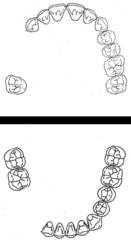
Class III
What kennedy classification?
Presents a unilateral edentulous area with natural teeth both anterior and posterior to it.
tooth (only supported by abutment teeth)
Kennedy Class III is supported by what?
Class IV
What kennedy classification?
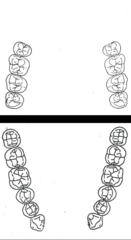
Class IV
What kennedy classification?
Displays a single, bilateral edentulous area located anterior to the remaining natural teeth. The edentulous area MUST cross the dental midline
tooth (only supported by abutment teeth)
Kennedy Class IV is supported by what?
- Class III
- Class IV
What two classes are only tooth-supported?
- Class I
- Class II
What two classes are supported by both tooth and tissue?
applegate
What classification system accounts for extractions?
False (should follow rather than precede extractions--go based off dentition post extraction!)
T/F: Applegate's rules of classification state that the classification should precede rather than follow extractions that may after original classification
is not
For Applegate's classification: if a 3rd molar is missing and not to be replaced it (is or is not) considered in the classification
is
For Applegate's classification: if a 3rd molar is present and it is to be used as an abutment, it (is or is not) considered in the classification
is not
For Applegate's classification: if a 2nd molar is missing and is not to be replaced, it (is or is not) considered in the classification
The most posterior edentulous area(s)
For Applegate's classification: what edentulous area always determines the classification?
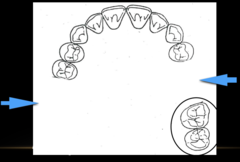
Left
For Applegate's classification:
Which arrow represents the classification?
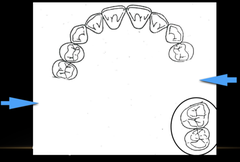
Right
For Applegate's classification:
Which arrow represents the modification?
Kennedy Class I Mod 1
What is the kennedy/applegate classification?

Kennedy Class I Mod 2
What is the kennedy/applegate classification?
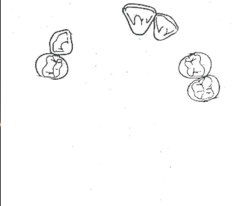
Class I
Each Kennedy classification refers to a single edentulous area EXCEPT which classification?
Kennedy Class II
What kennedy classification?

Kennedy Class II Mod 1
What kennedy classification?
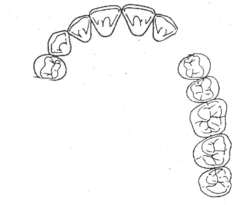
Kennedy Class II Mod 2
What kennedy classification?
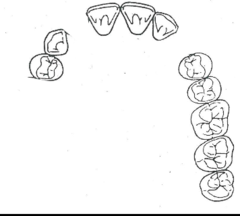
Kennedy Class III
What kennedy classification?
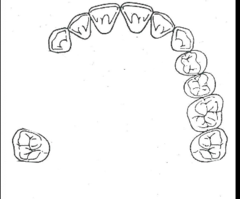
Kennedy Class III Mod 1
What kennedy classification?
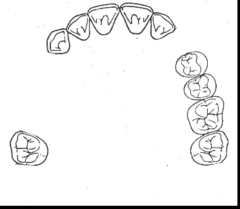
Kennedy Class III Mod 3
What kennedy classification?
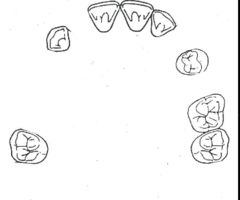
class IV
Which kennedy class can there be NO modification areas?
Kennedy class IV
What kennedy classification?
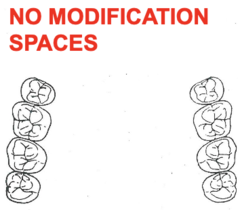
Kennedy Class III Mod 1
What kennedy classification?
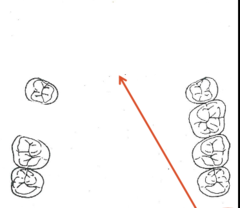
Kennedy class I Mod 2
What kennedy classification? (black are missing teeth, all missing teeth are replaced by partial denture except 3rd molar which is not replaced)
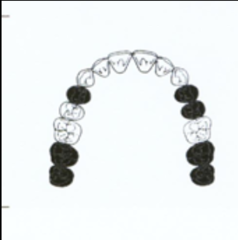
Kennedy class III Mod 1
What kennedy classification?
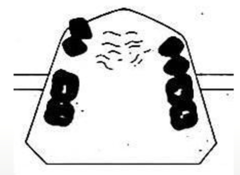
Kennedy class I Mod 2
What kennedy classification?

Kennedy class II Mod 3
What kennedy classification?
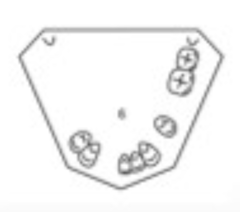
Kennedy class II Mod 1
What kennedy classification?

Kennedy class II
What kennedy classification?

Kennedy class I Mod 1
What kennedy classification?