evo bio exam 4. dr. blake slu
 Studied by 0 people
 Call with Kai
 Learn
Learn Practice Test
 Spaced Repetition
 Match
Match Flashcards
 Knowt Play
1/95

There's no tags or description
Looks like no tags are added yet.
Name | Mastery | Learn | Test | Matching | Spaced | Call with Kai |
|---|
No study sessions yet.
96 Terms
life history
Traits that affect an organism's schedule of reproduction and survival.
reproductive strategies
Behaviors or behavioral complexes that have been favored by natural selection to increase individual reproductive success. The behaviors need not be deliberate, and they often vary considerably between males and females.
selparous, iteraparous, "crazy"
semelparity
Reproduction in which an organism produces all of its offspring in a single event; also known as big-bang reproduction.
ex) female north pacific giant octopus lives for 3-5 years reproduces once then dies
iteroparity
Reproduction in which adults produce offspring over many years; also known as repeated reproduction.
ex) giant sequoia which reproduces annually
crazy reproductive organisms
ex) kiwi which reproduces with the giant egg
Demograohy
Scientific study of population change overtime
births, deaths, immigration, emigration
lifetable
demographic tool

survivorship curve
Graph showing the number of survivors in different age groups for a particular species.
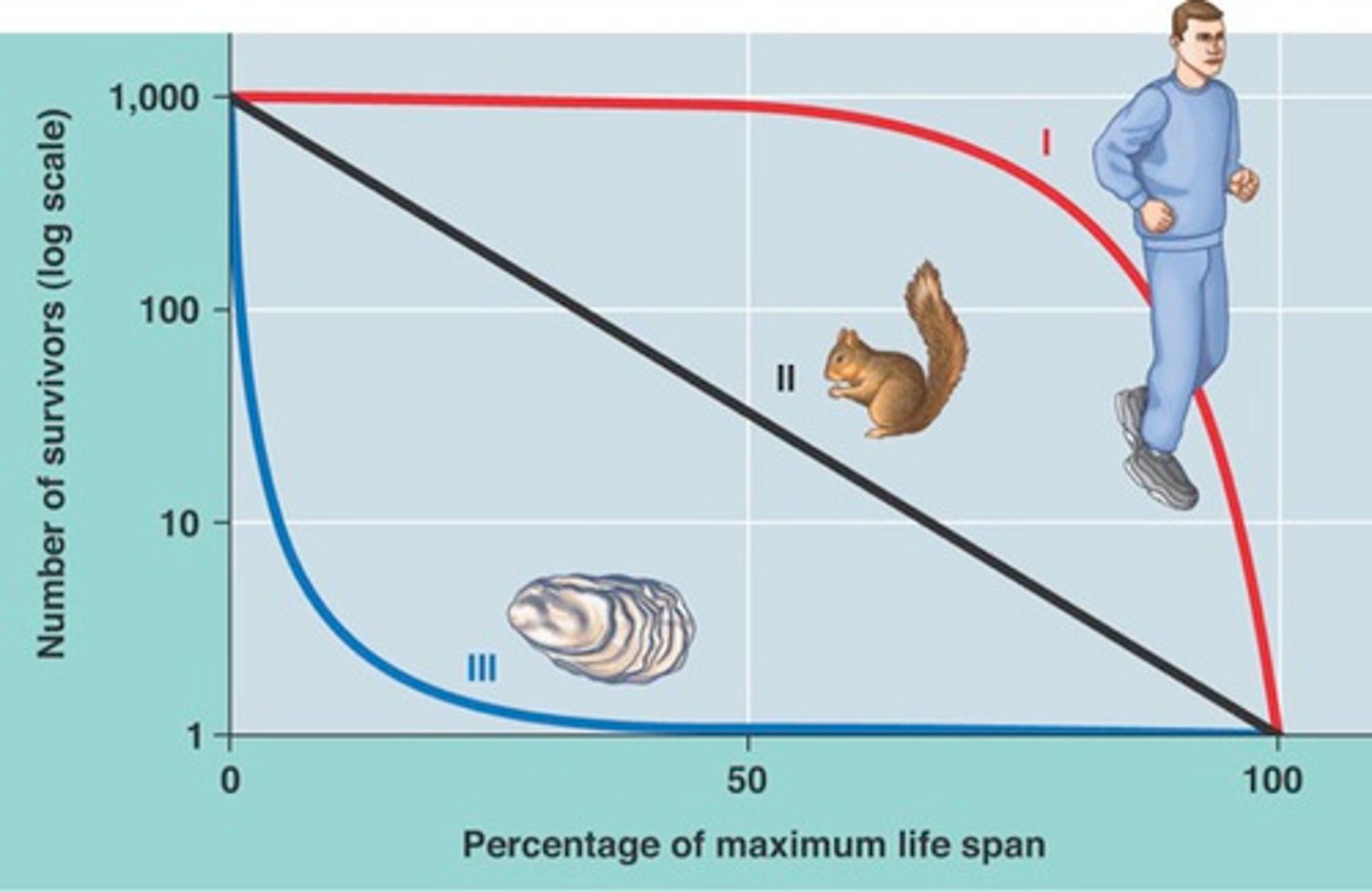
life history trade offs
some organisms: focus on growth and metabolism with little emphasis on reproduction, trying to maximize their own survival
some organisms: minimize efforts for growth and metabolism and try to maximize their reproduction rates,,
essentially the two disperse their lifetime energy differently
life history traits
Traits that affect an organism's schedule of reproduction and survival and growth
life history strategies
patterns of reproduction, growth, and survival based on trade-offs in the allocation of energy
life history trade off in the finissish
taller women= less reproduction
environmental constraints influence...
allocation of resources
crickets and life history trade offs
short winged females always allocate more energy to reproduction
longwinged females always put more energy into flight than reproduction
when food is scarce both put less energy into reproduction
K-related species
species possess relatively stable populations and tend to produce relatively low numbers of offspring
r-related species
a species that has a high intrinsic growth rate, which often leads to population overshoots and die-offs
life history traits are _______ traits
quantitative
genotypic variation can cause....
dramatic difference in phenotypic development involved in demographics
birth rate, rate of maturation, body size, survival etc,
life history trait
Heritability
the statistic that estimates how much variation in a phenotypic trait in a population is due to genetic variation among individuals in the population
phenotypic plasticity
variation in phenotypes caused by interactions between genotype and environmental factors
life history traits are influenced by:
many genes, each with small effects on development and physiology and their expression is strongly impacted by the environment
life history traits are intimately related to:
physiology,
genotype+ environmental interactions= phenotype and performance= physiological fitness
individual success determines population life table properties and the population influences the environment
these interactions lead to differing evolutioanry responses in the environment
life history traits offer opportunites for trade offs in what?
energy use.
ex)
size at birth
growth pattern
age aand size at maturity
number, size and sex ratio of offspring
age and size specific reproductive investments
age and size specific mortality schedules
length of life
aging reduces
fitness
rate of living theory of aging
aging is caused by the accumulation of irreparable damage to cells and tissues from replication and metabolism
repair effectivenes has reached its biological limit
aging is a function of metabolic rate
predictions of this theory:
1. aging rate should be correlated to metabolic rate among organisms
2. species should not evolve longer lifespans because selection for longevity is maxed out
Prediction 1 of Rate-of Living Theory and its flaw
aging rate should be correlated to metabolic rate among organisms
according to this prediction all organisms should expend about the same amount of energy per unit mass in their lifetime... but they done
prediction 2 of rate of living theory and its flaw
2. species should not evolve longer lifespans because selection for longevity is maxed out
species can actually select for longer lifespans
validity of rate of living theory of aging
-no strong support but there is intirinsic support for the physiological limit on cells
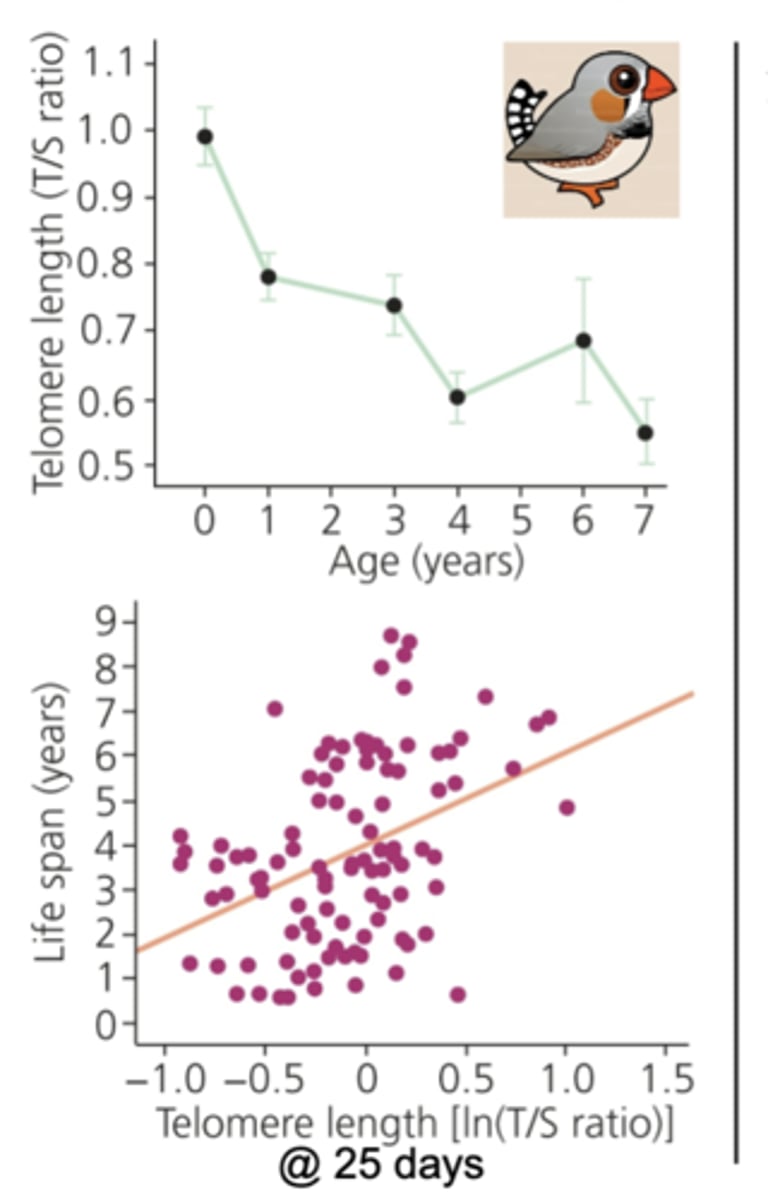
- telomeres protect the ends of chromosomes and every cell division they get shorter, unless telomerase is present
telomere length and longevity
telomere length decreases overtime
when telomeres become too short tumor suppressor protein p53 a tf production is initated that triggers a non dividing state in cells (cell senescence)
telomere lenth is inversely correlated to lifespan, short telomere reduce cell divisions but also reduce cancer risk
High levels of p53
reduce the ability of stem cells to divide and maintain and replace body parts and decrease cancer risk
mutation accumulation hypothesis
The hypothesis that senescence occurs because natural selection is not strong enough to purge deleterious mutations associated with traits that are expressed only late in life
late acting deleterious mutations are weakly selected
antagonistic pleiotropy hypothesis
the hypothesis that senescence is largely due to the evolutionary accumulation of antagonistic pleiotropic alleles that increase survival or reproduction early in life at the cost of deleterious effects late in life
pleiotropy
The ability of a single gene to have multiple effects.
reproductive effort and life history
natural selection will favor the clutch size that produces the most surviving offspring
given: future performance of parents
and reproductive success of offspring
so in some regards a slightly smaller clutch might be better
ex)more eggs this year means lower clutch next year
also offspring size
how big should offspring be
moderate?
why would a 300kg tortoise drag itself up and down a volcano every year?
tortoises follow vegetative productivity
smaller tortoise just does okay wherever so less likely to migrate bc only needs so much food and cant thermoregulate as well as big ones
migratory tortoises are in better condition and have more eggs than sedentary tortoises
bioenergetics
the study of how energy flows through living organisms
Microevolution
evolutionary change within a species or small group of organisms, especially over a short period.
change in allele frequency, occurring in humans
dynamic process which changes overtime, selection acts on individuals, but populationsa re what evolve
evolution and human health
microevo is occurring
disease is an important selective agent
GWAS helps identify allele frequency changes
pathogens and their hosts are evolved in our evolutionary arms race
Darwin's Four Postulates
1. Variation exists among individual organisms that make up a population
2. Some of the trait differences are heritable
3. Survival and reproductive success is highly variable
4. The subset of individuals that survive best and produce the most offspring is not a random sample
these are testable to see if microevolution is occurring in humans
what can lead to microevolutoin
mutation
drift
gene flow
natural selection
artificial selection
disease is a _____ agent
important selective
different pathogens impose
-different selective pressures
pathogencity
ability to infect a host and cause disease
aggressiveness (of a pathogen)
the ability of the pathogen to invade and establish within the host
virulence (of a pathogen)
severity of disease
Why did leprosy decline?
The leprosy pathogen is very similar to the one that causes tuberculosis. If a person has Tb they are immune to leprosy. As cities grew and Tb spread with increased crowding, population immunity to leprosy likely increased. Also, the isolation of lepers in the leprosaria likely limited its spread. The pathogen is not very good at dividing and spreading.
strong selection for leprosy resistance allele
gwas
genome wide association studies
observational study of genetic variance associated w a specific trait
snps
variations in the DNA sequence that occur when a single nucleotide in the genome is altered
present to significant degree w/in a population
haplotype
a set of DNA variations, or polymorphisms, that tend to be inherited together
may refer to a combination of alleles or to a set of snps found on the same chromo
selective sweeps
A phenomenon in which a selected allele goes to fixation, carrying with it alleles at tightly linked loci
advantageous mutation is becoming more frequent as selective sweep continues, may be fixed by the end of the sweep
genetic hithchiking
Fixation Index (Fst)
measure of population differentiation due to genetic structure
0= homogenized
measure of genetic variability at a specific locus
What is leprosy?
gram positive bacteria that can be treated with antibiotics
pathogen and host evolutionary arms race examples
antibiotic resistance
host immune responses can drive pathogen evolution
Penicillin is a selective agent
penicillin resistance decreases as public use goes down
Evolution of antibiotic resistance
1. lots of germs few are antibiotic resistant
2. antibiotics kill bacteria causing the illness, protecting body from infection
3. drug resistnat bact are allowed to grow and take over
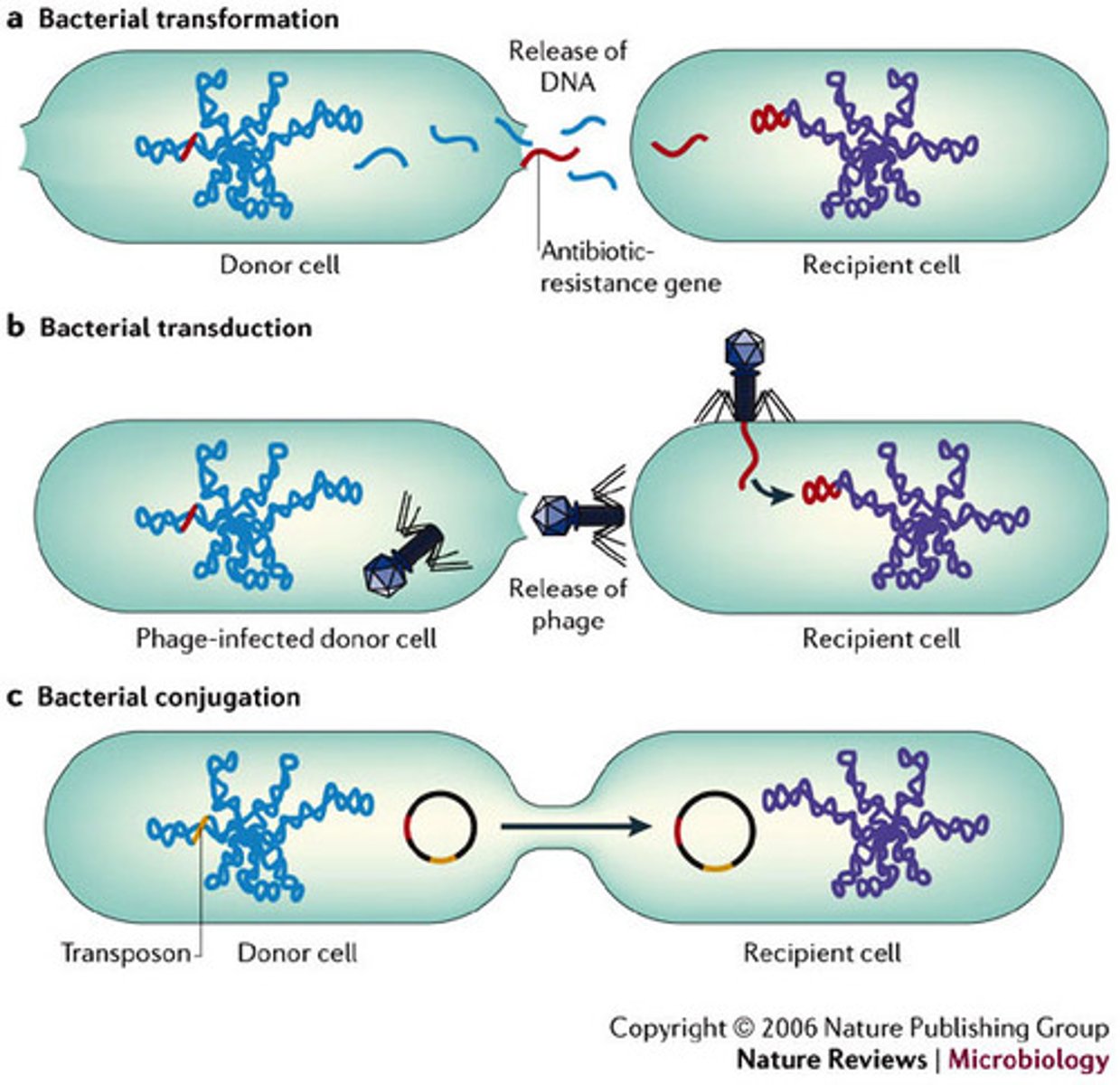
4. some bact give their drug resistance to other bact, causing more problems
horizontal gene transfer
The transfer of genes from one genome to another through mechanisms such as transposable elements, plasmid exchange, viral activity, and perhaps fusions of different organisms.
antibiotic resistance in galapagos tortoises
chickens treated w/ antibiotics
tortoise eats chicken poop
bam! tortoise resistance
host immune response can drive pathogen evolution
ex) the flu mutates antigenic sites every year to continuously infect us
to avoid extinction: the fly must continue to find naive host without antibodies or alter its hemaglutinin so that previously exposed hosts do not recognize it
flu viruses evolve 10^6 faster than mammals
mutation of flu at a steady rate
predicting which strain to use in the development of vaccines
the one w/ the most aa sequence changes is most likely to survive into the next year so this is what we use to make vaccines
flu pandemics
radically different hemagglutinins are a selective advantage
flu strains swap genes
flu strains swap genes
idk slide 46/52
does selection favor virulence?
coincidental evolution hypothesis
shortsighted evolution hypothesis
trade-off hypothesis
coincidental evolution hypothesis:
virulence is a byrpoduct of other traits, like the capacity to reproduce quickly in nature
shortsighted; selection favors strains that reproduce quickly and effectively. By contrast, virions in the nervous system are unlikely to be transmitted and their evolution will likely increase within host fitness
trade off hypothesis:
virulence can be bad from a pathogen perspective bc it leads to host death
virulence vs reproductive rate
as reproductive rate of phages increases virulence also increases
hosts that reproduce more slowly led to lower pathogen reproductive rates and lower virulence than a host that reproduced quickly
vector borne pathogens are more...... than direct contact pathogens
virulent
what is life
cells: membrane bound units in which the membrane regulates the passage of materials
replication: to be considered life, organisms must be capable of self replicaiton
information: life processes hereditary informationin the form of genes. Information is stored and transmitted (genotype) and expressed (phenotypes)
evolution: organisms are the product of evolutoin
energy: life must aquire and use energy
IDA
"Initial Darwinian ancestor—
the first living thing that is an ancestor of extant organisms; also known as the primordial form."
LUCA
last universal common ancestor
dogma of genetics
DNA -> RNA -> Protein
paradox: dna is needed to make enzymes, enzymes are needed to make DNA, so which came first?
RNA world hypothesis
hypothesis that RNA served as the genetic information of early life
gets us away from the dna paradox,,, bc rna can be catalytic and can self replicate
RNA self replication
-RNA has a genotype and phenotype
-but, RNA (and DNA) can only replicate via an enzyme and yet that enzyme did seem to exist in a pre-DNA world
- catalytic rna
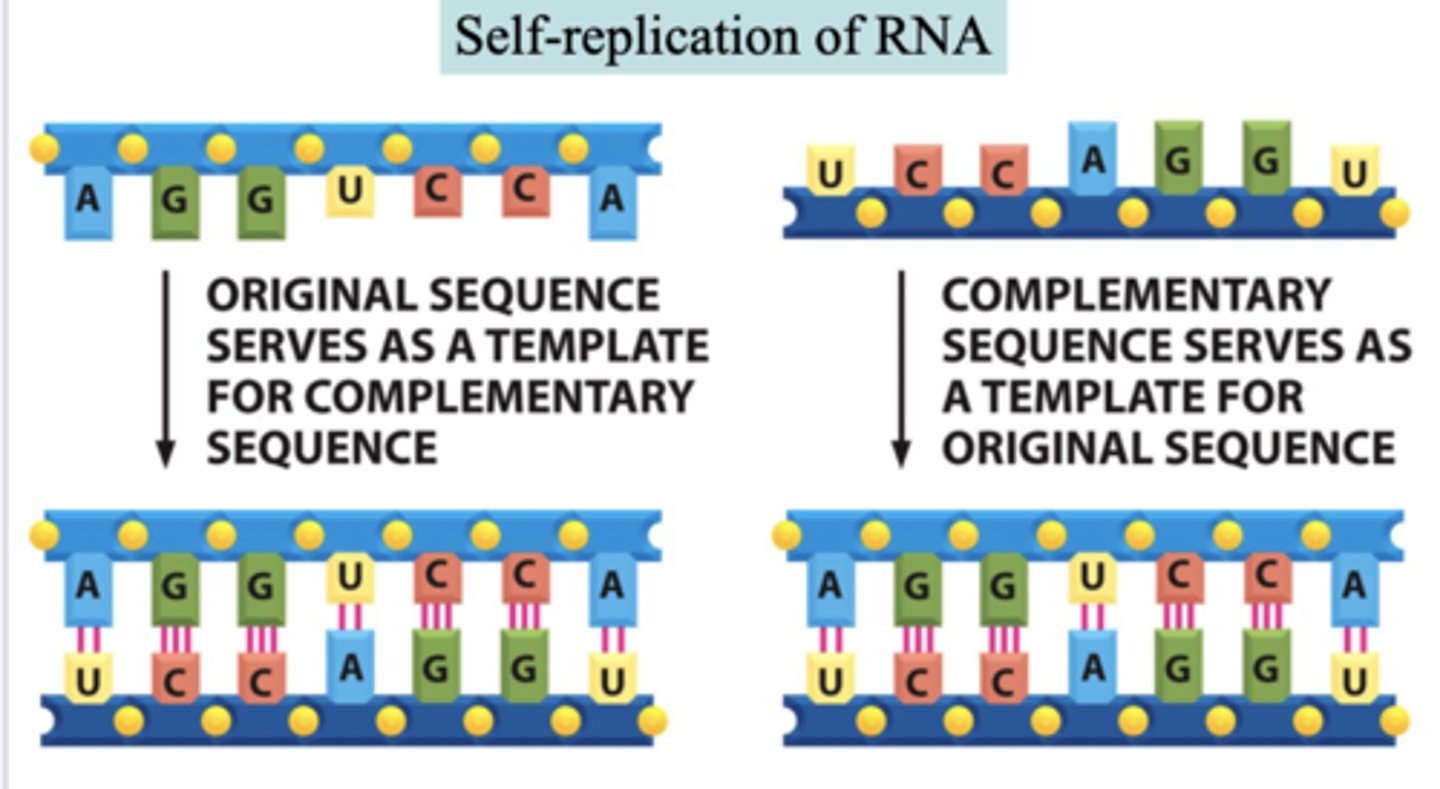
can the same replicated RNA sequence have different phenotypes
yes bc of secondary and tertiary structures in rna.
ribozymes
RNA molecules that function as enzymes and can mediate reactions
they have complex tertiary structures
condensation of amino acids in the ribosome in polypeptide fromation
rna splicing
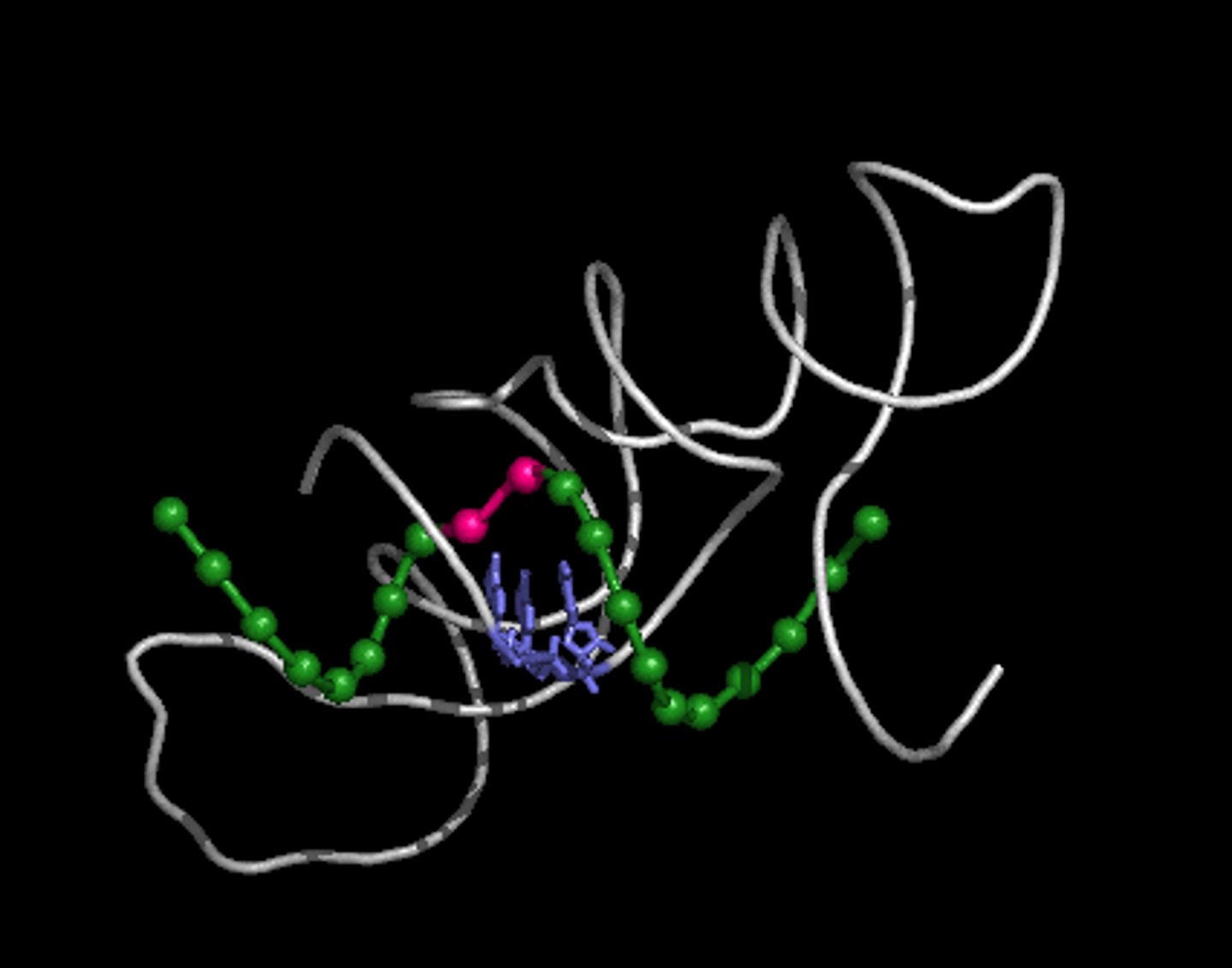
can catalytic rna replicate itself
yes but under experimental conditions
can catalytic rna evolve
yes.
tetrahymena ribozyme, an rna enzyme that catalyzes the cleavage of RNA
efficient self replication in rna
mutually beneficial rna molecules would encounter each other with low frequency if they diffused freely
and would be coopted by other rna molecules if they encoutnered them
compartmentalization would be a key to success
vesicles form spontaneously when phospholipids are shaken in water
rna in a smaller area increases the probability of them finding each other to catalyze reactions
why did dna become dominant
dna is chemically more stable than rna
dna is better at self reoair during replication due to the presence of thymine instead of uracil
dna has better information security because of the protective double helix structure
where did complex molecules come from
the things that make life have either always been around or a meteorite brought it to us
Oparin-Haldane hypothesis
simple organic compounds were changed by heat and solar radiation into more complex organic compounds
how life came to be.
when heated, simple molecules became amino acids
1. assemble simple molecules into building blocks for complex polymers
2. assemble polymers that can store info and catalyze rxns
3. add membranes and an energy source to make a living organism
cells obtaining energy
proton motive force
atp synthase
proton gradient
oxygen as the final electron acceptor
how did luca obtain energy
thermal vents
a natural proton motive force was created
how did luca get off the vent
-to escape luca had to make its own proton motive force
1. carbon and energy metabolism powered by natural proton gradients in an ancestral protocell w a leaky membrane
2. simplified carbon and energy metabolism of archaea. H+ membrane potential generated via an H+ pump
3. simplified carbon and energy metabolism of some bacteria
search for LUCA
earliest recorded life 3.7 bil years ago evident by carbon deposits in fossils
3.26 bil years ago evidence of cell division
search for LUCA through phylogeny
-need a gene present in all organisms that is heavily conserved
-under strong stabilizing selection
ex) small subunit of rRNA os responsible for translation, this is true for all life
what makes it difficult to find LUCA
horizontal gene transfer
how did early life obtain energy
from CO2 and other sources like methane
what organism started photosynthesis
cyanobacteria
oxygen catastrophe
Population of cyanobacteria exploded since they had an advantage, produced more oxygen faster than it could be absorbed, causing it to build up in the atmosphere, which wiped out the other organisms. Methane had been acting as a greenhouse gas that kept the Earth warm, but the extra oxygen reacted with methane to form carbon dioxide and water, which don't trap as much heat. The thin atmosphere caused Earth's first ice age.
but aye we got the ozone layer
Precambrian Era
oldest and longest era : unicellular organisms originated
has a poor fossil record but there is evidence of life in rust and stromatolites
stromatolites
Oldest known fossils formed from many layers of cyanobacteria and sediment.
cyanobacteria were uptaken to create what in modern cells
chloroplasts
Chemoorganoheterotrophs
energy and carbon from organic compounds
were uptaken to make mitochondria
endosymbiosis
engulfing of mitochondria and cyanobacteria
host cell profited from the chemical energy lodger produced
the lodger benefits from the protected nutrient rich environment surrounding it
Cambrian explosion
A burst of evolutionary origins when most of the major body plans of animals appeared in a relatively brief time in geologic history; recorded in the fossil record about 545 to 525 million years ago.
High O2 allowed for fast metabolism, larger body size, selection for increasing organism complexity and exploration of new niches
Genome size and functional complexity
reflect a high demand for energy in more complex organisms
what drove the evolution of eukaryotes
1. evolution of cyanobacteria and oxygen abundance
2. prokaryotes evolved to do aerobic respiration
3. lots of atp could now be used
4. this was a big selective advantage and caused proaerobic respiration
5. large anaerobic prokaryotes endosymbiosed smaller aerobic prokaryotes that produced a lot of ATO