Chapter 7- The New Art
 Call Kai
 Learn
Learn Practice Test
 Spaced Repetition
 Match
Match Flashcards
 Knowt Play
1/22

There's no tags or description
Looks like no tags are added yet.
Name | Mastery | Learn | Test | Matching | Spaced | Call with Kai | Chat |
|---|
No analytics yet
Send a link to your students to track their progress
23 Terms

Know it when you see it:
Design for a living space by Eliel Saarinen, Herman Gesellius, and Armas Lindgren, 1903.
True or False: The "Dragon Style" in Norwegian design was influenced by medieval Viking traditions.
True
Fill in the Blank: The Finnish epic poem that became a symbol of national consciousness and patriotism is called the____________
Kalevala

Know it when you see it:
Elbow chair designed by Eliel Saarinen for the State Railway Administration Offices, Helsinki, 1908-09.

Know it when you see it:
Finnish Pavilion designed by Eliel Saarinen, Herman Gesellius, and Armas Lindgren for the 1900 Exposition Universelle in Paris.
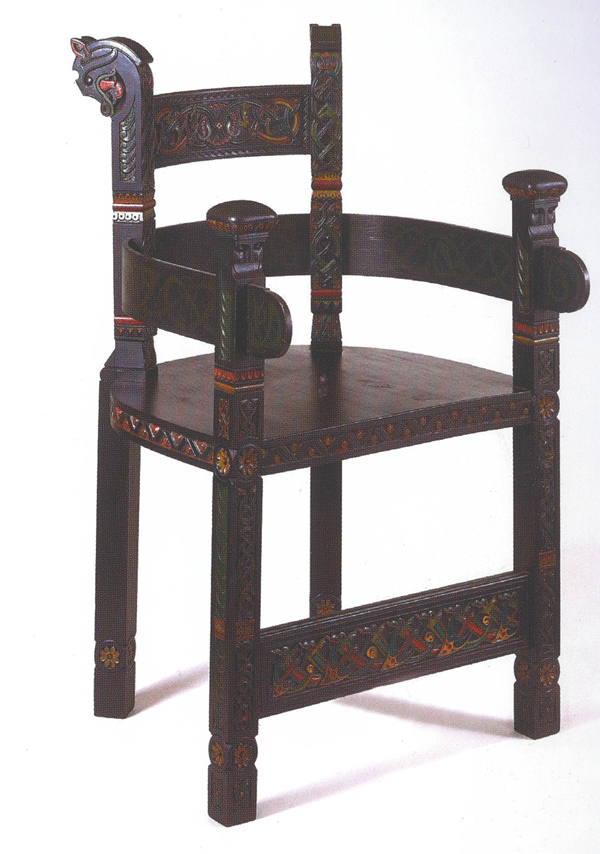
Know it when you see it:
Viking-revival armchair designed by Lars Kinsarvik, c. 1900.
Matching:
Eliel Saarinen
Lars Kinsarvik
Holm Hansen Munthe
Frognerseteren restaurant
Helsinki Central Railway Station
Viking-style armchair
Holm Hansen Munthe——- Frognerseteren restaurant
Eliel Saarinen———Helsinki Central Railway Station
Lars Kinsarvik———-Viking-style armchair
Which philosopher’s ideas are considered foundational to the National Romanticism movement in design?
Johann Gottfried von Herder
True or False: National Romanticism was solely a reaction against the industrialization and urbanization of the nineteenth century.
False
Which of the following was NOT a name used to describe the New Art movement in the 1890s?
Stile Liberty
Bauhaus
Jugendstil
Art Nouveau
Bauhaus
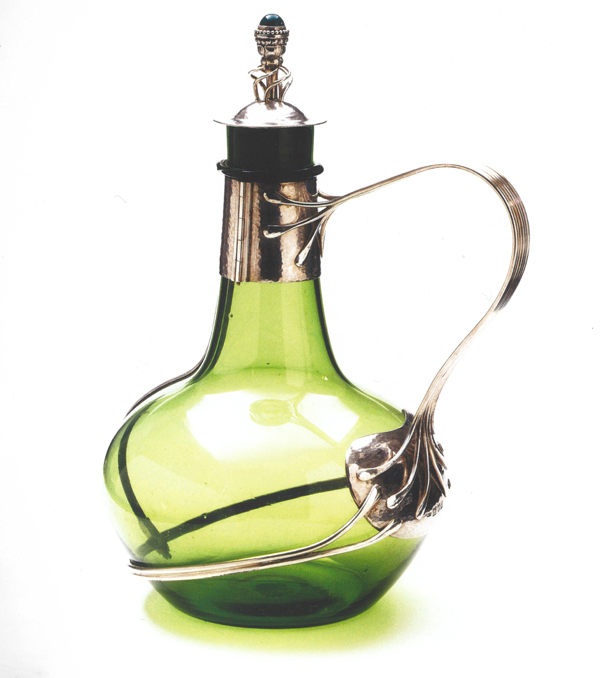
Know it when you see it:
Decanter designed by Charles Robert Ashbee, 1901/1904-05, executed by the Guild of Handicraft.
Which of the following statements best describes the New Art movement within the British Arts and Crafts movement?
It focused exclusively on traditional craftsmanship and rejected all forms of modernity.
It developed a coherent aesthetic based on practical yet beautiful designs intended to transform daily life.
It embraced industrial mechanization and mass production techniques.
It was characterized by a return to medieval Gothic styles and motifs.
It developed a coherent aesthetic based on practical yet beautiful designs intended to transform daily life.

Know it when you see it:
Library at Glasgow School of Art
Which of the following statements best describes the paradox in William Morris's philosophy as understood by the second-phase Arts and Crafts designers?
He favored simple designs but encouraged elaborate ornamentation.
He promoted mass production of art but disliked the mechanization of design.
He supported industrial production but opposed machine-made goods.
He wanted affordable, well-designed products but adhered to costly hand-manufacturing methods.
He wanted affordable, well-designed products but adhered to costly hand-manufacturing methods.

Know it when you see it:
Cymric clock designed by Archibald Knox for Liberty & Co., 1903.
Which principles espoused by the British Arts and Crafts movement were instrumental in the formation of the Modern Movement?
Simplicity, utility, and appropriateness

Know it when you see it:
Oak armchair designed by C. F. A. Voysey, 1902.

Know it when you see it:
Entrance to the Glasgow School of Art designed by Charles Rennie Mackintosh, 1897-99 and 1907-09.
Hermann Muthesius praised which British designer for achieving a complete synthesis between the work of the designer and the architect, creating what became known as a Gesamtkunstwerk?
Charles Voysey
The term "second phase" Arts and Crafts originated from a show presented in 1888 by the__________
Arts and Crafts Exhibition Society
Who was NOT one of the key early influencers of the Arts and Crafts movement in Britain?
A. W. N. Pugin
Christopher Dresser
John Ruskin
William Morris
Christopher Dresser
Match the designer to their significant contribution:
Arthur Heygate Mackmurdo
Charles Robert Ashbee
Archibald Knox
Charles Rennie Mackintosh
Designed the Glasgow School of Art
Founded the Century Guild of Artists
Moved the Guild of Handicraft to Chipping Campden
Created Celtic-inspired designs for Liberty & Co.
Arthur Heygate Mackmurdo—— Founded the Century Guild of Artists
Charles Robert Ashbee—— Moved the Guild of Handicraft to Chipping Campden
Archibald Knox——- Created Celtic-inspired designs for Liberty & Co.
Charles Rennie Mackintosh——— Designed the Glasgow School of Art