A&P-integumentary system
 Call Kai
 Learn
Learn Practice Test
 Spaced Repetition
 Match
Match Flashcards
 Knowt Play
1/56

There's no tags or description
Looks like no tags are added yet.
Name | Mastery | Learn | Test | Matching | Spaced | Call with Kai | Chat |
|---|
No analytics yet
Send a link to your students to track their progress
57 Terms
Dermatology
the scientific study and medical treatment of the integumentary system
What is the integumentary system composed of?
skin
hair
nails
cutaneous glands
What are the different functions of the skin?
protection
resistance to trauma and infection; barrier to UV rays
vitamin D synthesis
skin carries out 1st step
nonverbal communication
facial expressions
sensation
receptors for temperature, touch
thermoregulation
perspiration and vasoconstriction + vasodilation
The epidermis
composed of avascular keratinized stratified squamous epithelium
What are the cells of the epidermis?
stem cells
undifferentiated cells giving rise to keratinocytes
keratinocytes
synthesize keratin
melanocytes
synthesize melanin
tactile cells
sensory receptors
dendritic cells
macrophages fighting infection and bacteria
What are the different layers of the epidermis?
stratum basale
deepest layer composed of highly active cells (stem cells, melanocytes)
stratum spinosum
second layer, very thick
stratum granulosum
third layer that has granules of keratin
stratum lucidom
only found in thick skin (palms and soles)
stratum corneum
superficial layer with up to 30 layers of dead, keratinocytes
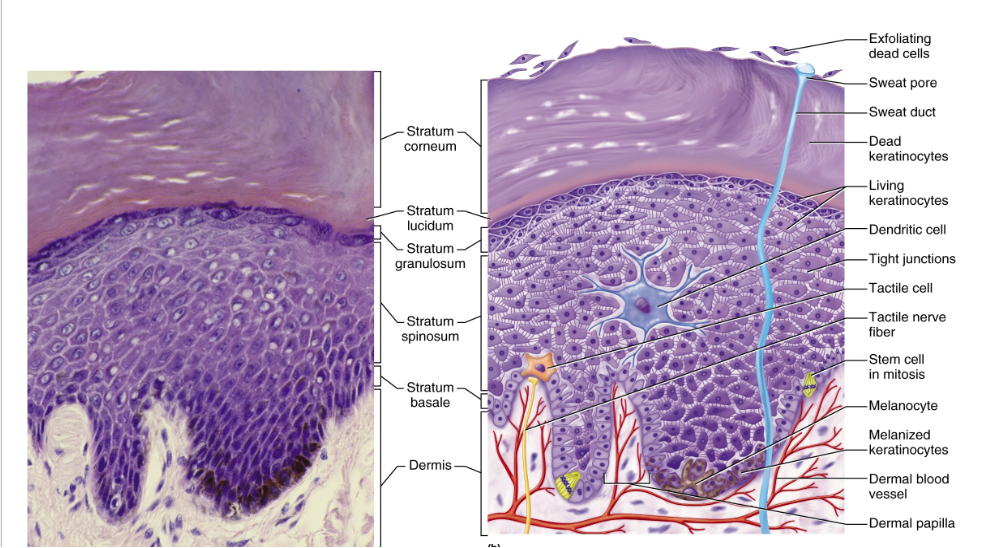
What layers of the epidermis are considered living and nonliving?
living: basale, spinosum, granulosum (half)
nonliving: lucidum, corneum
What is the life history of a keratinocyte?

The dermis
vascular layer composed mainly of collagen and well supplied with blood vessels and nerve endings
houses all accessory organs
What are the two layers of the dermis?
papillary layer
reticular layer
Papillary layer
superficial layer of the dermis
composed of areolar tissue with finger-like projections that connect to the epidermis
Reticular layer
deeper layer of dermis
composed of dense irregular connective tissue
ex. stretch marks come from tears in the collagen fibers
Dermal papillae
upward finger-like extensions of the dermis
ex. contain blood vessels
The hypodermis
subcutaneous tissue composed of adipose tissue that binds skin to underlying tissues
ex. not considered part of the skin
What is the function of subcutaneous fat?
energy regulation
pads the body
What are the two pigments responsible for skin color?
melanin
hemoglobin
carotene
Melanin
the most important factor in skin color
produced from melanocytes
Do darker skinned people have increased melanocytes?
no, they simple produce more melanin
ex. cells work harder and more independently
What are the two main pigments from melanin?
eumelanin
pheomelanin
Eumelanin
brownish-black pigment
Pheomelanin
reddish-yellow pigment
Hemoglobin
pigment found in RBCs that adds a pinkish hue
Carotene
yellow pigment acquired from egg yolks and vegetables
What are the different skin colors (diagnostic)
cyanosis
blueness due to oxygen deficiency
erythema
increased redness
pallor
paleness due to decreased blood flow
albinism
whitening of skin due to lack of melanin
jaundice
yellowing of skin due to bilirubin
hematoma
bruising due to clotting
Friction ridges
produce fingerprints
Flexion lines
marks sites where skin folds during flexion of joints
Freckles and moles
accumulations of melanocytes
freckles are flat
moles are raised
Lanugo
unpigmented hair covering head of fetus
Vellus
pale hair replacing lanugo at time of birth
Terminal
thick pigmented hair found on the eyebrows, eyelashes and scalp
Piloerector muscle
smooth muscle attaching follicle to dermis
contracts to make hair stand upright and produces goosebumps
ex. termed “arrector pilli”
Hair bulb
swelling of hair at the base composed of living active cells
Hair root
hair not visible on surface
Hair matrix
located in hair bulb
site of the hair’s growth cells
What are the components of a cross-section of hair?
medulla
hollow tube only found in thick hair
cortex
thickest layer composed of keratinized epithelium
cuticle
outermost layer that seals hair
Hair shaft
visible portion of hair
What are the functions of the hair?
scalp hair
functions for protection
trunk and limb hair
functions for sensory purposes
pubic and axillary hair
functions for sign of puberty
guard hairs
function to protect nostrils and ear canals
Where do the different shades of color come from?
combination of eumelanin and pheomelanin
Nails
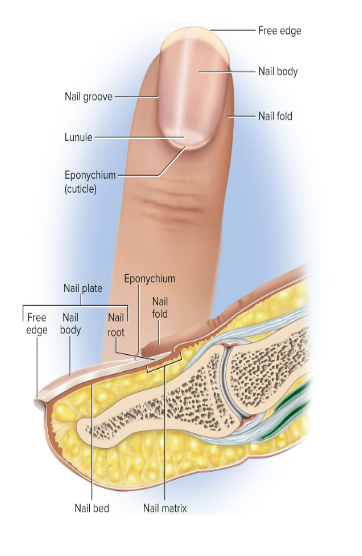
clear hard derivatives of the stratum corneum, composed of thin, dead cells packed with keratin
What are the different parts of the nail?
nail plate
visible portion that includes free edge, body, and root
nail fold
surrounding skin rising above nail
nail groove
separates nail fold from nail plate
nail bed
skin underneath nail plate
nail matrix
growth zone of thickened stratum basale
Hirsutism
excessive or undesirable hairiness in unusual areas of the body
What tissue type are nails and hair composed of?
keratinized squamous epithelium
Apocrine glands
inactive until puberty
thick secretions
usage of ducts attached to hair follicle
location: groin, anal region, axilla, and beard area
function: respond to stress and sexual stimulation
Merocrine sweat glands
produce most of sweat
usage of ducts that open directly onto the skin
thin secretion
location: palms, soles, and forehead
function: produce sweat to cool off body and keep the homeostasis of temperature
Sebaceous glands
produce oily secretion, sebum
ex. attached to hair follicle
Ceruminous glands
produce cerumen (earwax), a yellow secretion
What are the functions of ceruminous glands?
keeps eardrum pliable
waterproof canal
kills bacteria
blocks foreign particles
Insensible perspiration
secretion of 500 mL of sweat per day
ex. not noticeable
Diaphoresis
secretion of 1 L of sweat per day
ex. noticeable wetness
Cutaneous transpiration
water loss due to escape of liquid through gaps in cells
Mammary glands
develop only during pregnancy and lactation to produce milk
ex. usage of lactiferous ducts
Basal cell carcinoma
least aggressive type of cancer
small shiny bump with central depression
Squamous cell carcinoma
arises in stratum spinosum
location: lesions on scalp, lips, and back of hand
Malignant melanoma
fatal condition
arises from melanocytes
Where is skin damage most often found?
the head, neck, and hands
Deaths related to burns most often result from?
dehydration
infection
eschar
What are the different types of burns and their effects?
first-degree
affects just the epidermis
second-degree
affecting epidermis and dermis
third-degree
affecting epidermis, dermis, and deeper layers