Lecture 4 Great Diseases of The World causation of disease
 Call Kai
 Learn
Learn Practice Test
 Spaced Repetition
 Match
Match Flashcards
 Knowt Play
1/40

Earn XP
Description and Tags
causeation of disease
Name | Mastery | Learn | Test | Matching | Spaced | Call with Kai | Chat |
|---|
No analytics yet
Send a link to your students to track their progress
41 Terms
What are the 6 different theories of causation?
divine retribution
Miasma theory
humorism
theory of contagion
theory of spontaneous generation
germ theory
explain the divine retribution theory
disease outbreaks are attributed to mankind’s sins. drilling holes into people’s heads to free them from demons and spirits (trepanation)
explain the Miasma theory (500 BCE - 1880s CE)
diseases were caused by a poisonous form of “bad air” emancipating from decaying organic matter
paves the way for sanitation measures
explain the humorism theory (460-370 BCE)
when the imbalances of urine (yellow bile), feces (Black bile), Phlegm, and blood in our body are balanced then health will prevail. if these were imbalanced then health would deteriorate and sympthoms would develop
tried to relate diet, exercise, occupation, etc.. to subsequent health outcomes by using those to restore humoral equilibrium
the goal was personal hygiene to keep the humors of the body in balance
focused on patient care and prognosis, not the diagnosis
explain the theory of contagion (1546)
each disease was caused by a different type of rapidly multipling minute body and that these bodies were transferred from the infector to the infected in three ways
direct contact
carries such as soiled clothing and linen
through the air
explain the theory of spontaneous generation (384-322 BCE)
life can arise from non living matter
ex. when meat is left out, flies and maggots seemed to appear on the meat or when bread is left out, fungus appears
explain the germ theory (1859)
infectious diseases are caused by microbes or “germs”
What are some of the important contributions of Girolamo Fracastoro to diseases?
He came up with the theory of contagion in 1546 while observing patients with syphilis
What are some of the important contributions of Antonie Van Leeuwenhoek to diseases?
invented one of the earliest microscopes by grinding glass to create a magnifying lens (17th century)
known as the father of microbiology
discovered bacteria, sperm cells, blood cells, microscopic nematodes (roundworms), and much more
What are some of the important contributions of Louis Pasteur to diseases?
came up with pasteurization
studying spoilage of wine, developed a process for killing germs by boiling wine and then cooling it down
developed the germ theory by derived that germs came from air
known for Pasteur’s experiment of (1859) also called the swan neck flask experiment
made a series of flasks with long, twisted necksin which he boiled broth to sterilize it
allowed air inside the flasks to be exchanged with air from the outside, but prevented the introduction of any air borne microorganisms, which would get caught in the twists and bends of the flasks’ necks
the flasks remained sterile as long as the swan necks were intact and if they were broken or tilted then microbial growth began

What are some of the important contributions of Robert Koch to diseases?
German doctor and microbiologist
discovered that microbes cause wounds to go septic and he used dyes to stain the microbes, enabling him to photograph them under a microscope (huge discovery)
discovered causative agents of disease
tuberculosis, cholera, and anthrax
came up with Koch’s Postulates to study pathogens move effectively as prove every infectious disease was caused by a specific germ
responsible for establishing the new ‘Science of Modern Bacteriology” (1880-1890 CE)
What are some of the important contributions of Francesco Redi to diseases?
first to attempt to disprove the theory of spontaneous generation by preforming a controlled experiment
He performed an experiment to check whether maggots (baby flies) really came from decaying meat
He did this by placing meat in several jars leaving one open, one covering with fine gauze, and one sealed with cork
He concluded that maggots could only form when flies were allowed to lay eggs in the meat, and that the maggots were the offspring of flies, not the product of spontaneous generation!!!
What are some of the important contributions of Joseph Lister to diseases?
professor of surgery at Glasgow
read about Pastures discovery of germs and decided he needed to prevent infections by making sure germs in the air didn’t get into wounds
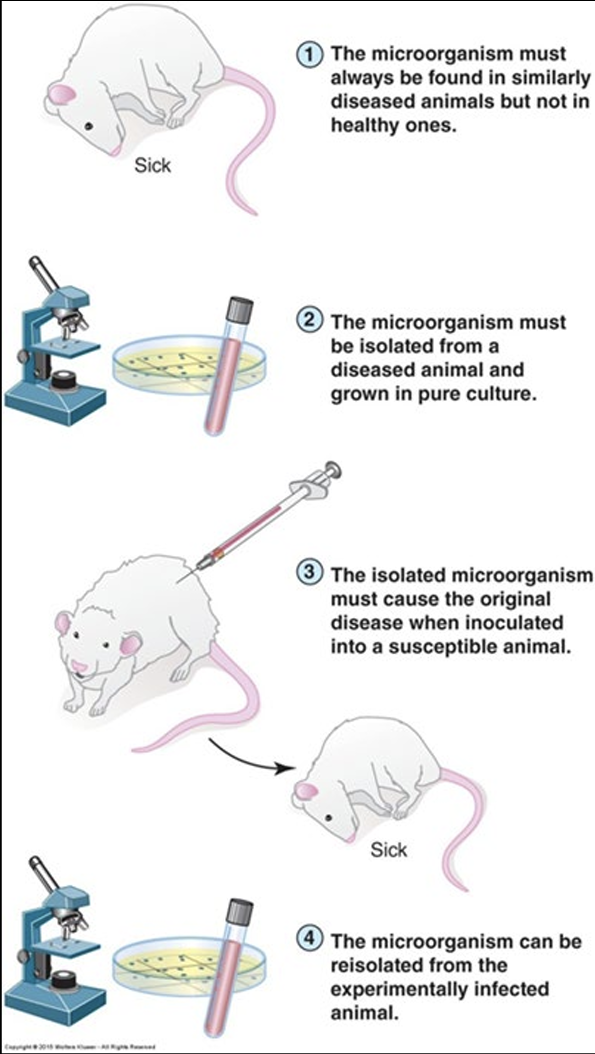
What are Koch’s Postulates?
A particular microbe must be found in all cases of the disease and must not be present in healthy animals or humans
The microbe must be isolated from the diseased animal or human and grown in pure culture in the laboratory
The same disease must be produced when microbes from the pure culture are inoculated into healthy susceptible laboratory animals
The same microbe must be recovered from the experimentally infected animals and grown again in pure culture
list 6 different types of pathogens
Prions
viruses
Bacteria
Fungi
Protozoa
Helminths

Describe the characteristics of viruses and give an example pathogen
Their genome is either DNA or RNA , which is surrounded by a protein shell (capsid) and sometimes a membrane (similar to a cell membrane)
Need a living host cell to replicate
Cannot be treated with antibiotics
A virus is a dormant particle outside a living cell
Only seen by electron microscope (very small)
Examples
Measles virus, smallpox virus, rabies virus, Ebola virus
Describe the characteristics of bacteria and give an example pathogen
Bacteria are prokaryotes (i.e., do not have a nucleus )
10-100 times larger than a virus
Mostly self-sufficient, single-cell organisms
Can be treated with antibiotics
Can replicate in non-living medium
examples
E. coli, Salmonella, Listeria, Yersinia, Borrelia, Mycobacterium etc.
Describe the characteristics of protozoa and give an example pathogen
Single-cell eukaryotes (i.e., have a nucleus)
Free-living or parasitic
Visible under a low-power microscope
Parasitic protozoa need to extract nutrients from a host to survive and reproduce
examples
Plasmodium (malaria), Toxoplasma, Giardia (diarrhea)
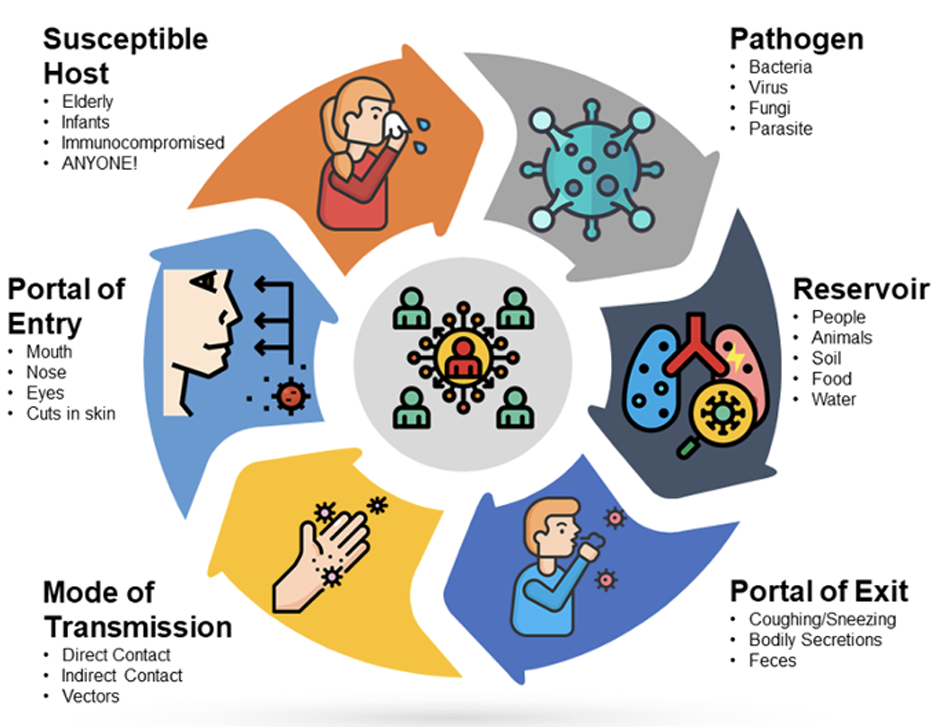
Describe the links in the chain of infection
The chain of infection is a set of 6 intertwined links that allow for communicable (infectious) diseases to spread
Each link of the chain is required to effectively transmit infectious illness
Breaking any one of the 6 links can slow the spread of infectious disease
Describe routes of entry and route of transmission of pathogens
direct
Person-person
droplet (coughing, sneezing)
indirect
fecal-oral
airborne
formites (inanimate object serves as a vehicle to infect people)
vector
insect bite
What are zoonotic diseases?
Animals can carry germs that can spread to people and cause illness, or vice versa (reverse zoonosis)
define carrier
an individual who is infected with an organism but no evidence of disease shows , although the disease may have been present earlier, and can be a source of infection to others
define reservoir of an infectious agent
the habitat in which the agent/pathogen normally lives, grows, and multiplies
define incubation period
time from infection to the first onset of signs and clinical symptoms
define latent period
time from infection to onset of infectiousness or communicability (i.e., being the source of the pathogen)
define infectious period
time during which an infected individual can transmit the pathogen to others
define infectivity
the ability of a pathogen to produce or transmit infection (i.e., SARS CoV-2 omicron variant)
define pathogenicity
the ability of an organism to cause disease (i.e., harm the host)
define virulence
the degree of harm/pathology caused by the organism
what’s the difference among epidemic diseases, epidemics, outbreaks, and pandemics
epidemic diseases - refers to an infection or disease that occurs regularly at a low or moderate frequency in the human population (e.g,. common cold, malaria in some countries)
Epidemic - occurs when there are sudden increases in frequency above endemic levels in the human population (e.g., a bad year for flu)
Outbreak - same as an epidemic but is often used for a more limited geographic area
pandemic - refers to an epidemic that has spread over several countries or continents, usually affecting a large number of individuals (e.g., ???
(true/false) If a human pathogen does not grow or cause disease in experimental animals, you can inoculate or infect humans to demonstrate the Koch’s postulates.
False, it’s only acceptable to use susceptible laboratory animals
Which theory is currently accepted as the true one regarding the origin of infectious diseases?
A. Miasma theory
B. Spontaneous generation
C. Germ theory
D. Humorism
E. None are correct
C. Germ theory
Select the correct list of pathogens from small to large
A. Virus, prion, protozoa, bacteria, fungus
B. Prion, virus, bacteria, protozoa, helminth
C. Prion, Protozoa, virus, bacterium, fungus
D. Fungus, protozoa, bacteria, virus, helminth
B. Prion → Virus → Bacteria → Protozoa → Helminth
Which of the following are eukaryotes? Choose all that apply
A. Bacteria
B. Protozoa
C. Fungi
D. Virus
E. Helminths
B. Protozoa
C. Fungi
E. Helminths
(true/false) To slow the spread of an infectious disease, you need to break at least 2 of the 6 links in the chain of infection
false, breaking one link is enough
Vector-borne diseases are transmitted by:
A. Arthropod (insect or arachnid) bite
B. Contaminated food
C. Contaminated water
D. Flies sitting on food
E. Contaminated needles
A. Arthropod (insect or arachnid) bite
Which disease is easier to control based on the length of their latent and incubation periods?
A. COVID-19
B. SARS
C. Same
B. SARS, short latent and incubation periods
symptoms appear quick
transmit for short times
easy to identify and isolate
(True/false) Pandemic diseases occur regularly at a low or moderate frequency in the human population \
False — pandemics are widespread, high‑impact events, not regular low‑frequency occurrences.
(true/false) An epidemic occurs when there is a sudden increase in the frequency of a disease above endemic levels in the human population (e.g., a bad year for flu)
True
The epidemiological triad model of infectious disease causation include:
A. Pathogen and environment
B. Pathogen, host, and environment
C. Pathogen and host
D. None are correct
B. Pathogen, host, and environment

(true/false) A pathogen infectivity and virulence are always directly correlated; i.e., an increase in infectivity always results in an increase in virulence
false. A pathogen can be highly infectious but low‑virulence
So an increase in infectivity does NOT necessarily increase virulence.