SE 101 UIUC theory quiz 1
 Call Kai
 Learn
Learn Practice Test
 Spaced Repetition
 Match
Match Flashcards
 Knowt Play
1/42

Earn XP
Description and Tags
Name | Mastery | Learn | Test | Matching | Spaced | Call with Kai |
|---|
No analytics yet
Send a link to your students to track their progress
43 Terms
Parallel object edges always appear parallel in a parallel projection.
True
In a trimetric projection, none of the angles between the projected principal axes are
equal.
True
Assuming that a projection plane is offset to a new parallel position, an axonometric
projection of an object onto the projection plane will be identical (i.e., same size and
shape) in either location
True
In an isometric drawing, each principal axis is foreshortened by approximately 82% of its
true length.
False
The receding axis angle of an oblique projection is governed by the out-of-plane angle alpha
False
Which of the following is not considered to be a main element of a projection system:
1. 3D object
2. 2D cutting plane
3. Projectors
4. 2D projection plane
5. 2D projected image
2d cutting plane
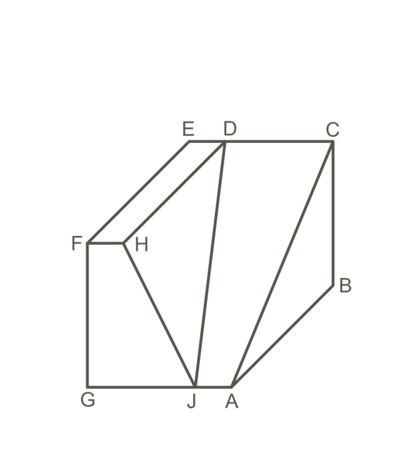
For the cavalier oblique drawing of the cut block shown in Figure P3-1, which edges are
scalable (i.e. directly measurable)?
1. BC & AC
2. EF & DJ
3. FH & HJ
4. GJ & DJ
5. All of the previous
6. None of the previous
FH & HJ
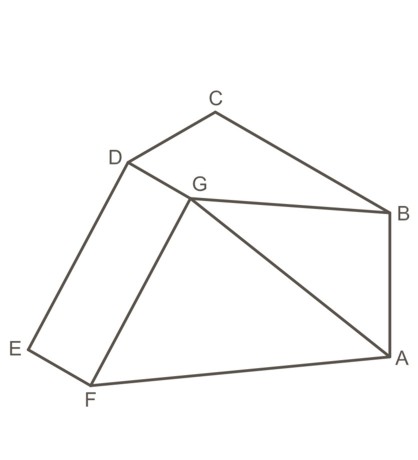
For the isometric drawing of the cut block shown in Figure P3-2, which edges are
scalable (i.e. directly measurable)?
1. BG
2. AG
3. AF
4. DE
5. All of the previous
6. None of the previous
6. None of the previous
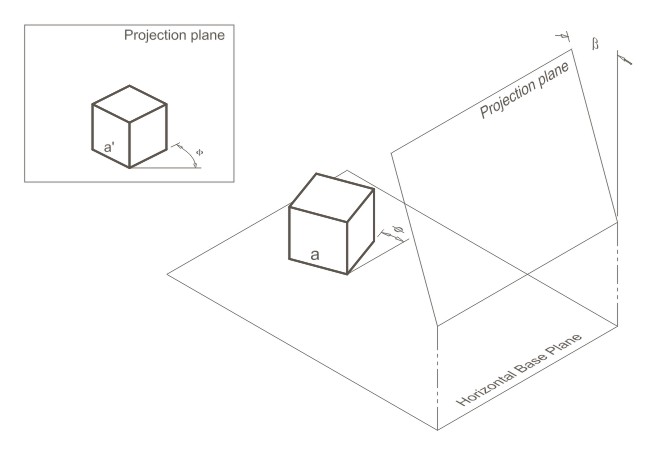
Referring to Figure P3-3, if the sight lines are parallel to each other and also
perpendicular to the infinite projection plane, beta = 15˚, and phi = 45˚, what is the type of
projection of the block that will appear on the projection plane?
1. One-point perspective
2. Two-point perspective
3. Trimetric
4. Isometric
5. Dimetric
6. Cabinet oblique
7. Cavalier oblique
8. General oblique
9. None of the previous
Dimetric
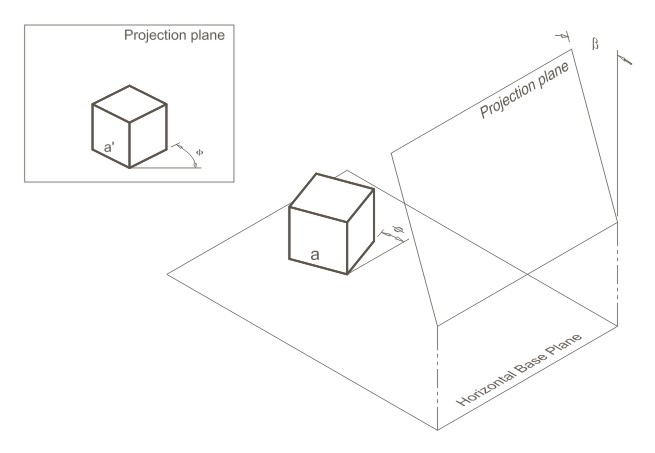
Referring to Figure P3-3, if the sight lines are perpendicular to the infinite projection
plane, beta = 30˚ and phi = 20˚ initially, which of the following is true of the ratio between the
projected length a' and the actual length a as phi is increased to 70˚?
1. Increases
2. Decreases
3. Does not change
4. Cannot determine without additional information
Increases
11. A two-point perspective has two principal axes parallel to the projection plane.
False
Two-point perspective and oblique projections have the same number of principal axes
inclined to the projection plane.
False
In a perspective projection, if the projection plane is located in front of the object, the
projected image will be smaller than the object.
True
When drawn correctly, it is not necessary to erase construction lines.
True
When sketching a straight line, it is important to keep your eye on the pencil as it moves.
False
The most popular lead grade is:
H
F
2H
HB
B
HB
Which line type is drawn more thickly than the others?
1. Construction
2. Continuous
3. Hidden
4. Center
Continuous
9. Trammels can be used for which of the following purposes?
1. Circle construction
2. Proportioning the features of a sketch
3. Transferring dimensions
4. All of the above
5. None of the above
All of the above
BIM is enabled by object-based parametric modeling.
True
RFI stands for
Request for Information
In which AEC business method does the owner contract directly with the design-build
team?
1. Design-Bid-Build (DBB)
2. Design-Build (DB)
3. Construction Management at Risk (CM@R)
4. Integrated Project Delivery (IPD)
Design-build
In the past 50 years, which of the following is not a reason for increased efficiencies in
manufacturing?
1. Automation
2. Use of information systems
3. Better supply chain management
4. Improved collaboration tools
5. All of the above
6. None of the above
None of the above
2D CAD is still common in the construction industry.
True
In BIM, parametric rules do not automatically modify the associated geometries of these
objects
False
In a CAD system, only one layer can be displayed at a time
False
The essential difference between a one and two-point perspective projection is the number of
principal axes parallel to the projection plane.
T
Two-point-perspective and oblique projections have the same number of principal axes
inclined to the projection plane.
False
In parametric solid modeling, the base feature is the feature created directly on the x-y
coordinate plane
F
Edges that are parallel on an object always appear parallel in an axonometric view of the
object.
T
In trimetric drawings, the angles of the principal axes may be chosen independently from the
relative scales along them.
F
If the projection plane is offset (translated) to a new parallel position, an axonometric
projection of an object onto the projection plane will be identical in scale to the previous one.
T
All of the common solid primitives can all be created by sweeping a closed profile.
T
A constructive solid geometry (CSG) solid modeler stores the boundaries of a solid in the
database.
F
. Assembly constraints are used to:
a) Combine part files to create assembly files
b) Manage the relationships between part and assembly files
c) Specify how assemblies should change as parts evolve
d) Specify the placement of parts within an assembly
d) Specify the placement of parts within an assembly
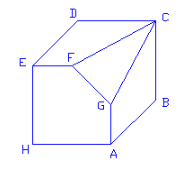
3. (See figure) Consider the Cavalier oblique drawing of a flat-faced block. If edge AB on the
drawing and the actual block are scaled 1:1 (i.e. equal in length), which other edges are
scaled 1:1?
a) HA & GC
b) FC & ED
c) FG & GC
d) EH & GF
e) All of the previous pairs
f) None of the previous pairs
d) EH & GF
Circles parallel to the projection plane will always project onto the projection plane as true
circles in the following cases:
a) Two-point-perspective
b) Cavalier-oblique
c) Dimetric projections
d) All of the previous
e) None of the previous
d) All of the previous
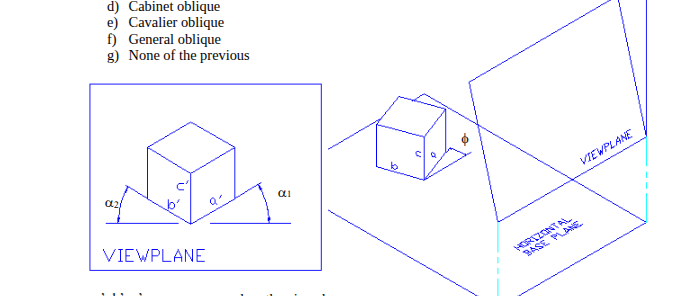
15. (See figure below) Consider the spatial setup for pictorial projection. If the sight lines are
parallel to each other and not perpendicular to the viewplane, beta = 0˚, and phi = 10˚, what is
the type of projection of the block that will appear on the viewplane?
a) Trimetric
b) Isometric
c) Dimetric
d) Cabinet oblique
e) Cavalier oblique
f) General oblique
g) None of the previous
g) None of the previous
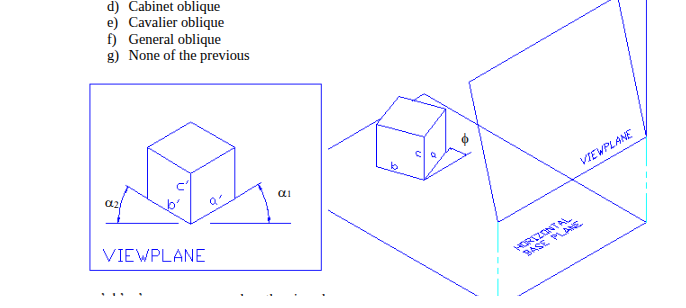
6. (See both figures above) If the sight lines are perpendicular to the viewplane, beta = 40˚, and
phi = 35˚ initially, which of the following is true about the scaling variables s1 and s2
relating object edge lengths (projected/actual – see formulas) as phi is increased from 35˚ to
55˚?
a) s1 will decrease and s2 will increase
b) s1 will decrease and s2 will decrease
c) s1 will increase and s2 will decrease
d) s1 will increase and s2 will increase
e) one cannot make a judgment on the previous conditions 1–4 due to insufficient
information
a) s1 will decrease and s2 will increase
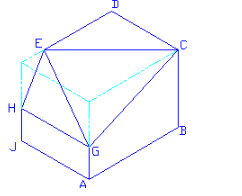
(See figure) Consider the isometric pictorial view of a flat-faced block. If edge JA on the
drawing and the actual block are scaled 1:1 (i.e., equal in length), which other edge is scaled
1:1?
a) HE
b) EG
c) GC
d) EC
e) all of the previous
f) none of the previous
f) none of the previous
18. The category of projections termed "axonometric" includes
a) Orthographic drawings of all sorts
b) All orthographic pictorials
c) Trimetric and oblique
d) Trimetric, oblique and perspective
e) Oblique and perspective
f) (None of the previous
b) All orthographic pictorials
9. Which of the following is not a Boolean operation?
a) Union or Join
b) Extrusion
c) Intersection
d) Subtraction or Difference
b) Extrusion
The term wireframe refers to:
a) A type of 3D model
b) A type of 3D display
c) A modeling kernel
d) A prototyping method
e) a and b
f) c and d
e) a and b
Boundary representation (B-rep) solid modelers include the following characteristics:
a) Primitives stored in database
b) Employs a tree structure
c) Vertex information stored in database
d) Surface boundaries defined in database
e) a and b
f) c and d
f) c and d