L1: Homeostasis and Integration: Case of Thermoregulation
 Call Kai
 Learn
Learn Practice Test
 Spaced Repetition
 Match
Match Flashcards
 Knowt Play
1/31

There's no tags or description
Looks like no tags are added yet.
Name | Mastery | Learn | Test | Matching | Spaced | Call with Kai | Chat |
|---|
No analytics yet
Send a link to your students to track their progress
32 Terms
Homeostasis purpose
Maintenance of a constant (normal) internal environment
Coordinated responses of organs/systems that automatically compensate for environmental changes
Coordinate response=
more than 1 system
Homeostasis (main controls) includes :
body temperature
blood pressure
O2/CO2 levels
How do mammals and birds maintain body
They are homeotherms
warm-blooded animals maintain body temperature within narrow range
low and high temperature NOT tolerated
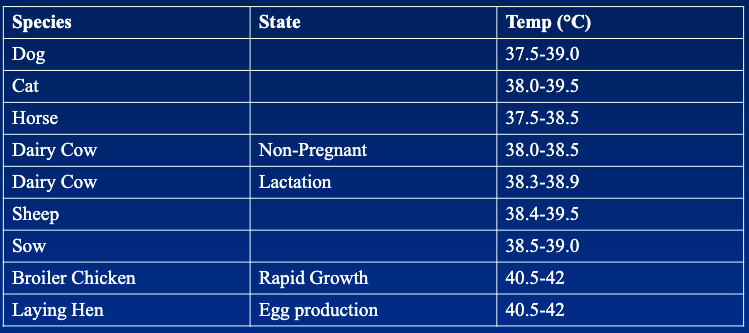
Core body temperature characteristics
protects vital organs
measured by rectal insertion of thermometer
influenced by environment, exercise, metabolism
*the lower temps. as you get more superficial help to protect the core body. As external temp. increase, the core temp. is maintained while the outer layers increase in temp

Thermoneutral zone
the ambient temperature at which no adjustment is needed
no additional energy required to maintain body temperature=perfect husbandry conditions

Critical temperatures (hot or cold)
energy required to maintain homeothermic condition (produce [cold stress] or actively dissipate heat [heat stress])
metabolic rate is used to maintain body temp. during cold stress
![<p>energy required to maintain homeothermic condition (produce [cold stress] or actively dissipate heat [heat stress])</p><ul><li><p>metabolic rate is used to maintain body temp. during cold stress</p></li></ul><p></p>](https://assets.knowt.com/user-attachments/bf22161e-4eb8-457f-9155-8275b9d9a1c6.png)
Hyperthermia (heat stress) causes:
generally fatal
cells cannot function (enzymes and proteins denatured)
during a fever, immune system increases body temp. to fight bacteria

Hypothermia (cold stress) causes:
cells can survive freezing so we can sustain a wider ranger of temps. than heat, but blood circulation and respiration fail = death

How does the balance between heat production and heat loss in mammals and birds occur:
mainly from body production - endothermics (not energy efficient)
metabolism (main factor) - conversion of nutrients to heat (energy), mainly in heart liver, kidneys and brain
growth and production (body factory)
exercise: about 80% of energy produced is heat
How is heat transported in the blood released into the environment
radiation
conduction
convection
evaporation/condensation
How is extra-heat produced in the body?
Muscle activity: exposure to cold → shivering
rhythmic (15/sec) involuntary muscle contraction
antagonistic muscles contract simultaneously
nervous input
no exercise = 100% energy goes to heat production
Non-shivering thermogenesis: ↑ metabolism
sympathetic nervous system results in secretion of catecholamines (adrenalin) = ↑ metabolism (calorigenic) especially from brown fat
thyroid hormones → ↑ metabolism
more sustained prolong response
How is extra-heat lost?
under normal conditions, metabolic heat is removed from the core by the blood through the skin by heading towards the dermis
insulation property of the skin inversely proportional to the blood flow
body can’t generate cold, so heat is lost
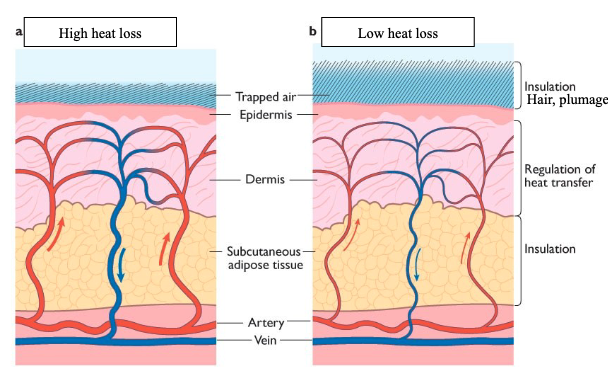
Mechanisms of heat transport
evaporation (most optimal in losing heat)
Gradient physical laws = transfer from high to low
radiation
conduction
convection

Radiation
electromagnetic radiation is emitted and absorbed; relative to the surface and temperature of the object/animal
Conduction
transfer through contact; depends on the conductivity (inverse of insulation). Animal → ground
Convection
transfer via moving air or water
Evaporation
very efficient, requires energy to break water molecules apart
through skin and airways
Methods of evaporation
passive evaporation: normal water loss
sweating: active process under sympathetic nervous system. Also results in loss of ions
panting: rapid shallow breathing (not in horses or pigs); as you breath in the air passes the nose and trachea and collects humidity, releasing air with water vapour
bathing: water absorb energy before evaporating
Thermoregulation: System components
sensor (sensory input) + integration + effectors (motor output) = reflex = automatic
thermoreceptors = nerve cells
involves participation of numerous physiological systems
voluntary component
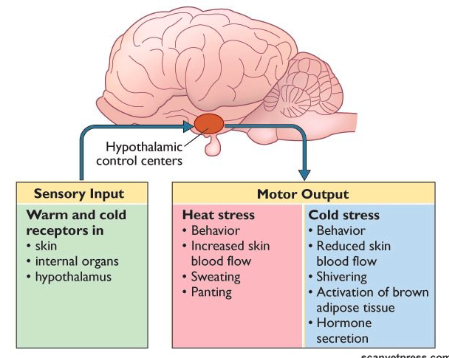
Integration center=
Hypothalamus
information compared to internal reference set points
contro center
Effectors
neurons connected to muscle (somatic) for shivering
sympathetic nervous system for blood flow, sweat gland and metabolism
hormones: hypothalamopituitary axis
Voluntary component
hypothalamus connected to the cortex = exchange of information
change of behavioural response = cognitive behaviour; ex. putting jacket on
Components which respond to heat
Heat receptors:
In the skin (below epidermis), in the body core (especially hypothalamus - sensitivity of 0.1°C), blood vessels, viscera
Information transferred through warm sensory fibres
Hypothalamus:
activation of the heat-loss centre (anterior)
Effectors:
Sympathetic vasoconstriction fibres slow down = vasodilatation; helps body cool down by sending blood to skin
Sympathetic activity increase for evaporative heat loss: sweating, panting
Reduction of physical activity
Behavioural response: increased exposure area to air, seeking shade, wind

Sensitivity to heat in different animals
Depends on the animal and the external conditions (humidity level)
Cattle and sheep very good
Pigs very bad = little sweat, small mouth for panting (transport at night preferred)
In birds: air sac (extension to the lung) deep in body cavity = ventilation helps cooling
Components which respond to cold
Cold receptors:
In the skin (below epidermis). In the body core (hypothalamus, blood vessels, viscera) Information transferred through cold sensory fibres. Much more numerous than warm fibres
Hypothalamus
activation of heat-producing centre (posterior)
Effectors
Reduction of heat loss: Sympathetic vasoconstriction fibres fire; Pili muscles from hair follicle contract; “Curl-up” position
Production of heat: Muscular contraction (shivering) by somatic motor system; Sympathetic and hormonal activity ↑ (catecholamines, thyroid hormones) = metabolism ↑ (especially in brown fat)

Adaptation mechanism to heat
prolonged exposure to heat = lots of sweat thus loss of ions. Increase in aldosterone (hormone) stimulates reabsorption of Na+ and Cl- from sweat glands
shedding
Adaptation mechanisms to cold
change of fur coat, increase in insulation properties (subcutaneous fat)
hibernation: voluntary decrease in core body temperature (asleep), followed by rapid raise (awake)
Pathology and examples
dysfunction of the thermoregulation system
fever
hyperthermia
hypothermia
Characteristics of a fever
Occurs by “resetting” hypothalamic thermostat to higher level
Response is equivalent to a decrease in temperature
Caused by pyrogens released during infection and tissue damage
Characteristics of hyperthermia
Happens when temperature exceeds the regulating capability. Heat production exceeds heat loss. Convulsions, nausea, loss of consciousness, death.
Excessive exercise, exposure to high temperatures
Characteristics of hypothermia
Heat loss exceeds heat production capability→ Slow nervous activity, muscular failure (cardiac, pulmonary), death
Critical with newborns