PSY 340 - EXAM 1
 Call Kai
 Learn
Learn Practice Test
 Spaced Repetition
 Match
Match Flashcards
 Knowt Play
1/93

There's no tags or description
Looks like no tags are added yet.
Name | Mastery | Learn | Test | Matching | Spaced | Call with Kai | Chat |
|---|
No analytics yet
Send a link to your students to track their progress
94 Terms
Themes of Class
Perception happens in the brain
The mind is the brain (also called monism)
Brains differ from each other
Maybe it’s biology
Biological Explanations of Behavior (Physiological)
links behavior to body/brain activity
Biological Explanations of Behavior (Functional)
purpose of behavior (why it evolved)
Biological Explanations of Behavior (Ontogenetic)
development of behavior across lifespan
Biological Explanations of Behavior (Evolutionary)
evolutionary history of behavior
Ethical Issues of Animals in Research (Minimalists)
some animal research is acceptable, but use IACUC and Replace, Reduce, Refine (Responsibility)
Neurons
receive and transmit information to other
Glia
Hold neurons in place
Supply neurons
Insulate neurons
Destroy pathogens
Modify neural function
Presynaptic terminal
release neurotransmitters
Efferent neuron
carries information away from the structure (motor)
Afferent neuron
brings information into a structure (sensory)
Intrinsic neuron
stays within a structure
Types of Glia (Astrocytes)
synchronize activity
modifies transmission
responds to blood flow changes
Types of Glia (Microglia)
removes waste & pathogens
Types of Glia (Oligodendrocytes & Schwann cells)
myelin sheaths for axons in CNS and PNS
Types of Glia (Radial Glia)
guide migration of neurons
Blood Brain Barrier
tight endothelial cells
blocks toxins
allows small uncharged molecules to pass (BUT active transport brings glucose, hormones, and amino acids through)
Thiamine (vitamin B1)
prolonged deficiency can lead to death of neurons and Korsokoff’s Syndrome (severe memory impairments)
Phases of Neural Activity
1. Resting Potential
2. Action Potential
3. Refractory Period
Resting Potential
the stable, negatively charged electrical state of a cell's membrane when it is not stimulated or undergoing activity
-70mV (inside is negative)
Forces acting on ions: electrical and [ ] gradient
Sodium-potassium pump (pumps 3Na+ out, K+ in, and requires energy)
![<p>the stable, negatively charged electrical state of a cell's membrane when it is not stimulated or undergoing activity</p><p>-70mV (inside is negative) </p><p>Forces acting on ions: electrical and [ ] gradient </p><p>Sodium-potassium pump (pumps 3Na+ out, K+ in, and requires energy) </p>](https://knowt-user-attachments.s3.amazonaws.com/e8eebf4e-d79c-43d6-9ff4-5527d52c220c.jpg)
Action Potential
a rapid electrical signal that travels down a neuron's axon to communicate with other cells, including neurons, muscles, and the heart
Stimulus —> depolarization
Voltage-gated Na+ channels open & Na+ rush in
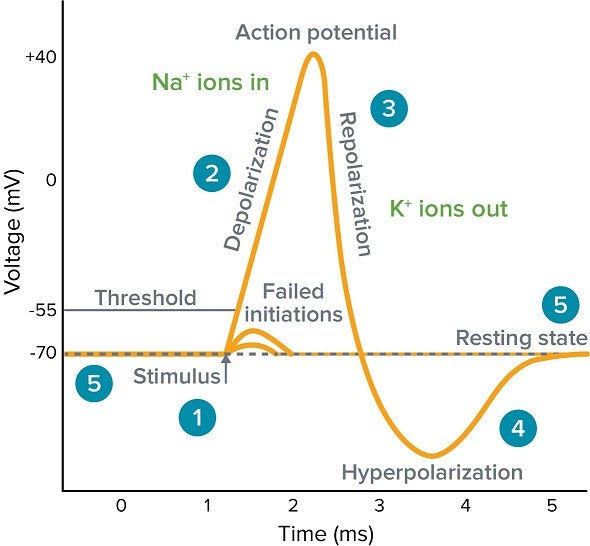
Propagation
begins at axon hillock
AP regenerates at each section of axon
cannot travel backwards bc previous segment is in refractory period
Myelin & Saltatory Conduction
Occurs as action potentials jump from node to node due to the Myelin
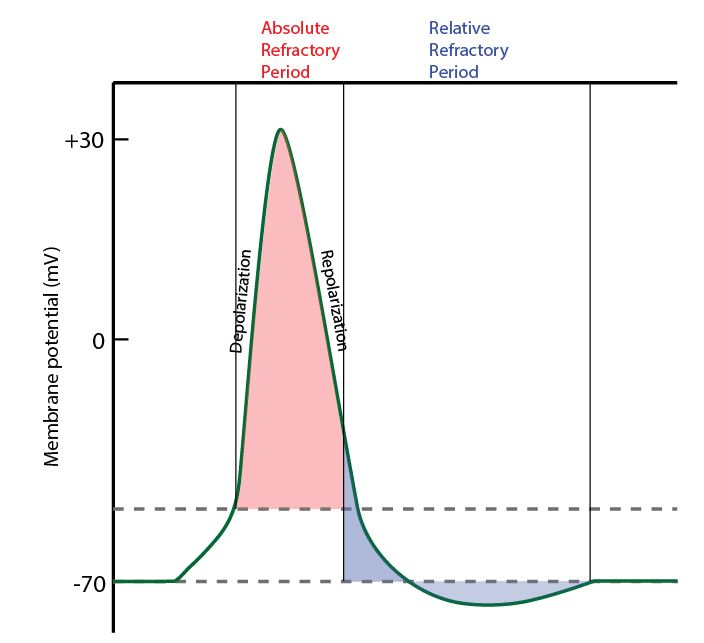
Refractory Period
a temporary state of unresponsiveness that occurs after a cell or tissue has been stimulated
Absolute (~1ms) —> no AP possible
Relative (2-4ms) —> strong stimulus required
Synapses
specialized junction between two neurons or between a neuron and a muscle or gland cell
Reflex Arc
the neural pathway responsible for rapid, involuntary responses to stimuli
Reflex Arc (Sensory Neuron)
Converts the stimulus information into AP
Reflex Arc (Interneuron)
relays signals within CNS
Reflex Arc (Motor Neuron)
sends commands to effector (muscles, glands)
Sherrington
discovered that reflexes are slower than axon conduction speed (means that there’s a synapse)
Synaptic Delay
time between sensory input and motor output —> extra delay due to chemical transmission
Temporal summation
repeated stimuli in rapid succession —> combined effects
Spatial summation
multiple presynaptic neurons firing at the same time —> combined
Graded Potentials (discovered by Eccles)
a short-distance, temporary, and localized change in a cell's membrane potential, with its magnitude varying directly with stimulus strength
Excitatory Post-Synaptic Potentials (EPSP)
excitatory depolarization that moves membrane potential closer to threshold
EPSPs summate may trigger action potential
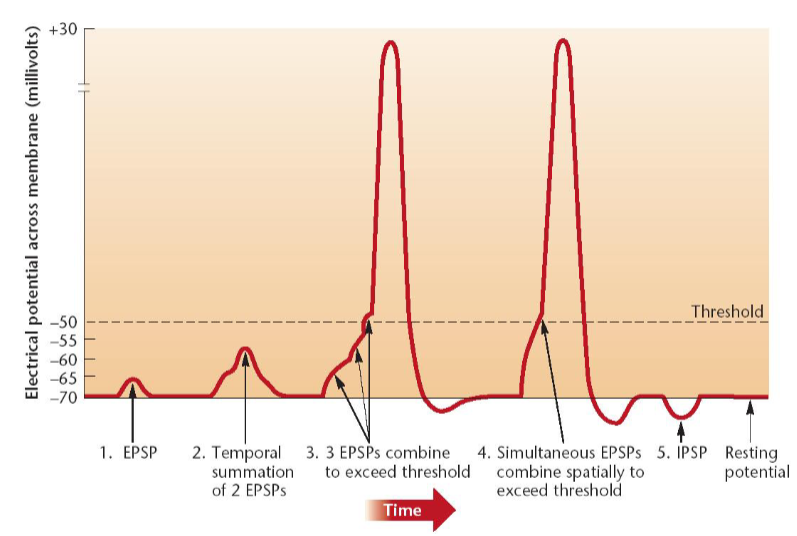
Inhibitory Post-Synaptic Potentials (IPSP)
inhibitory hyperpolarization that moves membrane potential farther from threshold
makes firing LESS likely to happen
Inhibitory Synapses
allows coordinated movement EX: when biceps fire, triceps relax
IPSP = graded hyperpolarization
Spontaneous Firing Rate
neurons fire at a baseline rate even without input
increase EPSPs —> increase firing
increase IPSPs —> decrease firing
Neuronal Connectivity
web of synapses between neurons in the brain that underlies all neural function and behavior, such as thought, emotion, and movement
T. R. Elliot
suggested that chemicals on organs mimic nerve stimulation
was initially ignored due to Sherrington’s influence
Otto Loewi
discovered neurotransmitters (true of most synapses)
Experimental Design:
Two frog hearts were isolated One heart (Heart A) still had its vagus nerve intact, the other (Heart B) had its vagus nerve removed.
Heart A was placed in a chamber filled with nutrient solution. The vagus nerve of Heart A was electrically stimulated, causing it to slow down.
The nutrient solution from Heart A was then transferred to the chamber containing Heart B. Heart B also slowed down, even though its vagus nerve had been removed
Anatomy of a Synapse
Vesicles hold NT
Presynaptic terminal releases NT
Synaptic clef between neurons
Postsynaptic terminal receives NT
Neurotransmitters
Chemicals produced and released by one neuron that affect another neuron
EX:
Amino acids: GABA (inhibitory), Glutamate (excitatory), Acetylcholine (ACH)
Neuropeptides: Endorphins, Substance P
Monoamines: Serotonin, Dopamine, Epinephrine, Norepinephrine
Purines: ATP, adenosine
Gases: nitric oxide
Synthesis of Neurotransmitter
Neurons synthesize neurotransmitters from substances in the diet.
EX:
Choline —> ACH (Peanuts, meat, fish, milk, broccoli, cabbage)
Phenylalanine —> Tyrosine —> Dopamine —> NE → Epinephrine
Tryptophan —> Serotonin (Turkey, bananas,
eggs)
Phenylketonuria
genetic disorder that affects the body's ability to break down the amino acid phenylalanine
Exocytosis
AP arrives
Voltage-gated Ca2+ channel opens
Ca2+ causes vesicles to fuse w membrane
NT diffuses across synapse
NT binds to receptors
Ionotropic Receptor
Fast, short duration
Open ion channels directly
Used for quick actions
NT EX: Glutamate, GABA, ACh
Metabotropic Receptor
Slower, long-lasting
Activate G-protein —> 2nd messenger —> widespread cell effects
NT EX: Dopamine, Serotonin
Neuropeptides
chains of amino acids produced and released by neurons that act as chemical messengers
produced in soma
require repeated stimulation to release
released from dendrites and cell body
spread widely, long-lasting effects
EX: Substance P, endorphins
Hallucinogenic Drugs (EX: LDS)
mimics serotonin
activate receptors at wrong time —> sensory distortions
Opiates (EX: Heroin, Morphine)
binds to opioid receptors
same receptors endorphins naturally binds to
reduce pain, increase reward
Stimulants
Amphetamine, methamphetamine, cocaine —> blocks dopamine reuptake (increase dopamine)
Ritalin, methylphenidate —> same mechanism as cocaine but controlled dosage
Inactivation of neurotransmitters
Diffuse away
Enzymatic breakdown (MOA breaks down monoamines, AChE breaks down ACh)
Reuptake into presynaptic neuron (via transporter proteins)
Negative Feedback Methods
Auto-receptors
Postsynaptic chemicals
Auto-receptors
presynaptic neuron that monitors its own NT release (negative feedback)
Postsynaptic chemical
signals back to presynaptic neuron via chemicals (NO, Anandamide, 2-AG —> marijuana enhance pathways)
Electrical Synapses
Rare and few
Gap junctions = direct ion flow
Very fast, depolarizes both cells simultaneously
Important in escape reflexes, breathing rhythms
Hormone Characteristics
released into bloodstream
long-lasting effects
some substances serve as both NTs and Hormones
Pituitary Glands
Stimulated by hypothalamus
Anterior pituitary releases: ACTH, FSH, LH, GH, prolactin, TSH
Posterior pituitary releases: oxytocin & vasopressin
CNS
brain and spinal cord
PNS
Somatic NS (voluntary muscles)
Autonomic NS (involuntary muscles)
Cranial Nerves
ANS
Sympathetic (arousing)
Parasympathetic (calming)
Enteric NS
Tract
set of axons inside CNS
Nerve
set of axons in the PNS
Ganglion
cluster of soma outside CNS
Nucleus
cluster of somas inside CNS
Lamina
layer of cell bodies (esp in cortex)
Sympathetic Nervous System
increases arousal
has a chain of ganglia outside spinal cord
Functions as single, unified system
NT: norepinephrine
Parasympathetic Nervous System
Calms body
Preganglionic axon from spinal cord —> ganglia
Postganglionic fibers from ganglia —> organs
NT: acetylcholine
Spinal Cord
Extension of brain
Gray matter = soma + dendrites
White matter = myelinated axon
Dorsal Root Ganglia
clusters of sensory neuron somas located outside spinal cord
bring sensory info INTO CNS
Hindbrain (Rhombencephalon)
Medulla
Pons
Cerebellum
Medulla
vital reflexes (breathing, heart rate, vomiting) and connects to cranial nerves
Pons
arousal, dreaming, houses RETICULAR FORAMEN and RAPHE SYSTEM (serotonin)
Cerebellum
Movement/coordination, Balance, Timing, & Attention shifting
Midbrain (Mesencephalon)
Tectum
Tegmentum
Substantia Nigra
Tectum
Superior Colliculus (visual reflex)
Inferior colliculus (auditory processing)
Tegmentum
Nuclei for cranial nerves III & IV
Part of Reticular Formation
Pathways linking to forebrain and spinal cord
Substantia Nigra
Dopamine neurons (loss of these —> Parkinson’s)
Forebrain
Cerebral Cortex
Thalamus
Hypothalamus
Amygdala
Cerebral Cortex
Main outer covering of brain
Thalamus
center of forebrain & sensory info relay station
Hypothalamus
motivated behaviors (hunger, sex, thirst, temp)
controls autonomic NS
sends signals to pituitary gland
Amygdala
Emotional processing
Subcortical Forebrain
Basal Ganglia
Basal Forebrain
Hippocampus
Basal Ganglia
Caudate nucleus —> motor control, learning, memory, and executive functions
Putamen —> motor control
Globus pallidus —> movement, habits, decision-making
Basal Forebrain
nucleus basalis —> regulates cognitive and behavioral processes
releases acetylcholine to cortex
arousal, attention, learning
Hippocampus
Between thalamus and cortex
formation of new memories
CSF
clear fluid that cushions the brain, circulates and reabsorbed by blood in subarachnoid space. Formed by choroid plexus
Blockage —> increase pressure —> cognitive impair
Cerebral Cortex Communication
via corpus callosum and anterior commissure
Occipital lobe
posterior cortex
contains primary visual cortex
damage —> cortical blindness
Parietal lobe
anterior to occipital, posterior to central sulcus
contains primary somatosensory cortex
receives info abt touch, muscle stretch, and join receptors
important for spatial processing and body awareness
Temporal lobe
lateral cortex
functions: language, face recognition, and emotion
damage —> Kluver-Bucy syndrome (emotional & behavioral abnormalities)
Frontal lobe
Precentral Gyrus (primary motor cortex, controls voluntary movement)
Prefrontal cortex (working memory, planning, decision-making, delayed-response tasks)