Lecture 23: The Eye
0.0(0)
Studied by 0 people Call Kai
 Learn
Learn Practice Test
 Spaced Repetition
 Match
Match Flashcards
 Knowt Play
Card Sorting
1/33

Earn XP
Description and Tags
Last updated 10:05 PM on 4/13/23
Name | Mastery | Learn | Test | Matching | Spaced | Call with Kai | Chat |
|---|
No analytics yet
Send a link to your students to track their progress
34 Terms
1
New cards
Cornea
clear outer covering
2
New cards
iris
controls the size of the pupil
3
New cards
pupil
hole that lets the appropriate amount of light in
4
New cards
lens
that which focuses the light on the retina
5
New cards
ciliary muscle
pulls on the lens to focus at different distances
6
New cards
sclera
outermost layer (white)
7
New cards
retina
the true sensory organ of the visual system
8
New cards
fovea
part of the retina with the greatest acuity
9
New cards
optic disk
where blood vessels and nerves leave the eye
10
New cards
What happens to the lens when you focus far away?
accommodated or unaccommodated?
accommodated or unaccommodated?
lens is thin and flat
* unaccommodated
* unaccommodated
11
New cards
What happens to the lens when you focus near?
accommodated or unaccommodated?
accommodated or unaccommodated?
lens is thick and round
* accommodated
* accommodated
12
New cards
What is myopia?
near-sightedness: occurs because lens cannot accommodate enough to focus far objects correctly (always focuses in front of retina)
13
New cards
What is hyperopia?
far-sightedness: occurs because lens cannot accommodate enough to focus near objects correctly (always focuses in back of retina)
14
New cards
What is emmetropia?
normal eyesight
15
New cards
Is it more prevalent to get hyperopia or myopia as you get older?
hyperopia
16
New cards
Where is the blind spot and what does that mean?
The blind spot is at the optic disc and its the part of the retina where all the outputs come together but no photoreceptors are present
17
New cards
Why do we not notice our own blind spot?
Because it is in a different spot in each eye so it gets filled in with normal vision
18
New cards
Where does an image land when you are focusing on it?
What is packed inside that part for fine grained processing?
What is packed inside that part for fine grained processing?
* the fovea
* photoreceptors
* photoreceptors
19
New cards
How does LASIKS correct near/far-sightedness?
By changing the curve of the cornea
20
New cards
What are the only two cells in the eye that respond to photons?
rods and cones
21
New cards
What is the process of traveling light starting with photoreceptors and ending with output cells
photoreceptors → bipolar cells → retinal ganglion cells → output cells
22
New cards
What is the job of horizontal cells?
coordinate the activity within one layer of photoreceptors
23
New cards
What happens in regards to the cells polarization when light is detected by a photoreceptor?
When are the most neurotransmitters released?
When are the least neurotransmitters released?
Why?
When are the most neurotransmitters released?
When are the least neurotransmitters released?
Why?
* the cell hyperpolarizes
* lots of neurotransmitters are released in the dark
* less neurotransmitters are released in the light
* This is because light reduces cGMP activity which closes cGMP gated Ca2+ and Na+ channels
* lots of neurotransmitters are released in the dark
* less neurotransmitters are released in the light
* This is because light reduces cGMP activity which closes cGMP gated Ca2+ and Na+ channels
24
New cards
Which ion rushes in during depolarization?
Which ion rushes out?
Which ion rushes out?
* Na+
* K+
* K+
25
New cards
Phototransduction
the absorption of a photon in the retinal that kicks off a g-protein, turning the light energy into electrical potential
* light acts on rhodopsin which starts the G protein that interacts with phosphodiesterase that halts depolarization by hydrolyzing cGMP
* light acts on rhodopsin which starts the G protein that interacts with phosphodiesterase that halts depolarization by hydrolyzing cGMP
26
New cards
What is photopigment made by?
retinal + an opsin
27
New cards
Rhodopsin
rod photopigment
28
New cards
What are cones responsive to and what are they responsible for?
Where are they?
Where are they?
They are responsive to bright light and are responsible for color vision/our ability to see fine detail
* mostly in the fovea (it only has cones, no rods)
* mostly in the fovea (it only has cones, no rods)
29
New cards
What are rods most sensitive to and what are they mainly used for?
Where can they be found?
Are they less or more numerous than cones?
Where can they be found?
Are they less or more numerous than cones?
* more sensitive to dim light and are thus mainly used for night vision
* become more numerous the further you get from the fovea
* become more numerous the further you get from the fovea
30
New cards
Do rods or cones have higher light sensitivity?
Do rods or cones have better spatial sensitivity?
Do rods or cones have better spatial sensitivity?
* rods have better light sensitivity
* cones have better spatial resolution
* cones have better spatial resolution
31
New cards
How does the inward current of a rod differ from the inward current of a cone after light stimulus?
The inward current of a rod becomes more positive and stays positive whereas the inward current of a cone depolarizes super quickly and the proceeds to hyper-polarize quickly after
32
New cards
Around what wavelength do rods absorb the most light at?
Around 500 nm
33
New cards
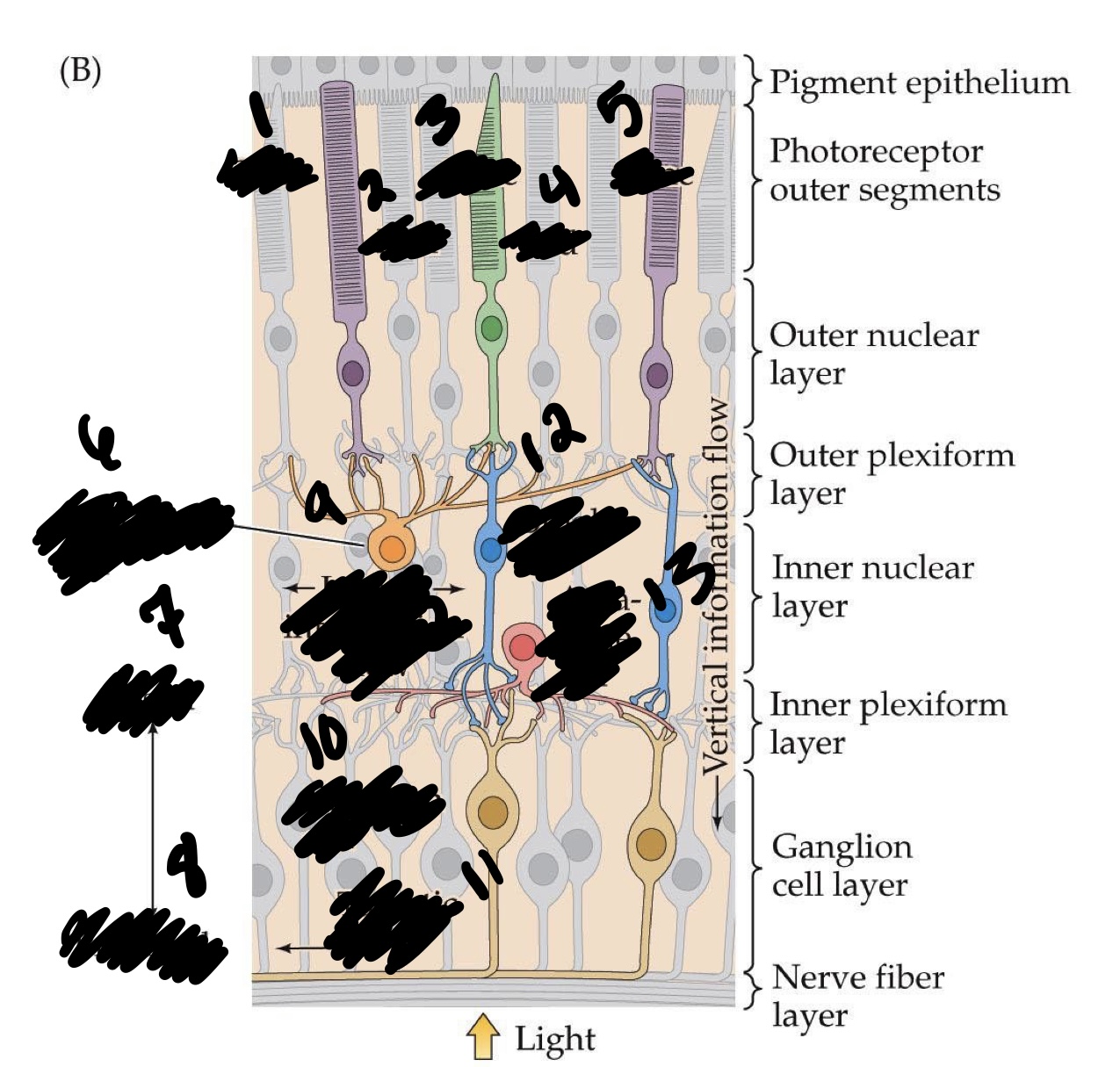
label
1. cone
2. rod
3. cone
4. rod
5. cone
6. horizontal cell
7. distal
8. proximal
9. lateral information flow
10. ganglion cell
11. to optic nerve
12. bipolar cell
13. amacrine cell
34
New cards
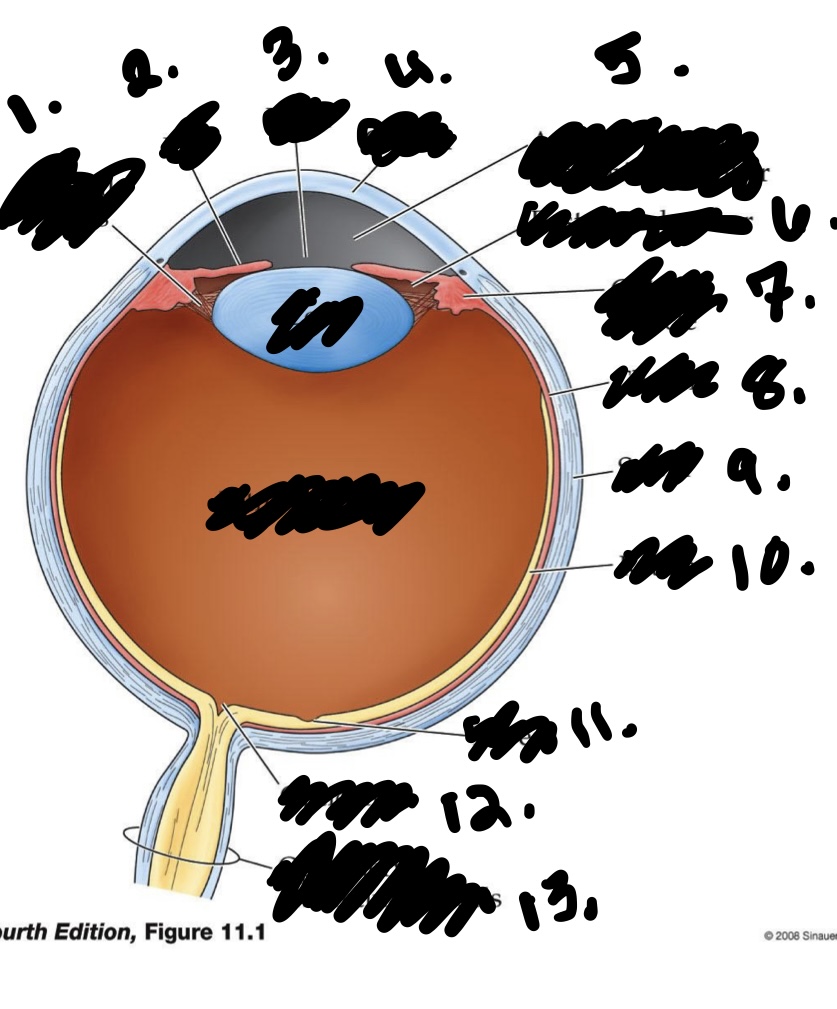
1. zonule fibers
2. iris
3. pupil
4. cornea
5. aqueous humor in anterior chamber
6. posterior chamber
7. ciliary muscle
8. choroid
9. sclera
10. retina
11. fovea
12. optic disk
13. optic nerve and retinal vessels
14. (big blue) = lens
15. (big brown) vitreous humor