Enzyme Regulation, Allostery and Inhibition
 Call Kai
 Learn
Learn Practice Test
 Spaced Repetition
 Match
Match Flashcards
 Knowt Play
1/107

There's no tags or description
Looks like no tags are added yet.
Name | Mastery | Learn | Test | Matching | Spaced | Call with Kai | Chat |
|---|
No analytics yet
Send a link to your students to track their progress
108 Terms
Do enzymes alter the reaction rate or the reaction equilibrium
reaction rate
regulated enzyme
enzyme with catalytic activity that increases or decreases in response to changing conditions in the cell or organism
substrate
Many enzymes have a Km that is near to the concentration of their what that
is found in cells
regulated enzymes are modulated in a variety of ways:
– reversible what modification
covalent
proteins
regulated enzymes are modulated in a variety of ways:
– binding of separate regulatory what
cleavage
regulated enzymes are modulated in a variety of ways:
– removal of peptide segments by proteolytic what
allostery
regulation through reversible, noncovalent binding of small compounds called allosteric modulators or allosteric effectors
phosphorylation
one of the most common types of covalent (but reversible) modification of proteins
and enzymes is what
protein kinases
catalyze the attachment of phosphoryl groups to specific amino acid residues
protein kinases catalyze the attachment of phosphoryl groups to specific amino acid residues
- which in eukaryotes
Ser and Thr, or Tyr
protein kinases catalyze the attachment of phosphoryl groups to specific amino acid residues
- which in prokaryotes
His
protein phosphatases
remove phosphoryl groups from proteins
phosphate
These are the three amino acids that can be modified by addition of a what group in eukaryotes, when proteins are ‘phosphorylated
adrenaline
Much of our knowledge of signal transduction came from 20th C studies on the role of what on glycogen breakdown during the ‘fight or flight’ response
glycogen phosphorylase
the enzyme that cleaves glucose from the glycogen chain in the form of glucose-1-phosphate
phosphorylation
The activity of glycogen phosphorylase is controlled by what
glycogen phosphorylase is what when phosphorylase kinase puts a phosphate on it
activated
Conformational
Phosphorylation in Glycogen Phosphorylase Causes a what Change
active
Phosphorylation in Glycogen Phosphorylase Causes a Conformational Change, conformational change shifts enzyme into a more catalytically what state
Sites
Some Enzymes are Phosphorylated at Multiple what
phosphorylase kinase becomes active when it is phosphorylated by protein kinase what
A
subunit
protein kinase A becomes active when it is released from its regulatory what
Dissociation
Regulation of Enzyme Activity by what of a Regulatory Subunit
protein kinase A
? catalytic subunits (constitutively active)
? regulatory subunits (keep catalytical subunit off)
2,2
target
cAMP binding to the regulatory subunits causes the what to change conformational and release the catalytic subunits which are free to act on what proteins
zymogen
inactive precursor that is cleaved to form an active protease enzyme
proprotein/proenzyme
precursors that are cleaved to form other proteins
trypsin
for the protease chymotrypsin to be activated it is first cleaved by the protease what
itself
for the protease chymotrypsin to be activated it is first cleaved by the protease trypsin, then chymotrypsin is further processed by who
cascade
a process where the same thing happens several times in a row
amplification
cascade can allow ‘what’ – a large response to a small initial signal
Blood
A Cascade of Proteolytically Activated Zymogens Leads to what Coagulation
collagen
Blood clots occur when what is exposed to blood
fibrin
Blood clot are an aggregation of specialized cell fragments called platelets that is cross-
linked and stabilized by fibers consisting of the protein what
fibrinogen
Fibrin is derived from the soluble zymogen what
Activation
Two Regulatory Cascades Lead to Fibrinogen what
proteolysis
The pathways converge on the step in which inactive prothrombin is converted t oactive thrombin by what

serine

The active what protease thrombin then cleaves fibrinogen into fibrin
Allosteric Enzymes Are Usually Regulated by what of the Pathway They Act in or Control
Products
regulated
The activity of many pathways is what to meet the needs of the cell
However, instead of regulating the activity of all the enzymes, it makes more sense to regulate the activity of which enzyme in the pathway, or the enzyme that controls which committed/irreversible step in pathway
first

In this pathway, all the reactions are what, so once A → B, the final product F will be made.
irreversible
committed
In this pathway, all the reactions are irreversible, so once A → B, the final product F will be made. Therefore, the first step is the what step in the pathway
feedback

In this example, the amount of product F is regulated by what inhibition - the final product F feeds back to inhibit the first enzyme in the pathway
regulatory

The pathway product F inhibits enzyme e1, which controls the committed step in the pathway, by binding to a what site on the enzyme that is distinct from the active site
allosteric
The pathway product F inhibits enzyme e1, which controls the committed step in the pathway, by binding to a regulatory site on the enzyme that is distinct from the active site
This site is called the what site
allosteric
Enzyme e1 is therefore an what enzyme or an enzyme that shows what regulation
committed
allosteric enzymes’ often catalyze which step of pathways
steps
‘Michaelis–Menten’ enzymes facilitate the remaining what
Allosteric enzymes may be inhibited, stimulated, or both, by what, regulatory molecules that convey the metabolic needs of the cell
small
behavior
Two models, the concerted model and the sequential model, explain the what of allosteric enzymes
proteins
In these models (the concerted model and the sequential model), binding of substrate or inhibitor to one protein, alters the conformation of other what in the complex
Features of which model for allosteric regulation:
– the enzyme exists in two different structures, T (tense) and R (relaxed)
concerted
Features of the concerted model for allosteric regulation:
– the enzyme exists in two different structures, T (tense) and R (relaxed)
– the R state is more or less enzymatically active than the T state
more
same
Features of the concerted model for allosteric regulation:
all active sites must be in which state
the binding of substrate to one active site shifts all the other active sites into which state (a concerted conformational change
R
The sequential model is basically the same as the concerted model but proposes that subunits undergo sequential changes in conformation to the active which state (not all at once
R
Molecules
Regulator what Alter the T ⇌ R Equilibrium
Inhibitors stabilize which state
T
Activators stabilize which state
R
Allosteric regulation by substrates
homotropic
Allosteric regulation by substances that are not substrates
heterotropic
regulation in which the enzyme modulator is a small molecule that is not the substrate
heterotropic
modulator
Binding of the allosteric what (M) to the allosteric site shifts the enzyme into an active conformation (R) more likely to bind substrate or carry out catalysis
substrate
The reaction velocity of allosteric enzymes displays a sigmoidal (s shape) relationship to
what concentration

hyperbolic
The reaction velocity of allosteric enzymes displays a sigmoidal (s shape) relationship to
substrate concentration compared to Michaelis-Menten enzymes which are more what in their kinetic
An allosteric activator (+) may cause the velocity vs substrate curve to shift where and become more hyperbolic like an enzyme following Michaelis-Menten kinetic

left
An allosteric inhibitor (-) may cause the velocity vs substrate curve to shift to the what and become more flat
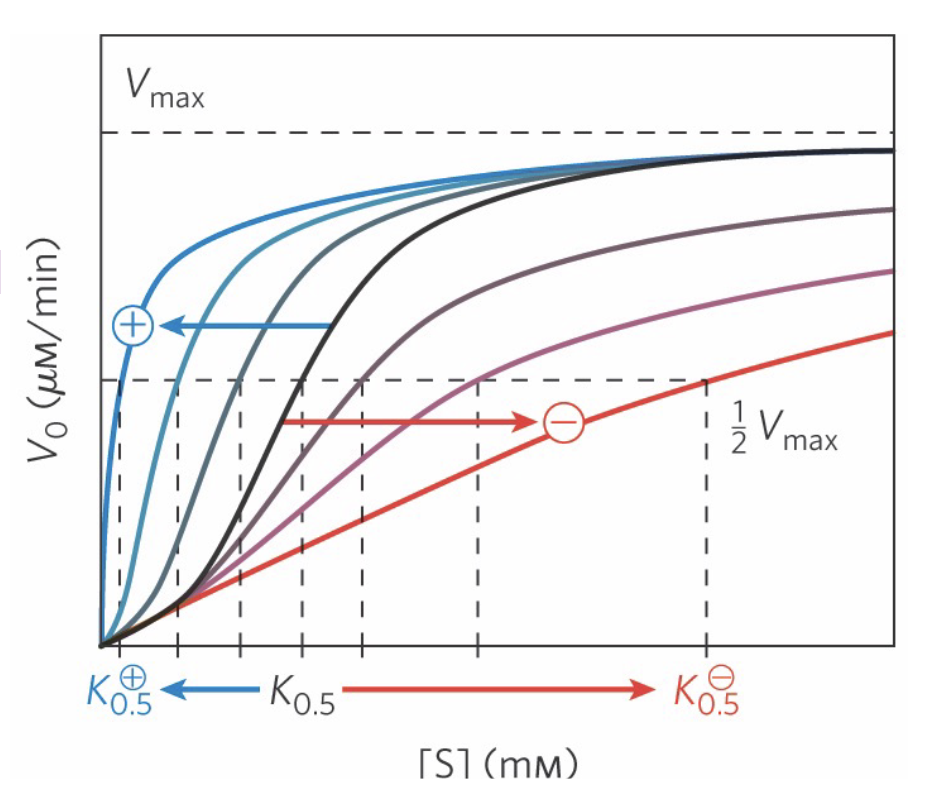
right
With allosteric inhibitors and activators, which is altered
Km
modulators
Allosteric what of enzyme activity allow the activity of pathways to be fine-tuned to the needs of the cell
aspartate transcarbamoylase (ATCase)
catalyzes the formation of carbamoylaspartate, an early step in pyrimidine biosynthesis
The nucleotide CTP is a what allosteric regulator of ATCase
negative
The nucleotide ATP is a what allosteric regulator of ATCase
positive
inhibited
Enzymes can be what so their catalytic activity is reduced or abolished
permanent
Inhibition can be reversible or what
inhibitors
~50% of prescribed drugs are what
Three common types of reversible inhibition
The inhibitor is structurally similar to the substrate and binds to the active site of the enzyme, preventing the actual substrate from binding
Competitive inhibition
Three common types of reversible inhibition
The inhibitor binds to only the enzyme–substrate complex (not to the free enzyme
Uncompetitive inhibition
Three common types of reversible inhibition
The inhibitor binds to a site different from the active site (does not compete with substrate) on either the enzyme (this is negative allostery) or enzyme–substrate complex
Noncompetitive inhibition
Inhibitor binds in active site
Competitive
Inhibitor does not bind in active site
Uncompetitive & Noncompetitive
inhibitor looks like substrate and binds enzyme at active site and competes with the normal substrate for binding
competitive
In presence of the inhibitor, Vmax of the enzyme is unchanged because the inhibition
can be overcome by doing what to the substrate (the substrate can ‘outcompete’
adding more
The KM is what in the presence of an inhibitor because it takes more substrate
to reach ½ VMAX
increased
As more competitive inhibitor is added, the rate of the reaction does what
decreases
But at each concentration of competitive inhibitor, if what substrate is added, the reaction approaches uninhibited VMA
more
As more competitive inhibitor is added, the KM what
increases
With competitive inhibitors does Vmax change
No
inhibitor binds the enzyme-substrate complex only
uncompetitive
The enzyme–substrate–inhibitor (ESI) complex does or does not form product
does not
uncompetitive
Consequently, Vmax is lower in the presence of inhibitor (you can’t add enough substrate to overcome which inhibition)
The KM is also what in uncompetive inhibition (for complicated reasons)
lower
As more uncompetitive inhibitor is added, the rate of the reaction does what
decreases
inhibitor can bind to free enzyme or to the enzyme–substrate complex, but not at the active site
noncompetitive
Vmax is what in the presence of a noncompetitive inhibitor. Noncompetitive
inhibition cannot be overcome by increasing substrate concentration (because the
substrate and inhibitor bind different sites
lower
bind
KM is not changed by the presence of a noncompetitive inhibitor because the substrate can still what its site.
As more noncompetitive inhibitor is added, the rate of the reaction does what
decreases
if more substrate is added, the reaction never approaches uninhibited VMAX.
VMAX is lower
uncompetitive
if more substrate is added, the reaction never approaches uninhibited VMAX
noncompetitive
Which inhibitors bind very tightly to enzymes and permanently reduce or abolish enzyme activity
Irreversible