Biological membranes
 Studied by 0 people
 Call Kai
 Learn
Learn Practice Test
 Spaced Repetition
 Match
Match Flashcards
 Knowt Play
1/37

There's no tags or description
Looks like no tags are added yet.
Name | Mastery | Learn | Test | Matching | Spaced |
|---|
No study sessions yet.
38 Terms
What is the function of membranes at the surface of cells (plasma membranes)?
- Act as a barrier between the cell and its environment
- Partially permeable so control which substances enter and leave the cell
- Allow cell recognition
- Allow cell communication (cell signalling)
What is the function of membranes within cells?
- Act as a barrier between the organelle and the cytoplasm, dividing the cell into different compartments to make different functions more efficient
- Partially permeable so control which substances enter and leave the organelle
- Form vesicles to transport substances between different areas of the cell
What is the function of membranes within organelles?
- Act as barrier between the membrane contents and the rest of the organelle
- Can be the site of chemical reactions (e.g. the inner membrane of mitochondria contain enzymes for aerobic respiration)
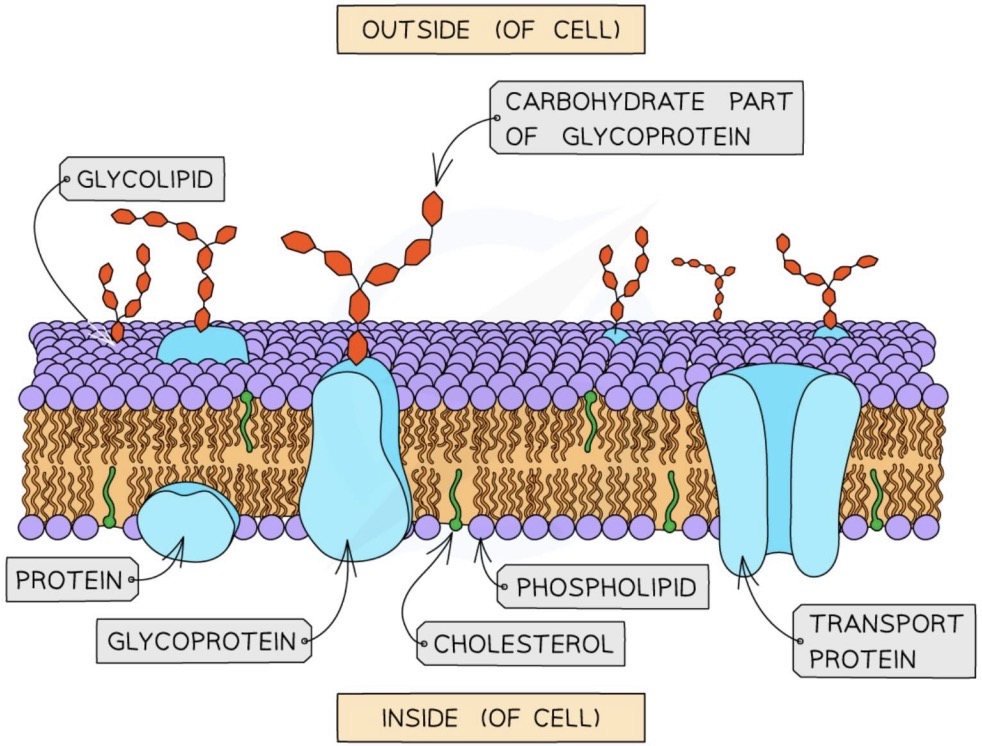
Describe the structure of cell membranes using the fluid mosaic model
- Phospholipids form a continuous bilayer with the hydrophilic heads facing outwards and the hydrophobic tails facing inwards
- The bilayer is fluid since the phospholipids are constantly moving
- Cholesterol molecules are imbedded within the bilayer and bind to the hydrophobic tails
- Intrinsic proteins are imbedded throughout the bilayer whereas extrinsic proteins are only found on one side of the bilayer
- Some proteins have a polysaccharide chain attached, forming glycoproteins
- Some lipids have a polysaccharide chain attached, forming glycolipids
What is the function of phospholipids in membrane structure?
Forms a barrier to water-soluble substances → Phospholipid molecules have a hydrophilic head and a hydrophobic tail. The molecules automatically arrange themselves into a bilayer with the heads facing out and the tails facing in. This means the centre of the bilayer is hydrophobic and does not allow water to pass through it, therefore creating a barrier to water soluble molecules.
What is the function of cholesterol in membrane structure?
Regulates membrane fluidity → At cold temperatures, cholesterol prevents the phospholipids from packing too close together and at high temperatures, cholesterol prevents the phospholipids from becoming too far apart. This maintains the optimum fluidity level.
Controls the movement of molecules into and out of the cell → Cholesterol reduces membrane permeability for polar molecules but maintains membrane permeability for non-polar molecules.
What is the function of proteins in membrane structure?
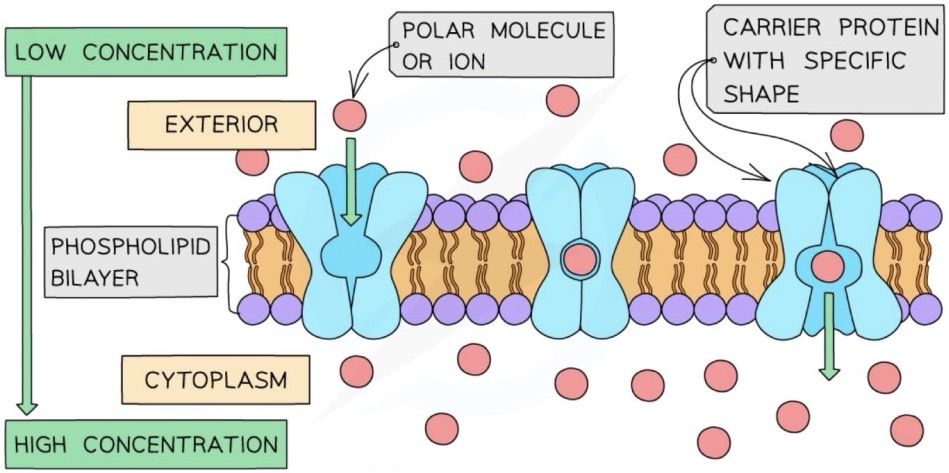
Channel proteins → Form hydrophilic channels (e.g. aquaporin) that allow the facilitated diffusion of polar molecules and ions down a concentration gradient. Different channel proteins facilitate diffusion for different polar molecules and ions.
Carrier proteins → Allow the facilitated diffusion of larger molecules (e.g. amino acids and glucose) across cell membranes down a concentration gradient. A large molecule attaches to the carrier protein and then the protein changes shape, causing the molecule to be released on the opposite side of the cell membrane.
What factors affect membrane structure and permeability?
- Temperature
- Solvents
How does temperature affect membrane structure and permeability?
- When the temperature increases, phospholipids gain more kinetic energy and thus move faster
- This causes the membrane to lose its structure, therefore increasing membrane permeability
- Additionally, channel proteins and carrier proteins denature at higher temperatures which also increases membrane permeability
How do solvents affect membrane structure and permeability?
- Many organic solvents (e.g. ethanol) are less polar than water or are not polar at all
- This dissolves phospholipids, disrupting membrane structure and increasing membrane permeability
Define diffusion
The net passive movement of particles down a concentration gradient to meet an equilibrium
What factors affect the rate of diffusion?
- Concentration gradient
- Temperature
- Surface area
- Thickness of membrane
How does concentration gradient affect the rate of diffusion?
The rate of diffusion increases when there is a greater concentration difference between 2 regions (i.e. steeper concentration gradient)
This is because the net movement of particles from the high concentration to the lower concentration will be larger
How does temperature affect the rate of diffusion?
The rate of diffusion increases at higher temperatures
This is because the particles gain more kinetic energy and therefore move faster
How does surface area affect the rate of diffusion?
The rate of diffusion increases when there is a large surface area
This is because there are more points where the particles can cross the membrane at any given time
How does thickness of membrane affect the rate of diffusion?
The rate of diffusion increases when the membrane is thinner
This is because is because the diffusion distance is shorter and so the particles have less to travel
Simple diffusion occurs when…
Small non-polar molecules (e.g. O2 and CO2) diffuse across cell membranes
Define facilitated diffusion
The net passive movement of polar molecules and ions down a concentration gradient using channel proteins or carrier proteins
Define active transport
The movement of particles across cell membranes against a concentration gradient using energy (ATP) and carrier proteins
Describe active transport across cell membranes using carrier proteins
- The molecule or ion binds to receptors in the carrier protein
- On the inside of the cell, ATP binds to the carrier protein and is hydrolysed into ADP and phosphate
- The binding of the phosphate causes the carrier protein to undergo a conformational change, opening up to the inside of the cell
- The molecule or ion is released to the inside of the cell
- The phosphate molecule is released from the carrier protein and recombines with ADP to form ATP
- The carrier protein returns to its original shape
Define bulk transport
The transport of large quantities of material across the plasma membrane
Bulk transport can happen by 2 process…
Endocytosis and exocytosis
Define endocytosis
The transport of material inside the cell using vesicles
Describe the process of endocytosis
- The plasma membrane wraps around the material
- The engulfing membrane then pinches off to form a vesicles inside the cell containing the ingested material inside
Define exocytosis
The transport of material to outside the cell using vesicles
Describe the process of exocytosis
- Material in the rough ER or smooth ER can be packaged into membrane bound vesicles
- The vesicles fuse with the cis face of the Golgi apparatus
- The material is then transported through the Golgi apparatus and repackaged into secretory vesicles formed at the trans face
- The secretory vesicles fuse with the plasma membrane and releases its contents via exocytosis
- The movement of the vesicles requires energy (ATP)
Define phagocytosis
The engulfment (‘eating’) of large quantities of solid molecules by endocytosis
Define pinocytosis
The absorption (‘drinking’) of large quantities of water by endocytosis
Define osmosis
The net movement of water molecules across a partially permeable membrane down a water potential gradient to meet an equilibrium
What is water potential?
The pressure exerted by water molecules as they collide with a membrane or container
The symbol for water potential is…
Ψ
What are the units for water potential?
Pascals (Pa) or kilopascals (kPa)
What has the highest water potential?
Pure water (0Pa)
ANIMAL CELLS
In a hypotonic solution, the net movement of water molecules is ____ the cell
The cell is at risk of ____, known as ____
Into
Bursting
Lysis
ANIMAL CELLS
In a hypertonic solution, the net movement of water molecules is ____ the cell
The cell is at risk of ____
Out of
Shrinking
PLANT CELLS
In a hypotonic solution, the net movement of water molecules is ____ the cell. The vacuole ____ and pushes against the ____, causing the cell to become ____
Into
Swells
Cell wall
Turgid
PLANT CELLS
In a hypertonic solution, the net movement of water molecules is ____ the cell
The vacuole pulls away from the ____, known as ____, causing the cell to become ____
Out of
Cell wall
Plasmolysis
Flaccid
PLANT + ANIMAL CELLS
In an isotonic solution, the net movement of water molecules is at ____ and the cell stays the ____
Equilibrium
Same