Derivatives
 Call Kai
 Learn
Learn Practice Test
 Spaced Repetition
 Match
Match Flashcards
 Knowt Play
1/41

There's no tags or description
Looks like no tags are added yet.
Name | Mastery | Learn | Test | Matching | Spaced | Call with Kai | Chat |
|---|
No analytics yet
Send a link to your students to track their progress
42 Terms
Synthetic long forward
Buy call and short put with strike at forward’s price.
To write a covered call is short call or buy call?
Short call
Define position delta
Portfolio delta
Define a collar
Long shares, short call, then buy put
Theta for deep ITM and OTM options increase or decrease in magnitude nearing maturity?
Decreases, as there is not much uncertainty regarding optionality.
Is a long calendar spread position long or short vega?
Long, as farther dated options have higher vega.
What is the belief expressed by a calendar spread?
The period until the short leg expiration will remain calm, yet the underlying will rise after in calendar call spread, or fall in case of calendar put spread.
Define risk reversal.
Options tend to exhibit a left skew due to purchase of protective puts. Traders may express views on volatility surface by taking positions in risk reversals. A long risk reversal buys call and sells a put.
Term structure of volatility.
IV for longer-dated options tends to be higher.

Criteria for identifying appropriate option strategies.
What may an investor do if he wants to buy a stock only if the price declines below a determined target price
Write puts.
Profit per unit premium
(Breakeven - price target)/premium for puts and vice versa for calls.
How to solve for required notional of a swap given modified durations of portfolio, swap, and target?
N=(ModDur_t-ModDur_P)/ModDur_S) * MV
Formulate principal invoice amount in fixed income futures
A bond futures has a basket of underlyings. A conversion factor is the bond's price per $1 of par, discounting its own cash flows at the notional yield. Invoice = (Futures settlement price/100) × CF × Contract size.
How is the bond futures price determined?
futures price = CTD forward price/CF. A low-coupon, long-maturity bond is likely the CTD if yields are higher than notional yield.
If futures price isn’t tied to the CTD, arbitrage can be done. Basis=cash price - futures price * CF. If basis is negative, for instance, a trader sell futures and buys bonds.
In bond futures, how to solve for basis point value hedge ratio?
Similar to swaps, BPVHR = (BPV_T-BPV_P)/BPV_F. In case of perfect hedging, BPV_T=0, and using BPV_F = BPV_ctd/CF, BPVHR = (-BPV_p * CF)/BPV_ctd.
How can investors use currency swaps to earn extra yield?
For instance, when demand for dollar is high, a usd-yen swap may have negative basis. Investors may enter as the basis payer to profit more than simply buying treasury.
Why may investors use equity/total return swaps?
They are preferred by some investors over ownership of shares when access to a specific market is limited, when taxes are levied for owning physical stocksbut are not levied on swaps, the custodian fees are high, or the cost of monitoring the stock position is elevated (e.g., because of corporate actions)
Formulate the number of futures contract needed to adjust for portfolio beta.
Nf = ((βT − βS)/βf ) (S/F), where S is market value of portfolio and F is notional of a futures contract.
Formulate realized variance from variance swaps.
252 * sum Ri² / (N-1), where N is number of observations
Formulate settlement amounts using vega notional and variance notional
Settlement amount = variance notional x (realized variance² - strike²) = vega notional x (realized variance² - strike²)/2 x Strike. This implies that variance notional = vega notional/2 x Strike
Formulate value of a var swap at time t.
Variance notional × PVt (T) × { t/T × [RealizedVol (0, t) ]² + (T − t)/T × [ImpliedVol (t, T) ]² − Strike²}
The sensitivity of a variance swap to changes in implied volatility diminishes over time.
What is the convexity of a variance swap?
A variance swap is replicated using a strip of options across strikes plus a delta hedge in the underlying/futures. Its payoff is convex in volatility, whereas an ATM option’s value is approximately linear in volatility for small changes.
how to compute probability of a rate hike using fed funds futures?
(Effective fed funds rate implied by futures - current fed funds mid)/(fed funds mid assuming hike - current fed funds mid), where fed funds futures = 100 - effective rate.
Handle vs pip in fx?
Handle is left of decimal to first two decimal points. Pip is the fourth decimal place.
Explain how fx swap is used and the forward rate is priced.
FX swaps exchange two currencies at inception and reverse the exchange at maturity, with no interim cash flows. They can be used to roll currency forwards. In a matched swap, the two legs involve equal and opposite amounts of the base currency, so they carry no net spot position. Both legs are priced off the mid spot rate, with forward points taken from the bid or offer according to the direction of the forward leg. In a mismatched swap, the matched portion is priced the same way, while the mismatched excess is priced on one side of the market, with spot and forward points both taken from the bid or offer according to whether the base currency is being bought or sold.
Formulate the domestic-currency return and std on a portfolio of multiple foreign assets
∑ ωi (1 + R_FC,i) (1 + R_FX,i) − 1, where R_FX is defined as the domestic currency as the price currency. For a single risk-free foreign asset, std is (1+R_FC) * std(R_FX).
Two step process to handle asset allocation with currency risk.
1: Optimize portfolio as if currency risk is completely hedged. 2: Decide what active currency exposures are desired.
Spectrum of currency risk management and what factors determine the appropriate strategy.
Passive hedging, discretionary hedging, active currency management (seeking alpha using currencies), currency overlay (CFA uses this term here to mean FX as an asset class). Active management is more suitable for a long-term perspective, few immediate liquidity needs, a lower weight in fixed income that in equities, and a focus on emerging markets. FX as an asset class is more likely to occur if the alpha is sufficient and adds diversification.
Formulate real exchange rate and interpret
RER = S × (P* / P), where S is defined as units of domestic per foreign, P* as foreign price level, and P as domestic price level. RER should converge to a model like PPP over the long-term. Over the shorter terms, nominal interest rates can let RER oscillate around the long-term equilibrium.
One-Year Yield Levels:
Switzerland ‒0.80% United States 0.30% Poland 1.26% Mexico 5.98%
One-Year Implied Volatility:
PLN/CHF 7.58% MXN/CHF 12.7% MXN/PLN 11.8% MXN/USD 9.81%
Highest carry-to-risk ratio is USD/MXN carry trade.
static hedge vs dynamic hedge
Static hedge is not adjusting hedging position even as market value of portfolio changed. Dynamic hedge rebalances the hedging portfolio.
Define trading the forward rate bias.
Violation of uncovered interest rate parity is referred to as the forward rate bias. An implication of uncovered interest rate parity is that the forward rate should be an unbiased predictor of future spot rates. The historical data, however, show that the forward rate is biased. Trading the bias thus mean buying high-yielding currencies and selling low-yielding ones.
What is a put ratio spread?
A 1×2 put spread is where a trader buys a higher strike put and sells 2 lower strike puts to try to reduce cost of the position.
Define knock-in/knock-out options and digital options
An option with a knock-in feature is a vanilla option that is created only when the spot exchange rate touches a pre-specified level. Similarly a knock-out option is a vanilla option that ceases to exist when the spot exchange rate touches some pre-specified barrier level.
European digital: pays the fixed amount if spot is past the strike at expiry.
American digital: pays the fixed amount if spot touches the trigger level at any time before expiry.
Define cross hedges and macro hedges
A cross hedge hedges an exposure using a different but highly-correlated asset. A macro hedge is the same idea scaled up to the whole portfolio: rather than offsetting one asset, it hedges against a broad risk exposure or scenario (recession, financial stress, inflation). Gold and volatility overlays are classic examples, since they tend to rise when the portfolio's stress scenario hits.
Explain and formulate the minimum variance hedge ratio.
The minimum-variance hedge ratio is the amount of hedging instrument that minimizes the volatility of post-hedge return. Mathematically, yt = α + βxt + εt, and OLS minimizes the variance of the residual, which represents post-hedge return.
Beta = correlation * std(y)/std(x).
Explain NDFs.
NDFs are cash-settled forward contracts used for emerging market currencies subject to capital controls. Instead of exchanging principal, the two parties settle only the gain or loss, then converted to non-controlled currency for payment. Because notional principal never changes hands, credit risk is lower than for a vanilla forward, but NDFs carry significant "tail risk" from sudden government policy shifts, and since capital controls break the arbitrage behind covered interest rate parity, their pricing reflects offshore supply and demand and speculative flows rather than strict parity.
What are the most important currencies with NDFs?
Chinese yuan (CNY), Korean won (KRW), Russian ruble (RUB), Indian rupee (INR), and Brazilian real (BRL).
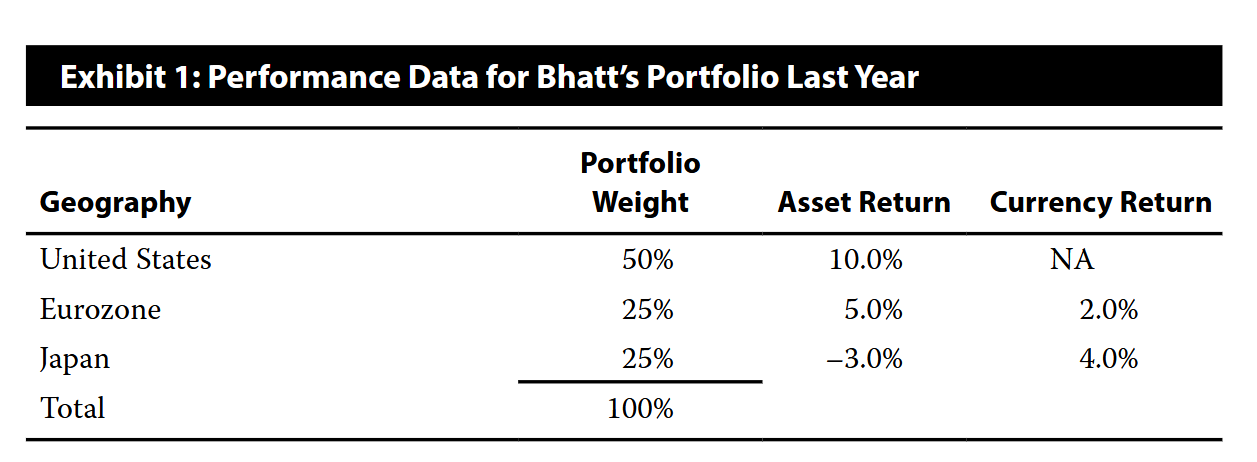
Based on the chart, what is the contribution of foreign currency to total return?
RDC = ∑ωi [ R_FC,i + R_FX,i + (R_FC,i × R_FX,i ) ].
R_FX,i terms sum up to 1.5%. The cross-terms sum to -0.005%. 1.5-0.005=1.495, which is the contribution of foreign currency return.
Which has greater liquidity, currency forward or futures?
Forwards.
Heuristic vs formal risk constraints
Formal constraints are statistical in nature and are often tied to return distributions of the portfolio. Heuristics show up as controls imposed on permissible portfolio composition (sizing of positions, max sector deviations, max leverage, etc).