The Integumentary System: Functions and Aging Vocabulary
 Call Kai
 Learn
Learn Practice Test
 Spaced Repetition
 Match
Match Flashcards
 Knowt Play
1/43

Earn XP
Description and Tags
Vocabulary flashcards covering skin color factors, protective mechanisms, thermoregulation, vitamin D synthesis, cutaneous sensory receptors, and age-related changes of the integumentary system.
Name | Mastery | Learn | Test | Matching | Spaced | Call with Kai | Chat |
|---|
No analytics yet
Send a link to your students to track their progress
44 Terms
Melanin
A yellow, tan, reddish brown, brown, or black pigment that protects against UV radiation and accumulates in freckles and moles.
How are freckles or moles created?
By accumulation of melanin in one spot
Does number of melaninocytes affect color of skin?
No, differences in skin color are primarily due to the amount and type of melanin produced by melanocytes
Carotene
Is an orange pigment that accumulates in the stratum corneum, dermis, and hypodermis
used to synthesize Vitamin A for vision.
Hemoglobin (in RBC’s)
A pigment inside red blood cells that changes color during oxygen transport, reflecting changes in dermal blood flow and oxygen content
Red means lots of oxygen content
Blue color has less oxygen content
What is hemoglobin?
Hemoglobin is in blood cells carrying oxygen
Bilirubin
A yellow breakdown product of hemoglobin resulting from red blood cell death, which accumulates during liver disease to cause jaundice → eventually turns green
Functions of the skin:
Protects in different ways:
Chemical and Mechanical protection
Skin Continuity
closely-packed cells, tight junctions, desmosomes, multi-layered
Hardness
Keratin
Prevents water loss and entry
Glycolipids
Melanin
UV radiation
Secretions (sweat, sebum)
Acidic (acid mantle)
Bactericidal
Acid Mantle
The acidic, bactericidal surface environment of the skin created by sweat and sebum secretions.
Keratin
A hard protein present in the skin that provides mechanical protection and helps prevent water loss and entry.
Glycolipids
Epidermal lipid compounds that act as a barrier to prevent water entry and water loss.
Dendritic cells
Specialized immune cells located within the epidermis that aid in immune defense.
Dermal Macrophages and Leukocytes
Immune cells stationed in the dermis that protect the skin against foreign pathogens and debris.
Insensible Perspiration
Unnoticed, unmeasurable sweat evaporation occurring continuously under baseline conditions at approximately 0.5 L/day.
Sensible Perspiration
Visible, heavy sweating secreted by sweat glands in amounts reaching liters per day to promote evaporative body cooling.
Vasodilation
The widening (dilation) of dermal blood vessels, which increases blood flow toward the skin surface to increase heat loss and cool the body.

Vasoconstriction
The narrowing (constricting) of dermal blood vessels, which reduces blood flow near the skin surface to decrease heat loss and warm the body.
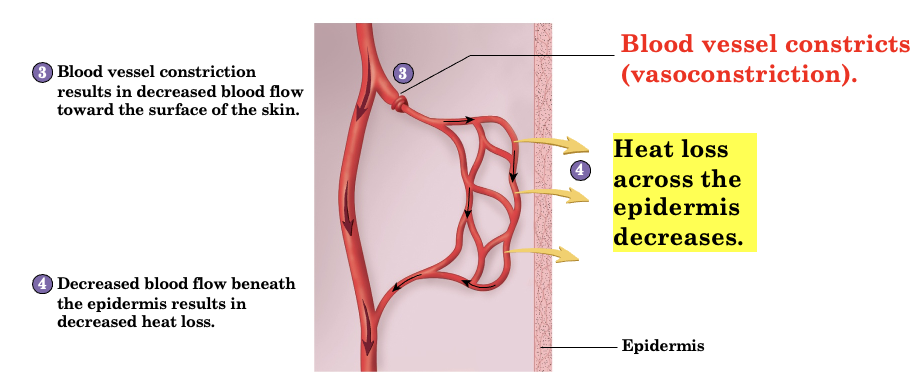
Hypothalamus
The region of the brain that dictates body temperature regulation by controlling dermal blood flow and sweat gland secretions.
7-dehydrocholesterol
A precursor molecule in the skin that converts to cholecalciferol (Vitamin D3) upon exposure to UV light.
Cholecalciferol
Vitamin D3, synthesized in the skin from 7-dehydrocholesterol under UV exposure prior to modification by the liver and kidneys.
What is vitamin D3 good for?
Activates immune system → prevents you getting sick
Very important for the bones → helps absorb calcium and phosphorus, into the bones
Calcitriol
The active form of Vitamin D produced by liver and kidney modifications, required for intestinal calcium absorption and urinary calcium conservation.
Tactile (Merkel) Discs
Epidermal sensory receptors specialized in detecting light touch sensations.
Tactile (Meissner) Corpuscles
Cutaneous sensory receptors in the skin responsible for detecting fine touch.
Lamellated (Pacinian) Corpuscles
Deep cutaneous sensory receptors responsible for perceiving pressure and vibration sensations.
Bulbous (Ruffini) Corpuscles
Cutaneous sensory receptors that respond to continuous pressure and tissue stretching.
Hair Root Plexus
A hair follicle receptor consisting of nerve endings wrapped around hair follicles to detect hair movement and touch.
Aged skin characteristics
Fibroblasts
Dermal cells that, with advancing age, produce fewer collagen and elastic fibers, resulting in a thinner dermis.
Wrinkles
Collagen → become fewer, tangle, stiffen and beak apart
Elastic → they lose elasticity and thicken into clumps
Age-Related Collagen Alterations
Structural changes in dermal collagen fibers during aging, where fibers decrease in number, stiffen, break apart, and tangle.
Age-Related Elastic Fiber Alterations
Degenerative changes in aging skin where elastic fibers lose elasticity and thicken into clumps, leading to wrinkle formation.
Glandular Atrophy
Age-related shrinkage of cutaneous glands, leading to dry and itchy skin, coarse or brittle hair, and impaired heat loss (overheating).
Age-Related Melanocyte Reduction
A decrease in active epidermal melanocytes, causing skin paleness and reduced protection against harmful UV radiation.
Age-Related Vitamin D3 Reduction
A decline in cutaneous Vitamin D3 synthesis in elderly individuals, contributing to decreased bone density and muscle weakness.
Decreased Dermal Blood Flow
A reduction in blood circulation to aged skin, leading to cold intolerance, impaired temperature regulation, and delayed wound healing.
Subcutaneous Fat Loss
The reduction of hypodermal fat in aging skin, which decreases thermal insulation, causes cold sensitivity, and contributes to skin thinning.
Increased age affects healing. How?
Healing becomes compromised and increase risk of damage, infection, and cancer.
Fewer melanocytes + dendritic cells
Increased age affects skin thinning. How?
Decreased collagen + elastic fibers
Decreased mitosis + subcutaneous fat
Less fat means less insulation → feel cold
Increased age affects Hair thinning. How?
Less active hair follicles
Balding → genetics based
Gray/white hair → duet to decreased pigment
Why is skin referred to as the Acid Mantle (skin)?
Skin is referred to as the Acid Mantle because it has a slightly acidic pH, which helps protect against pathogens and maintain moisture.
How is sunlight important to bone health?
Sunlight is important to bone health because it stimulates the production of vitamin D in the skin, which is essential for calcium absorption and bone mineralization.
Which alteration in skin color may indicate a liver disorder?
Jaundice, characterized by yellowing of the skin. (accumulation of bilirubin)
What effect would a decrease in oxygenation have on skin color; why?
A decrease in oxygenation can lead to a pale or bluish skin color, known as cyanosis, due to reduced blood flow and oxygen levels in the skin.
Why does your skin appear more red when you exercise?
Your skin appears more red when you exercise due to increased blood flow to the skin's surface, which helps to dissipate heat and regulate body temperature.