Chemistry
 Call Kai
 Learn
Learn Practice Test
 Spaced Repetition
 Match
Match Flashcards
 Knowt Play
1/116

Earn XP
Description and Tags
Long quiz Chap 1 n 2
Name | Mastery | Learn | Test | Matching | Spaced | Call with Kai | Chat |
|---|
No analytics yet
Send a link to your students to track their progress
117 Terms
Chemistry
It is the study of matter, its properties, and the changes it undergoes.
Science Related Fields of chemistry
Technology, Medicine, Biochemistry, Energy
Matter
It is anything that has mass and takes up space
Classifying Matter
Atom

Classifying Matter
Molecules of an element
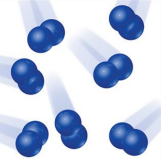
Classifying Matter
Molecules of a compound

Classifying Matter
Mixture of elements and a compound
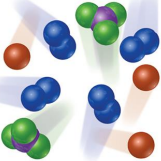
States of matter
1) solid.
2) liquid.
3) gas.
Substance
It has distinct properties and a
composition that does not vary from sample to
sample.
elements and compounds.
Two types of substances
Atoms
building blocks of matter.
element
It is made of a unique kind of atom, but can be made of more than one atom of that kind.
compound
made of atoms from two or more different elements.
molecules.
groups of atoms
Oxygen percentage in the human body
65%
Oxygen in the earth’s crust
49.5%
5 elements
Make up 90% of the Earth’s crust by mass.
three elements
make up 90% of the human body mass!
Silicon percentage in the Earth’s crust
25.7%
Aluminum percentage in the Earth’s crust
7.5%
Iron percentage in the Earth’s crust
4.7%
Calcium percentage in the Earth’s crust
3.4%
Other percentage in the Earth’s crust
9.2%
Other percentage in the Human body
7%
Hydrogen percentage in the Human body
10%
Carbon percentage in the Human body
18%
symbol of carbon
C
symbol of fluorine
F
symbol of Hydrogen
H
symbol of Iodine
I
symbol of Nitrogen
N
Symbol of Oxygen
O
Symbol of Phosphorus
P
Symbol of Sulfur
S
Symbol of Aluminum
Al
Symbol of Bromine
Br
Symbol of Calcium
Ca
Symbol of Chlorine
Cl
Symbol of Helium
He
Symbol of Lithium
Li
Symbol of Magnesium
Mg
Symbol of Silicon
Si
Symbol of Copper
Cu
Symbol of Iron
Fe
Symbol of Lead
Pb
Symbol of Mercury
Hg
Symbol of Potassium
K
Symbol of Silver
Ag
Symbol of Sodium
Na
Symbol of Tin
Sn
Symbol of Calcium
means that the relative number of atoms of each element in the compound is the same in any sample.

The Law of Constant Composition (or The Law of Definite Proportions).
Mixtures
exhibit the properties of the substances that make them.
Two types of mixtures
heterogeneous, homogeneous
homogeneous mixture is also called
solution
Heterogeneous
made up of parts that are different, diverse, or not uniform
Homogeneous
being the same, uniform throughout, or made of similar parts
Physical properties
can be observed without changing a substance into another substance.
Chemical properties
only be observed when a substance is changed into another substance.
Intensive properties
independent of the amount of the substance that is present
Extensive properties
depend upon the amount of the substance present.
Physical changes
changes in matter that do not change the composition of a substance.
Chemical changes
result in new substance
3 types of mixture
– filtration
– distillation
– chromatography
Filtration
solid substances are separated from liquids and solutions
Distillation
uses differences in the boiling points of substances to separate a homogeneous mixture into its components
Chromatography
This technique separates substances on the basis of differences in the ability of substances to adhere to the solid surface, in this case, dyes to paper
Kinetic energy
is the energy of motion.
Formula of kinetic
KE = 1/2 mv²
Potential energy
an object depends on its relative position compared to other objects
Mass
is a measure of the amount of material in an object. SI uses the kilogram as the base unit. The metric system uses the gram as the base unit.
Length
a measure of distance. The meter is the base unit.
Temperature
In scientific measurements, the Celsius and Kelvin scales are most often used.
freezing point of water
0 degree Celsius
boiling point of water.
100 degree Celsius
k = degree Celsius + 273.15
Celsius to Kelvin conversion formula
Precision
measure of how closely individual measurements agree with one another.
Accuracy
refers to how closely individual measurements agree with the correct, or “true,” value.
Law of Constant Composition
Compounds have a definite composition. That means that the relative number of atoms of each element in the compound is the same in any sample.
Joseph Proust.
He discovered Law of Constant Composition
Law of Conservation of Mass
The total mass of substances present at the end of a chemical process is the same as the mass of substances present before the process took place.
Antoine Lavoisier.
He discovered Law of Conservation of Mass
Law of Multiple Proportions
If two elements, A and B, form more than one compound, the masses of B that combine with a given mass of A are in the ratio of small whole numbers.
John Dalton
he discovered this law while developing his atomic theory.
J. J. Thomson
He discovered Streams of negatively charged particles were found to emanate from cathode tubes, causing fluorescence.

charge/mass ratio of the electron
1.76 × 10^8 coulombs/gram (C/g).
Millikan Oil-Drop Experiment (Electrons)
Once the charge/mass ratio of the electron was known, determination of either the charge or the mass of an electron would yield the other.
Robert Millikan
He determined the charge on the electron in 1909
Radioactivity
is the spontaneous emission of high-energy radiation by an atom.
They studied Radioactivity
Marie and Pierre Curie also studied it.
Radioactive was first observed by
Henri Becquerel
Ernest Rutherford
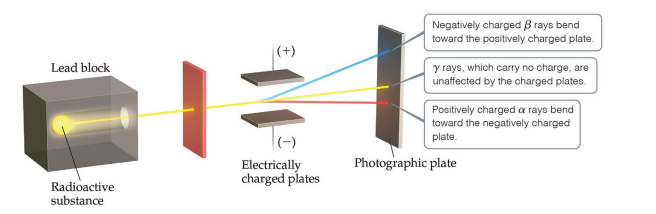
He discovered Three types of radiation
a = particles (positively charged)
B = particles (negatively charged, like electrons)
Y = rays (uncharged
The Atom, Circa 1900
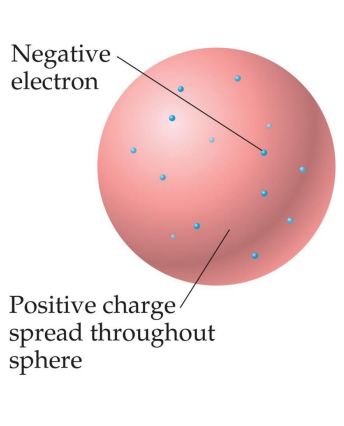
Also known as plum pudding model, put forward by
J. J. Thomson.
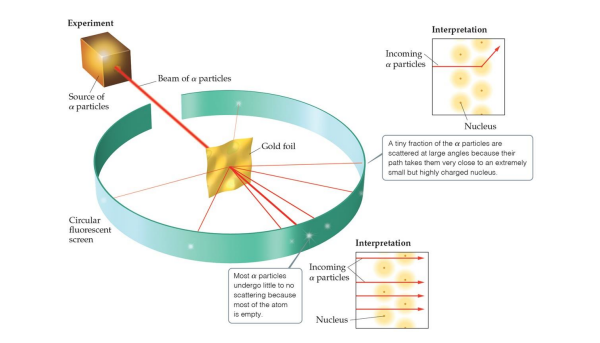
Discovery of the Nucleus
Ernest Rutherford shot (a) particles at a thin sheet of
foil and observed the pattern of scatter of the particles.
1–5 Å or 100–500 pm
Measurement of Atom
Charge of Proton
+1
Charge of Electron
-1
Atomic Number
the number of protons in the nucleus of an atom.
Isotopes
atoms of the same element with different masses