Managing Plant Nutrients
 Studied by 0 people
 Call Kai
 Learn
Learn Practice Test
 Spaced Repetition
 Match
Match Flashcards
 Knowt Play
1/111

There's no tags or description
Looks like no tags are added yet.
Name | Mastery | Learn | Test | Matching | Spaced |
|---|
No study sessions yet.
112 Terms
17 essential mineral nutrients
Boron - BO33-
Calcium - Ca2+
Carbon
Chlorine - Cl-
Copper - Cu2+
Hydrogen
Iron - Fe2+, Fe3+, heme
Magnesium - Mg2+
Manganese - Mn2+
Molybdenum - Mo3+
Nickel - Ni2+
Nitrogen - NO3-, NO2-, NH4+
Oxygen
Phosphorus - PO43-, P2O74-
Potassium - K+
Sulfur - SO42-, SO32-, SH-
Zinc - Zn2+
Plant mineral nutrients are in the charged (___) form of the element
ion
True or false. Some plant mineral nutrients have one or more different charges and chemical forms.
True
Plant cell walls are ______
porous
Water and nutrient ions can flow nearly unimpeded into the ____ and the flow continues as far as the endodermis
root
____ ____ are the site of water and ion entry into the plant
Root hairs
Nutrient ions can also be taken into the plant root through exchange with ____ ________, and through symbiotic relationships with microorganisms
soil particles
What are negatively charged nutrients?
Anions
Anions are _______ by negatively charged soil particles
repelled
2 examples of anions
Nitrate (NO−3)
Chloride (Cl-)
What are positively charged nutrients?
Cations
Cations _______ to negatively charged soil particles
adhere
_______ may be exchanged with cations or H+ bond to root or in soil solution
Cations
Once in the endodermis, nutrients are imported into __________ cell
endodermal
Once in _____ cells, the nutrient is transported up to other plant organs
xylem
The main control point for mineral transport into the plant is the ________________
plasmalemma
The plasmalemma is a _____ bilayer that is mostly impermeable to water and ions
lipid
________ in the plasmalemma membrane act as selective channels
Proteins
Mycorrhizae infections are composed of hyphae (small tubular filaments) that form an ___________ with plants
association
Mycorrhizae infection: fungal hyphae are finer than _____ and extend further into soil pores than root hairs aiding in nutrient absorption
roots
What % of dicots have mycorrhizal associations?
83%
What % of monocots have mycorrhizal associations?
79%
Plant bacterium _________ relationship that is specific to plant species
symbiotic
Plants respond to specific soil bacteria (rhizobia) in a symbiotic relationship by forming _______ to house bacteria
nodules
In a symbiotic relationship between a plant and bacteria, the plant supplies the bacterium with __________ food
carbohydrate
In a symbiotic relationship between a plant and bacteria, the bacteria supplies the plant with a useable form of _________
nitrogen
3 primary macronutrients
Nitrogen
Phosphorus
Potassium
3 secondary macronutrients
Calcium
Magnesium
Sulfur
8 macronutrients
Boron
Chlorine
Copper
Iron
Manganese
Molybdenum
Nickel
Zinc
Plant mineral nutrients are governed by the “law of ________”, meaning that the nutrient in the least supply dicates plant growth
minimum
6 most limiting mineral nutrients (in order of most to least limiting)
Nitrogen
Phosphorus
Potassium
Magnesium
Calcium
Iron
Which nutrient is the most required of all macro and micronutrients?
Nitrogen
Which nutrient is known as the most limiting element?
Nitrogen
Which limiting element is…
part of amino acids, proteins, and enzymes
nucleosides, nucleotides, and nucleic acids
constituent of the chlorophyll molecule
synthesis of phytohormones
Nitrogen
What is the sufficiency range of Nitrogen?
1.0 - 6.0%
Which nutrient has a sufficiency range of 1.0 - 6.0%?
Nitrogen
2 most common forms of Nitrogen in the soil
NO3- (grows the plant)
NH4+ (greens the plant)
NH4+ (form of Nitrogen) is held by _________
colloids
NO3- (form of Nitrogen) is ______ leachable from soils?
highly
Nitrogen is most available at pH # to #
6.0 to 8.0
Are all forms of Nitrogen mobile or immobile in plants?
mobile, so deficinecy starts at base
Important points in the Nitrogen cycle are where Nitrogen is ____ ________ and where it can be ____
crop available
lost
Urea-based, ammonium-based, nitrate-based, and organic are all _________ fertilizers
Nitrogen
NO3- _____ the plant
grows
NH4+ ______ the plant
greens
Which form of Nitrogen is usually found in higher concentrations than the other?NH4+ or NO3-?
NO3-
Ideally, there should be a # : 1 ratio of NO3- : NH4+ in soils
3:1
Which nutrient has the following deficiency symptoms?
plants appear weak and stunted
small leaves with light green to yellow color
uniform yellowing
older leaves to younger leaves
older leaves may fall prematurely
photosynthesis is significantly reduced
reduced cytokinin production
rapid shift towards senescence
Nitrogen
Which limiting element…
is a component of enzymes and proteins
is a component of ATP, RNA, and DNA
buffers cellular pH changes
Phosphorus
What is the sufficiency range of Phosphorus?
0.2 - 0.5%
Which limiting element has a sufficiency range of 0.2 - 0.5%?
Phosphorus
2 forms of Phosphorus in soil
PO43-
P2O74-
The majority of phosphorus in soil is __________ to plants
unavailable
Is Phosphorus mobile or immobile in plants?
mobile, so deficiency starts at base
Phosphorus is mostly available at the slightly acidic to neutral pH range (## - ##)
5.5 - 7.0
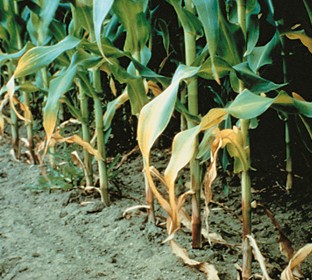
Identify which nutrient is deficient
Nitrogen
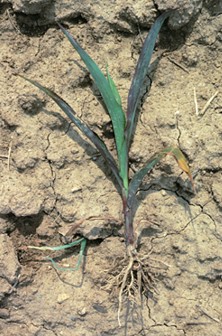
Identify which nutrient is deficient
Phosphorus
Which nutrient has the following deficiency symptoms?
Purple/reddish coloration
Slows and retards growth of roots and shoots, stunting the plant
Redding or purple color on lower leaves
Phosphorus
Phosphorus deficiency symptoms occur when it falls below ## %?
0.2%
Low soil ______ can cause a Phosphorus deficiency
temps
True or false. Phosphorus is held tightly in the soil.
True
Which nutrient has high potential to be carried in runoff and erosion?
Phosphorus
Which nutrient is the most limiting nutrient for aquatic plant growth?
Phosphorus
Phosphorus is important for ____ growth
root
“Starter fertilizers” are high in soluble forms of which nutrient?
Phosphorus
Which limiting element…
essential in maintaining water status
controls turgor pressure & opening / closing the stomata
required for carb transport
involved in cellulose synthesis
Potassium (K)
What is the sufficiency range of Potassium (K)?
1.5 - 4.0%
Which limiting nutrient has a sufficiency range of 1.5 - 4.0%?
Potassium (K)
Less than #% of soil Potassium is avaible, while 90 - 98% is tied up
2%
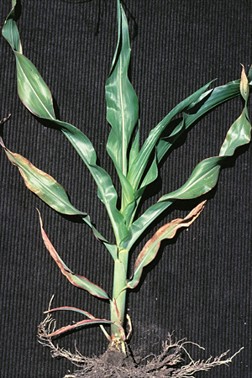
Identify the nutrient deficiency
Potassium (K)
Which nutrient has the following deficiency symptoms?
plants easily lodge or fall over (reduce lignification)
yellow color around edges of older leaves
leaves appear to be “burned” around edges
droopy, flaccid leaves due to loss of water status
symptoms appear on older leaves first
Potassium (K)
Is Potassium (K) mobile or immobile in plants?
mobile, so deficiency starts at base
Potassium (K) increases plant ______ and quality
vigor
Potassium (K) application is needed on ______ soils
sandy
Which limiting element…
binds cell wall pection for structural role
is involved in cell elongaation and division
regulates cellular anion levels
enhances pollen tube germination
helps in protein synthesis and carb transfer
Calcium (Ca)
High levels of Calcium (Ca) in soil may interfere with which other 4 nutrients?
Potassium (K)
Iron (Fe)
Magnesium (Mg)
Boron (B)
Calcium (Ca) is taken up by plants ________
passively
Because Calcium (Ca) is taken up by plants passvely, plant uptake is highly dependent on adequate _____ supply to plant roots
water
Calcium (Ca) availability in soil depends on ___
pH
At pH above 7.0, Calcium (Ca) readily reacts with _________, rendering both relatively unavailable to plants
phosphate
Which nutrient has the following deficiency symptoms?
growing points of leaves and roots turn brown and die
young leaves become chlorotic and deformed, eventually leading to marginal necrosis
fruit/flower quality is reduced
Calcium (Ca)
Is Calcium (Ca) mobile or immobile in plants?
immobile, so deficiency starts at top
Which limiting element…
is found in center of tetrapyrrole ring of chlorophyll molecule
catalyzes the transfer of phosphoryl groups between ATP and ADP
cofactor for kinase enzymes
neutralizes anions in thylakoid membrane
stabilizes ribosomes during protein synthesis
Magnesium (Mg)
What is the sufficiency range of Magnesium (Mg) in plants?
0.15 - 0.4%
Which limiting nutrient has a sufficiency range of 0.15 - 0.4% in plants?
Magnesium (Mg)

Identify the nutrient deficiency
Calcium (Ca)
Magnesium (Mg) availability in soil depends on the soil’s ___
pH
In mineral soils, exchangeable Magnesium (Mg) is most available at pH ## - ##
6.5 - 8.5
Mg is not held to soil CEC sites tightly so exchangeable Magnesium (Mg) can _____
leach
Excess K, NH4, Ca, and Al can lead to ___________ deficiencies
Magnesium (Mg)
________ stimulates Magnesium (Mg) uptake
Nitrate (NO3-)
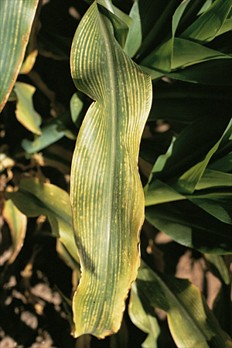
Identify the nutrient deficiency
Magnesium (Mg)
Which nutrient has the following deficiency symptoms?
yellowing and interveinal chlorosis of older leaves
margins of younger leaves become necrotic
green conductive tissue surrounded by yellow background
Magnesium (Mg)
Is Magnesium (Mg) mobile or immobile in plants?
mobile, so deficiency starts at base
Magnesium uptake declines rapidly at a pH less than ##
5.5
Which limiting nutrient…
has a role in oxidation-reduction, electron transfer
is involved in chlorophyll synthesis
is a component of cytochromes of PS I and II
is a component of ferridoxin
is required for NO3- and SO42- reduction
is needed for N2 assimilation
is needed for energy production (NADP)
Iron (Fe)
2 most common forms on Iron (Fe) in soil
Fe3+ (Ferric)
Fe2+ (Ferrous)
Which form of Iron (Fe) dominates in soil? Fe3+ (Ferric) or Fe2+ (Ferrous)?
Fe3+ (Ferric)
Which form of Iron (Fe) is the physiologically active form? Fe3+ (Ferric) or Fe2+ (Ferrous)?
Fe2+ (Ferrous)
As pH increases, Iron (Fe) intake ________
decreases