Multi - Lines, planes, points, distance, and intersections
 Call Kai
 Learn
Learn Practice Test
 Spaced Repetition
 Match
Match Flashcards
 Knowt Play
1/11

There's no tags or description
Looks like no tags are added yet.
Name | Mastery | Learn | Test | Matching | Spaced | Call with Kai | Chat |
|---|
No analytics yet
Send a link to your students to track their progress
12 Terms
Whether lines are identical, parallel, skew, or intersecting
Parallel: direction vectors have scalar multiple
Identical: plug in point from one line into equation for other
Set up system of equations for x, y, and z with parameters t and s, then substitute t and s into the third equation —> if true, intersecting, if false, skew
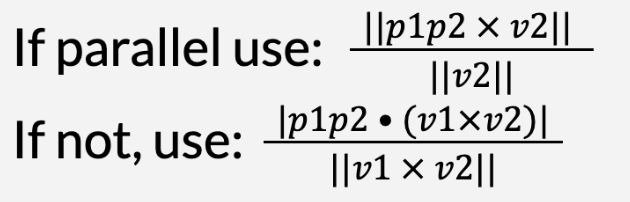
Distance between two lines
p1 and p2 are points on the line, v1 and v2 are the direction vectors of the lines
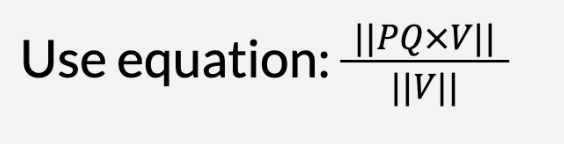
Distance between point and line
PQ is the vector formed from the given point and a point on the line
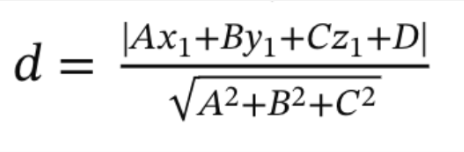
Distance between point and plane
point: (x1, y1, z1) plane: A(x-x0)+B(x-x0)+C(x-x0) = 0
Where line intersects plane
Find parametric equations of line
plug into plane equations
solve for t
plug t back into line equation
Line formed by the intersection of two planes
cross the normal vectors to find line vector
set one variable equal to zero in both plane equations, solving for the other two variables
Find plane equation from three points
Find vectors AB and BC, then cross them
plug resulting vector and any of the original points into the plane equation
Plane going through intersection of two planes and perpendicular to a third
write equation for family of planes
group the coefficients (rearrange)
if perpendicular = n1 dot n2 = 0
solve for lambda and substitute back

Dot product
perpendicular: cross product equals zero

Cross product
parallel: cross product equals zero

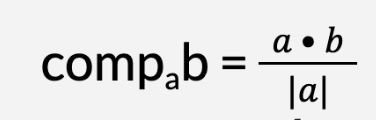
Scalar component
Vector projection
