Plant Physiology Exam 1
 Call Kai
 Learn
Learn Practice Test
 Spaced Repetition
 Match
Match Flashcards
 Knowt Play
1/291

There's no tags or description
Looks like no tags are added yet.
Name | Mastery | Learn | Test | Matching | Spaced | Call with Kai | Chat |
|---|
No analytics yet
Send a link to your students to track their progress
292 Terms
What are the 6 key elements of the plant lifestyle?
1. Photosynthetic - can convert light energy to chemical energy.
2. Non-motile/sessile - for the most part, plants are stuck in one place.
3. Plants typically have verticality that requires specialized structural support against the forces of gravity.
4. Constant water loss - plants are locked in a battle between water loss and carbon uptake.
5. Specialized translocation mechanisms for movement of water and minerals.
6. Alternation of generations: haploid and diploid phases.
Key adaptation over plant evolution
cuticle, stomata, vascular tissue, trachieds, leaves, pollen, seeds, wood, vessels, flowers
Animal vs. plant life cycle
-Animal: multicellular (2n) and unicellular gametes (1n).
-Plant: Multicellular sporophyte (2n), spores (2n), multicellular gametophyte (1n), gametes (1n). Plants have alteration of generations.
Alteration of generations, starting with gametophyte:
gametophyte plant --> sperm/eggs --> FERTILIZATION
--> mitosis --> sporophyte plant (2n) --> MEIOSIS --> spores
--> mitosis.
As plants evolved, the gametophyte or the sporophyte generation has become more prominant?
Sporophyte
Angiosperm lifecycle
Sporophyte Generation Dominant; Double Fertilization occurs when One Sperm Cell Unites With Egg to form a Zygote; a Second Sperm Cell Unites with Two Polar Nuclei to form Endosperm (Nutritive Material for Developing Embryo)...
What are the 3 main vegetative organs and what are their purposes?
1.Roots - anchor plants to earth, absorb water and nutrients.
2.Stems - structural support, transport conduit between roots and leaves.
3.Leaves - Photosynthesis.
Typical dicots have what kind of root system? Appearance/arrangement?
taproot. Vascular tissue arranged in a x in the center of the root.
What is the primary tissue type for external and internal skin?
Dermal tissue
What is the primary tissue type for the "body" of the organs?
Ground tissue
What is the primary tissue type for the cells that specialize in transport?
Vascular tissue
How are stomata arranged in dicots typically?
like puzzle pieces
How are stomata arranged in monocots typically?
linearly
trichome
Hair-like projections that extend from a plant's epidermis; help reduce water evaporation and may provide protection from herbivores.
Welwitschia
an extremely drought resistant plant from Namibia and Angola
Ground tissues: parenchyma
Parenchyma cells make up the bulk of ground tissues in roots, stems, and leaves.
Parenchyma are living cells with thin walls.
Ground tissues: collenchyma and sclerenchyma
Collenchyma and sclerenchyma are also ground tissues - sclerenchyma are dead at maturity.
Vascular tissues: xylem
Made up of tracheids and vessel elements. Xylem carries water and dissolved minerals through the plant.
Vascular tissues: phloem
Made up of sieve cells and companion cells. Carries photosynthate/ sugars.
phloem
Vascular tissue that transports solutions of nutrients and carbohydrates produced by photosynthesis through the plant
Typical monocots have what kind of root system? Appearance/arrangement?
Typical dicot stems have what kind of arrangement?
Vascular tissues are arranged in a circle around the stem.
Dicot leaf diagram

What is the kind of ground tissue that makes up leaves?
mesophyll. Spongy mesophyll in middle.
Plant cell diagram

How do plant cells differ from animal cells- what features are unique to plant cells?
-cell walls,
-chloroplasts,
-large central vacuoles,
-microfilaments for cell division,
square-ish shape.
How do plant cells differ from animal cells- what features are unique to animal cells?
-centrioles for cell division,
-small vacuoles,
-lysosomes for digestion,
round-ish shape.
What are the 3 important functions of vacuoles?
1. Maintaining cell turgor - prevent plasmolysis and regulate cell expansion.
2. Isolating materials that might be harmful or a threat to the cell, such as degradative enzymes.
3. Maintaining an acidic internal pH - protons transported from cytoplasm.
Typical mature plant cell has one large vacuole occupying _______ of the cell's volume
30-90% ( a large portion of the plant cell)
Vacuole will exert ______ pressure against cell wall.
outward. - think balloon (Vacuole) in wicker basket (Fibers woven in the cell wall).
_________ is the "glue" between cell walls.
Middle lamella.
Cell walls are strong, but still flexible - cell strength comes from a combination of:
the constraining cell wall and cellular turgor pressure.
Chloroplasts makeup:
-Chlorenchyma cells:parenchyma containing chloroplast.
-They have thick clear cell walls as separation.
-Chloroplasts are double membrane bound, plus they have a third set of interior membranes (the lamellae that make up the thylakoids)
Chloroplast function:
Organelles where solar energy is captured by photosynthesis
Chloroplast diagram
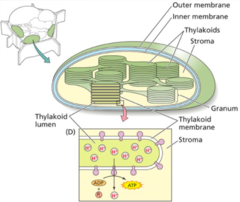
Chloroplast at 52,000x magnification

What besides chloroplasts has double membranes?
mitochondria
Mitochondria
Organelle where respiration takes place.
________ is the reversal of the process of photosynthesis.
Respiration
Why are membranes important?
-Membranes are semi-permeable and create "compartments".
-Compartments are essential for creating gradients.
-Compartments allow the accumulation of valuable resources and the exclusion of toxic materials.
Plasma membrane diagram

unsaturated phospholipid tail-
has a kinked tail created by a double bond in the middle.
saturated phospholipid tail-
straight
Phospholipids have:
one straight and one kinked hydrophobic tail. And a hydrophilic head region.
Phospholipids spontaneously form ________.
lipid bilayers. In water, they form spheres.
What are the 3 classes of membrane associated proteins?
integral, peripheral, anchored.
Integral membrane associated proteins-
embedded in phospholipid bilayer, usually spanning width - important for ion channels and signal transduction
Peripheral membrane associated proteins-
bound to membrane by non- covalent bonds (ionic or hydrogen bonds) - can be "salted" away from the membrane
Anchored membrane associated proteins-
covalently attached to membrane by lipid molecules. They are anchored to the center of the membrane.
Biological membranes are not just for chloroplasts and mitochondria:
-Plasma membrane: primary cell membrane.
- Tonoplast: Vacuole Membrane.
Nuclear Envelope: Nuclear Membrane.
Endoplasmic reticulum (ER):extensive set of internal membranes, where lipid synthesis (smooth ER) and translation of proteins (Rough ER) destined for membranes and external secretion takes place.
Golgi Apparatus: final processing of proteins destined for secretion, important in cell plate and cell wall formation during cell cycle.
Ribosomes
A cell organelle constructed in the nucleolus and functioning as the site of protein synthesis in the cytoplasm; consists of rRNA and protein molecules, which make up two subunits.
Golgi apparatus
A system of membranes that modifies and packages proteins for export by the cell. Made of of trans, medial, and cis cisternae. movement between organelles is bidirectional.
What factors cause molecules to move across membranes at different rates?
-Pressure,
-Temperature,
-Size and charge of molecules,
-General permeability of the particular membrane.
Mitochondrial example of permeability:
The inner membrane is highly impermeable to H+
This essential feature allows gradients to form and ATP production to... look up
Nuclear envelope with pores
Another way to control movement across membranes is the presence of pores - which can be very simple or highly complex. The nuclear pore complex acts as a supramolecular sieve.
plasmodesmata:
are holes between cell walls of adjacent cells through which endoplasmic reticula pass. Allow passage of cytoplasm, etc (guard cells do not have plasmodesmata).
These holes allow symplastic (free) movement.
Central Dogma:
the basic flow of information between the hereditary material (DNA) and the machines that do almost all cellular work (proteins)
DNA is _______ to mRNA, which his _______ to protein.
transcribed, translated
Key processes of the central dogma- Replication:
The process of copying and maintaining the information contained in DNA (DNA to DNA)
Key processes of the central dogma- Transcription:
The process of mRNA synthesis using the information encoded in DNA (DNA to mRNA). In special cases, RNA can be transcribed into DNA.
Key processes of the central dogma- Translation:
The process of protein synthesis
Which enzyme performs replication?
DNA polymerase
Which enzyme performs transcription?
RNA polymerase
Which enzyme performs translation?
Ribosomes
Differences between DNA and RNA:
DNA: Generally double stranded, has deoxyribose sugar, A=T.
RNA: Generally single stranded, has ribose sugar, A=U.
When you add a _____ and a _____ to the deoxyribose sugar, you get a deoxyribonucleotide.
nitrogenous base (A,G,C,T), phosphate
Nucleotide Triphosphates:
A molecule containing a nucleoside bound to three phosphates. The building blocks of DNA
Nitrogenous bases are connected by:
hydrogen bonds. [A=T, C=G] or [A=U, C=G] in RNA.
DNA and RNA have directionality. DNA is double stranded, and the strands run ______ to each other.
anti-parallel. 5'---->3'
Introns:
Eukaryotic genes have introns. Introns are spliced out of the mRNA before it leaves the nucleus. They are regulatory regions. The introns are spliced out by looping the region, and then connecting the two ends of the exons together. Those regions are then recycled.
What Are Proteins?
Large, chemically complex molecules:
Long chains of amino acids - typically hundreds to thousands long.
Polypeptides = Proteins.
Peptides are short amino acid polymers.
There are 20 different amino acids used to build proteins.
Hydrophobic, non-polar amino acids:
Proline (Pro), Methionine (Met), Glycine (Gly), Alanine (Ala), Valine (Val), Phenylalanine (Phe), Isoleucine (Ile), Leucine (Leu), Tryptophan (Trp).
Remember: GAV LIMP TP
Hydrophilic, polar amino acids:
Serine (Ser), Threonine (Thr), Cysteine (Cys), Tyrosine (Tyr), Asparagine (Asn), Glutamine (Gln). Remember: SomeTimes Cats Try A Growl.
Acidic amino acids (- charge):
Aspartic acid (Asp) and Glutamic acid (Glu).
Basic amino acids (+ charge):
Lysine (Lys), Arginine (Arg), Histidine (His). Remember: HAL
Which amino acids form disulfide bonds?
Cystine?? Look up.
There are ___ codons that exist.
64. Three are stop codons (UAA, UAG, UGA) and one is a start codon (AUG).
How are peptide bonds formed?
an amide dehydration reaction. Called a dehydration reaction because water is created and released during the formation of the peptide bond. Amide because a peptide bond is a acyl group linked to nitrogen.
Ribosomes work with _____ to assemble proteins.
tRNA. There is a tRNA for each codon.
Changed in the side chains of proteins can change the:
structure and function.
The primary protein structure is:______
an amino acid sequence.
The secondary protein structure is:
the folding of an amino acid chain. (alpha helix or beta sheet)
The tertiary protein structure is:
The folded amino acid chain folding on itself
The quaternary protein structure is:
multiple proteins joined together
Where do transcription and translation occur in prokaryotes?
In the cytoplasm.
Where do transcription and translation occur in Eukaryotes?
Transcription and processing of DNA to mRNA takes place in the nucleus. The mRNA is exported into the cytoplasm.
Translation takes place in the cytoplasm.
Translation in the cytoplasm is often coupled to direct translocation of the nascent peptide into the ER.
How do we use changes in DNA sequence to study plant biology?
Mutants: looking at plants with "messed up" physiology will allow us to infer the function of the gene in normal physiological pathways.
Mendelian genetics:
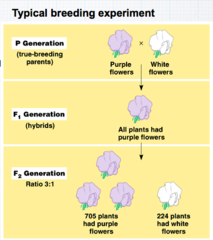
P generation (parental generation)
F1 generation (first filial generation, the word filial from the Latin word for "son") are the hybrid offspring.
Allowing these F1 hybrids to self-pollinate produces:
F2 generation (second filial generation).
It is the analysis of this that lead to an understanding of genetic crosses.
Genotype:
sequence of the gene (wild- type vs. mutant, etc) (Fer/FER vs FER/FER-1)
Allele:
a version of a gene
Phenotype:
what the plant looks like (can be visible differences or biochemical or physiological changes)
Forward genetics:
Look for mutant phenotypes in a process, then find the gene.
Reverse genetics:
Start with a gene, mutate it, and try to find a phenotype
4 Steps for mutant screens:
1. Generate a collection of plants with random mutations.
2. Screen for the phenotype you are interested in (Short roots, reduced photosynthesis, too many petals, etc.).
3. Identify the gene that was mutated and try to figure out the genetic mechanism.
4. Make double mutants (and triple, quadruple, etc.) to elucidate genetic pathways.
5 Methods to generate mutants:
1. Spontaneous mutations,
2. Chemical mutagenesis,
3. T-DNA insertion,
4. Transposon insertion,
5. Irradiation.
Spontaneous mutations
Can lead to evolution by natural selection.
The rate is VERY low.
(In Arabidopsis, a study following spontaneous mutations in a population over 30 generations of selfing showed that the probability of a new mutation at one position is 1:140,000,000!)
Chemical mutagenesis
Treat plants with a chemical that causes modifications of the DNA bases leading to mutations.
(Example: EMS mutagenesis)
Advantages of EMS mutagenesis:
-Generates point mutations so it is possible to recover weak alleles.
-Can be done in any species
Disadvantages of EMS mutagenesis:
Historically difficult to find the gene with the mutation.
Next Generation Sequencing is making this process easier though.
EMS mutagenesis:
(EMS = Ethyl methanesulfonate.)
Adds a methyl group on G, so in next round of replication, a T is inserted instead of C leading to a G-A mutation.