waves
 Call Kai
 Learn
Learn Practice Test
 Spaced Repetition
 Match
Match Flashcards
 Knowt Play
1/69

Earn XP
Description and Tags
wave hello to 100% in this topic
Name | Mastery | Learn | Test | Matching | Spaced | Call with Kai | Chat |
|---|
No analytics yet
Send a link to your students to track their progress
70 Terms
waves
is a vibration or oscillation that travels through space and transfers energy
what does wave motion do?
transfers energy from one point to another but it does not transfer matter
types of waves
mechanical waves and electromagnetic waves
mechanical waves
they require a medium such as air or water to travel through
electromagnetic waves (medium)
does not require a medium through which to travel
two types mechanical waves
transverse and longitudinal
transverse waves
particles of the medium move perpendicular to the direction of wave travel (water waves)
longitudinal waves
particles of the medium more in a direction parallel to the direction of wave travel (sound)
Crest (peak)
the highest point of a wave
trough
the lowest point of a wave
equilibrium point
the vertical midpoint of a wave
wavelength (lamda)
the distance between two crests or troughs
amplitude (m)
the maximum displacement of a wave peak or trough from equilibrium
frequency (f)
the number of waves which pass a fixed point in one second (Hz)
period (T)
the time a wave takes to complete a wavelength (s)
reflection angle of incidence
angle of incidence = angle of reflection
where is the normal drawn?
perpendicular to the barrier
what happens to the wavelength in reflection?
wavelength stays the same
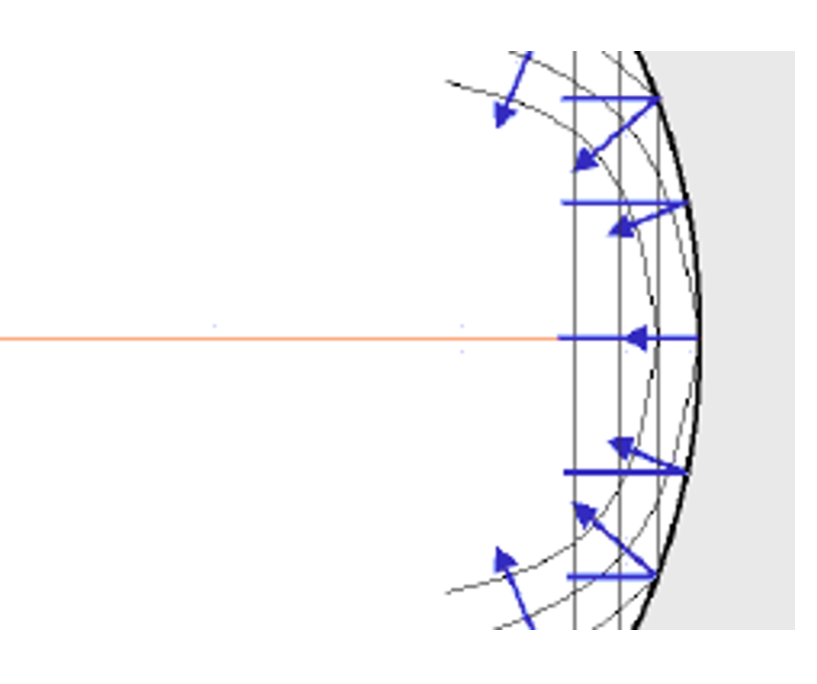
is this concave or convex?
concave
what is an echo?
is a reflection of sound
refraction def
is the bending of a wave when it enters a medium with a different wave speed
fst wd (also frequency)
fast to slow towards the normal, wavelength decreases, frequency stays the same
sfa wi
slow to the fast away from the normal, wavelength increase, frequency the same

total internal reflection
when a wave goes from a slow to fast medium it bends away from the normal
when the incident angle exceeds the critical angle tir occurs
wave reflects back into the boundary
Diffraction def
is the bending of waves around small obstacles and the spreading out of waves beyond small openings
what leads to greater diffraction??
greater wavelength (most often answer)
wavelength and gap having the same magnitude
in diffraction wavelength and frequency is
the same as before
high frequency means what to the pitch
higher
what type of medium is sound the fastest in??
in solids, as they have strong atomic bonds and strong interactions between particles.
this means there is more collision between sound particles leading for sound to travel faster
what happens to the speed of sound when temp increases?
the speed of sound in air increases when the temperature of the air increases.
at higher temperatures particles have higher average speed and average kinetic energy.
more energetic particles transfer energy more rapidly via collisions. temperature effects outweigh density effects within a given phase
when graphing from displacement to pressure the…
the crests and troughs become zero, and the zeros becomes compression or rarefaction
What are seismic waves?
Mechanical waves caused by events such as earthquakes.
What type of wave is a P wave?
A longitudinal compression wave.
What type of wave is an S wave?
A transverse (shear) wave.
Which seismic waves arrive first at a seismograph?
P waves.
Which seismic waves are generally more destructive?
S waves.
What does the velocity of a P wave depend on?
The material through which it travels.
How does P-wave velocity generally change with depth?
It increases with depth.
What happens to seismic waves when they encounter materials of different densities?
They refract.
State 2 ways seismic waves provide evidence about the Earth’s structure
S-waves cannot travel through liquids, showing that the Earth's outer core is liquid.
Seismic waves refract and change speed as they pass through Earth, indicating the presence of layers with different densities and materials.
Explain how a mechanical wave transfers energy without transferring matter overall.
A mechanical wave transfers energy by causing particles in a medium to vibrate and pass energy to neighbouring particles.
The particles only oscillate around their equilibrium positions, so there Is no overall transfer of matter, only energy.
Superposition
The resultant displacement when two waves meet at a point
In Phase
When peaks and troughs align
Out of Phase
their peaks and troughs no longer align
Completely Out of Phase
Peak of one wave aligns with the trough of the other wave
Constructive Interference
occurs when 2 waves combine to give a larger wave
happens at max when 2 waves are IN PHASE
Destructive Interference
when two waves combine to give a smaller wave
happens at max when 2 waves are COMPLETELY OUT OF PHASE
How is the Angle of Incidence measured?
from the normal to the ray
Free Vibration
any object made of elastic material when disturbed will vibrate at a particular set of frequencies
dependent on the elasticity and shape of the object
Forced Oscillation
produced when an external periodic driving force vibrates a system
the system will vibrate at the same frequency as the applied force and will continue to vibrate as long as the force is applied
Resonance
occurs for a driven object if the force you are applying has same frequency as the natural frequency of the object
what happens at resonance?
the maximum amount of energy is being transferred to the object
you get the greatest response (amplitude) for least amount of input
Explain how resonance is achieved when a person is pushed on a swing
Frequency of the person pushing the swing matches the natural frequency of the swing
Resonance results in an ever increasing amplitude for the person being swung
Standing Waves
is a wave that does not appear to be progressing forwards
forms when 2 waves of the same amplitude and frequency, and travelling in opposite directions ae superimposed along a 1D line
Displacement Nodes
points on standing waves where destructive interference always occurs
lamda/2 apart
no displacement
Displacement Antinodes
the particles move up and down, or forwards and backwards (sound) and reach the maximum displacement possible (constructive inteference)
lamda/2 apart
Pressure Nodes
are points where the pressure in a standing sound wave is always at atmospheric pressure
sound cannot be heard as there is no pressure variation
occurs at displacement antinodes
Pressure Antinodes
the sound pressure varies constantly and reaches the maximum pressure possible
sound is most audible at these points
occur at displacement nodes
Explain how standing waves are produced
When 2 waves of the same speed, frequency and amplitude travelling in opposite directions along a 1D line are superposed
They occur as a result as resonance
Effects of standing wave
The wave profile does not move along the medium as energy doesn’t pass along it
Fluctuations occur between the nodes
Explain how reflected waves produce standing waves
The reflected wave has the same frequency, wavelength and speed and adds to the incident wave along 1D.
Therefore the conditions for the production of a standing wave are satisfied.
The first natural frequency is the
first harmonic
Opened ended pipe
A = N + 1
Close Ended Pipe (nodes and antinodes)
N = A
String
N = A + 1
Natural frequency
frequency that standing waves are established
almost all natural systems have more than one natural frequency
Beats
Beats occur when two sound waves of slightly different frequencies intefere with each other
How are beats produced?
When 2 sounds waves with close but not identical frequencies overlap, they interfere constructively and destructively with each other. The alternating pattern creates a beat frequency
If a classroom door is open slightly, you can hear a 200 Hz sound coming from the corridor yet you cannot see a 400 THZ beam of light in the corridor. Explain this observation
Sound has a much greater wavelength than light and therefore diffracts more when passing through the door
can show with calc where use the values from the formula sheet
Explain why when lightning occurs close to you it is heard as a high frequency crack, whereas when it is far away from you it is heard as a low frequency rumble
Low frequency sounds have longer wavelengths (lower pitch, lower frequency)
Therefore the sound of lightning diffracts around objects more easily and is therefore heard at greater distances from the source