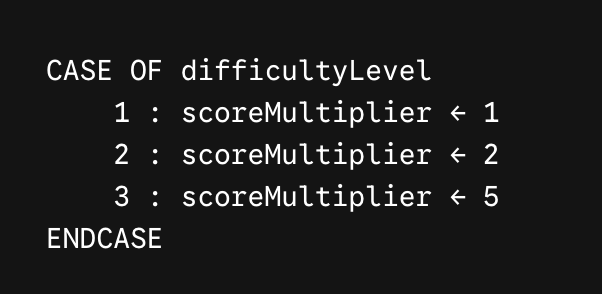
Computing AC1 and AC2
 Call Kai
 Learn
Learn Practice Test
 Spaced Repetition
 Match
Match Flashcards
 Knowt Play
1/65

Earn XP
Description and Tags
Name | Mastery | Learn | Test | Matching | Spaced | Call with Kai |
|---|
No analytics yet
Send a link to your students to track their progress
66 Terms
"What are the 5 stages of the product development lifecycle"
"Analysis <-> Design <-> coding <-> testing <-> launch"
"What are the two parts of analysis"
"Decomposition - breaking down a complex problem or system into smaller, more manageable parts
Abstraction - removing unnecessary details to focus on what is important and simplify the complexity"
"What are the 3 parts of design"
"Structured diagram - visualise end goals
Flowcharts - show how programs decomposed parts will run including any decisions or inputs needed
Pseudocode - Enable ideas and problems to be read in english"
"What are the 2 parts of testing"
"Unit testing - testing each part individually
Integration testing - testing all the code together as a program"
"What are the 6 shapes in a flowchart" (check on how to use a function in a flowchart here)
"[Diamond shape] <-> decisions
[Oval shape] <-> TERMINATOR (START/END)
[Parallelogram] <-> Input / output
[Rectangle] <-> Process
[Arrow] <-> arrows
[Rectangle with double vertical lines] <-> function"
"What is a loop in a loop called"
"nesting"
"example of totalling
x <- 7
y <- 3
z <- x+y
OUTPUT z
10
"Minimum / maximum"
"DECLARE Numbers : ARRAY OF INTEGER
DECLARE Min, i : INTEGER
Numbers <- [3, 2, 4, 7, 8, 6]
Min <- Numbers [1]
FOR i <- 1 TO LENGTH (Numbers) DO
IF Numbers [i] < Min THEN Min <- Numbers [i]
ENDIF
NEXT i"
"Average of an array"
Numbers <-[9, 1, 7, 0, 3, 42]
Total = 0
For i <- 1 TO LENGTH (Numbers) DO
Total <- Total + Numbers [i]
Next i
Avg <- Total / LENGTH (Numbers)
OUTPUT "Average is ", Avg
"What is does not equal to, equal to and does it equal to in python and pseudocode"
"python - !=
pseudocode - <>
python - =
pseudocode - <-
python - ==
pseudocode - ="
"Definition of validation check"
"a check to see if data is reasonable"
"Name the 6 validation checks"
"Range check
Length check (only works for strings)
Type check
Presence check
Format check
Check digit"
"Range check example"
"INPUT x
OUTPUT give number between 1-10"
WHILE x < 1 or x > 10
OUTPUT "Between 1 and 10"
Input x
ENDWHILE"
"Length check example"
"INPUT Password
OUTPUT "Must have exactly 8 chars"
WHILE LENGTH (Password) <> 8
OUTPUT "must have 8"
INPUT Password
ENDWHILE"
"Type check example"
"OUTPUT "Give number"
INPUT Num
WHILE Type (Num) <> Integer
OUTPUT "Number pls"
INPUT Num
ENDWHILE"
"Presence check example"
"OUTPUT "Enter name"
INPUT x
WHILE x <- ""
INPUT x
ENDWHILE"
"Format check"
"Bool <- False
repeat
INPUT Date
IF date matches "DD/MM/YY"
Bool <- True
Until Bool = True"
"Definition of Verification checks"
"if data has been copied correctly from one source to another"
"What are the two types of verification checks"
"Double entry check Visual check"
"double entry check example"
"INPUT A
INPUT B
WHILE A <> B
INPUT A
INPUT B
ENDWHILE"
"Visual check example"
"User looks at string and checks it is correct"
"What is the definition of test data"
"used for checking the program works as expected where it rejects invalid data and accepts reasonable data"
"The 4 types + definitions + examples (1-10) - of test data"
"normal - expected to work (2,3,4,5,6,7,8,9)
abnormal / erroneous - not expected to work (-1, 0, 13)
extreme - at either end but valid (1, 10)
boundary - either end but valid + not (0, 1, 10, 11)"
"When writing in pseudocode variables must be…"
"Declared"
"What is the comment sign"
"//"
"What are 5 data types + examples in pseudocode"
Integer - whole number - 1, -1, 2, 456, -235
Real (float in python) - number able to contain decimal - 1.0, 2.3, 4.0
Char - A single character, symbol, num, punctuation - A, #, 3, !
String - sequence of characters - "happy"
Boolean - logical values True and False - True, False
"does python have constants"
"No"
"Why is assigning constant variables advantageous"
"it doesn't require declarations"
"Constant variable example"
"CONSTANT HourlyRate <- 6.5"
"f you want 30 spaces in python it's [0:30] but in pseudocode it is …"
"[1:30]"
"How to declare array"
"DECLARE Names : ARRAY OF STRING"
"What about 2D declaring"
"DECLARE Names : ARRAY [1:3, 1:3] OF STRING"
"Operators Add Minus Times To the power of divide integer division remainder of"
"Add +
Minus -
Times *
To the power of ^
divide /
integer division DIV
remainder e.g 10 MOD 4 = 2 MOD"
"How to turn something into all lowercase or uppercase"
"Name <- "RISHITA"
NewName <- LCASE(Name)
NewBigName <- UCASE(Name)"
"How to get substrings in pseudocode"
"Name <- Rishita
SUBSTRING(Name, 1, 5) would be Rishi
SUBSTRING(Name, 3, 5) would be shi
SUBSTRING(Name, 1, 7) would be Rishita"
"Procedure Example" (remember all procedures call statements must have a () even if is empty)
"PROCEDURE sayHello
(start : INTEGER, end : INTEGER)
For i <- Start TO end
OUTPUT "Hello"
Next i
ENDPROCEDURE
later…
CALL sayHello (1, 5) ---- the output would be ------
(Hello, Hello, Hello, Hello, Hello)"
"what is the only diffrence between functions and procedures"
"functions have return statements"
"function example"
"FUNCTION add (A : INTEGER, B : INTEGER)
Returns Integer
DECLARE C : INTEGER
C <- A + B Return C
ENDFUNCTION
later…
TOTAL <- (5, 6) OUTPUT TOTAL -----------
11
"What are the two Filemodes"
"Read and Write"
"what are the ways to write the four different commands in file handling"
"To open - OPENFILE <Score.txt> For <Read>
To Read - READFILE <Score.txt>, <Score>
To Write - WRITEFILE <Score.txt>, <Score>
To Close - CLOSEFILE <Score.txt>"
"What are the 3 loops / iterations"
"While - pre condition
Repeat until - post condition
For - count controlled"
"What is the other selection statement"
"if statement"
"What is iteration"
"the process of repeating a sequence of instructions"
"give coding structure for all four"
"For loops: For i <- ….. ……….
Next i
While loops: WHILE ……… ……….DO
ENDWHILE
Repeat until: REPEAT…. ………..
UNTIL ………..
If statement: IF ………
THEN ………
ELSEIF ………
THEN ………
ELSE ………
THEN ………
ENDIF"
"Which loop only works in pseudocode"
"Repeat until loops"
"How to generate a random number"
"for a number between 0 and 5:
Round (Random ( ) * 5, 0) - the zero represents the decimal places rounded to (0 gives an integer)
So for a number between 4 and 10:
Round (Random ( ) * 6, 0) + 4 (10 - 4 = 6)"
"what is Scope"
"asking if something is local or global"
"what is local"
"available only inside the variable, procedure, loop"
"what is global"
"always available"
"What is a database"
"a table that holds data"
"What are the columns and rows referred to as"
"Column - Fields
Rows - Records"
"What is SQL"
"a programming language for storing and processing info in a relational database."
"What is a primary key"
"a unique identifier that each table should have"
"What are the 6 main datatypes in SQL"
alphanumeric / text - String (python) - BK01
Character - Char (python) - # / A
Integer - Integer (python) - 45
Boolean - Boolean (python) - Yes / No
Real - float (python) - 6.99
Date / time (only in SQL) - (12/12/12)
"How many main words are there that can potentially be used in a SQL statement that we know so far"
"6"
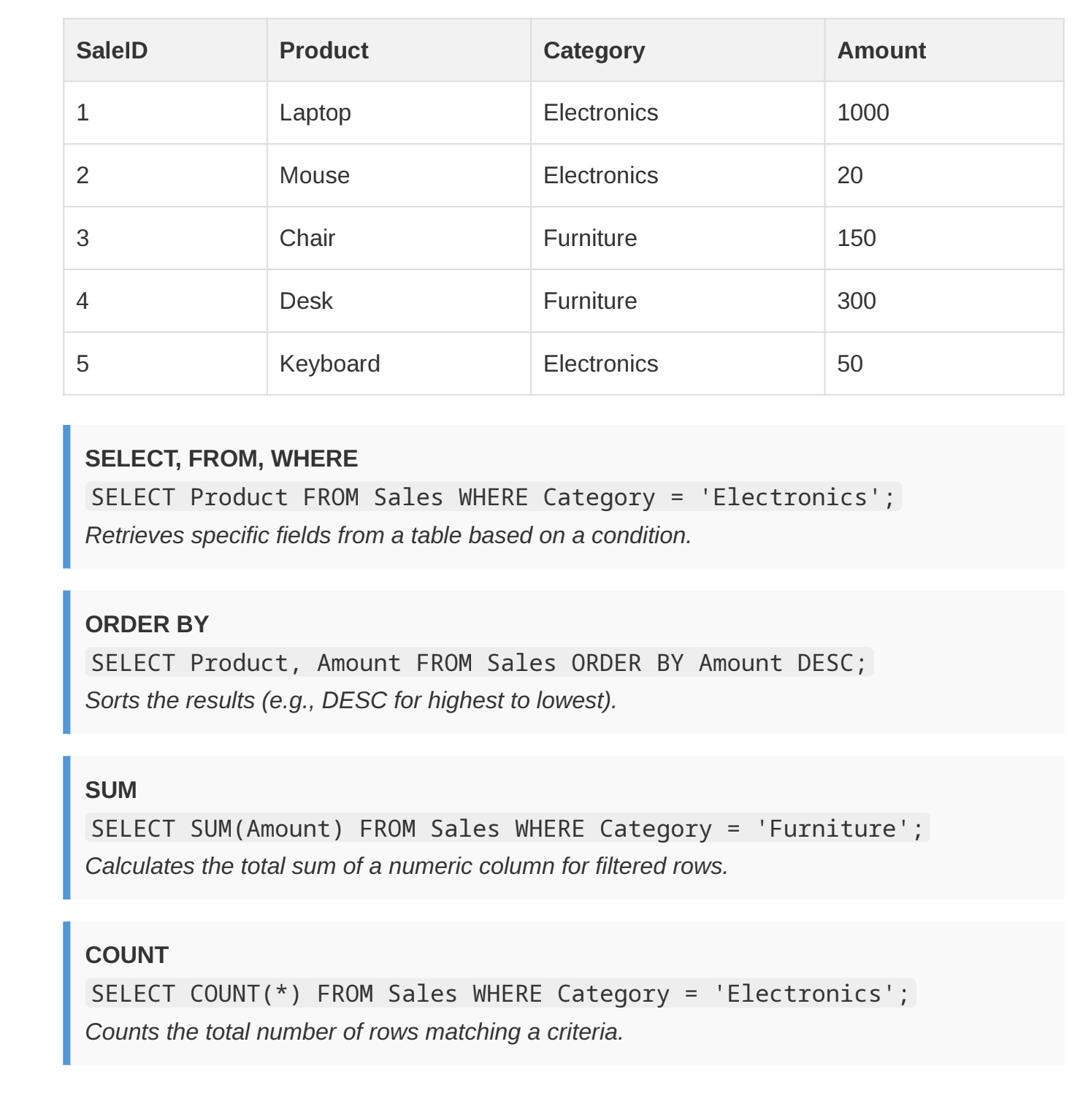
"What are all the different SQL statements + definitions"
"SELECT - selecting the necessary field
FROM - which table is being referred
WHERE - The question you want the answer too
ORDER BY - info in any kind of order
SUM - all numbers added
COUNT - how many of something there are"
"what does * mean"
"select all"
"give examples of how to use each one"
"How many logic gates are there"
"6"
"what does it do - Not gate"
"takes an input and flips it"
"what does it do - And Gate"
"Both inputs must be 1 for output to be 1"
"what does it do - Or gate"
"Atleast 1 input needs to be 1 for the output to be 1"
what does it do - Nand Gate (Not + And)
Opposite outputs of the and table outputs
"what does it do - Nor Gate (Not + Or)"
"the opposite outputs of the Or gate outputs"
"what does it do - Xor gate (Special Or)"
"exactly one of the two inputs need to be 1 for the output to be 1 - different inputs"
what does a case statement look like