Biology 3/4 Cells & Nucleic Acids
 Call Kai
 Learn
Learn Practice Test
 Spaced Repetition
 Match
Match Flashcards
 Knowt Play
1/48

There's no tags or description
Looks like no tags are added yet.
Name | Mastery | Learn | Test | Matching | Spaced | Call with Kai | Chat |
|---|
No analytics yet
Send a link to your students to track their progress
49 Terms
What are cells
The smallest building blocks of life
What is the purpose of nucleic acid
it is the blueprint/instructions which codes for protein
What is the function of Nucleic Acid
it is the genetic instruction of the cell
What determines how a cell develops
The packing of large polymers in the nucleus to store information determines how a cell develops as they encode for proteins that are responsible for a specific function
polymer
large chain of molecule made of small repeating subunits (monomers)
Types of nucleic acids
DNA and RNA
What does DNA stand for
Deoxyribose nucleic acid
what does RNA stand for
Ribonucleic Acid
nucleotide
small repeating subunit (monomers)
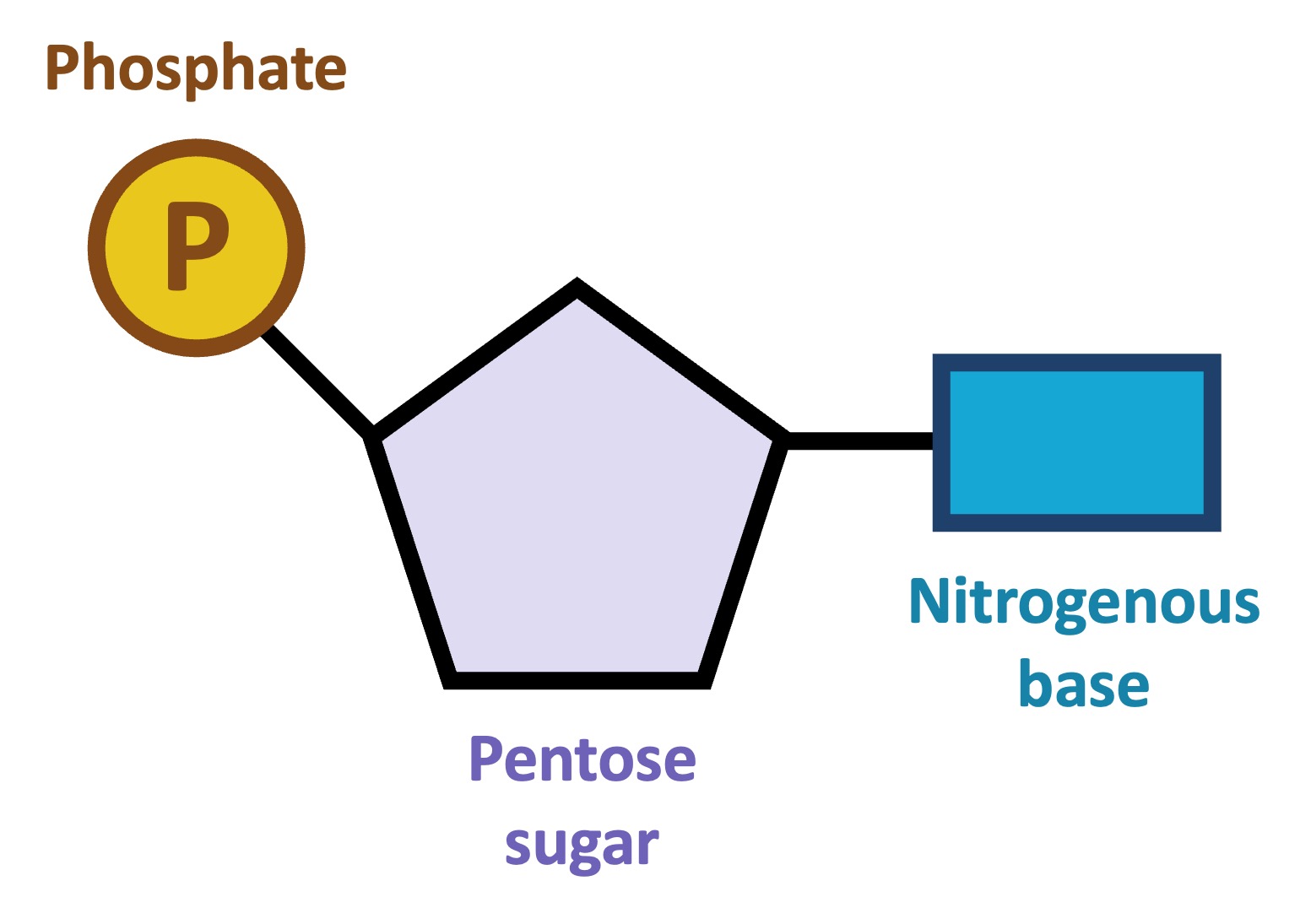
draw and label a basic diagram of nucleotides
phosphate group, 5 carbon sugar, Nitrogenous bases
What changes in a nucleotide
the nitrogenous bases
What are the types of nitrogenous bases write them in pairs and list them as DNA, RNA or both
Adenine + Thymine (DNA), Cytosine + Guanine (Both) , Adenine + Uracil (RNA)
What differentiates DNA and RNA
Different shapes/arrangement therefore different functions
Nucleotides may be different
How are nucleotides joined together to create a polymer
Condensation polymerisation, which is a reaction between nucleotides that allows the nucleic acid chain to build up
Condensation
Water is formed as a byproduct
Polymerisation
Creation of a polymer ( joining of monomers)
What bond are nucleotides linked together by
Phosphate bonds, which are strong covalent bonds
What forms the backbone of DNA
Sugar phosphate backbone
Why is numbering the carbons important
rovides a universal map of a molecule's structure.
What is each number of the carbons
1’ attaches to nitrogenous base
3’ attaches to the phosphate of the adjacents Nucleotide
5’ attaches to the phosphate of the same nucleotide
How are DNA strands aligned
Antiparrallel
Where is DNA found
In the nucleus of the cell
How is DNA packed in humans
in humans it is packed as 46 chromosomes which contain genes
What do the chromosomes consist of
long DNA strands tightly coiled around histone proteins which allows them to accommodate large amounts of DNA
What is DNA made of
phosphate Deoxyribose sugar, Nitrogenous bases
What is the structure of DNA
double stranded double helix
How are the double strands held together
Via a hydrogen bond which binds complementary bases
What is the structure of RNA
single stranded
What is RNA made of
Ribose sugar
Phosphate group
Nitrogenous bases (uracil replaces thymine)
What are thye types of RNA
mRNA - messeger RNA
tRNA - Transfer RNA
rRNA - Ribosomal RNA
What does mRNA do
carries copies of genetic instructions from DNA to ribosome
purpose of mRNA
so DNA doesnt get damaged, DNA is permanent, DNA is too large
What does tRNA do
carries specific amino acids in their correct order to the ribosome
What does rRNA do
forms the majority of the structure of the ribosome
genes
a sections of DNA that codes for a protein
WHat is the process by which a protein is made form a gene called
Gene expression
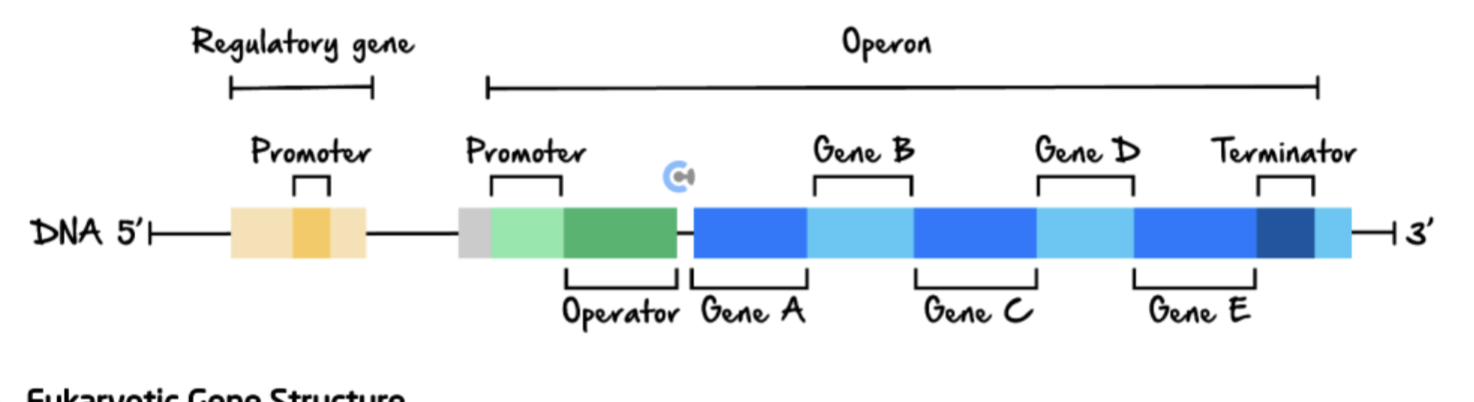
draw prokaryotic gene structure
draw eukaryotic gene structure
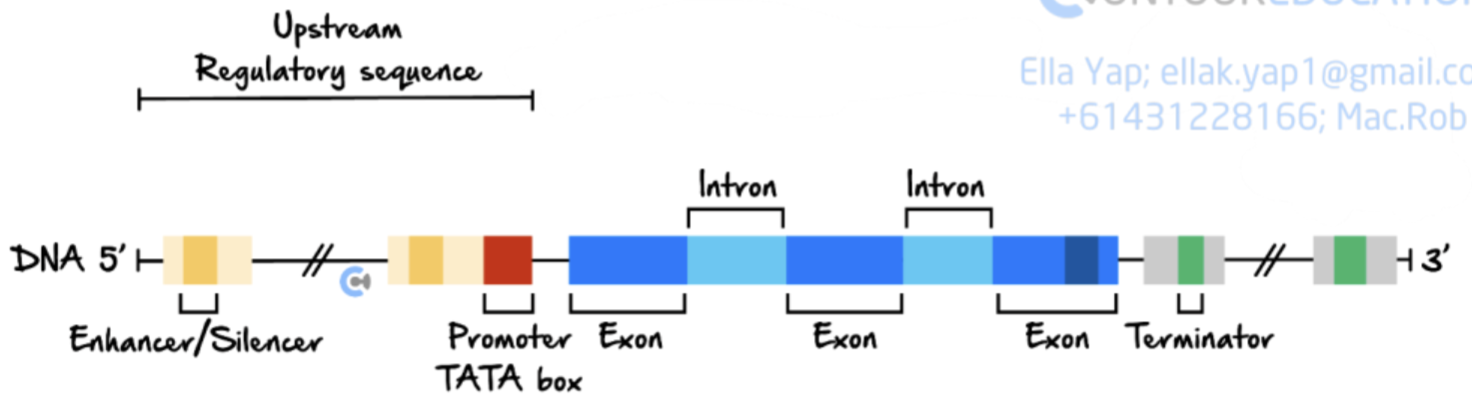
What are the components of genes
Exons, Introns, Promoter, Operator, Terminator
Exons
Coding region
introns
non-coding region
promoter
start of the gene
operator
regulating sequence
terminator
end of gene
What are the characteristics of genetic code
Universal
Triplet
Degenerate
Universal
the same codons code for the same amino acids in all organisms
triplet
3 bases code for 1 amino acid
Degenerate
more than one codon can code for the same amino acid