OCR A | Chemistry | Module 4 Flashcards
 Call Kai
 Learn
Learn Practice Test
 Spaced Repetition
 Match
Match Flashcards
 Knowt Play
1/24

Earn XP
Description and Tags
Entirety of Module 4 AS Chem OCR A.
Name | Mastery | Learn | Test | Matching | Spaced | Call with Kai | Chat |
|---|
No analytics yet
Send a link to your students to track their progress
25 Terms
Define homologous series.
A series of organic compounds that have the same functional group where each successive member varies by CH2
Define functional group.
The group of atoms responsible for the characteristic reactions of a compound.
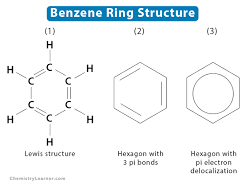
What is an aromatic compound?
A compound containing a benzene ring
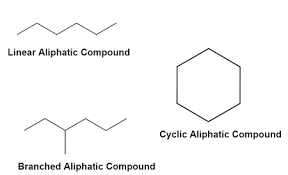
What is an aliphatic compound?
An aliphatic compound is a hydrocarbon joined in a straight, branched or non aromatic rings
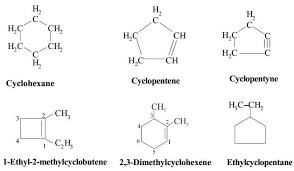
What is an alicyclic compound?
An alicyclic compound is an aromatic compound joined in non aromatic rings with / without side chains.
What is a saturated compound?
A saturated compound only contains single C-C bonds.
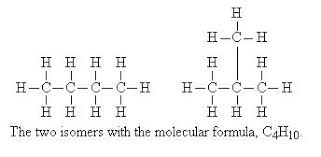
What is an unsaturated compound?
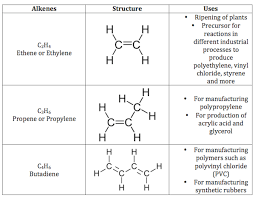
An unsaturated compound is one which only has one or multiple C=C or C≡C bonds
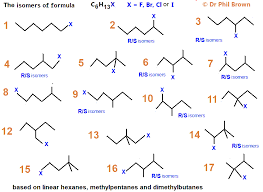
What is a structural isomer?
A structural isomer is where molecules have different arrangements of the carbon skeleton. Some are straight chains and some are branched.
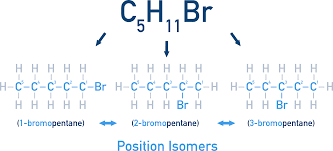
What is a positional isomer?
A positional isomer is one where molecules have the same skeleton and same functional group. The difference is that the group is attached to different carbons.
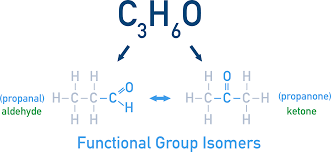
What is a functional isomer?
A functional isomer is one where the same atoms are arranged into different functional groups (eg. aldehydes and ketones)
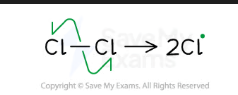
What is homolytic fission?
Homolytic fission occurs when each of the bonded atoms takes one of the shared pair of electrons. This forms two radicals.
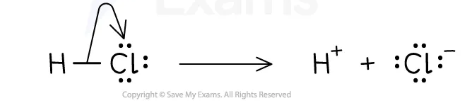
What is heterolytic fission?
Heterolytic fission occurs when only one of the bonded atoms takes both of the shared pair of electrons. This forms a negative and positive ion.
What is a radical?
An atom / group of atoms with a single unpaired electron.
What is a nucleophile?
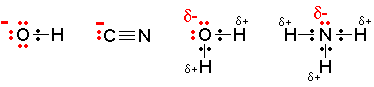
Donates electrons. A nucleophile i s attracted to a positively charged area, so it must have a strong δ- or negative charge.
What are common nucleophiles?
Common nucleophiles are hydroxide ions, cyanide ions, water and ammonia.
What is an electrophile?
Steals electrons. Because an electrophile is attracted to a negatively charged (electron dense) area it must have a δ+ or positive charge.
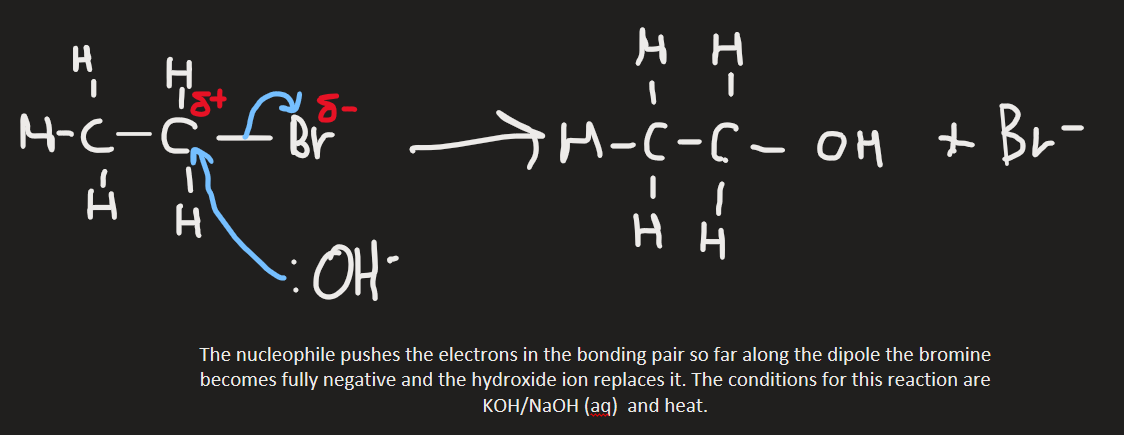
What are the reactants in the production of ethanol?
Bromoethane
Aqueous Sodium OR
Potassium Hydroxide
What are the products in the production of ethanol?
Ethanol
Bromide Ion
What kind of reaction is the production of ethanol?
Nucleophilic Substitution
What are the conditions for the production of ethanol?
Heat
Reaction Mechanism for the production of ethanol.
What are the reactants in the production of propionitrile?
Bromoethane and Cyanide (Ion)
What are the products in the production of propionitrile?
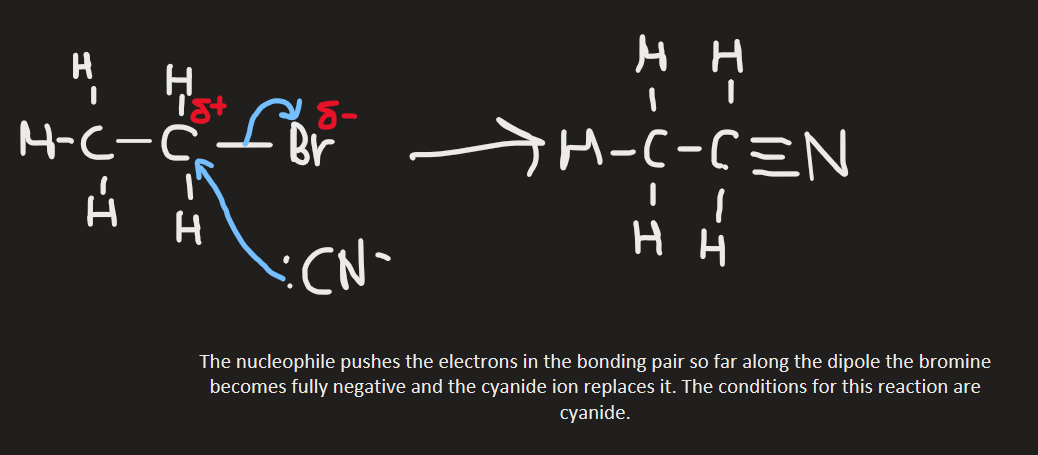
What are the conditions for the production of propionitrile?
Reaction mechanism for the production of propionitrile?