Section 2.2 - Test Levels & Test Types (Quizzes I - IX)
 Studied by 0 people
 Call Kai
 Learn
Learn Practice Test
 Spaced Repetition
 Match
Match Flashcards
 Knowt Play
1/348

Earn XP
Description and Tags
Quizzes I through IX of ISTQB Section 2.2
Name | Mastery | Learn | Test | Matching | Spaced | Call with Kai |
|---|
No study sessions yet.
349 Terms
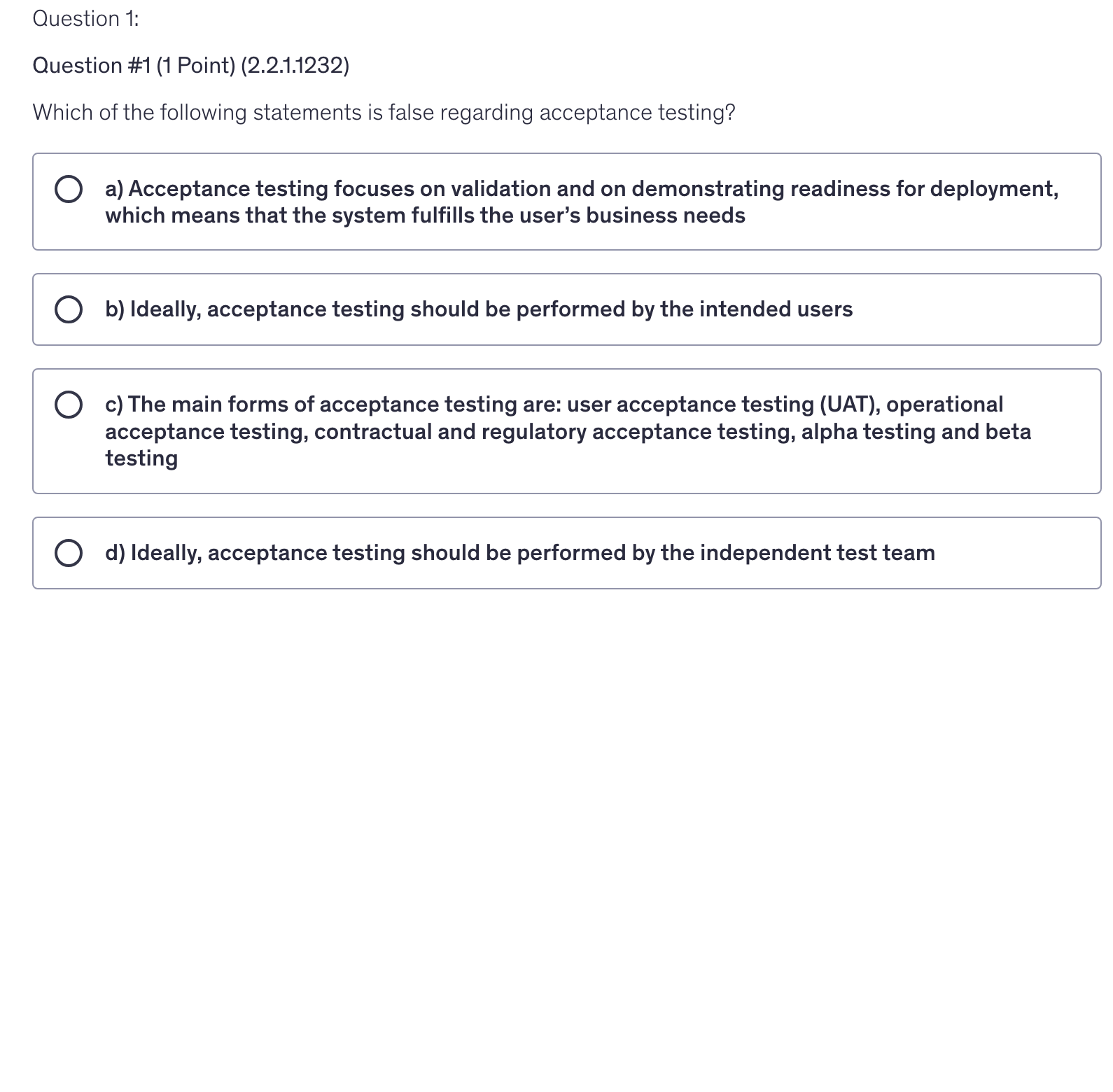
Which of the following statements is false regarding acceptance testing?
d) Ideally, acceptance testing should be performed by the independent test team
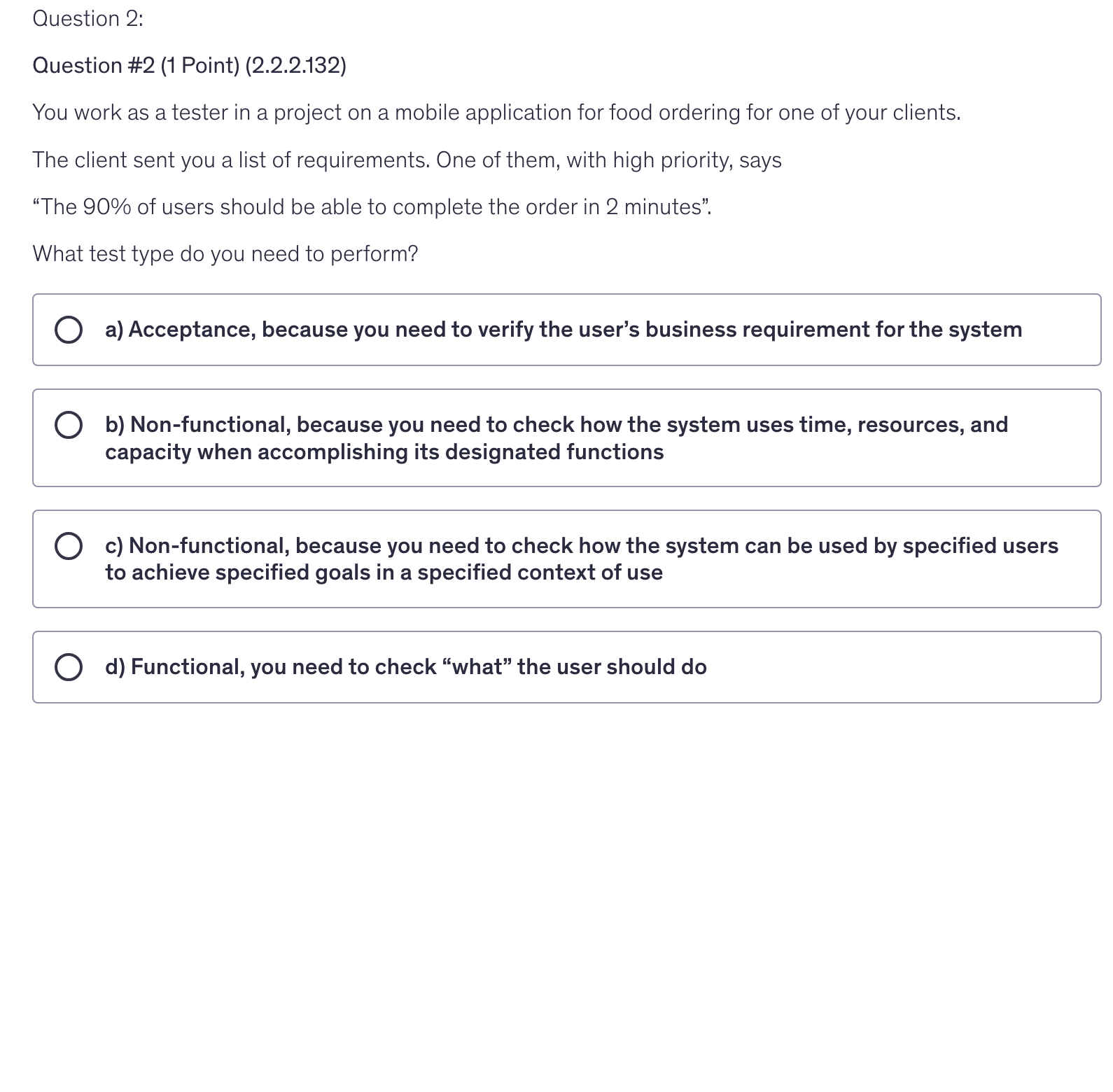
You work as a tester in a project on a mobile application for food ordering for one of your clients.
The client sent you a list of requirements. One of them, with high priority, says
“The 90% of users should be able to complete the order in 2 minutes”.
What test type do you need to perform?
c) Non-functional, because you need to check how the system can be used by specified users to achieve specified goals in a specified context of use
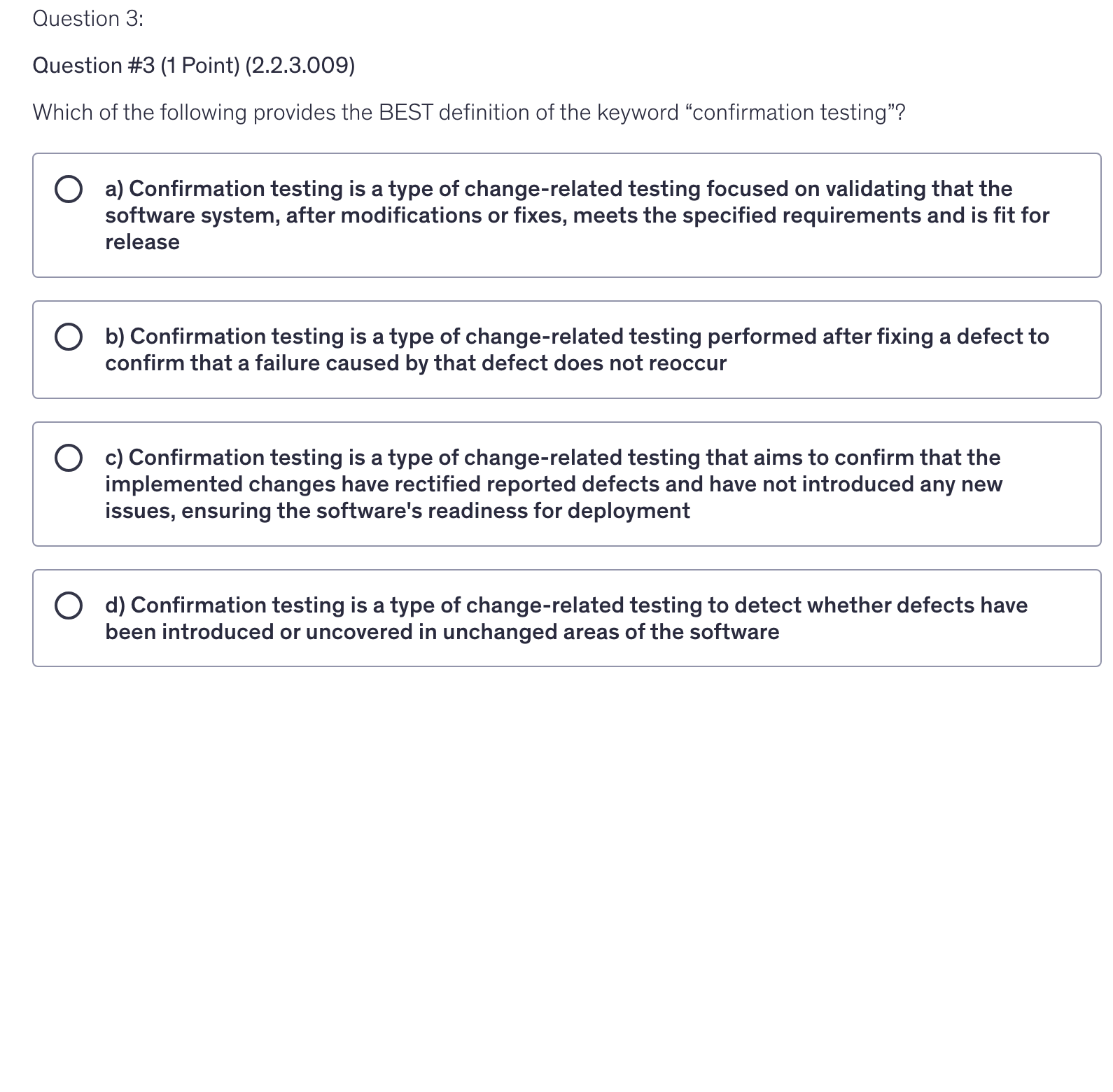
Which of the following provides the BEST definition of the keyword “confirmation testing”?
b) Confirmation testing is a type of change-related testing performed after fixing a defect to confirm that a failure caused by that defect does not reoccur
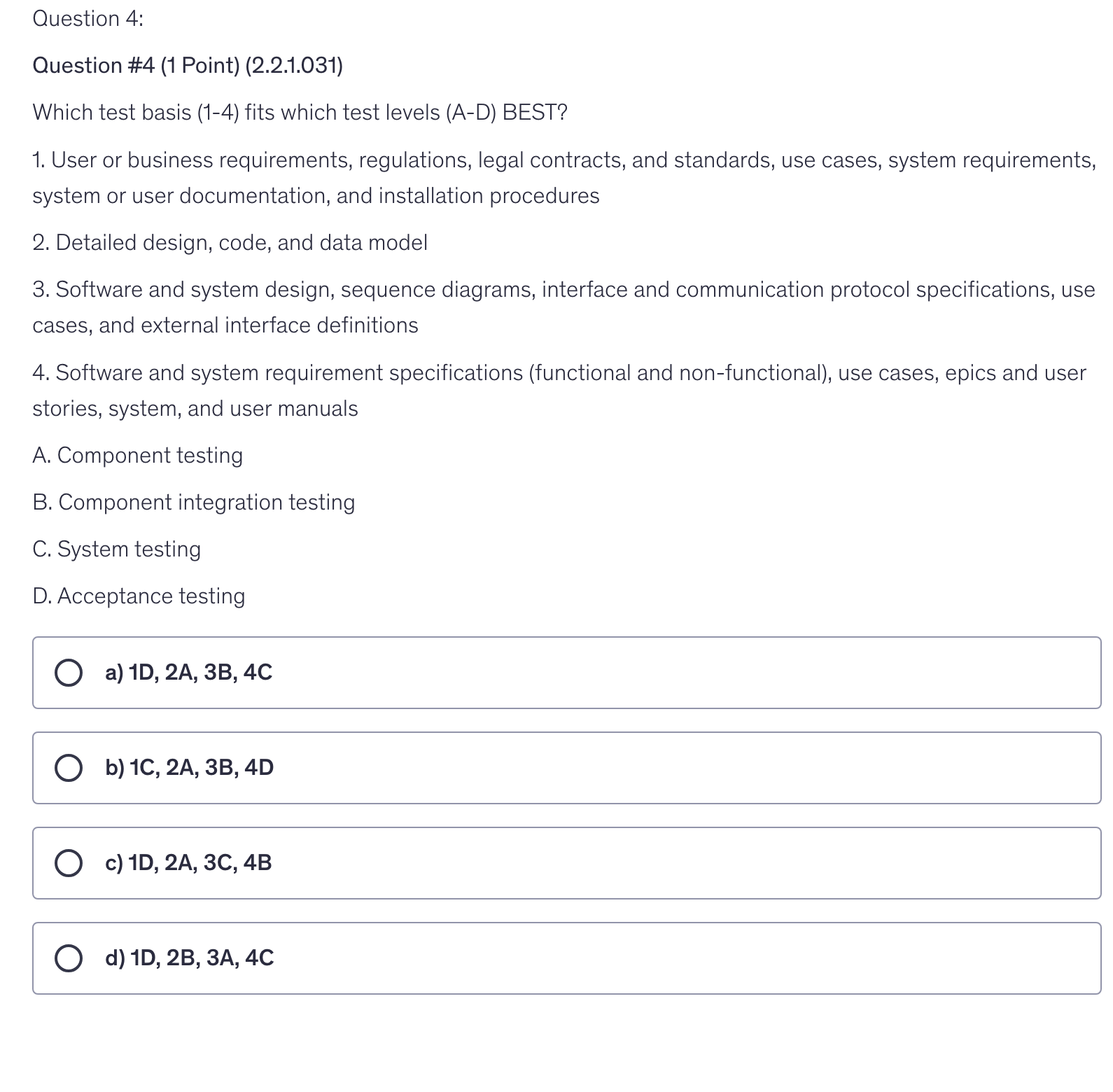
1. User or business requirements, regulations, legal contracts, and standards, use cases, system requirements, system or user documentation, and installation procedures
2. Detailed design, code, and data model
3. Software and system design, sequence diagrams, interface and communication protocol specifications, use cases, and external interface definitions
4. Software and system requirement specifications (functional and non-functional), use cases, epics and user stories, system, and user manuals
A. Component testing
B. Component integration testing
C. System testing
D. Acceptance testing
a) 1D, 2A, 3B, 4C
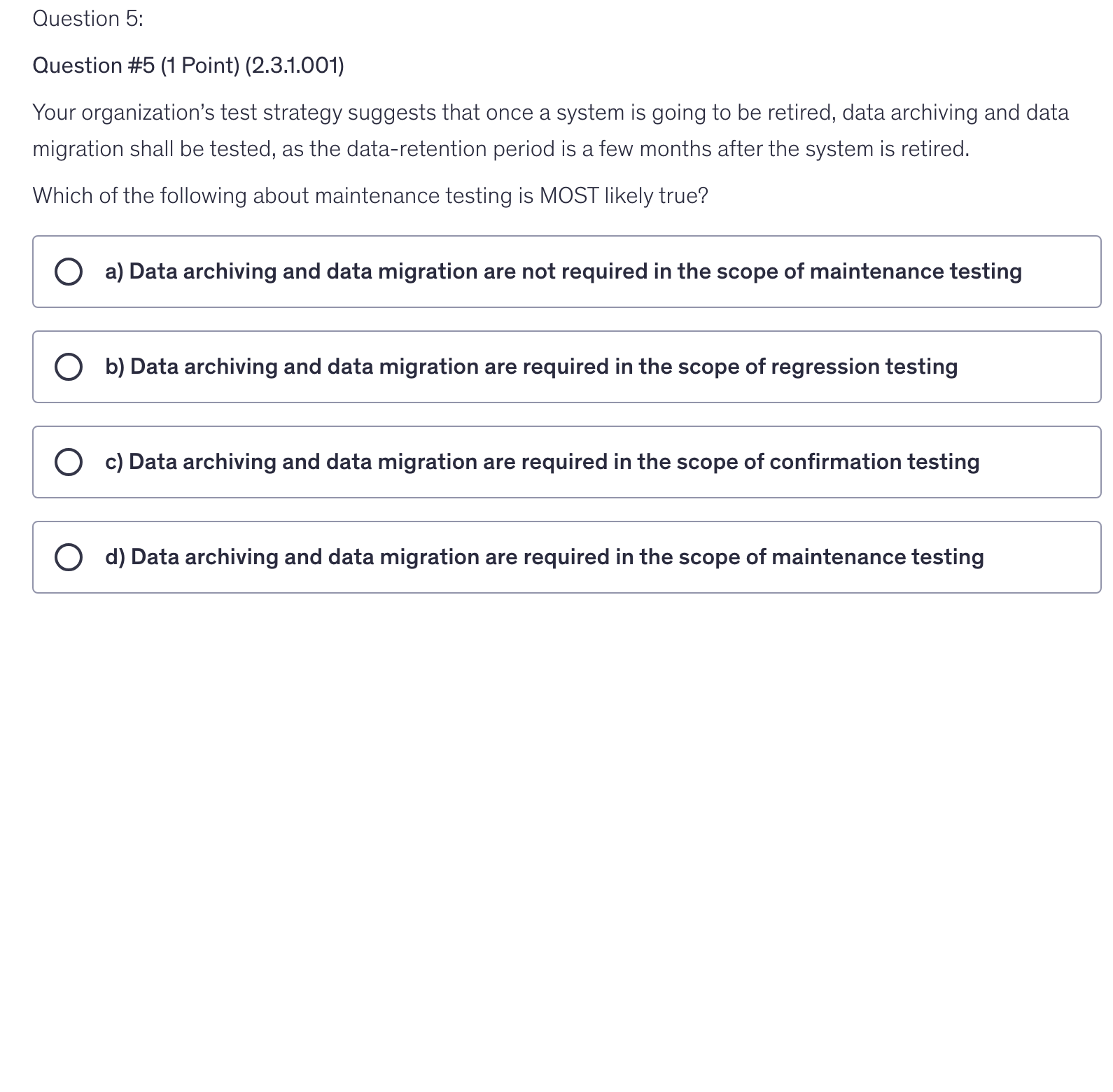
Your organization’s test strategy suggests that once a system is going to be retired, data archiving and data migration shall be tested, as the data-retention period is a few months after the system is retired.
Which of the following about maintenance testing is MOST likely true?
d) Data archiving and data migration are required in the scope of maintenance testing
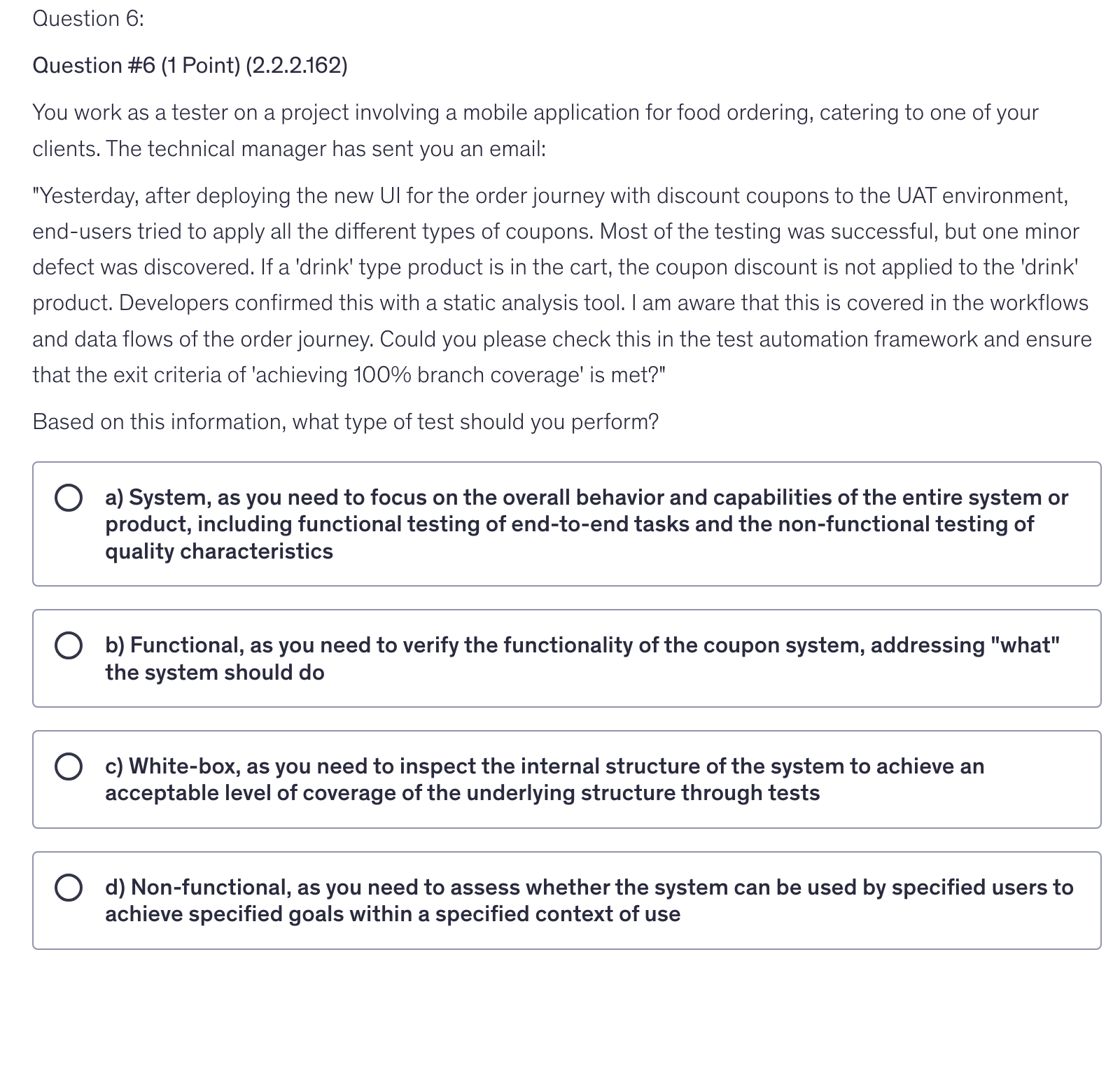
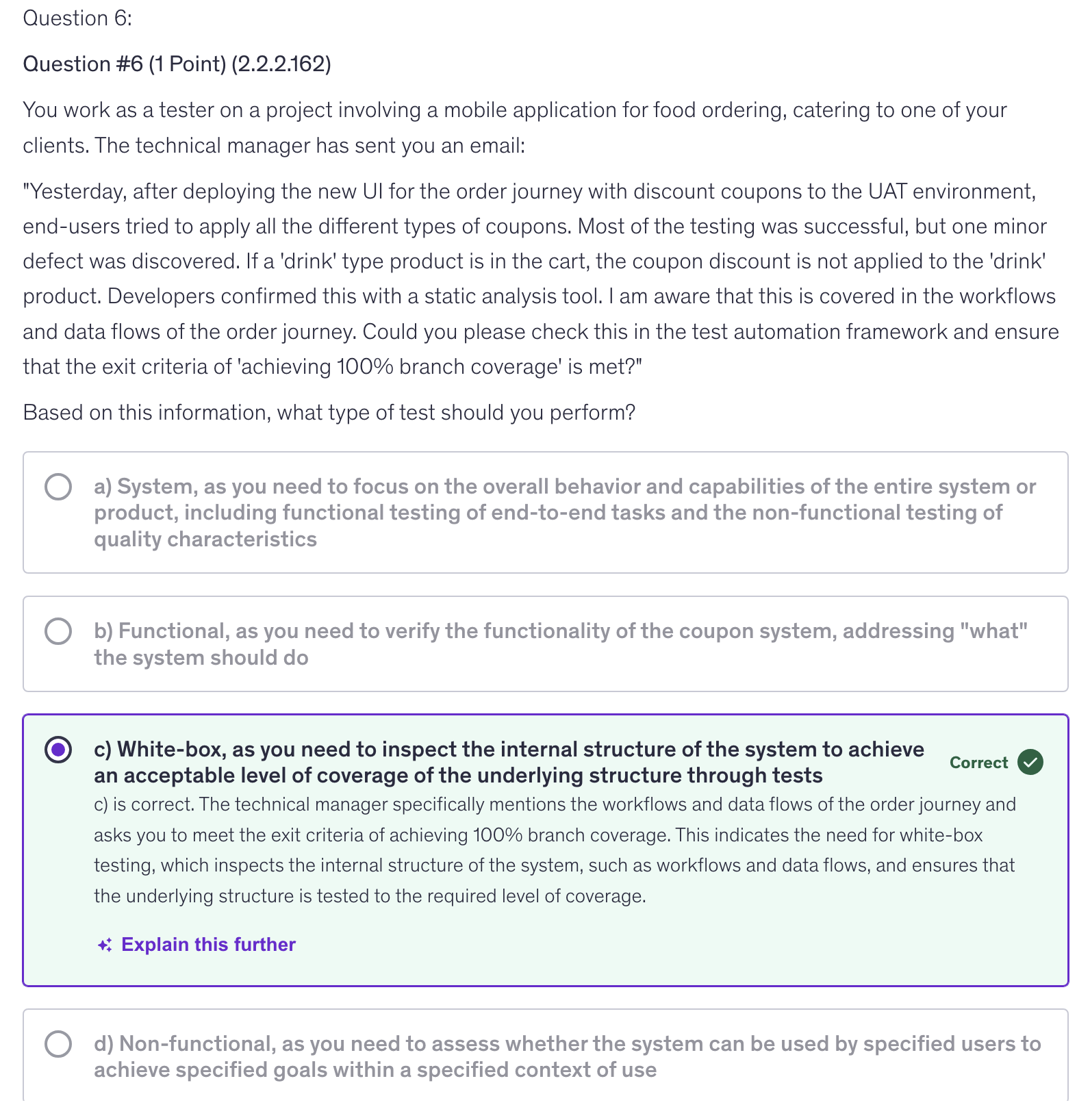
You work as a tester on a project involving a mobile application for food ordering, catering to one of your clients. The technical manager has sent you an email:
"Yesterday, after deploying the new UI for the order journey with discount coupons to the UAT environment, end-users tried to apply all the different types of coupons. Most of the testing was successful, but one minor defect was discovered. If a 'drink' type product is in the cart, the coupon discount is not applied to the 'drink' product. Developers confirmed this with a static analysis tool. I am aware that this is covered in the workflows and data flows of the order journey. Could you please check this in the test automation framework and ensure that the exit criteria of 'achieving 100% branch coverage' is met?"
Based on this information, what type of test should you perform?
c) White-box, as you need to inspect the internal structure of the system to achieve an acceptable level of coverage of the underlying structure through tests
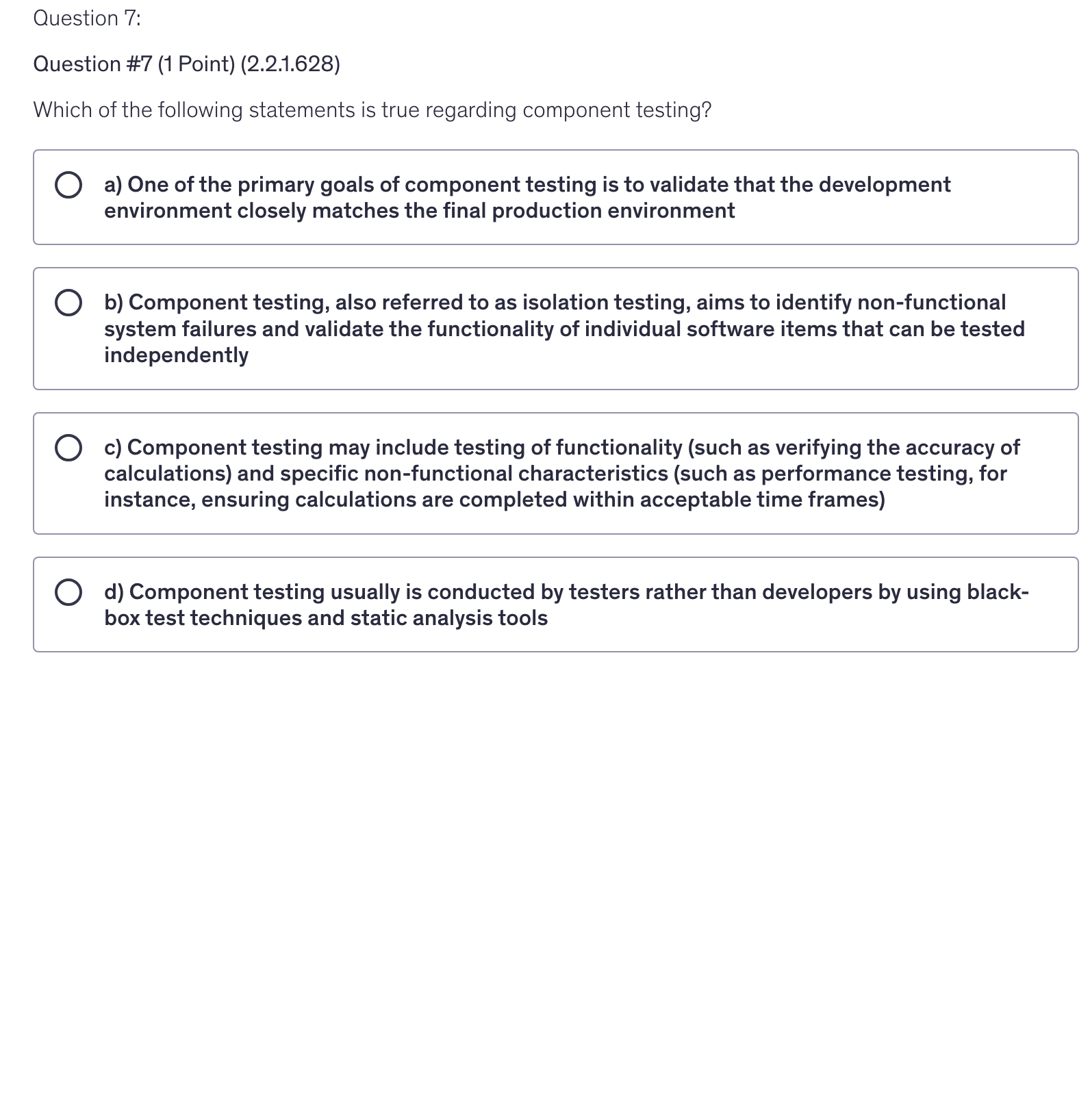
Which of the following statements is true regarding component testing?
c) Component testing may include testing of functionality (such as verifying the accuracy of calculations) and specific non-functional characteristics (such as performance testing, for instance, ensuring calculations are completed within acceptable time frames)
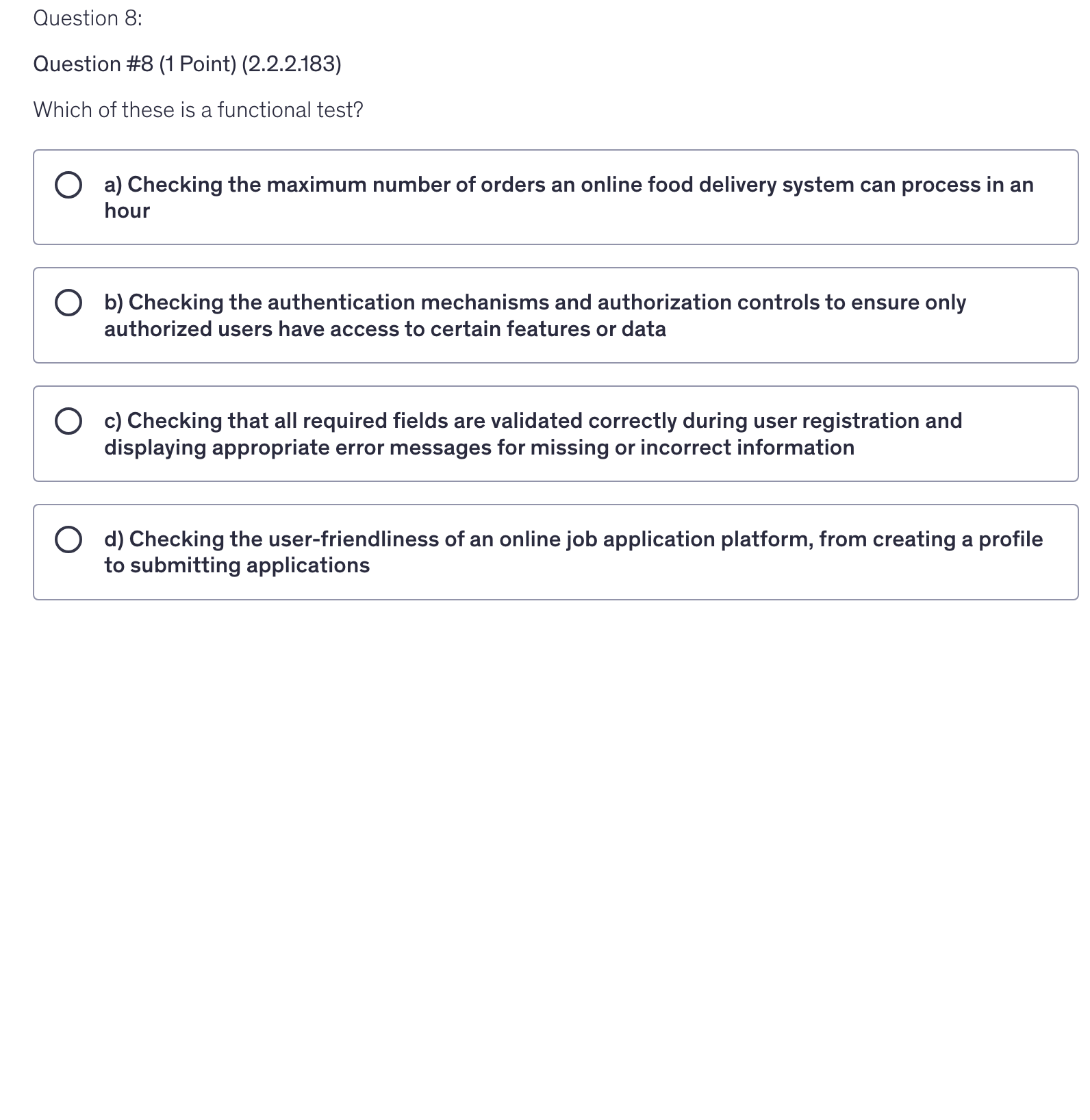
Which of these is a functional test?
c) Checking that all required fields are validated correctly during user registration and displaying appropriate error messages for missing or incorrect information
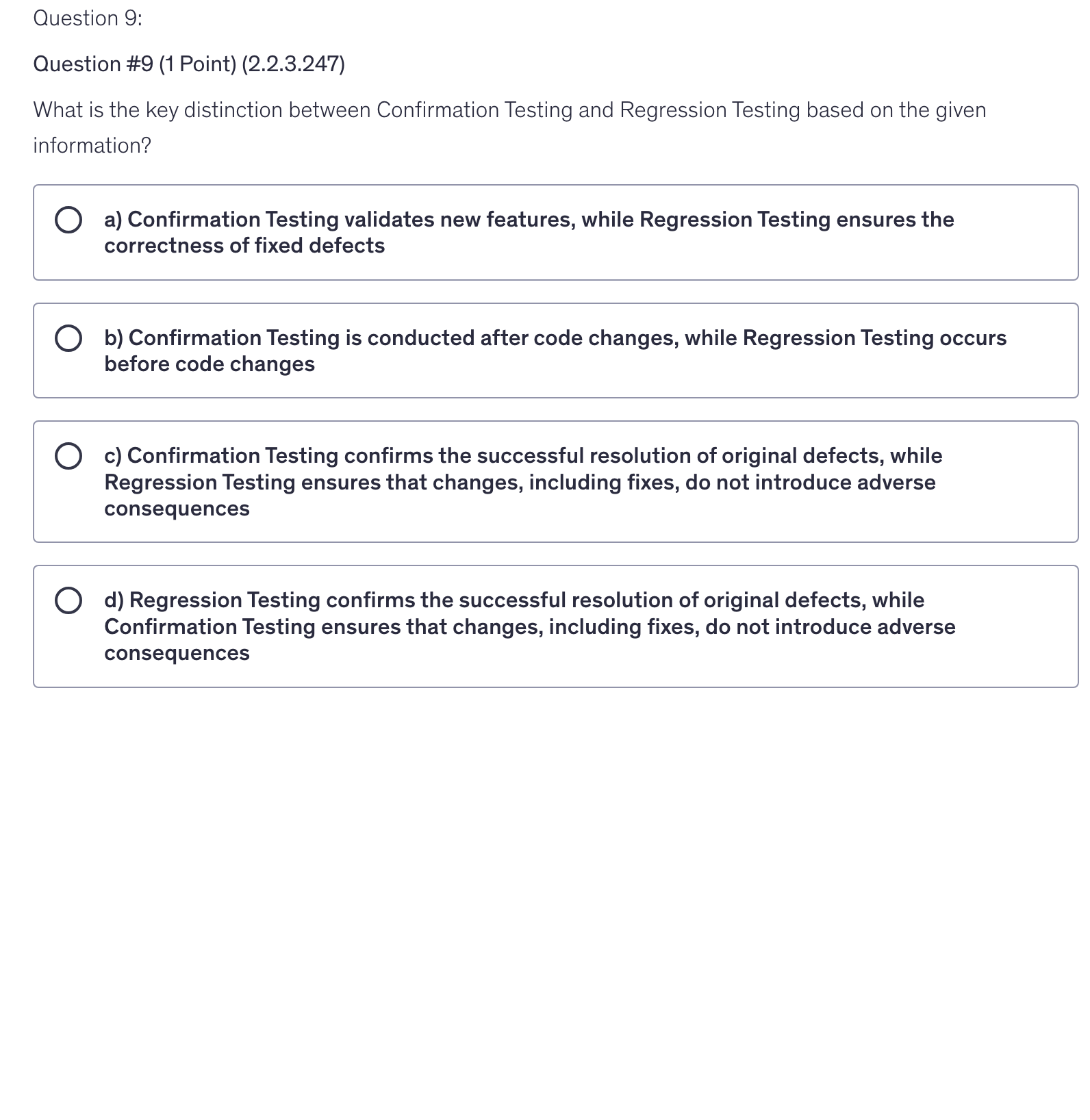
What is the key distinction between Confirmation Testing and Regression Testing based on the given information?
c) Confirmation Testing confirms the successful resolution of original defects, while Regression Testing ensures that changes, including fixes, do not introduce adverse consequences
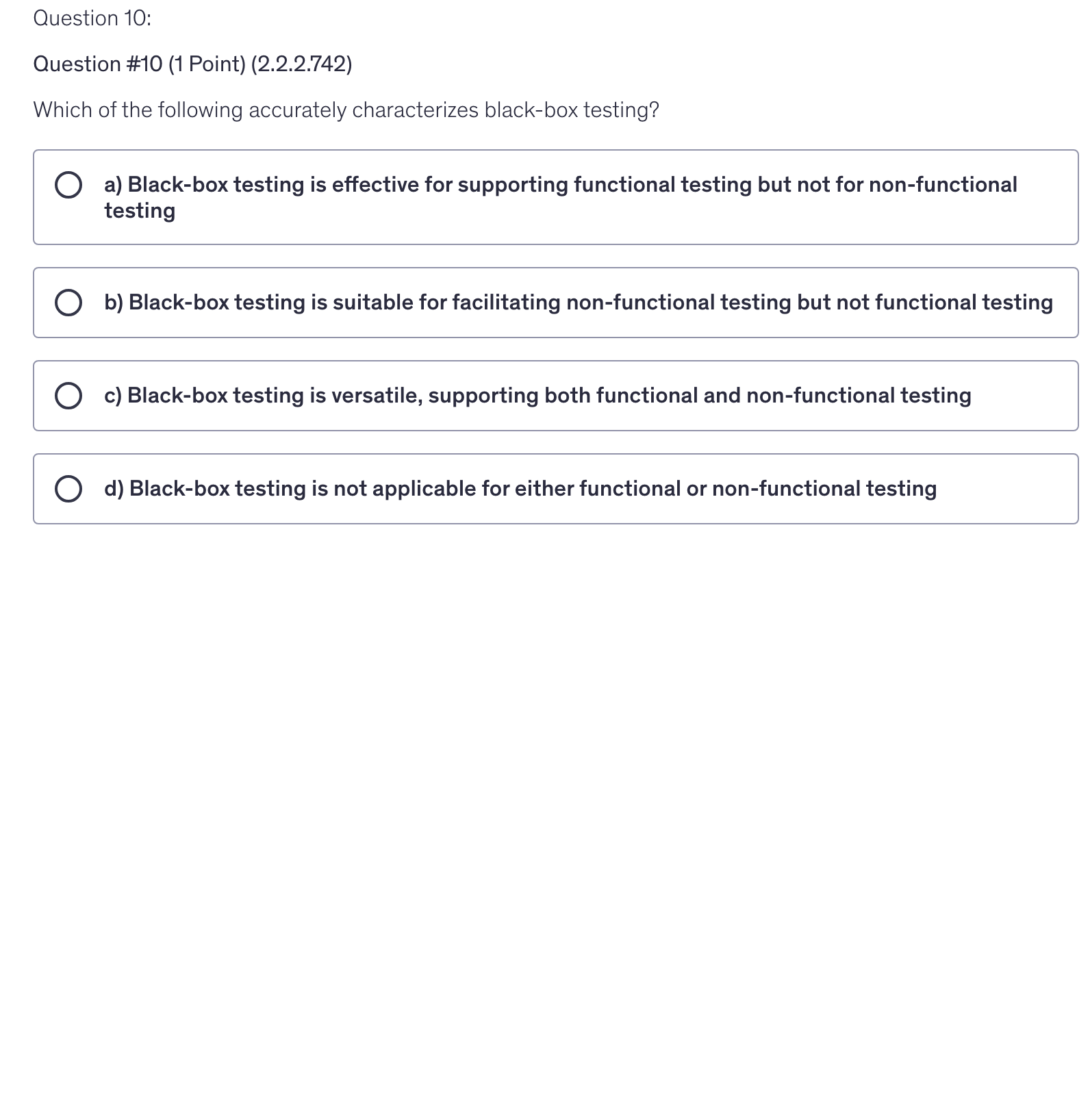
Which of the following accurately characterizes black-box testing?
c) Black-box testing is versatile, supporting both functional and non-functional testing
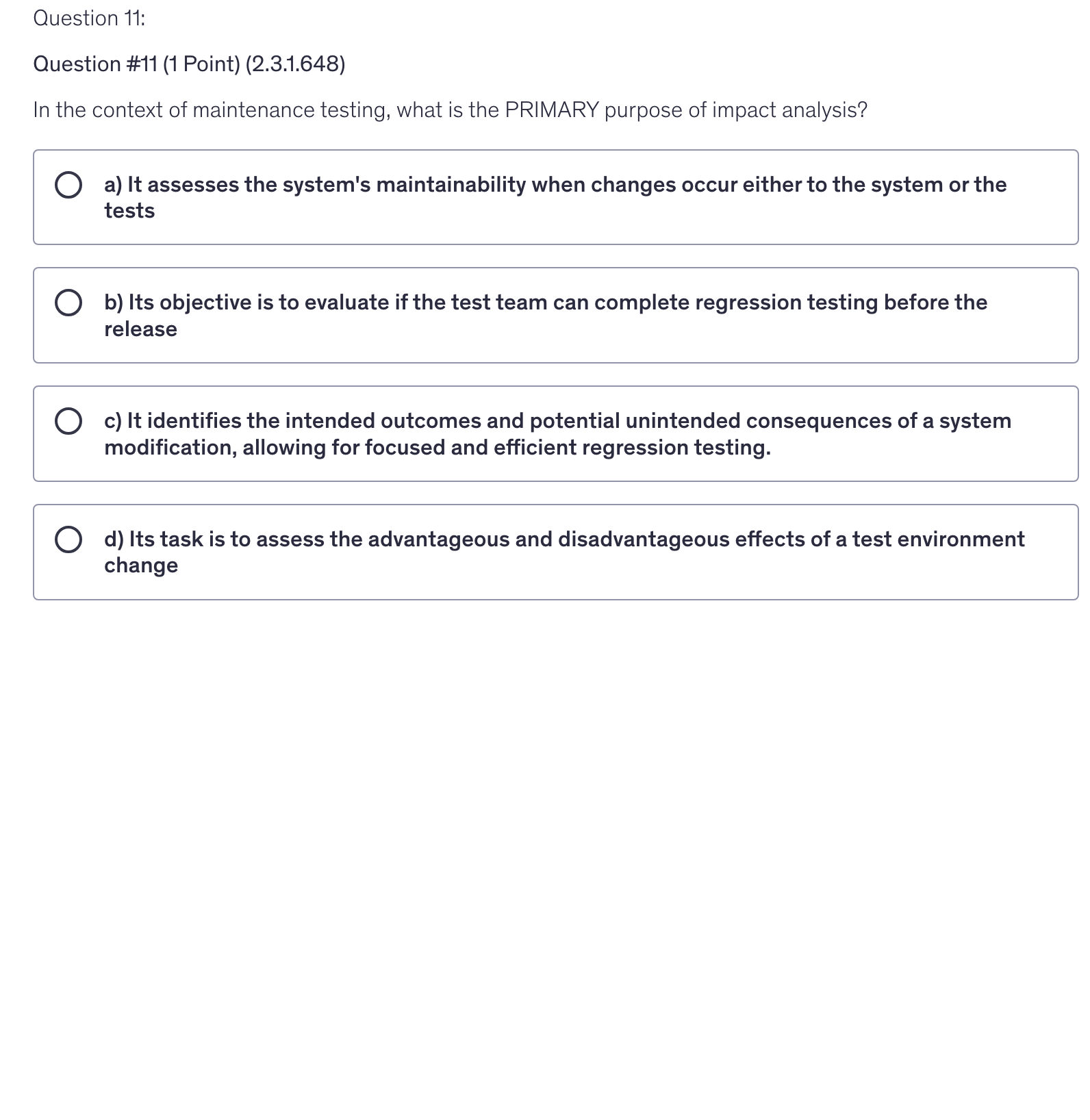
In the context of maintenance testing, what is the PRIMARY purpose of impact analysis?
c) It identifies the intended outcomes and potential unintended consequences of a system modification, allowing for focused and efficient regression testing
You work as a tester on a transportation and logistics app for a delivery service.
Your tasks are:
"To detect whether defects have been introduced or uncovered in unchanged areas of the software"
What levels of testing are possibly available for you to perform?
i. Component testing
ii. Component integration testing
iii. System testing
iv. Acceptance testing
v. Confirmation testing
vi. Regression testing
c) i, ii, iii, iv
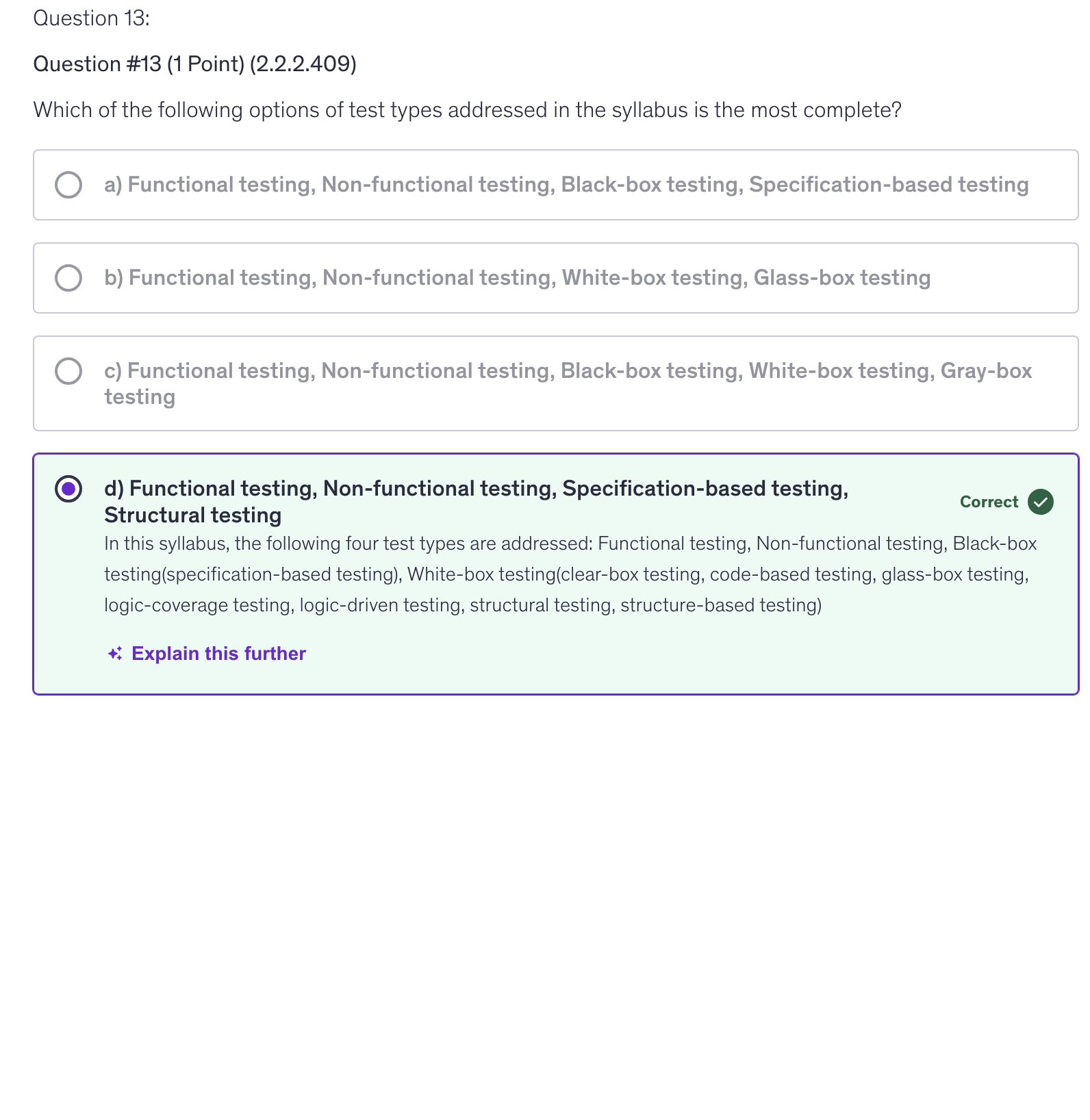
Which of the following options of test types addressed in the syllabus is the most complete?
d) Functional testing, non-functional testing, specification-based testing, structural testing
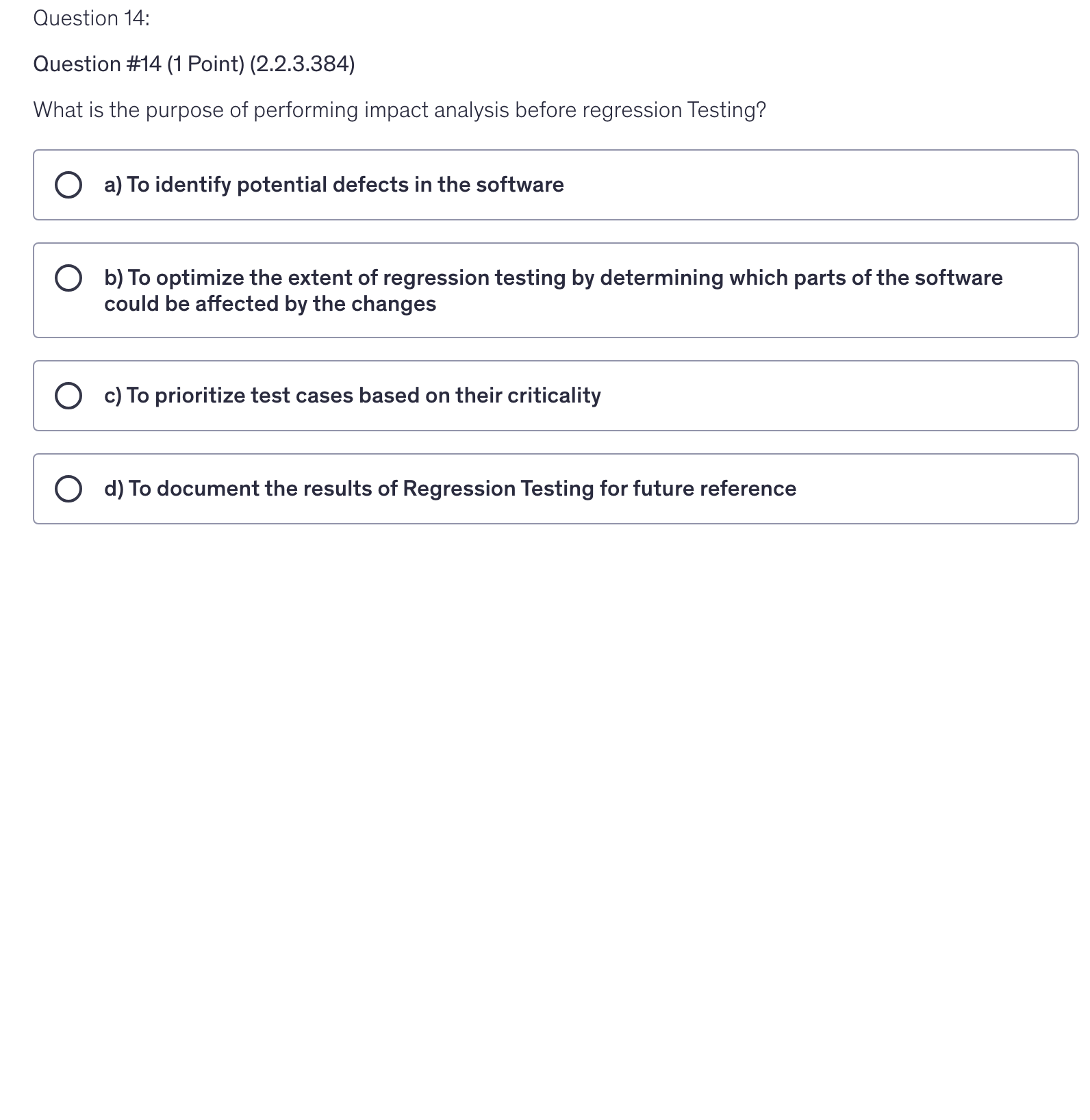
What is the purpose of performing impact analysis before regression Testing?
b) To optimize the extent of regression testing by determining which parts of the software could be affected by the changes
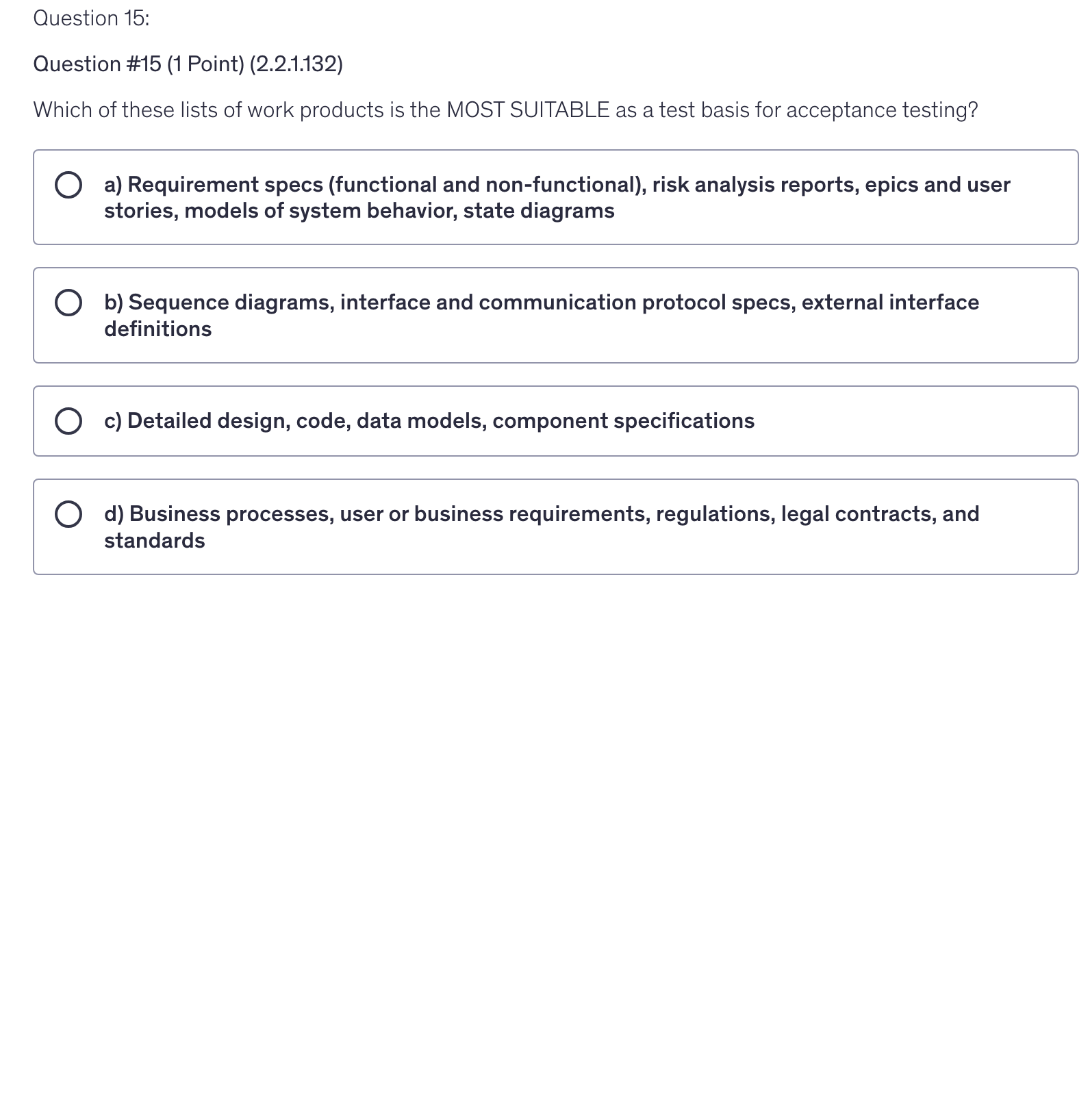
Which of these lists of work products is the MOST SUITABLE as a test basis for acceptance testing?
d) Business processes, user or business requirements, regulations, legal contracts, and standards
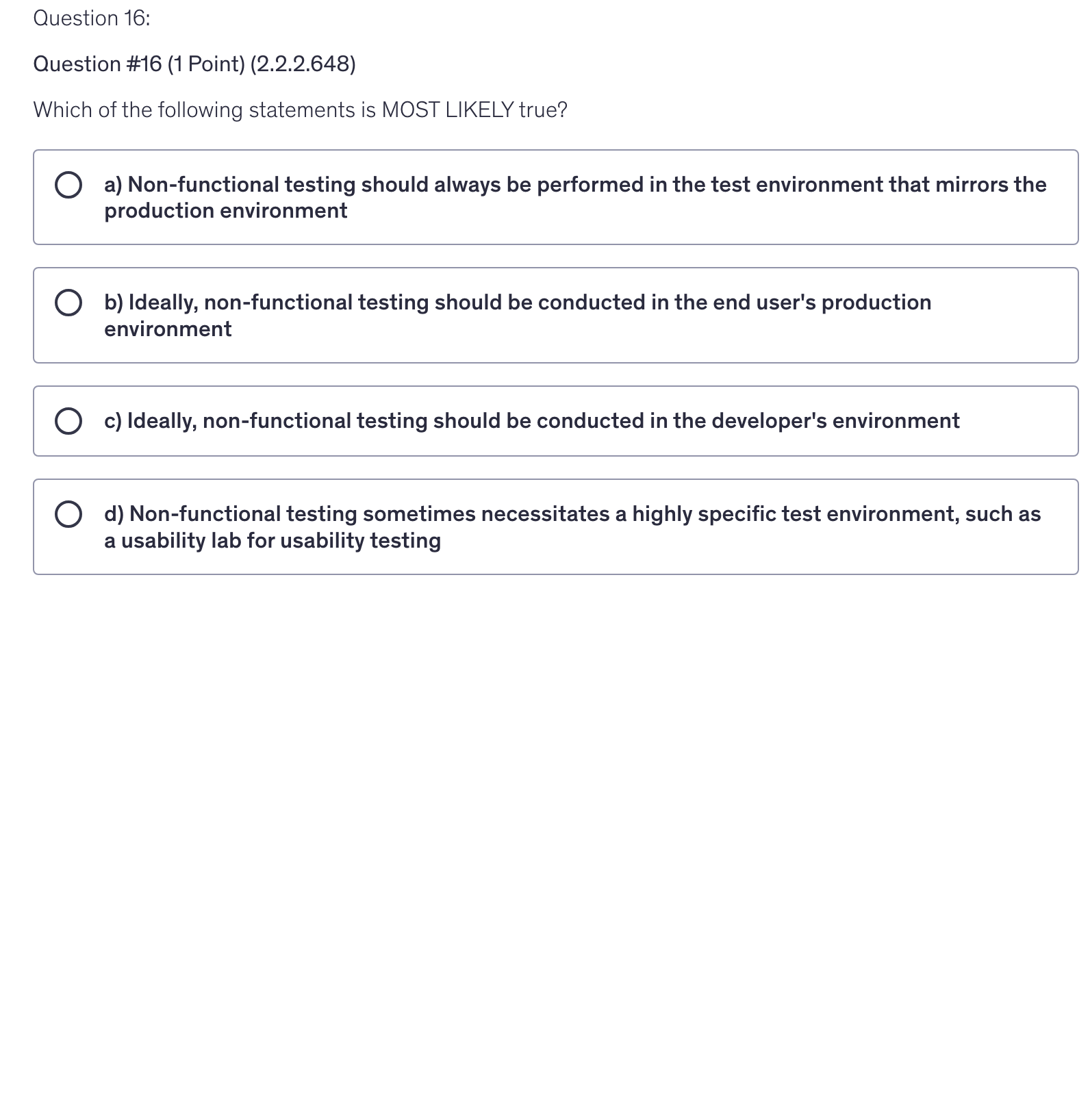
Which of the following statements is MOST LIKELY true?
d) Non-functional testing sometimes necessitates a highly specific test environment, such as a usability lab for usability testing
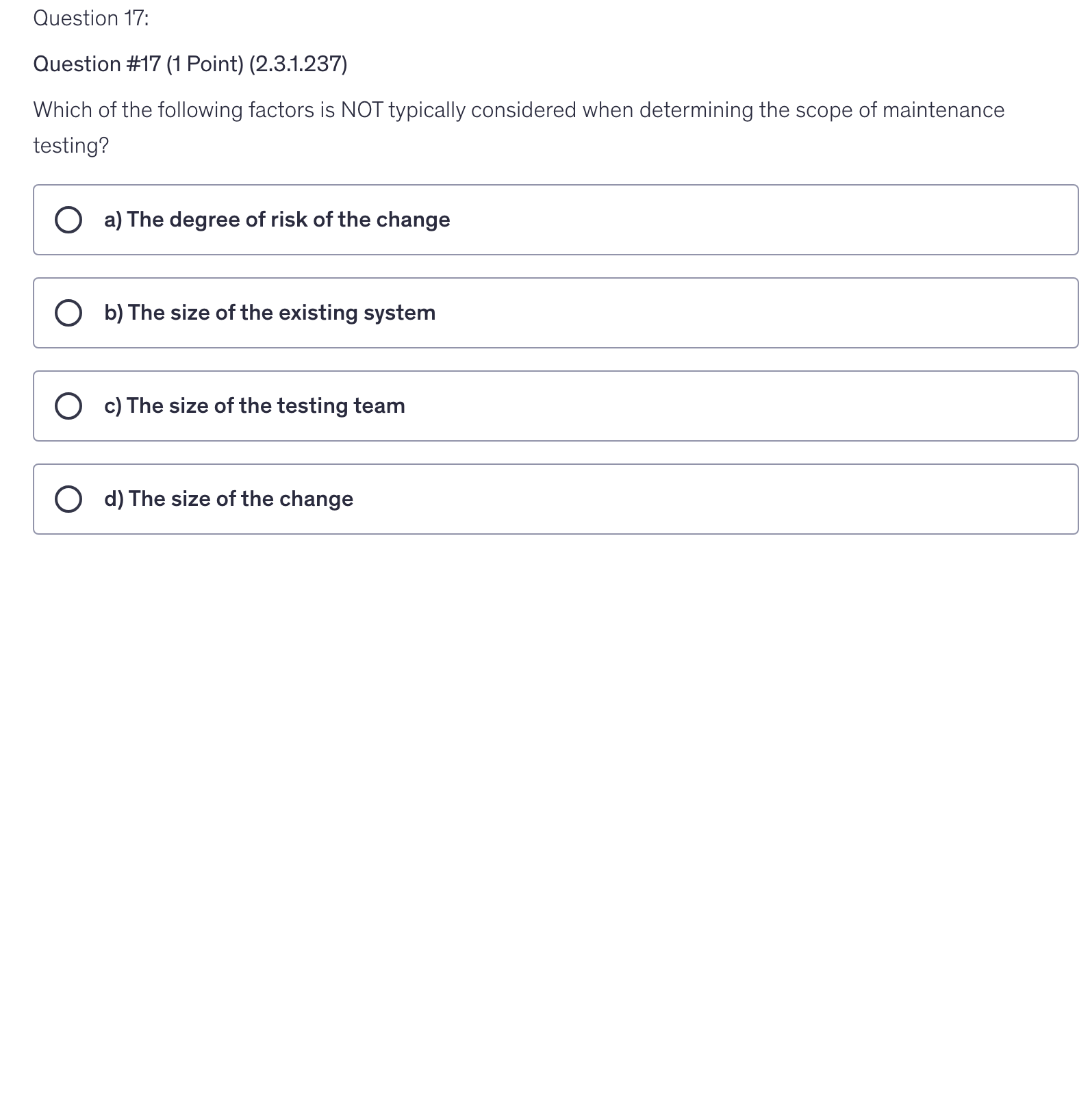
Which of the following factors is NOT typically considered when determining the scope of maintenance testing?
c) The size of the testing team
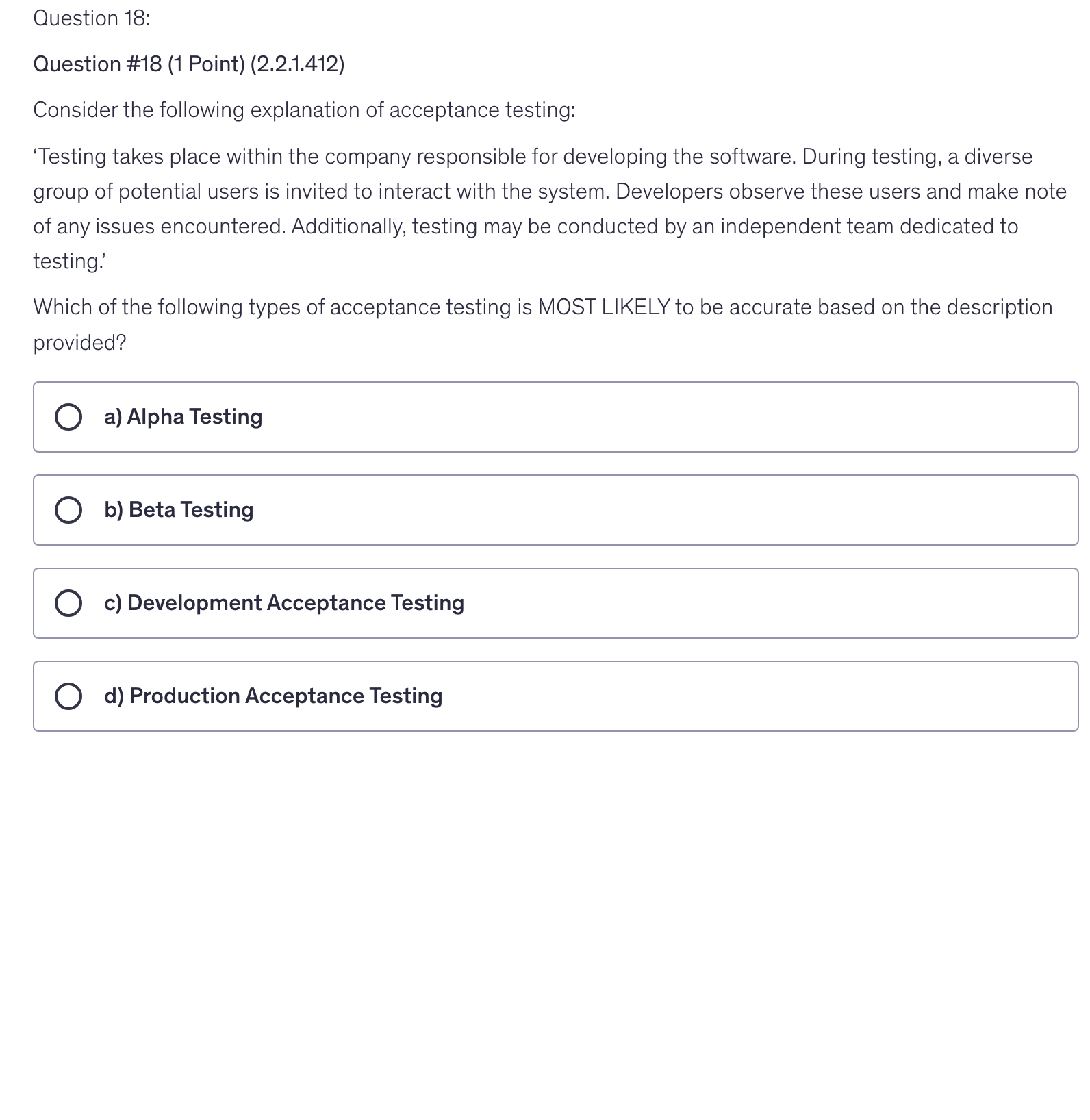
Consider the following explanation of acceptance testing:
‘Testing takes place within the company responsible for developing the software. During testing, a diverse group of potential users is invited to interact with the system. Developers observe these users and make note of any issues encountered. Additionally, testing may be conducted by an independent team dedicated to testing.’
Which of the following types of acceptance testing is MOST LIKELY to be accurate based on the description provided?
a) Alpha Testing
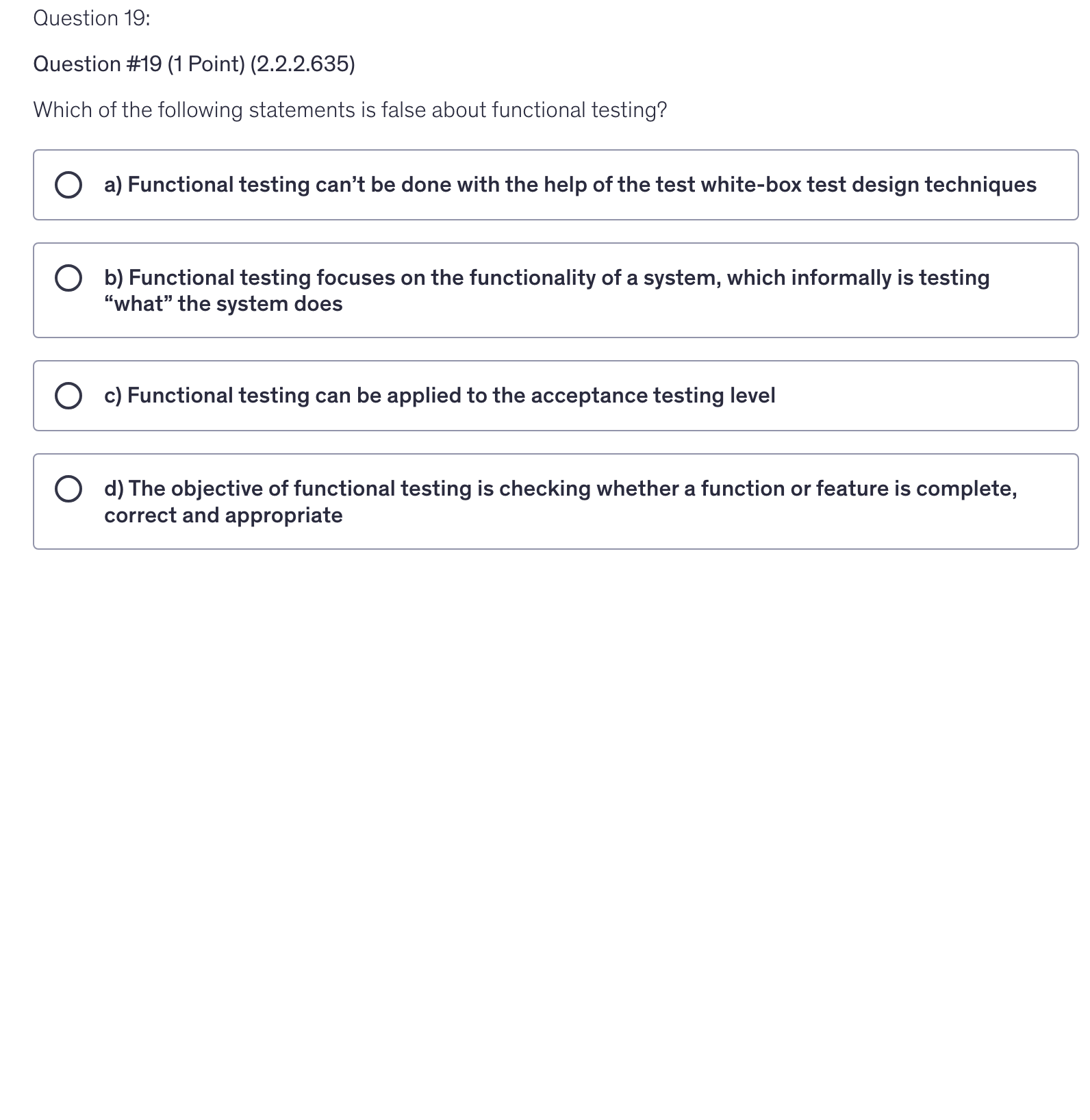
Which of the following statements is false about functional testing?
a) Functional testing can’t be done with the help of white-box test design techniques
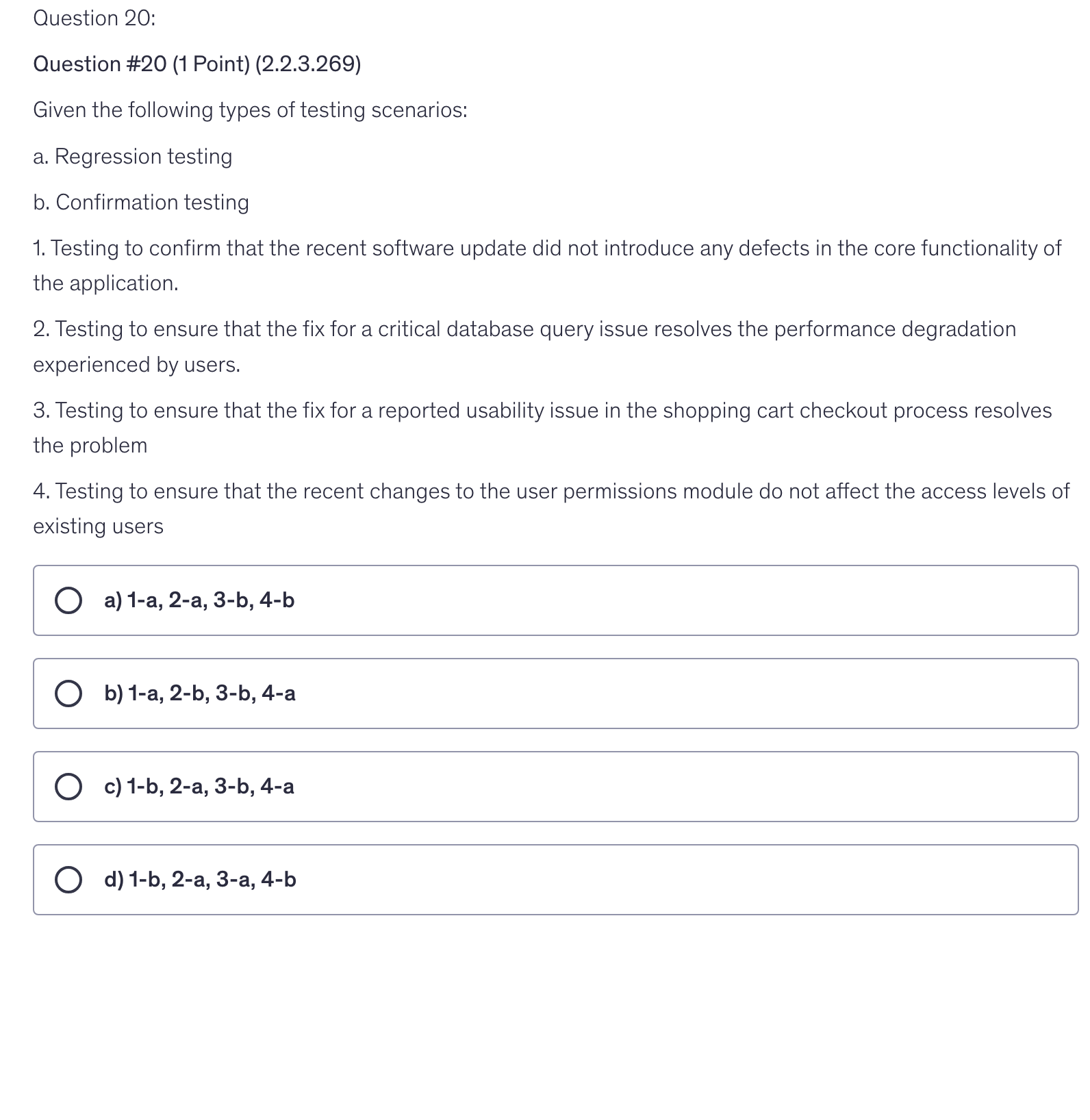
Given the following types of testing scenarios:
a. Regression testing
b. Confirmation testing
1. Testing to confirm that the recent software update did not introduce any defects in the core functionality of the application.
2. Testing to ensure that the fix for a critical database query issue resolves the performance degradation experienced by users.
3. Testing to ensure that the fix for a reported usability issue in the shopping cart checkout process resolves the problem
4. Testing to ensure that the recent changes to the user permissions module do not affect the access levels of existing users
b) 1-a, 2-b, 3-b, 4-a
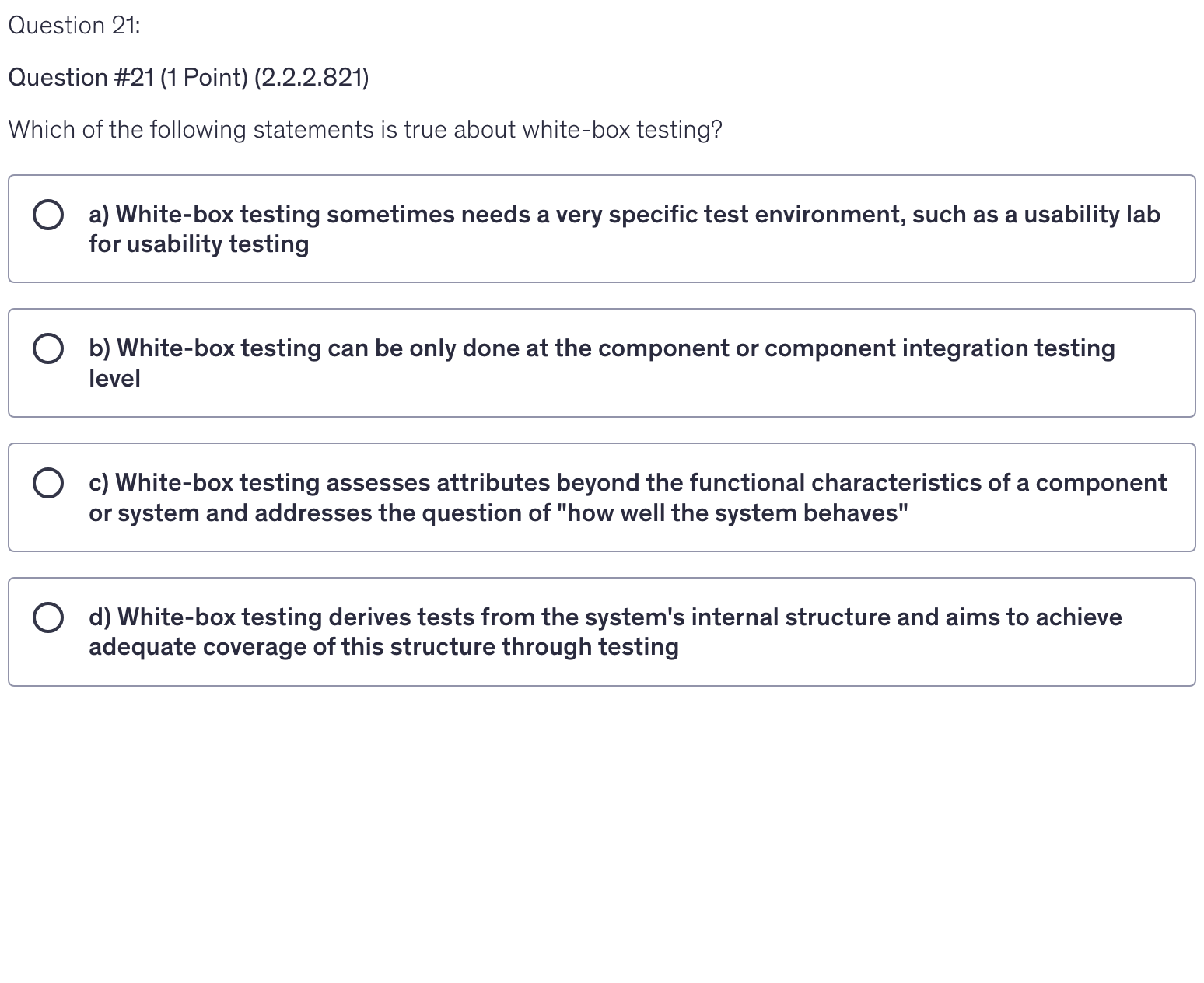
Which of the following statements is true about white-box testing?
d) White box testing derives from the system’s internal structure and aims to achieve adequate coverage of this structure through testing
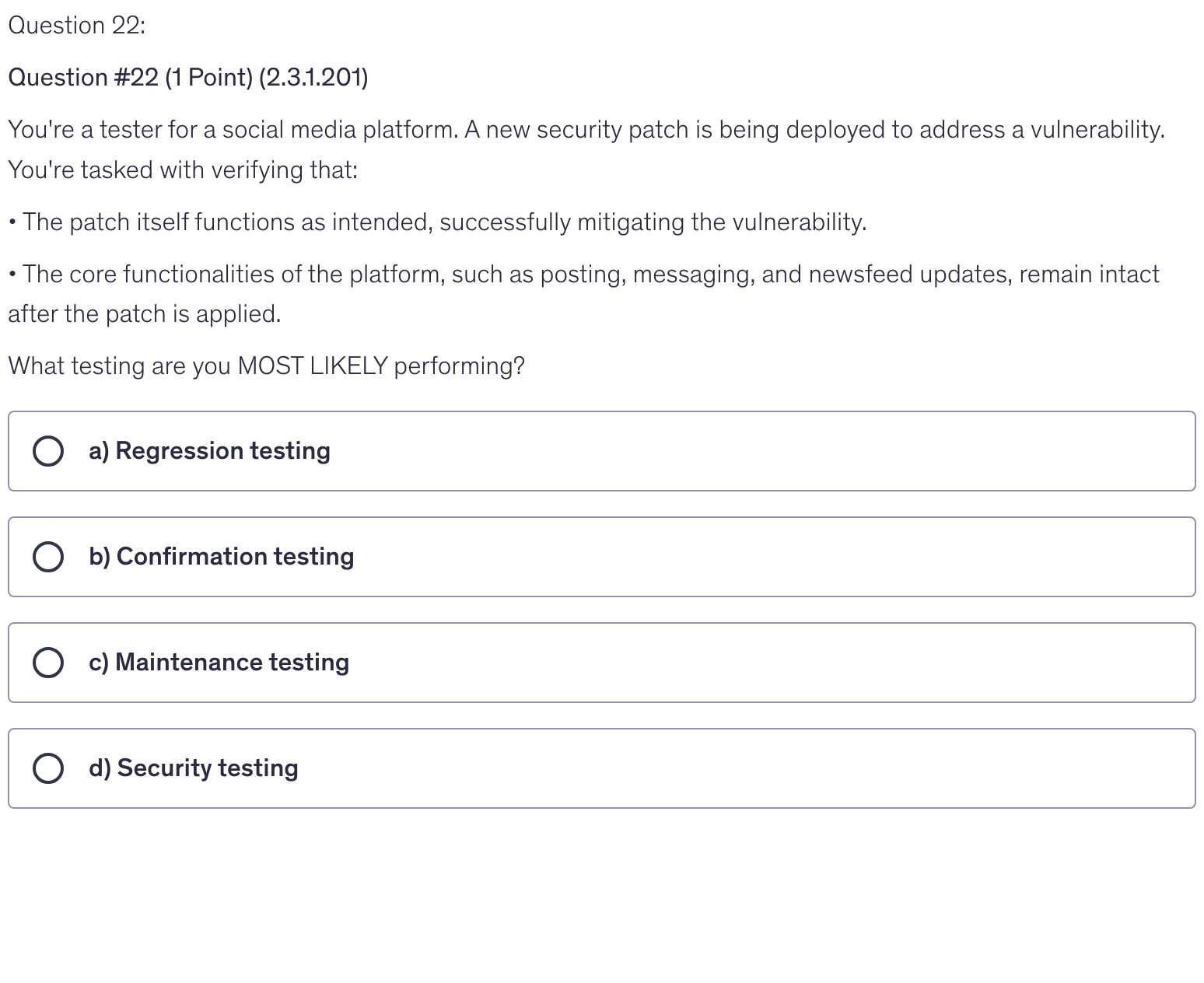
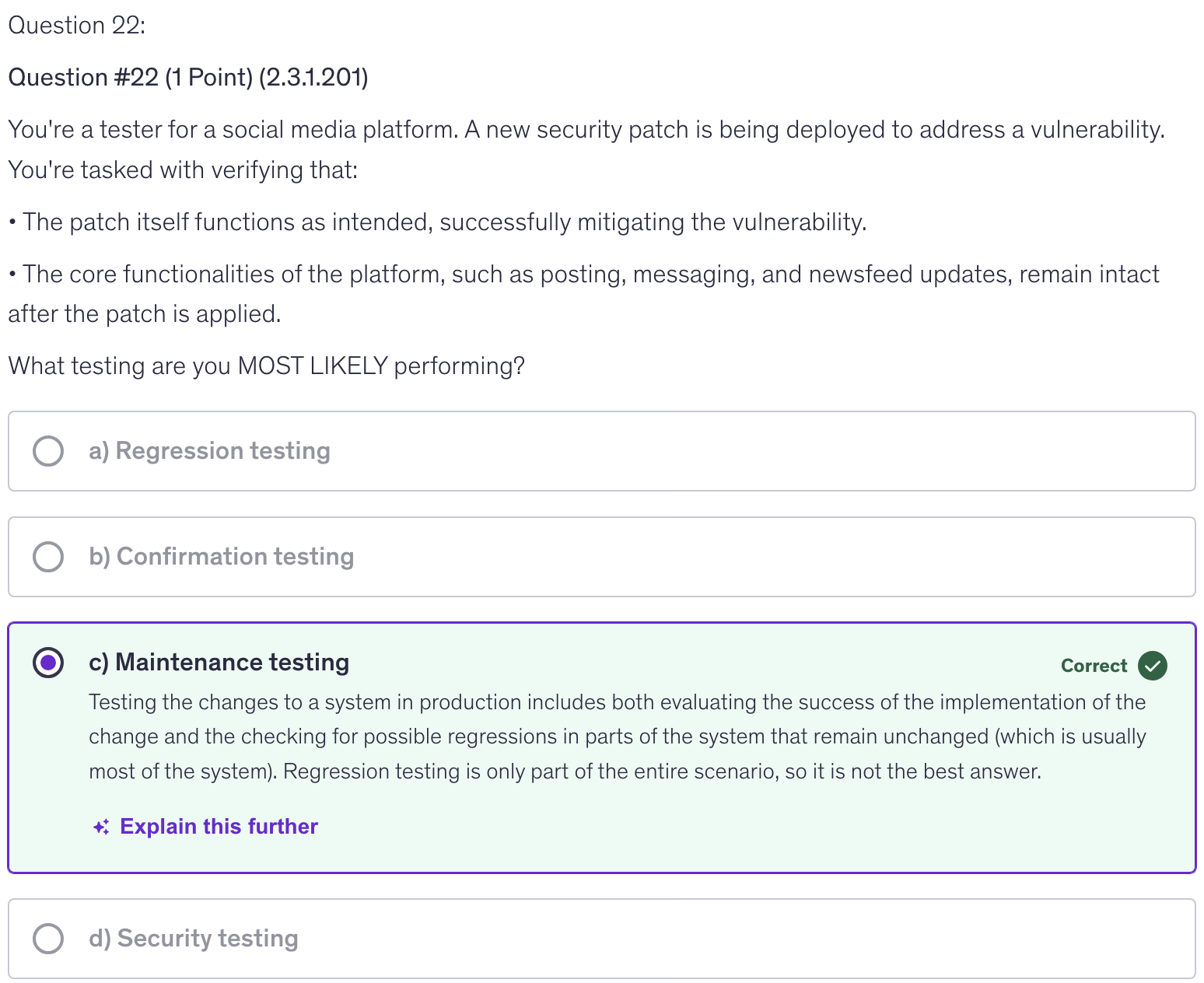
You're a tester for a social media platform. A new security patch is being deployed to address a vulnerability. You're tasked with verifying that:
• The patch itself functions as intended, successfully mitigating the vulnerability.
• The core functionalities of the platform, such as posting, messaging, and newsfeed updates, remain intact after the patch is applied.
What testing are you MOST LIKELY performing?
c) Maintenance Testing
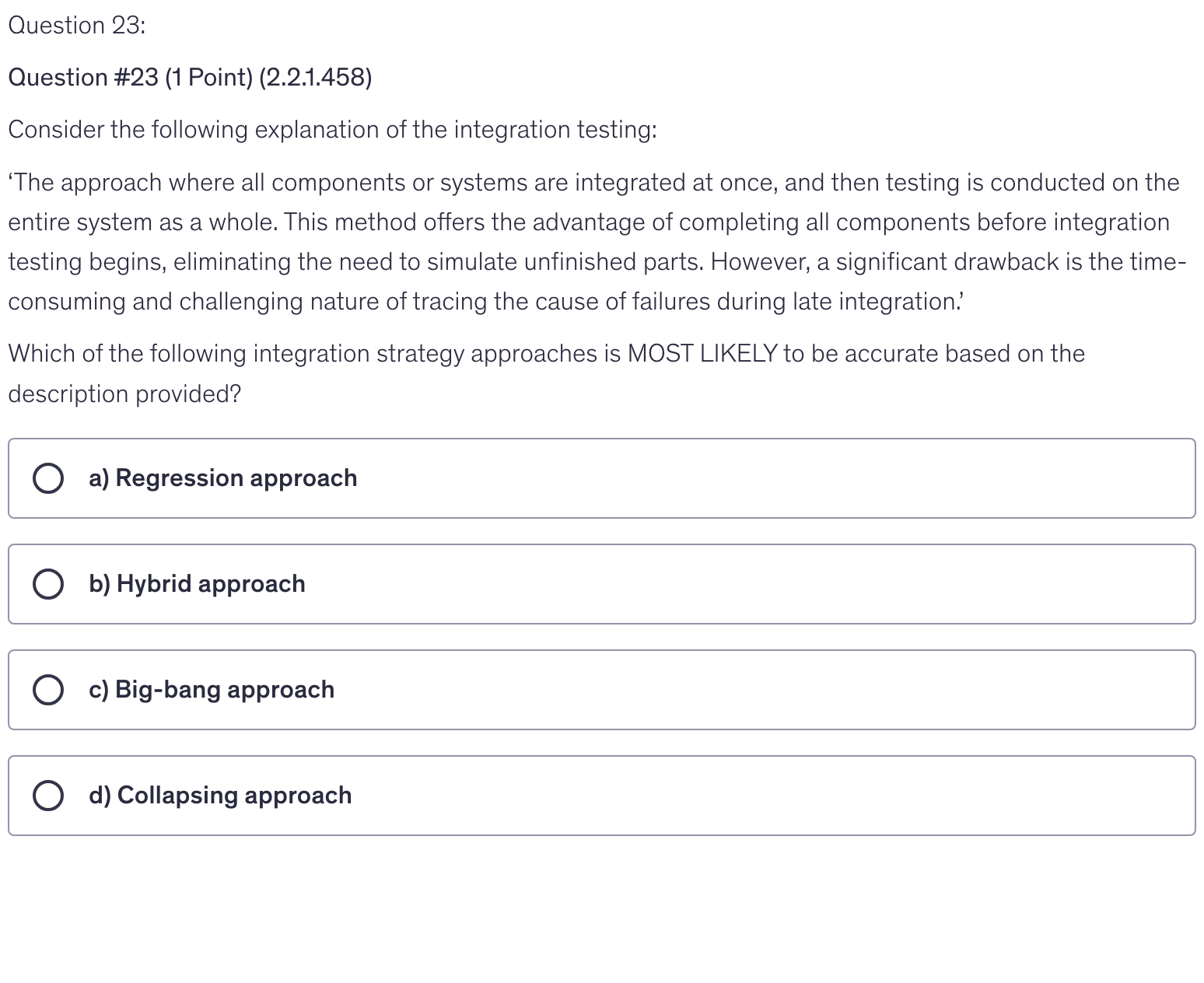
Consider the following explanation of the integration testing:
‘The approach where all components or systems are integrated at once, and then testing is conducted on the entire system as a whole. This method offers the advantage of completing all components before integration testing begins, eliminating the need to simulate unfinished parts. However, a significant drawback is the time-consuming and challenging nature of tracing the cause of failures during late integration.’
Which of the following integration strategy approaches is MOST LIKELY to be accurate based on the description provided?
c) Big-bang approach
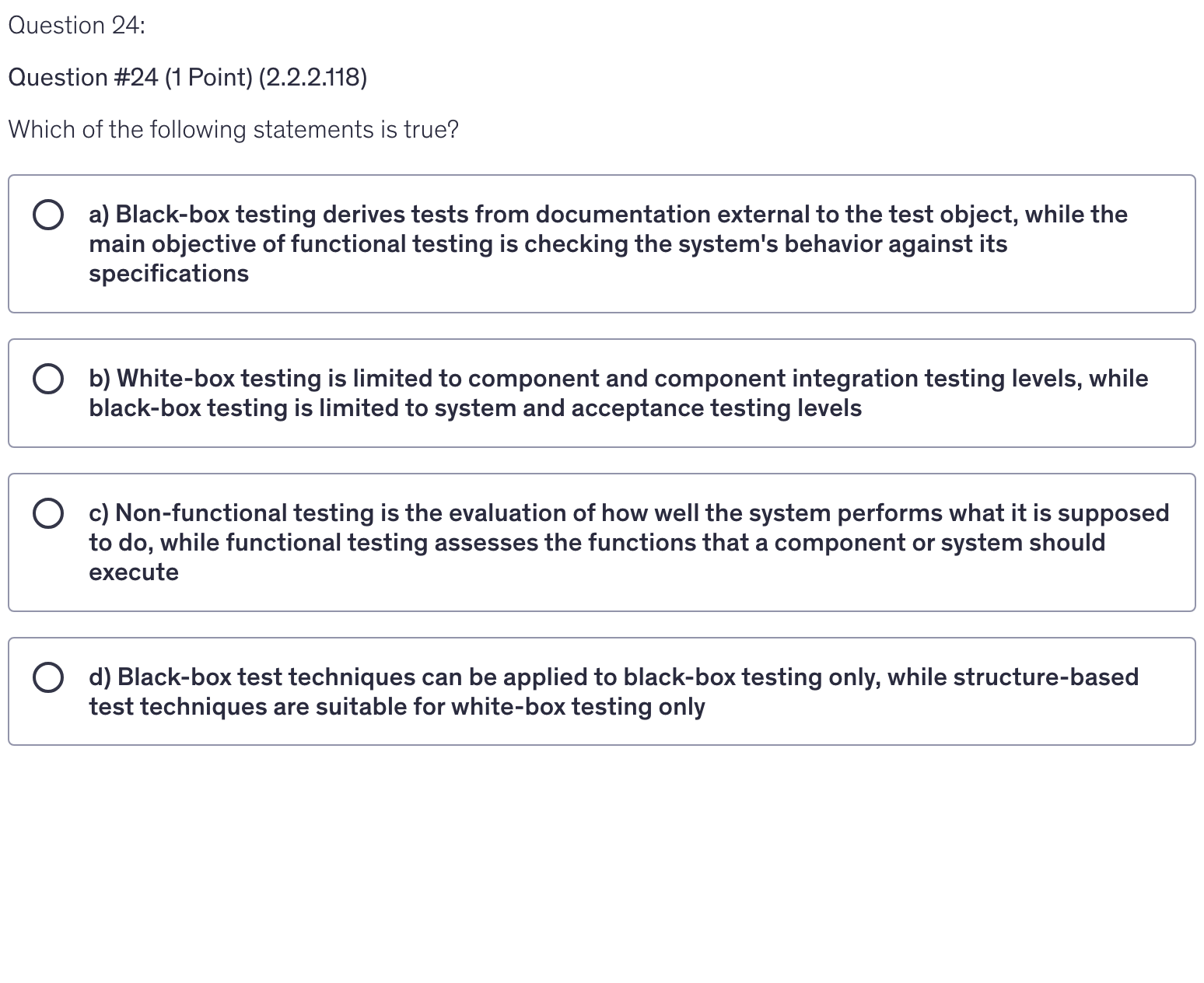
Which of the following statements is true?
c) Non-functional testing is the evaluation of how well the system performs what it is supposed to do, while functional testing assesses the functions that a component or system should execute
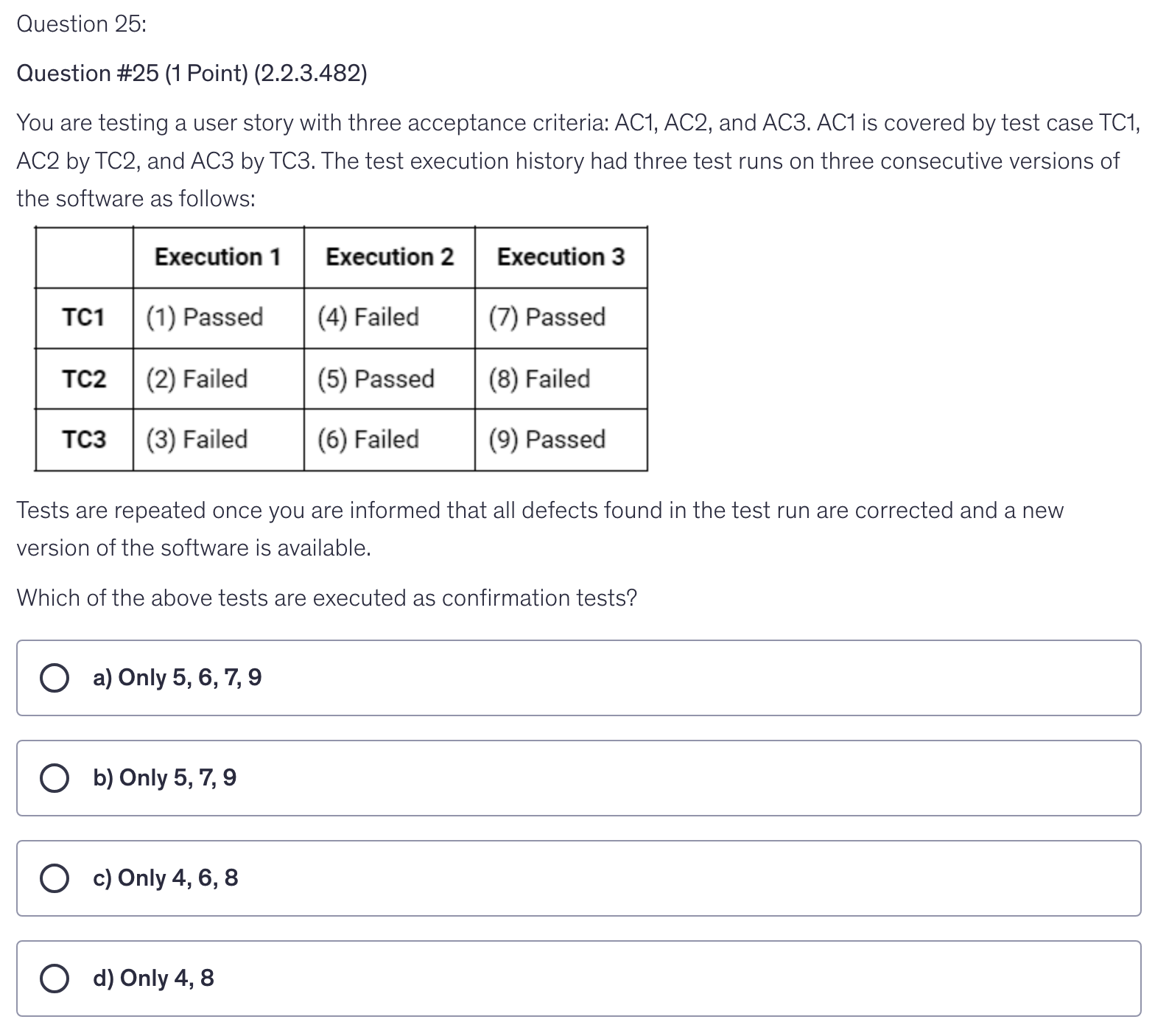
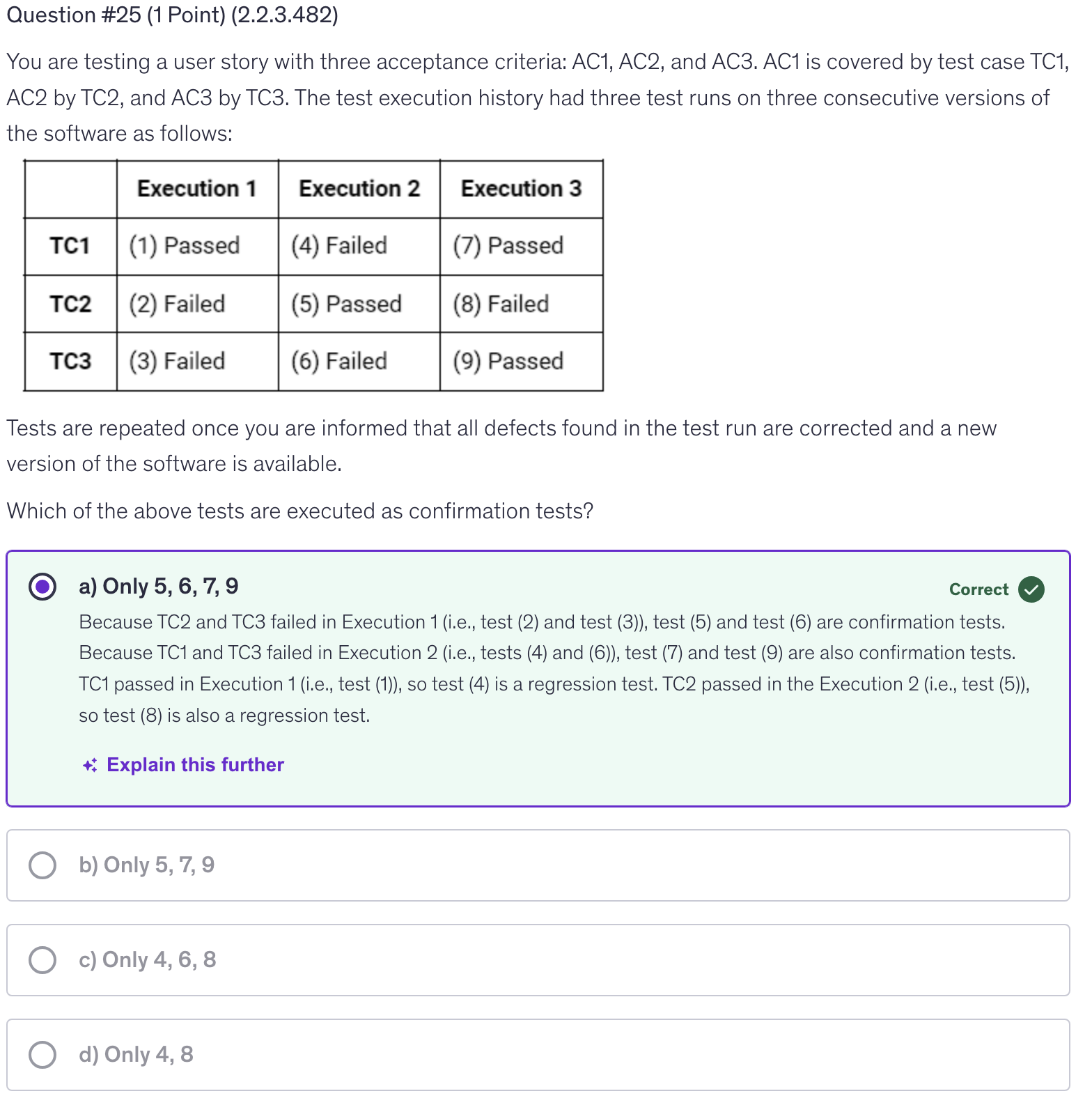
You are testing a user story with three acceptance criteria: AC1, AC2, and AC3. AC1 is covered by test case TC1, AC2 by TC2, and AC3 by TC3. The test execution history had three test runs on three consecutive versions of the software as follows:
Tests are repeated once you are informed that all defects found in the test run are corrected and a new version of the software is available.
Which of the above tests are executed as confirmation tests?
a) Only 5, 6, 7, 9
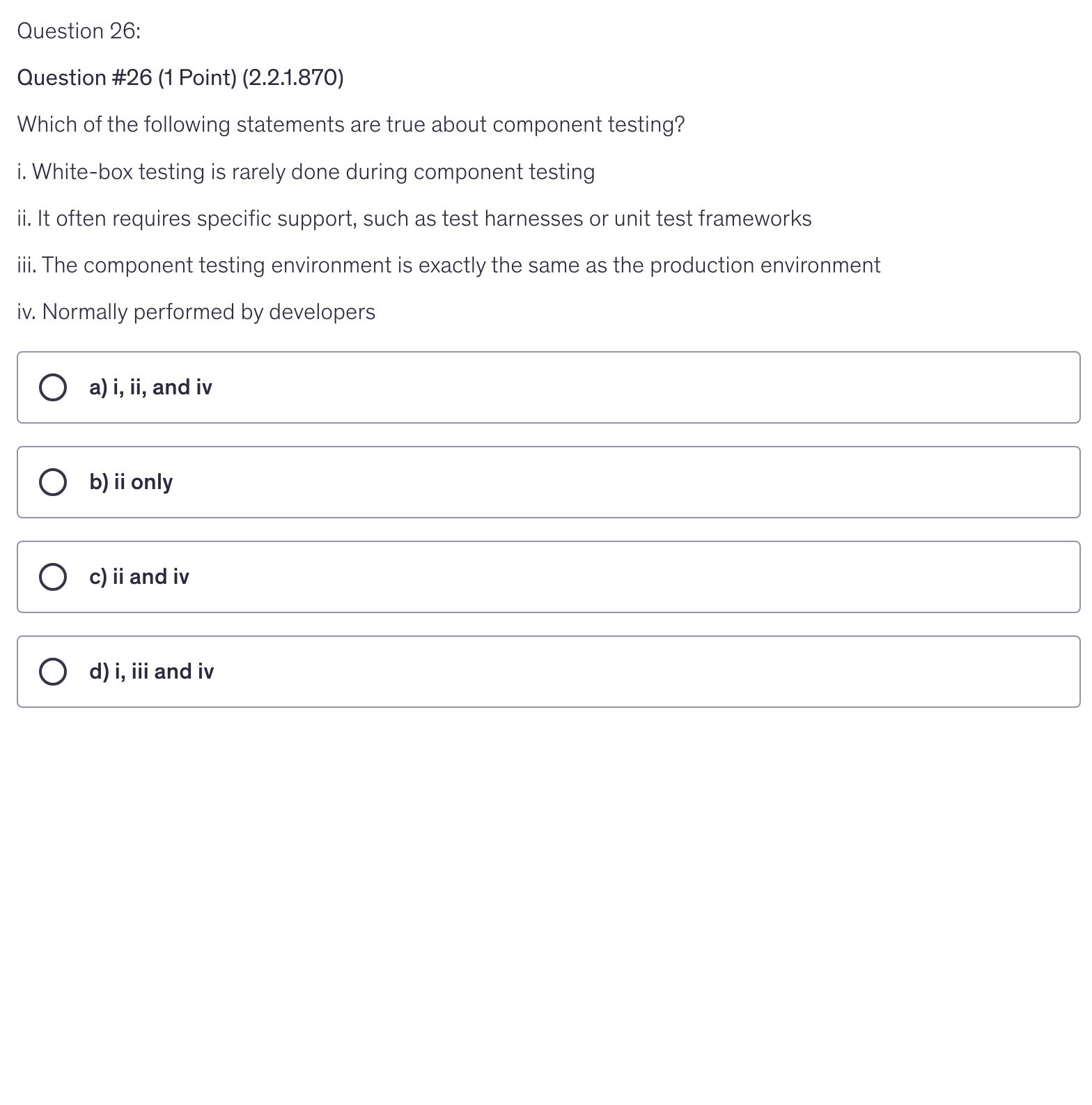
Which of the following statements are true about component testing?
i. White-box testing is rarely done during component testing
ii. It often requires specific support, such as test harnesses or unit test frameworks
iii. The component testing environment is exactly the same as the production environment
iv. Normally performed by developers
c) ii and iv
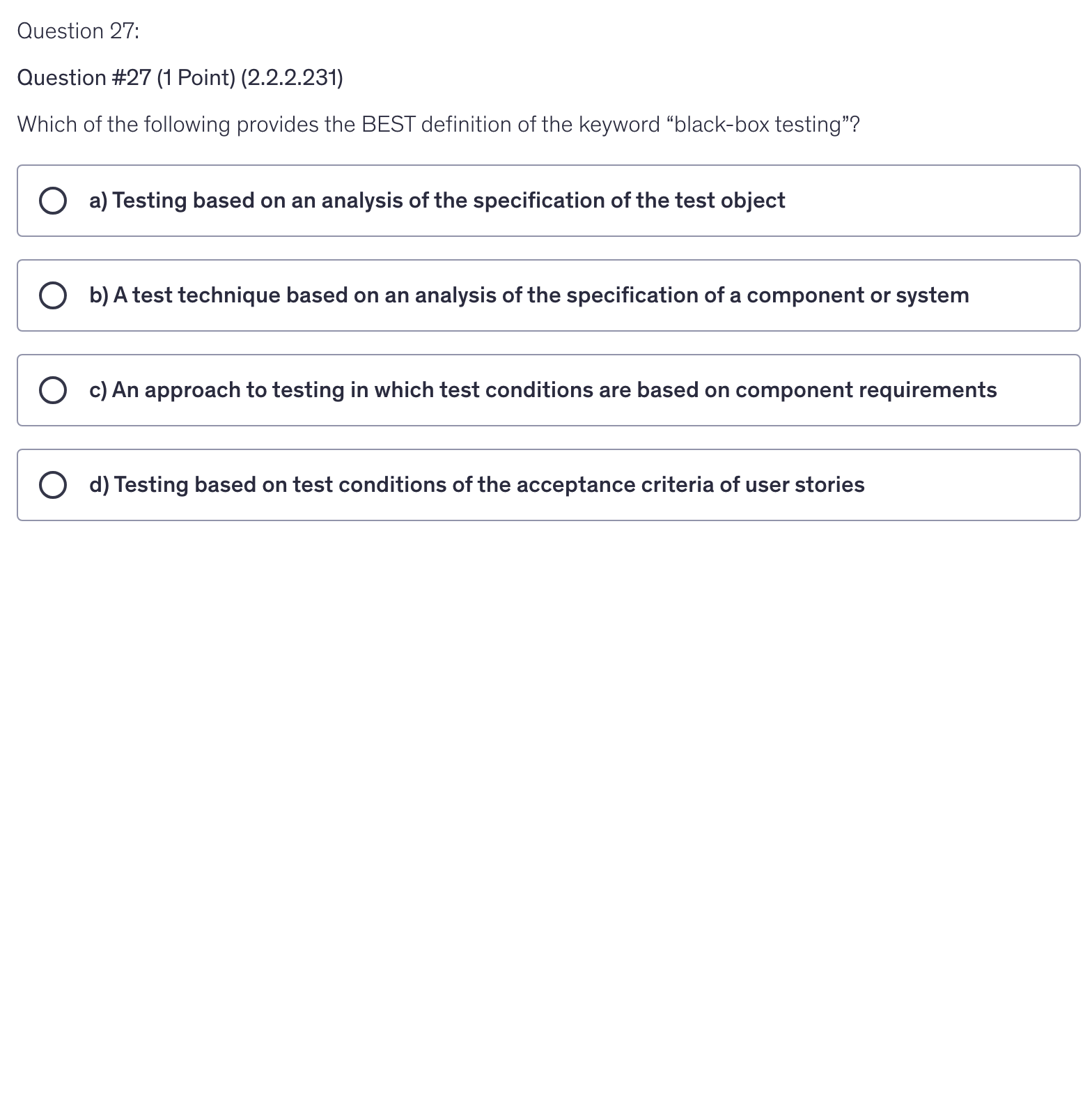
Which of the following provides the BEST definition of the keyword “black-box testing”?
a) Analysis based on an analysis of the specification of the test object
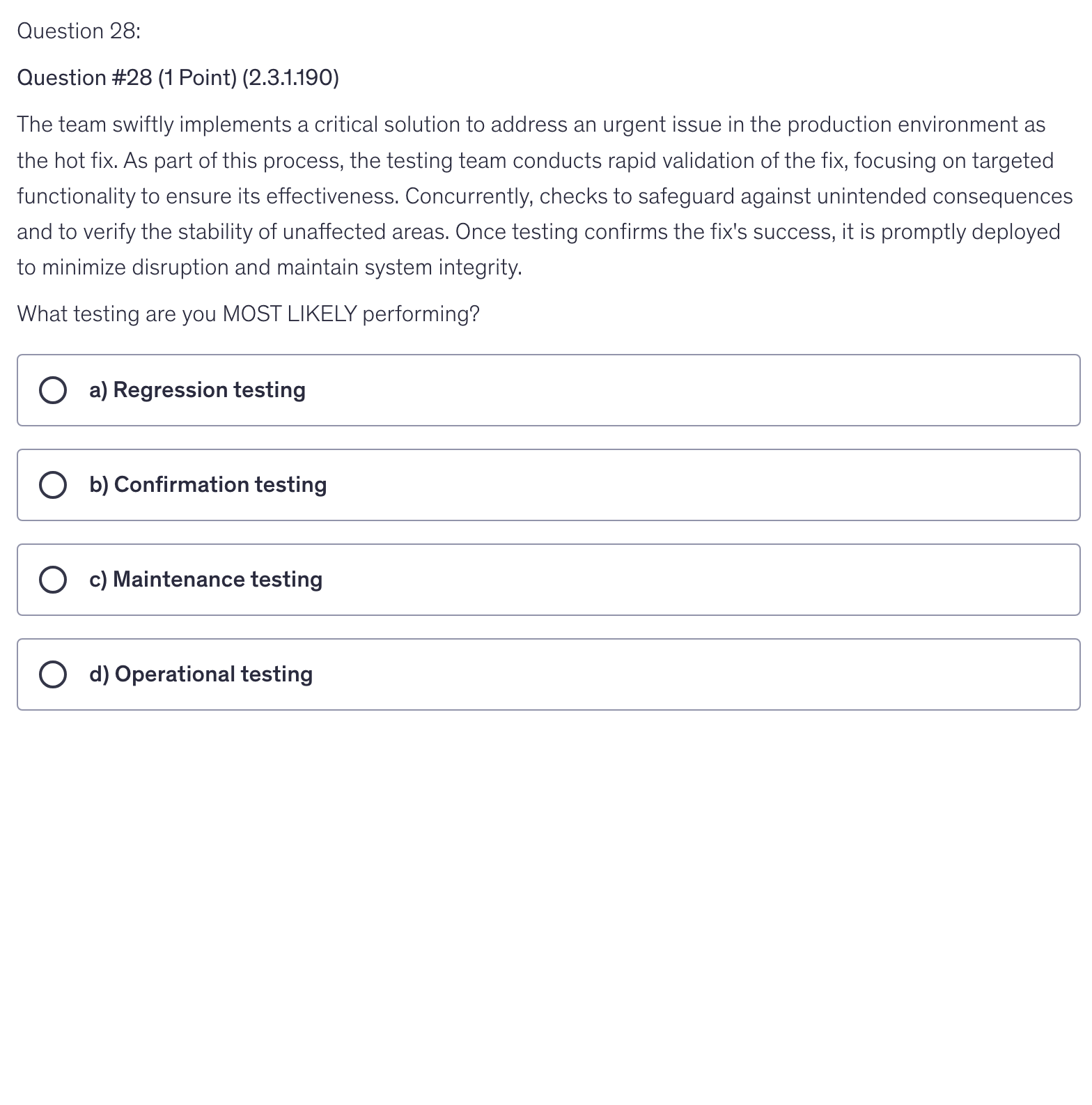
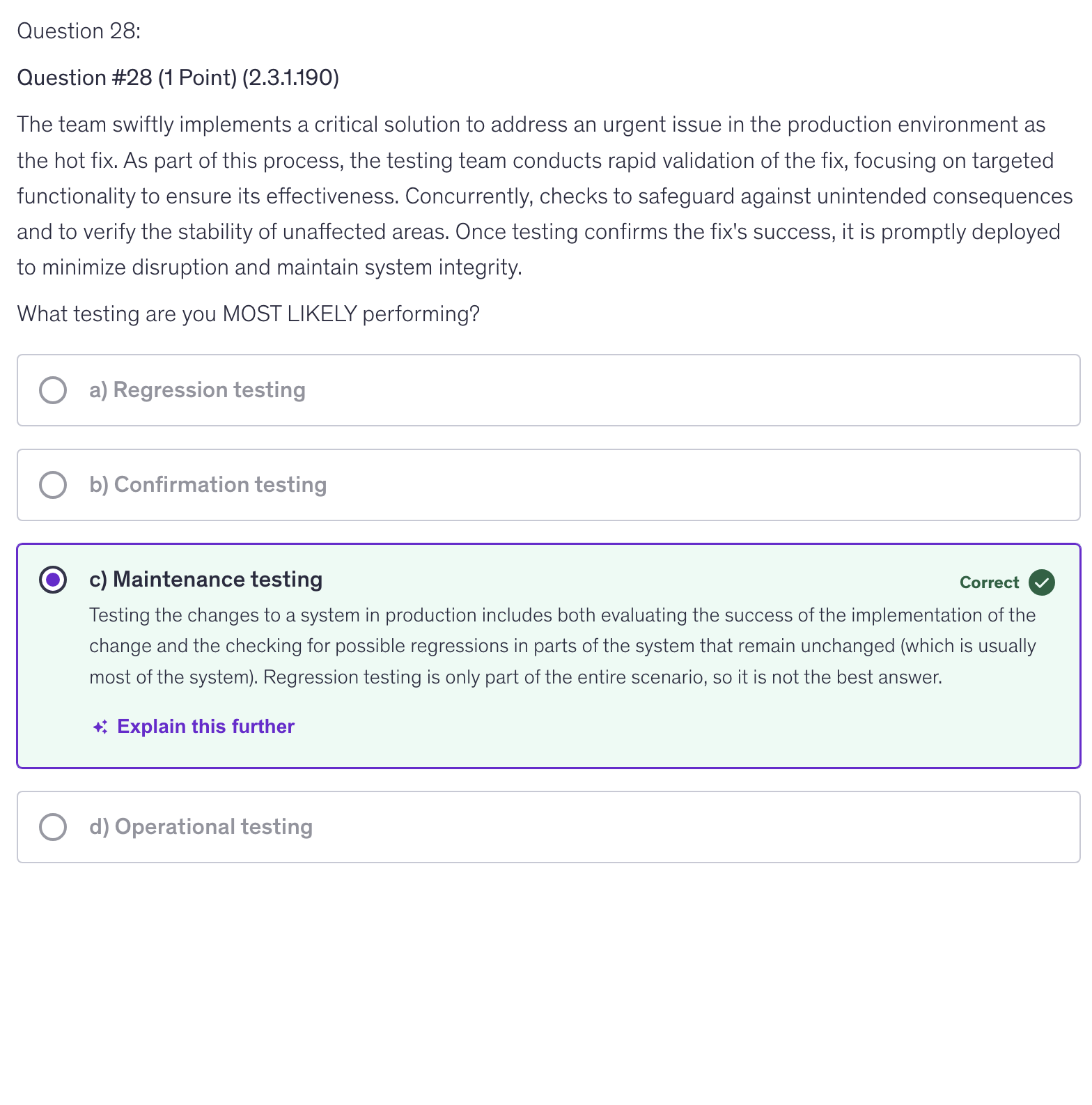
The team swiftly implements a critical solution to address an urgent issue in the production environment as the hot fix. As part of this process, the testing team conducts rapid validation of the fix, focusing on targeted functionality to ensure its effectiveness. Concurrently, checks to safeguard against unintended consequences and to verify the stability of unaffected areas. Once testing confirms the fix's success, it is promptly deployed to minimize disruption and maintain system integrity.
What testing are you MOST LIKELY performing?
c) Maintenance testing
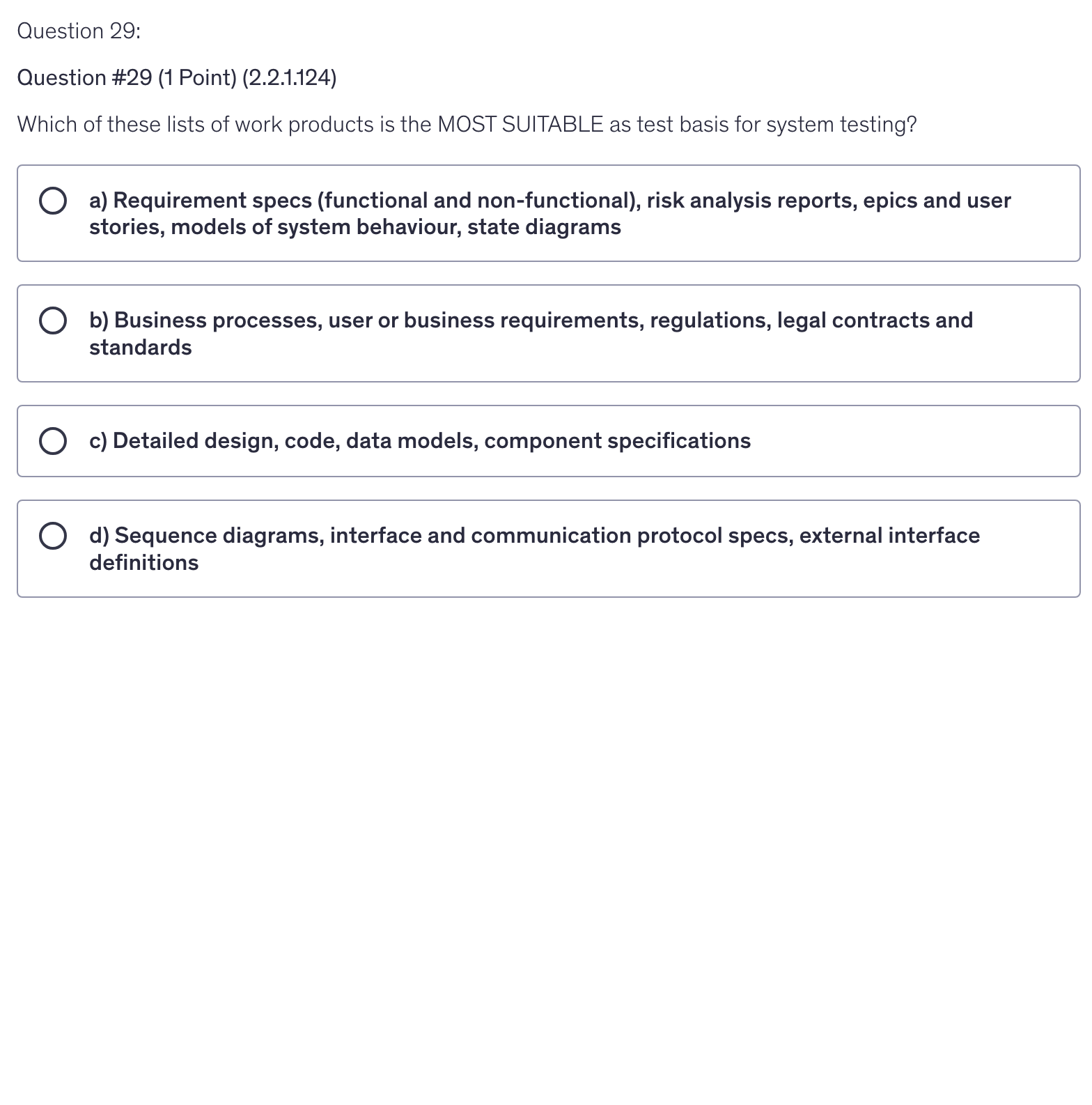
Which of these lists of work products is the MOST SUITABLE as test basis for system testing?
a) Requirement specs (functional and non-functional), risk analysis reports, epics and user stories, models of system behaviour, state diagrams
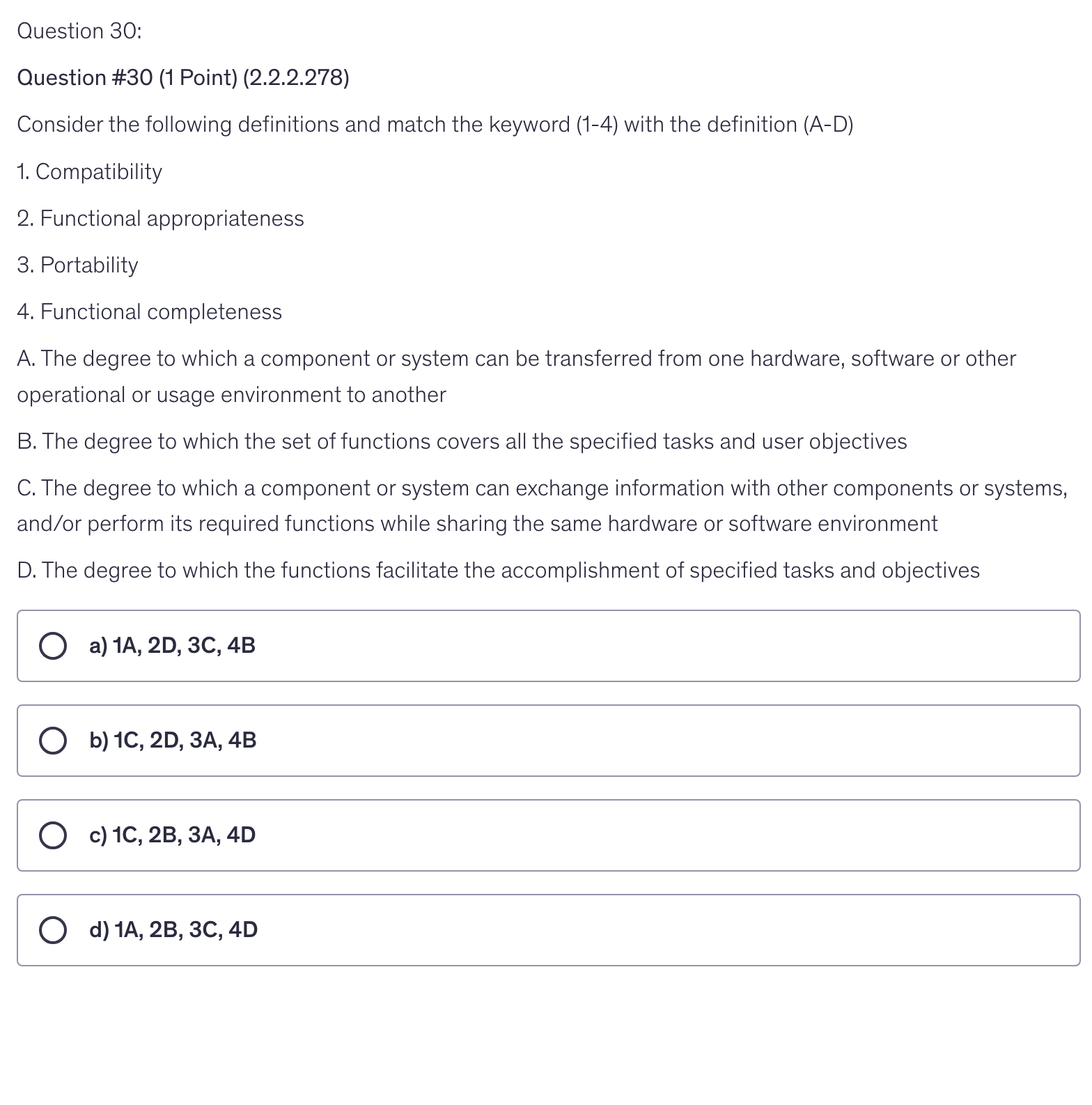
Consider the following definitions and match the keyword (1-4) with the definition (A-D)
1. Compatibility
2. Functional appropriateness
3. Portability
4. Functional completeness
A. The degree to which a component or system can be transferred from one hardware, software or other operational or usage environment to another
B. The degree to which the set of functions covers all the specified tasks and user objectives
C. The degree to which a component or system can exchange information with other components or systems, and/or perform its required functions while sharing the same hardware or software environment
D. The degree to which the functions facilitate the accomplishment of specified tasks and objectives
b) 1C, 2D, 3A, 4B
What is the potential drawback of relying solely on re-running failed test cases during confirmation testing?
b) It might miss regressions introduced by the fix in other areas
You work as a tester on a project involving a mobile application for food ordering, and catering to one of your clients. The client has provided you with a list of requirements. One of these requirements, which holds high priority, states: "The GET API should return the order details within 2 seconds."
Based on this scenario, what type of test should you perform?
b) Non-functional, as you need to assess how the system utilizes time, resources, and capacity while fulfilling its designated functions
The scope of maintenance testing primarily depends on the:
b) Size of the existing system
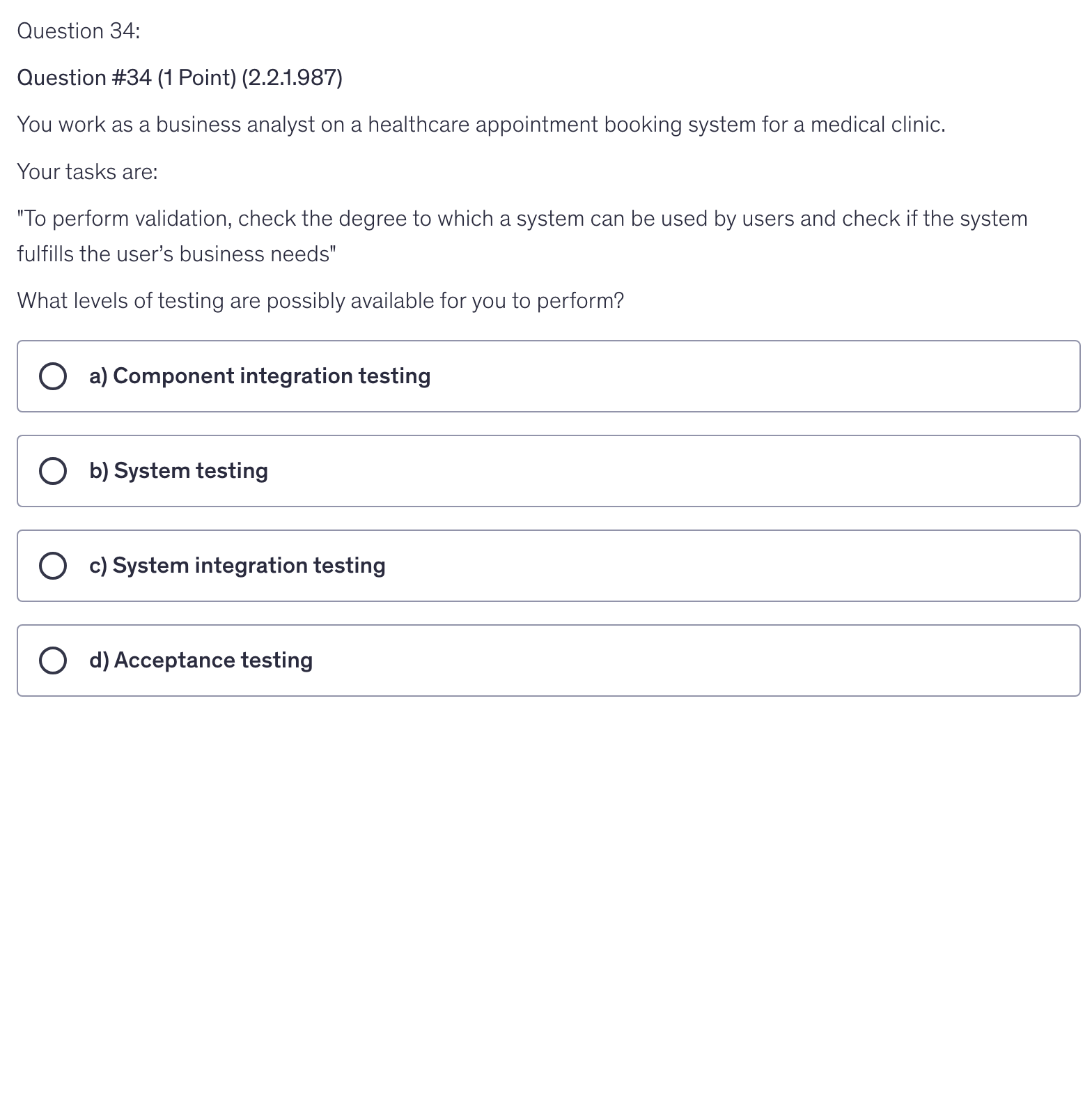
You work as a business analyst on a healthcare appointment booking system for a medical clinic.
Your tasks are:
"To perform validation, check the degree to which a system can be used by users and check if the system fulfills the user’s business needs"
What levels of testing are possibly available for you to perform?
d) Acceptance testing
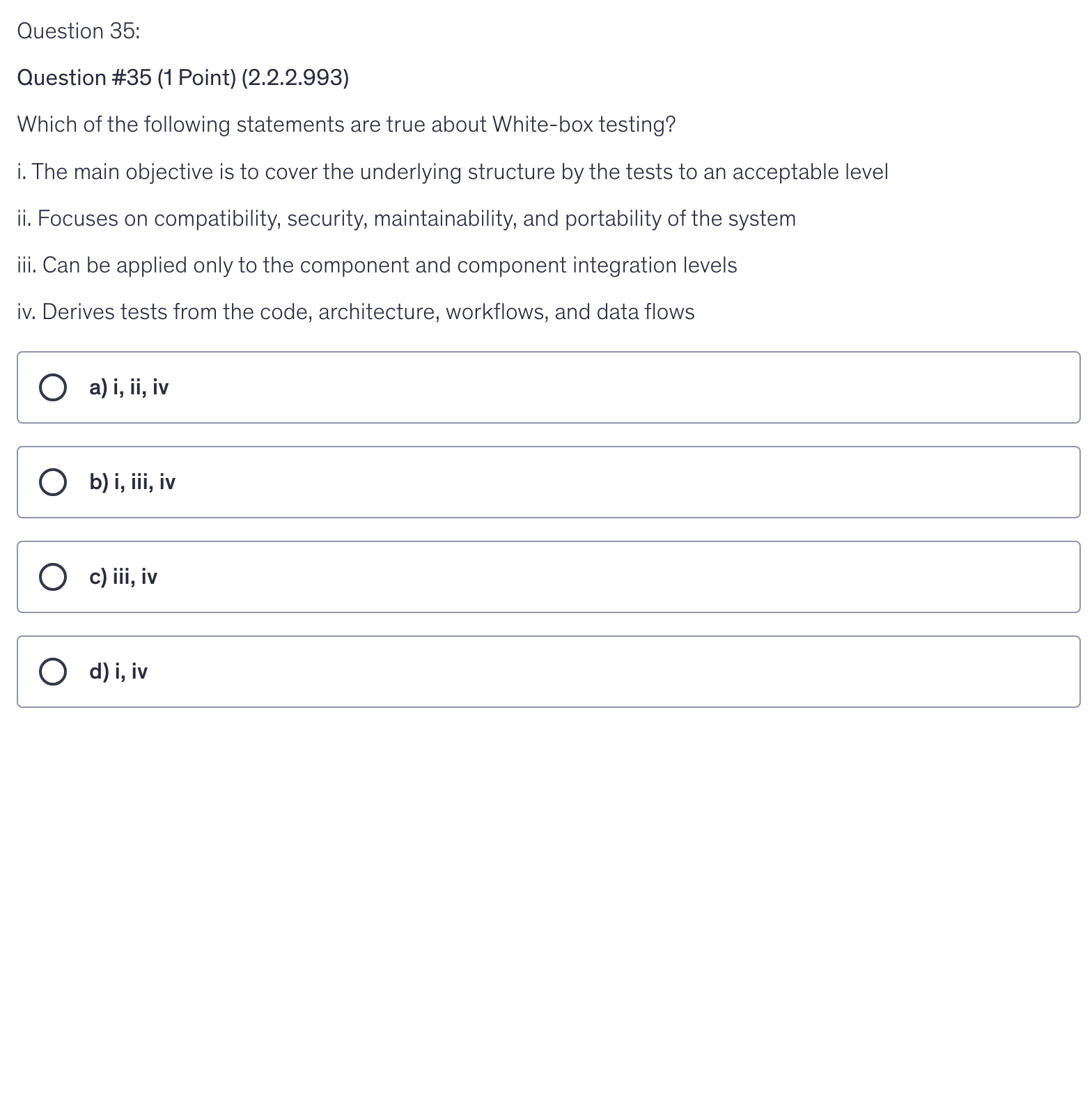
Which of the following statements are true about White-box testing?
i. The main objective is to cover the underlying structure by the tests to an acceptable level
ii. Focuses on compatibility, security, maintainability, and portability of the system
iii. Can be applied only to the component and component integration levels
iv. Derives tests from the code, architecture, workflows, and data flows
d) i, iv
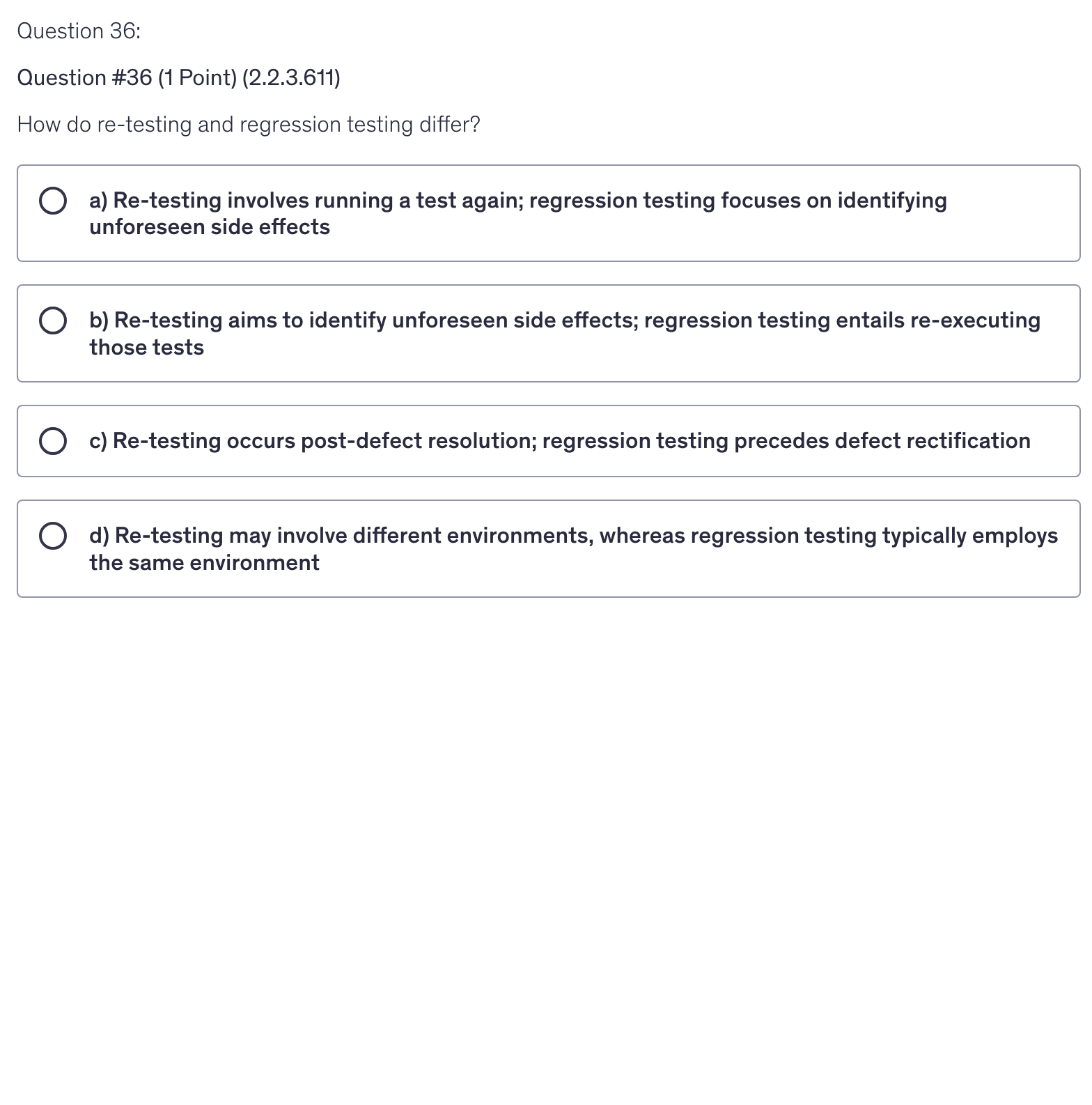
How do re-testing and regression testing differ?
a) Re-testing involves running a test again; regression testing focuses on identifying unforeseen side effects
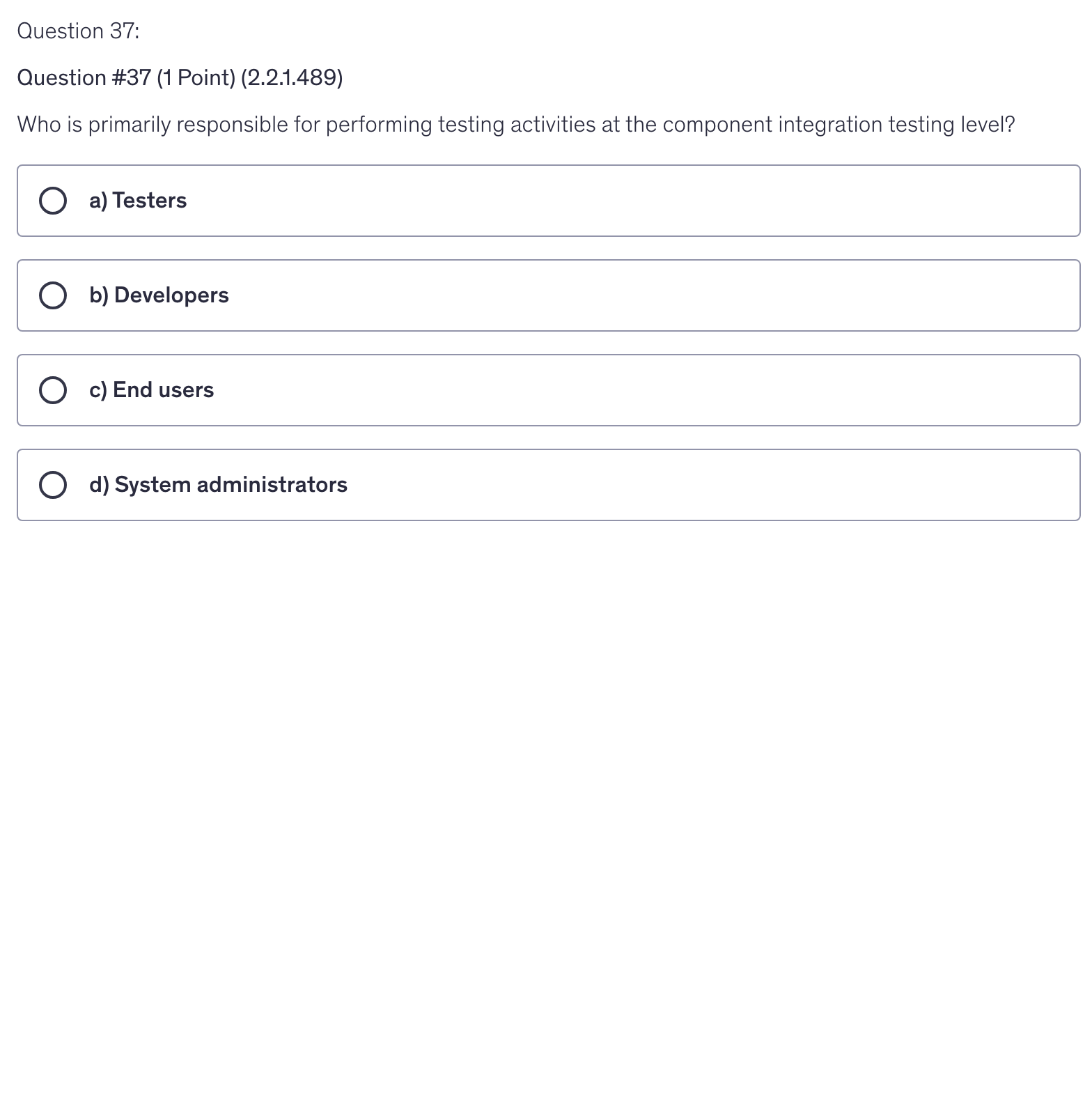
Who is primarily responsible for performing testing activities at the component integration testing level?
b) Developers
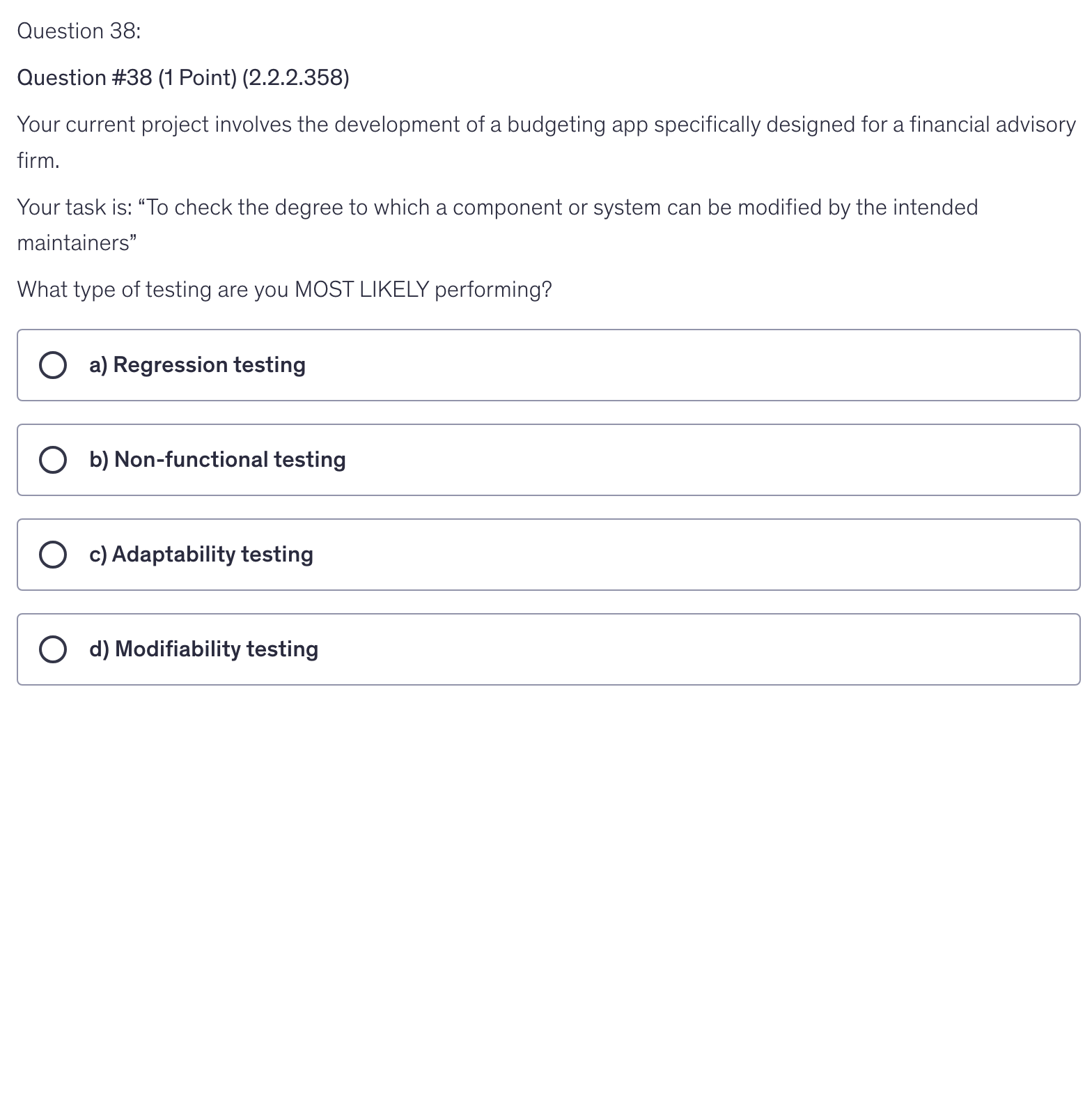
Your current project involves the development of a budgeting app specifically designed for a financial advisory firm.
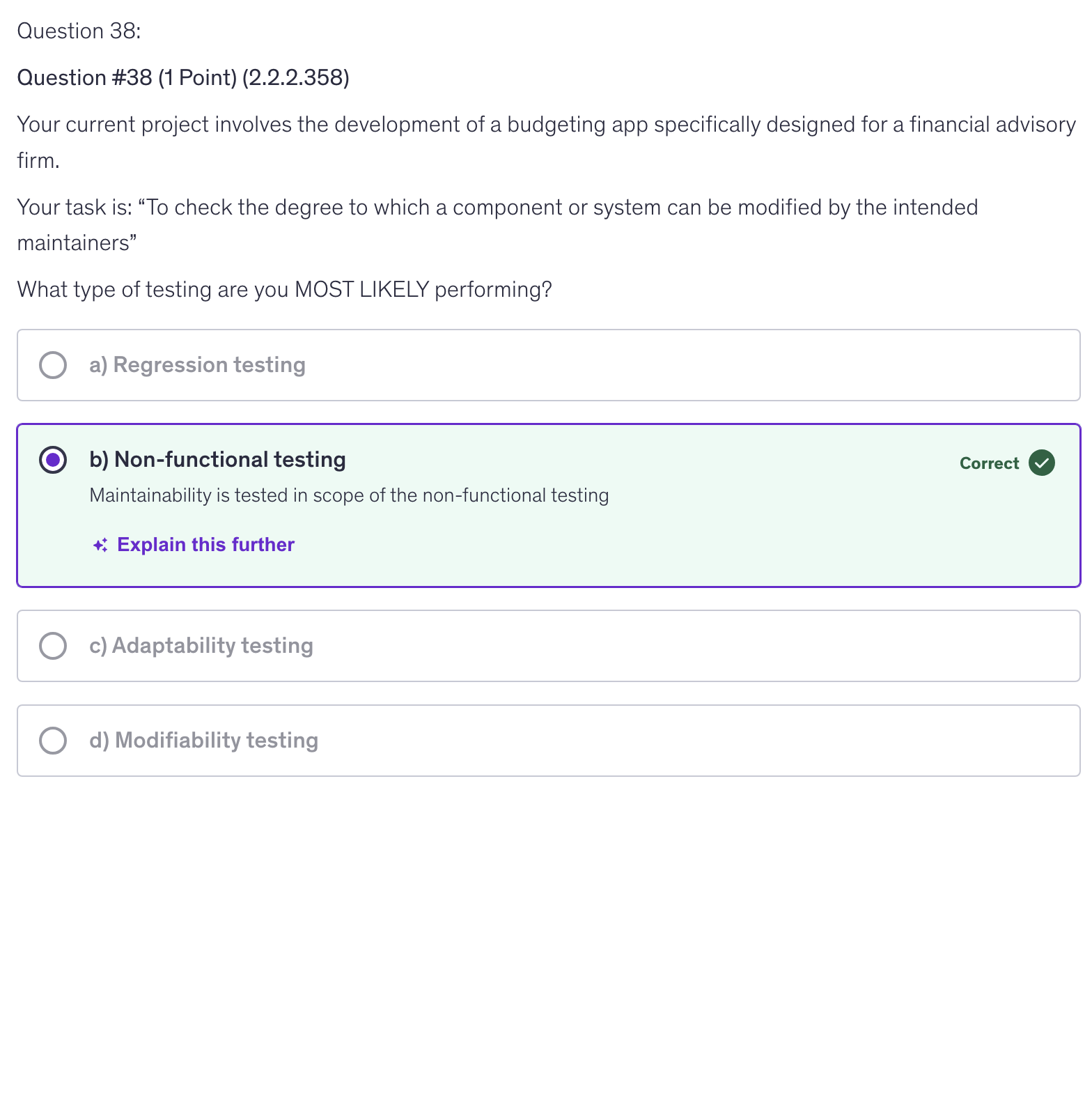
Your task is: “To check the degree to which a component or system can be modified by the intended maintainers”
What type of testing are you MOST LIKELY performing?
b) Non-functional testing
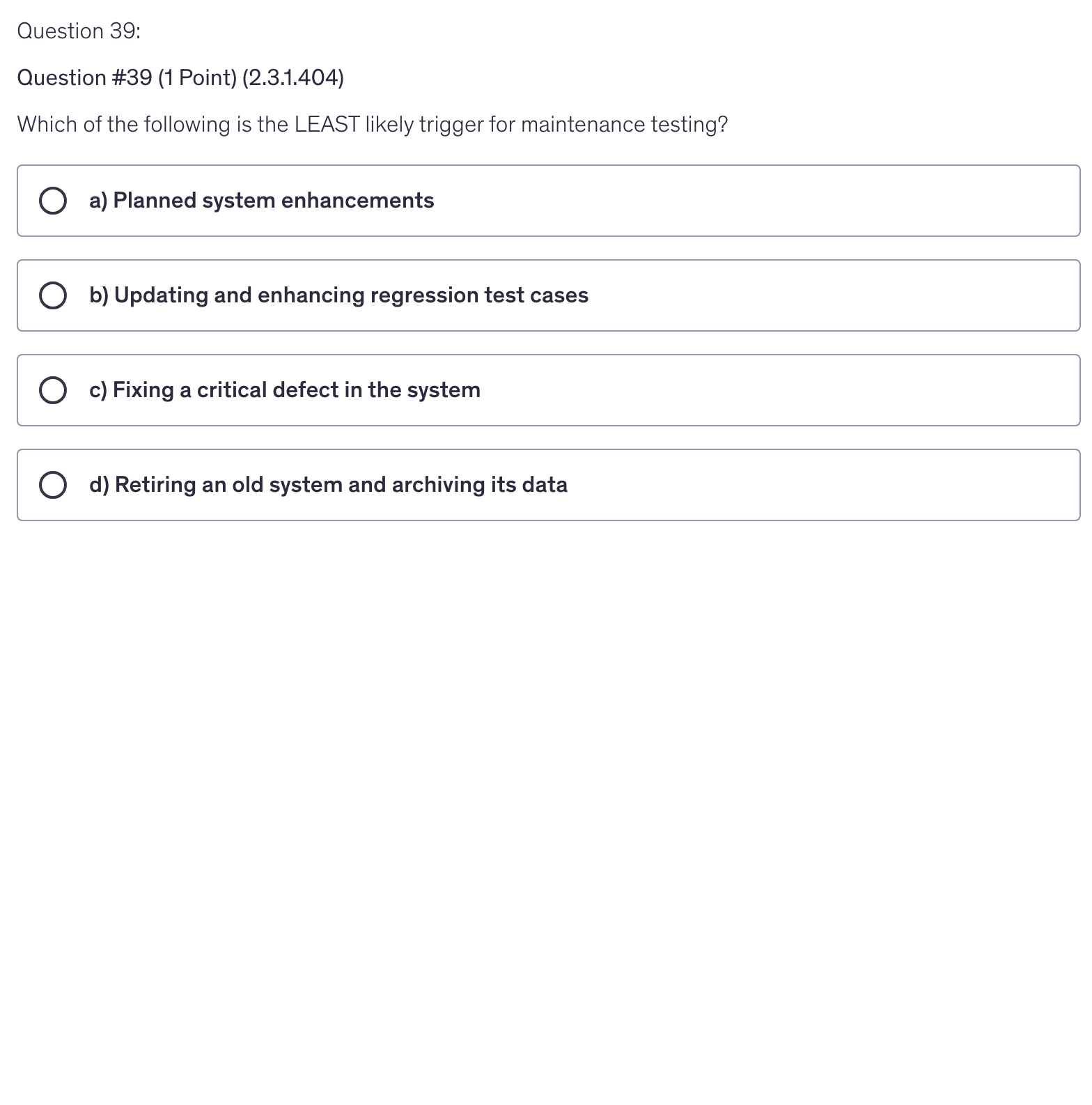
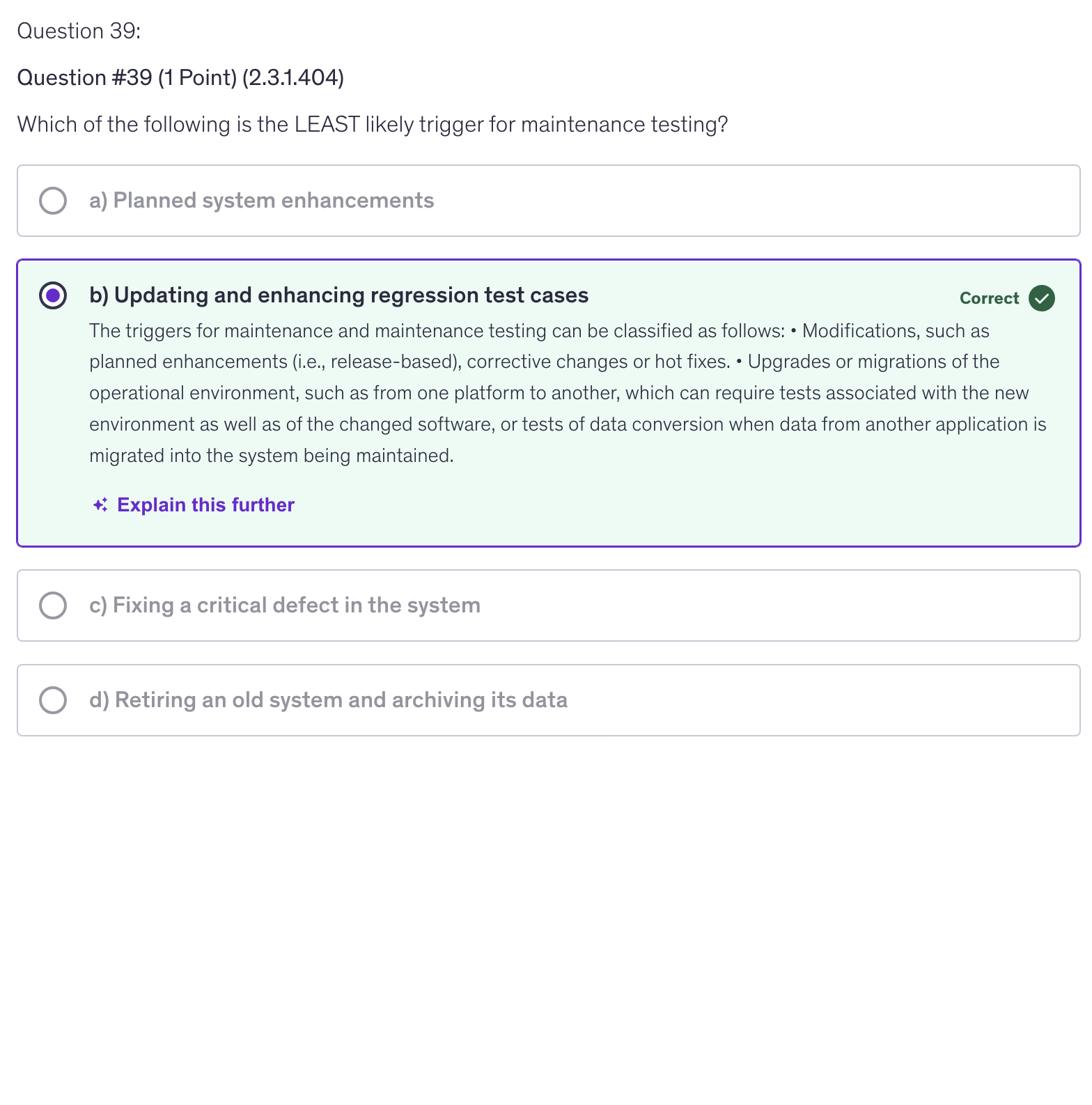
Which of the following is the LEAST likely trigger for maintenance testing?
b) Updating and enhancing regression test cases
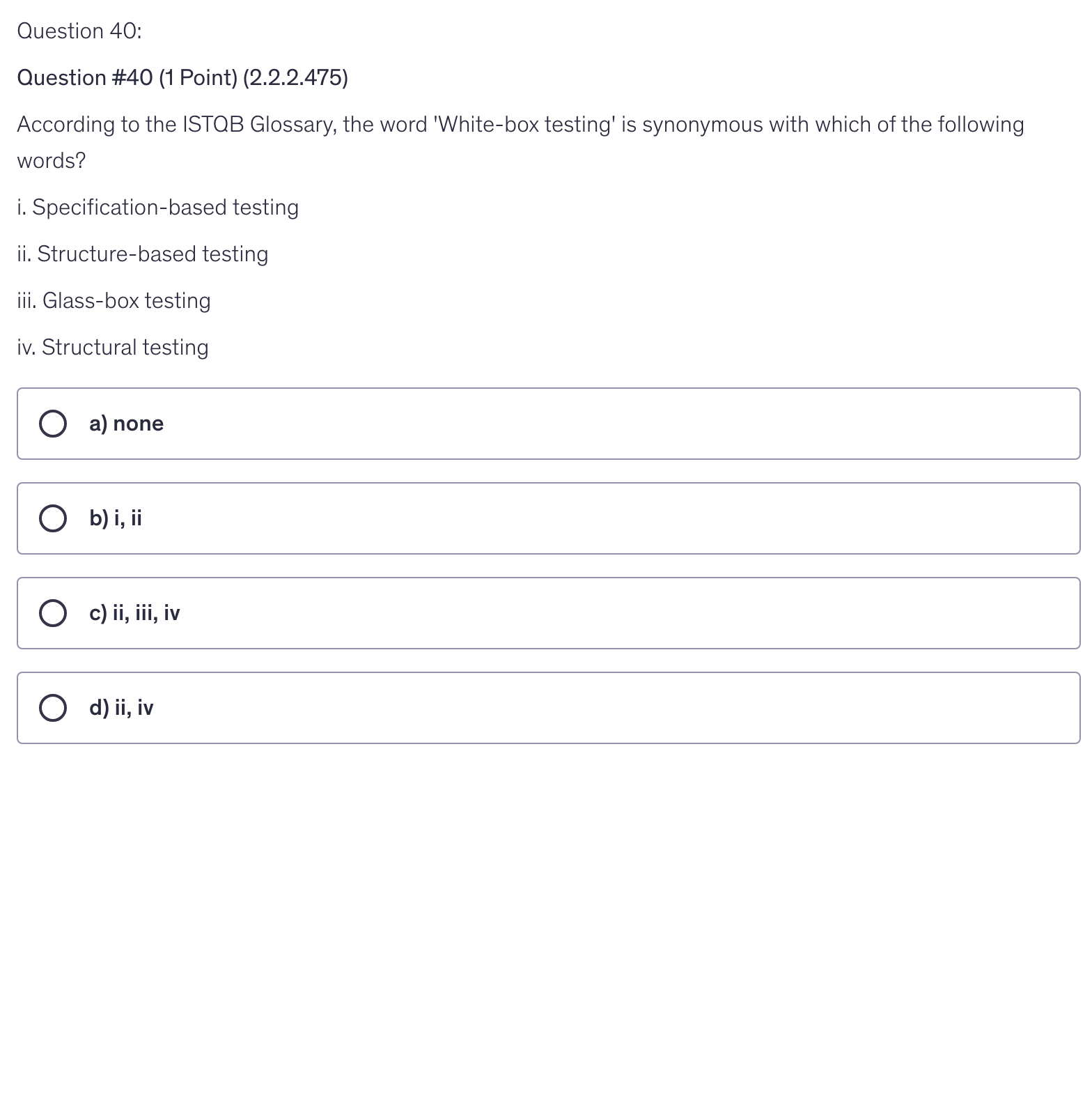
According to the ISTQB Glossary, the word 'White-box testing' is synonymous with which of the following words?
i. Specification-based testing
ii. Structure-based testing
iii. Glass-box testing
iv. Structural testing
c) ii, iii, iv
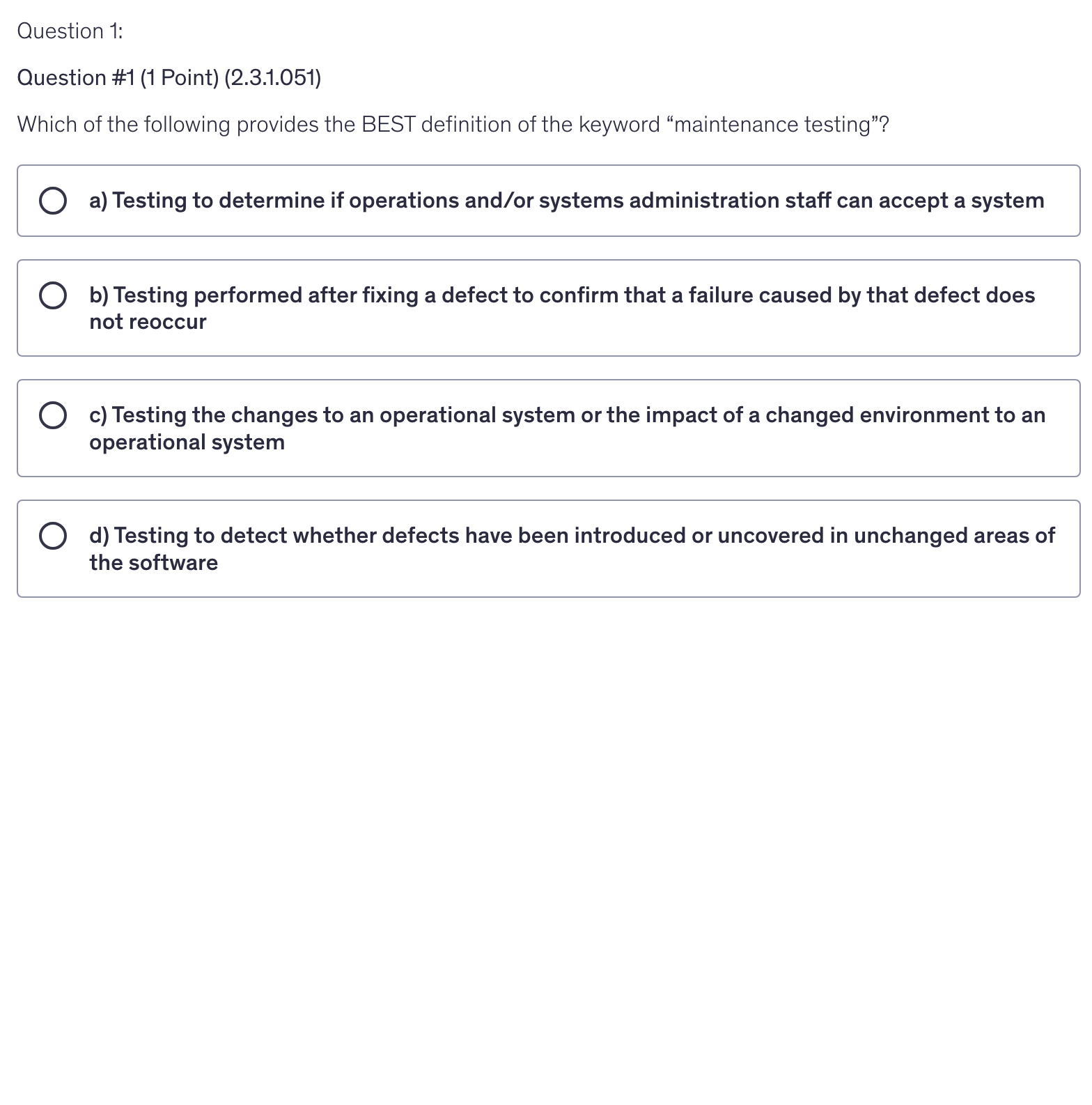
Which of the following provides the BEST definition of the keyword “maintenance testing”?
c) Testing the changes to an operational system or the impact of a changed environment to an operational system
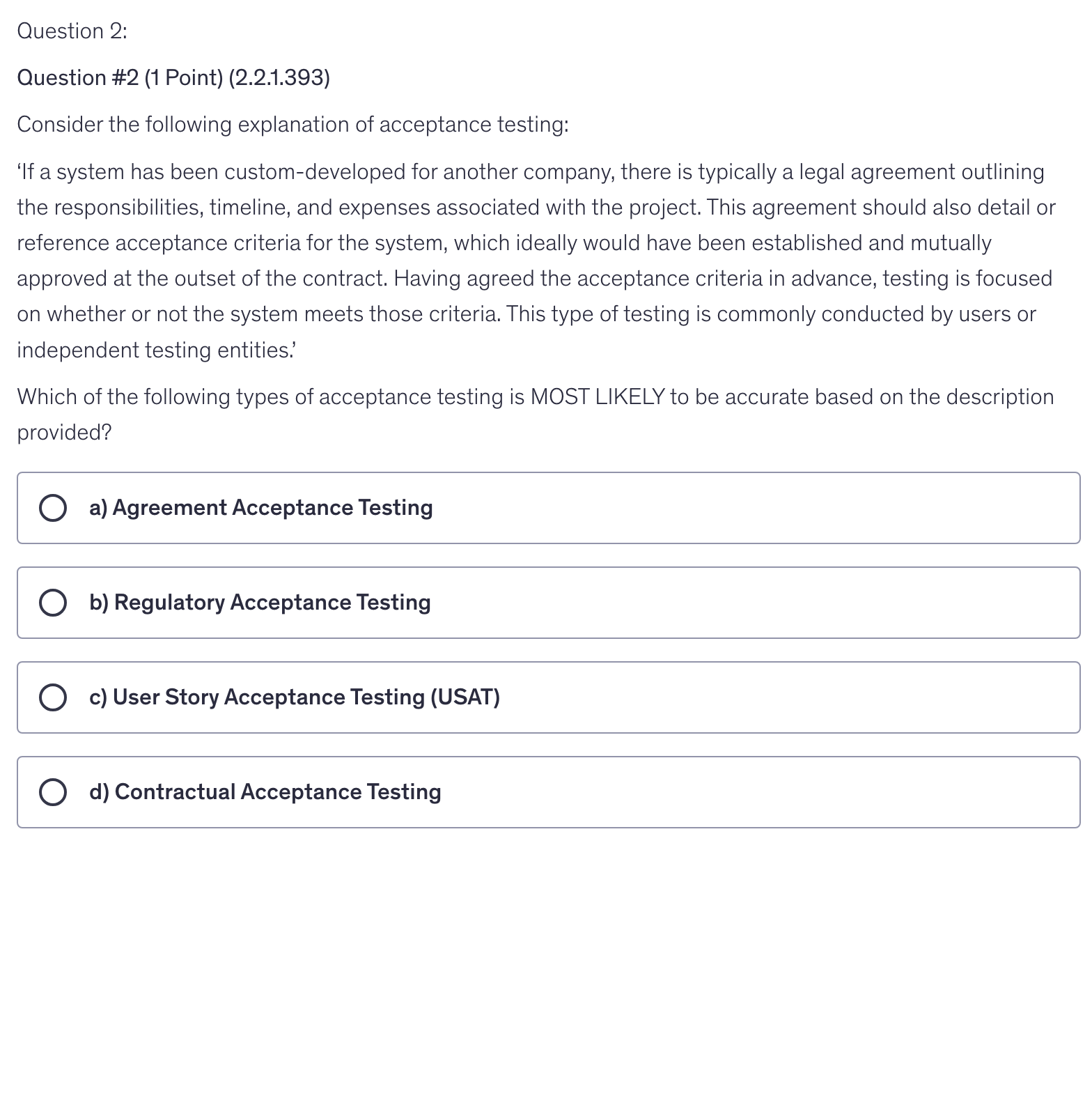
Consider the following explanation of acceptance testing:
‘If a system has been custom-developed for another company, there is typically a legal agreement outlining the responsibilities, timeline, and expenses associated with the project. This agreement should also detail or reference acceptance criteria for the system, which ideally would have been established and mutually approved at the outset of the contract. Having agreed the acceptance criteria in advance, testing is focused on whether or not the system meets those criteria. This type of testing is commonly conducted by users or independent testing entities.’
Which of the following types of acceptance testing is MOST LIKELY to be accurate based on the description provided?
d) Contractual Acceptance Testing
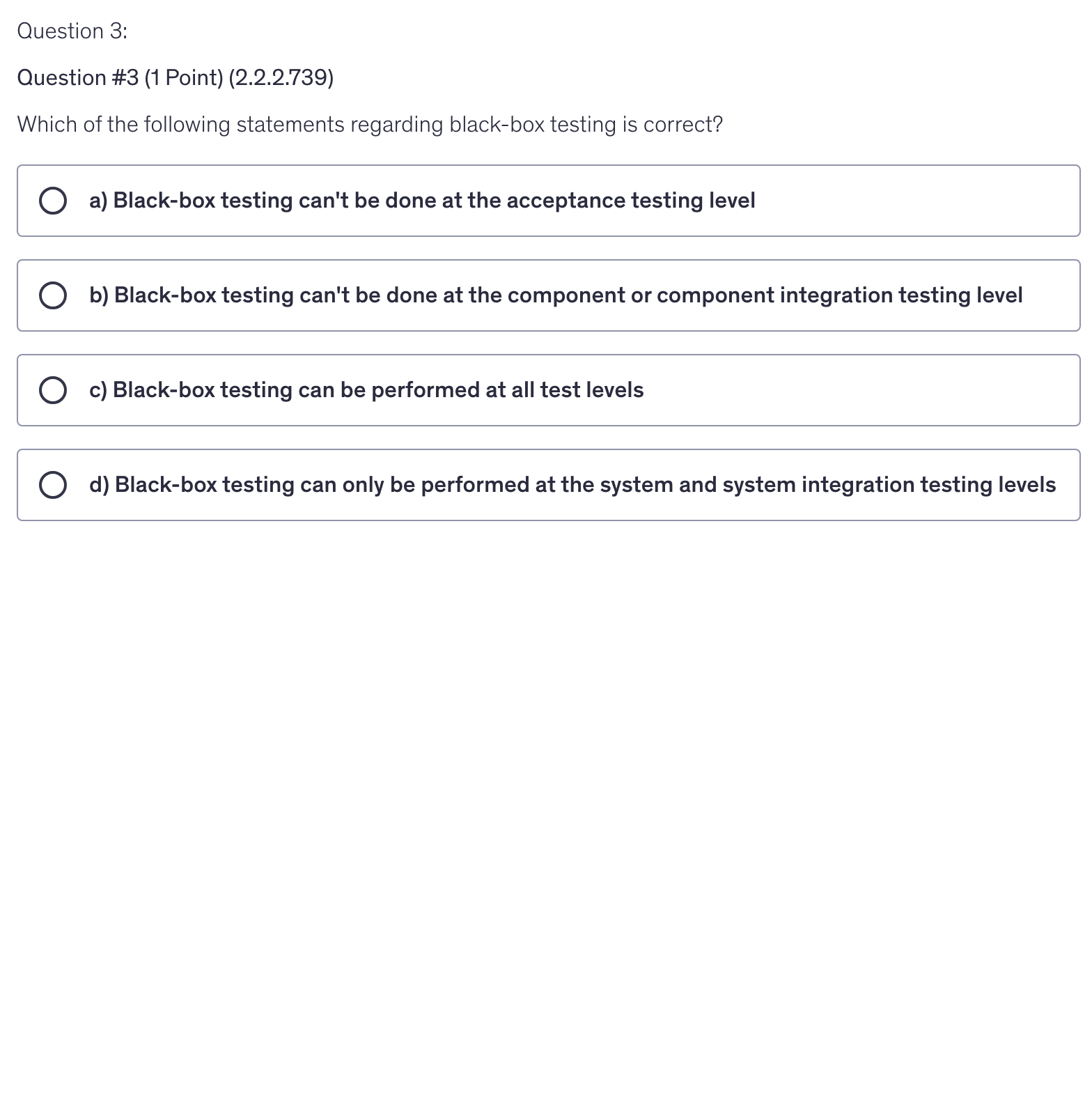
Which of the following statements regarding black-box testing is correct?
c) Black-box testing can be performed at all test levels
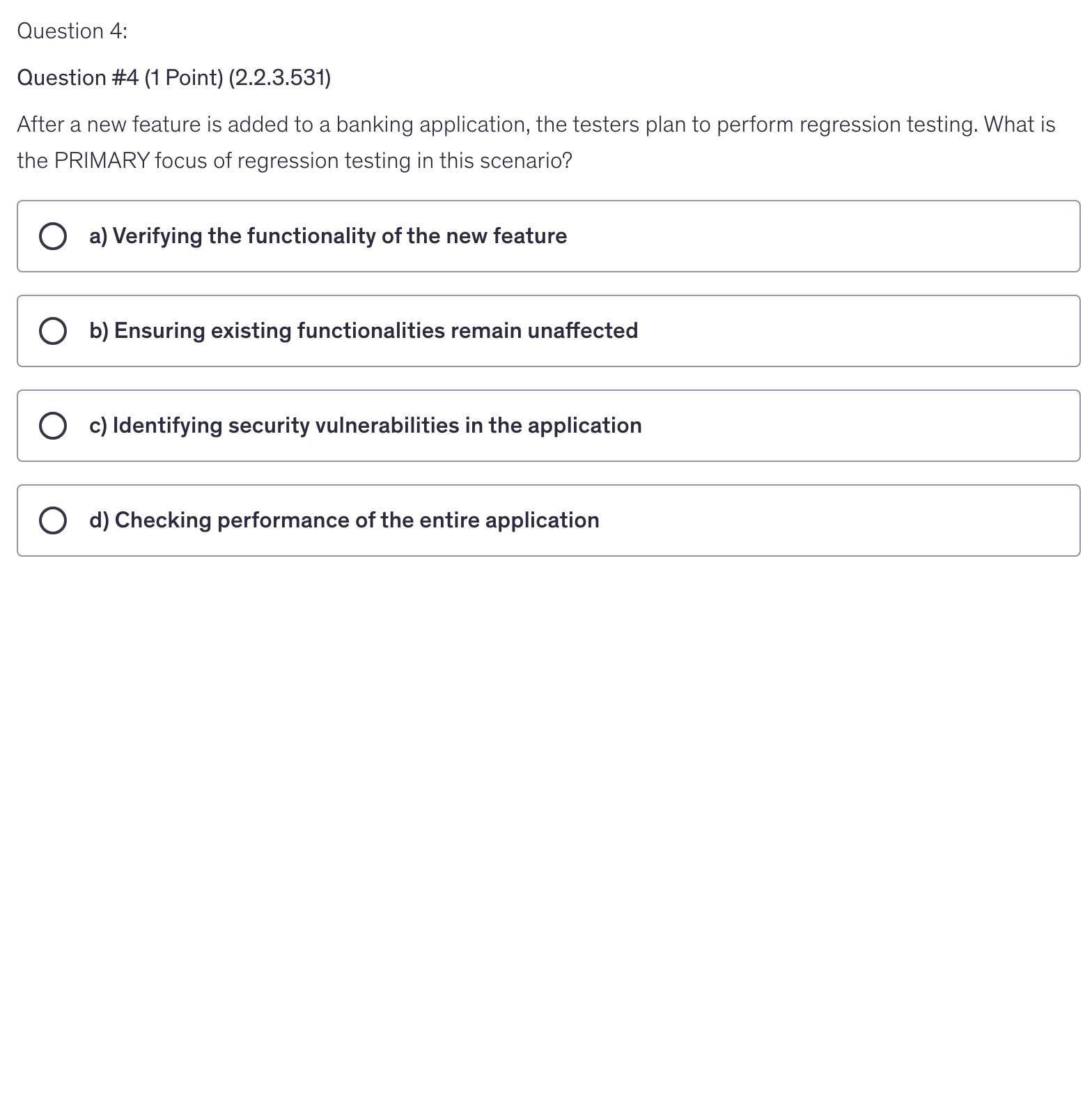
After a new feature is added to a banking application, the testers plan to perform regression testing. What is the PRIMARY focus of regression testing in this scenario?
b) Ensuring existing functionalities remain unaffected
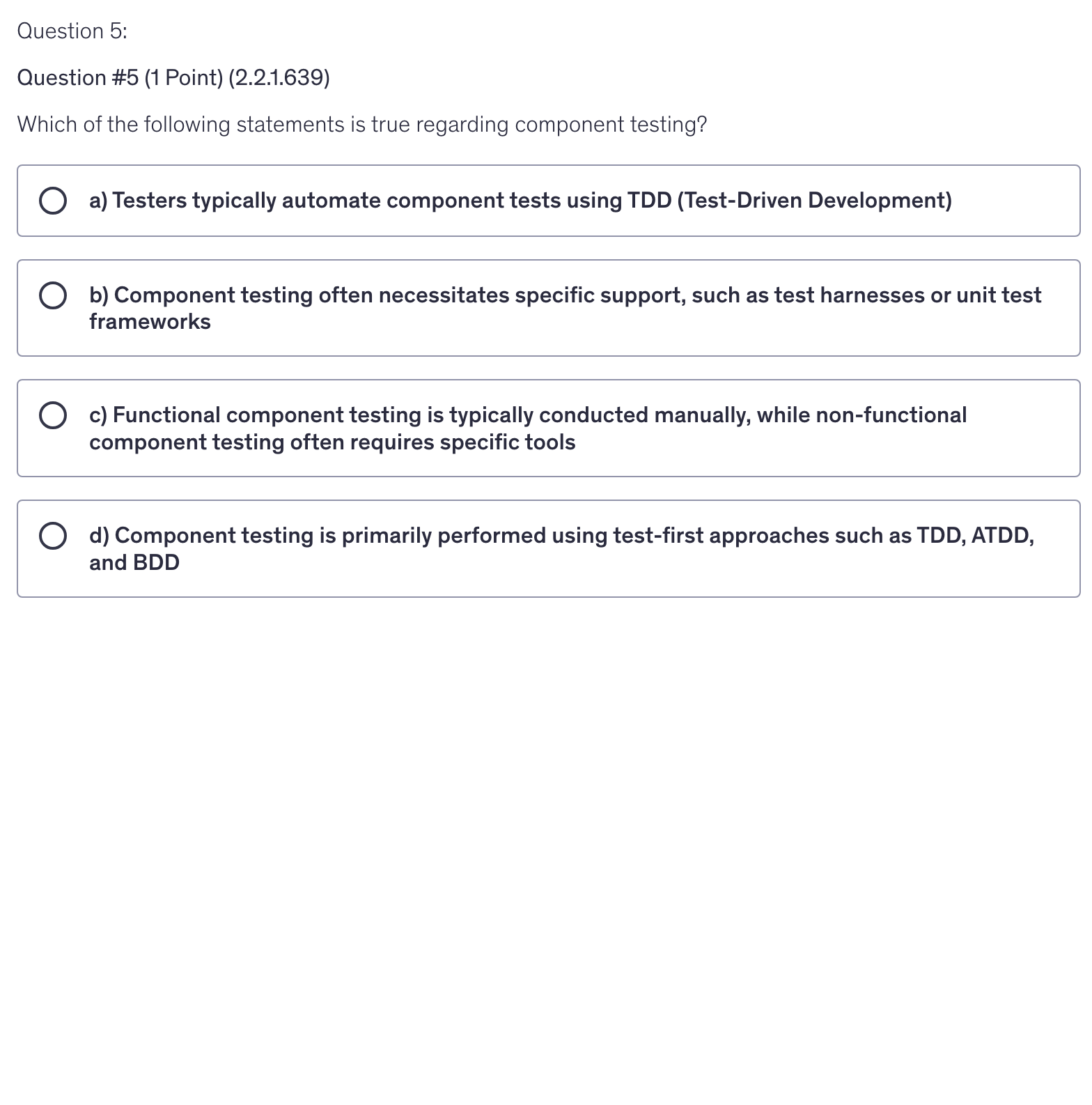
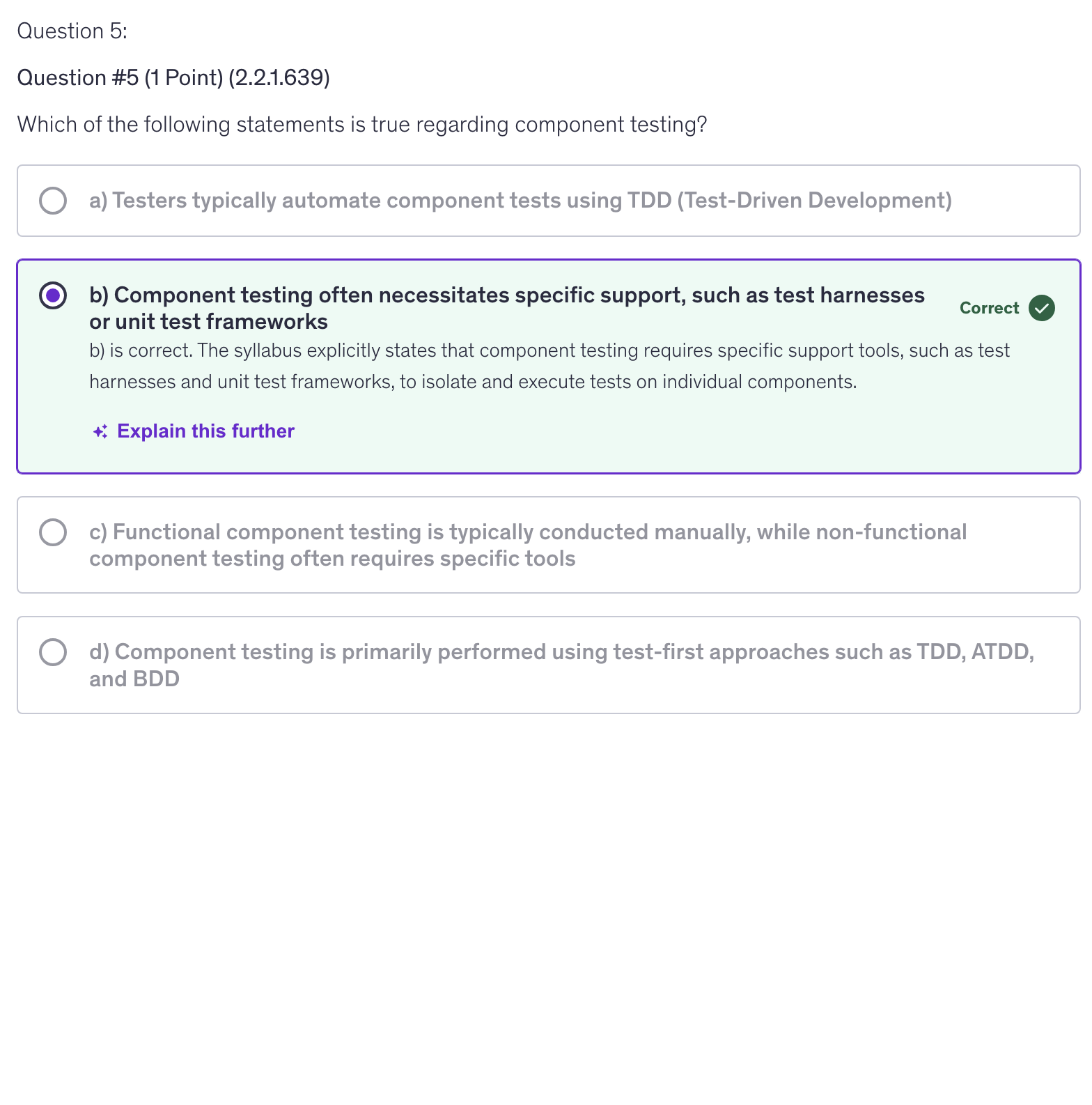
Which of the following statements is true regarding component testing?
b) Component testing often necessitates specific support, such as test harnesses or unit test frameworks
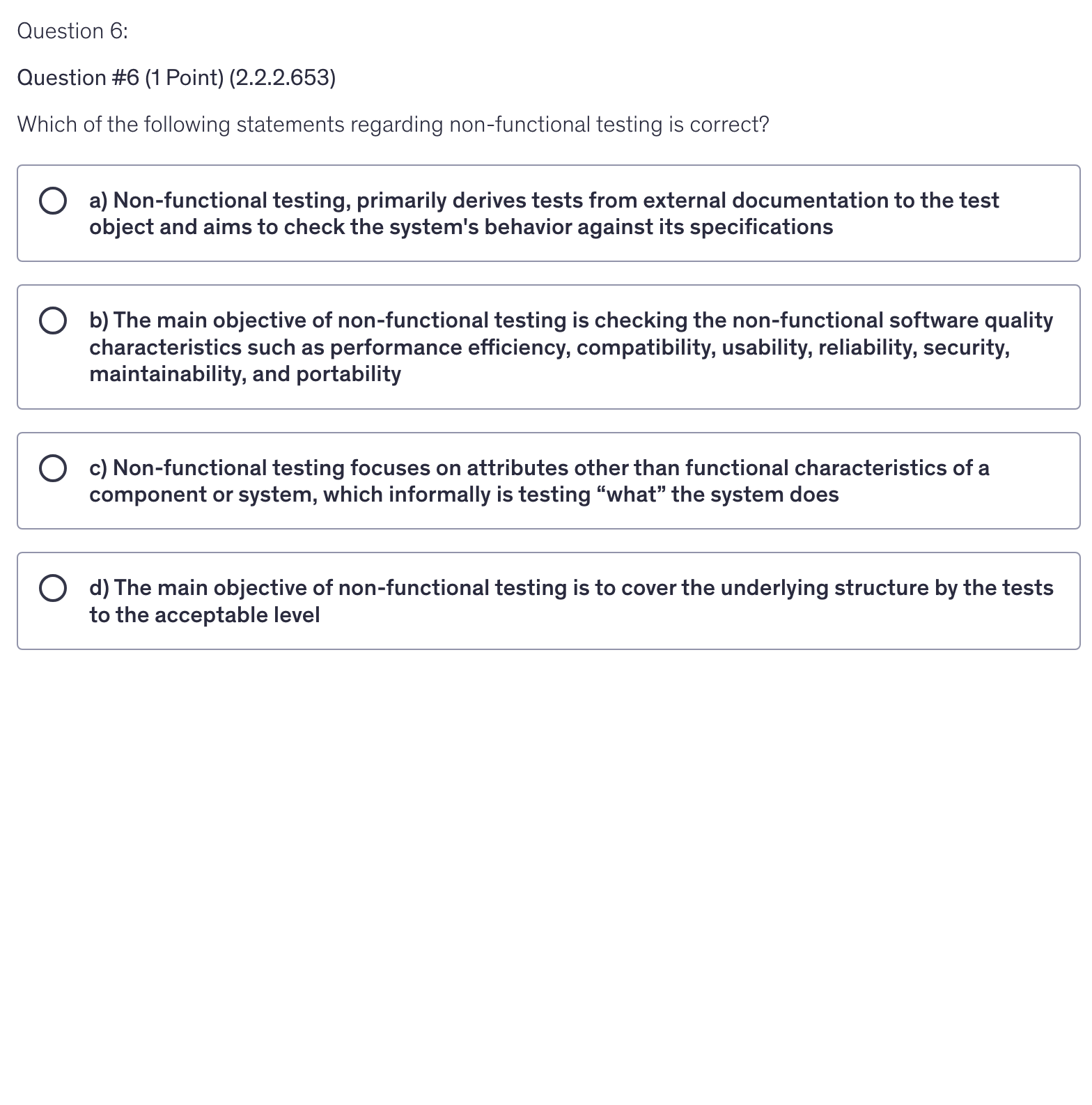
Which of the following statements regarding non-functional testing is correct?
b) The main objective of non-functional testing is checking the non-functional software quality characteristics such as performance efficiency; compatibility, usability, reliability, security, maintainability, and portability
Which trigger for maintenance testing involves migrating data from another application into the system being maintained?
a) Upgrades or migrations of the operational environment
Which of the following statements is true regarding system integration testing?
d) System integration testing requires suitable test environments preferably similar to the operational environment
During functional testing, which approach is used to determine whether the system behaves as expected based on predefined scenarios?
a) Black-box testing
You're performing confirmation testing on a critical bug that requires a quick fix. Which of the following testing strategies would be MOST appropriate?
b) Focus on re-running the failing test cases related to the bug, prioritizing speed

Which of the following tests is MOST likely to be conducted as part of white-box testing?
c) To check if all work-flows have been covered
How does the degree of risk of the change affect the scope of maintenance testing?
a) Higher risk changes require more extensive testing
Consider the following explanation of acceptance testing:
‘A type of acceptance testing performed to determine if intended users accept the system. It involves testing by end-users or on their behalf. The primary objective is to ensure the system is genuinely suitable for its intended purpose and prepared for real-world use. It can occur in the actual operational environment or a simulated one, as realistic as possible. The goal of this testing is to instill confidence that the system will effectively facilitate users in performing their required tasks efficiently. The system must meet their needs and fulfill the specified requirements. Users concentrate on their business processes, aiming for smooth execution with minimal difficulty, cost, and risk.’
Which of the following types of acceptance testing is MOST LIKELY to be accurate based on the description provided?
b) UAT
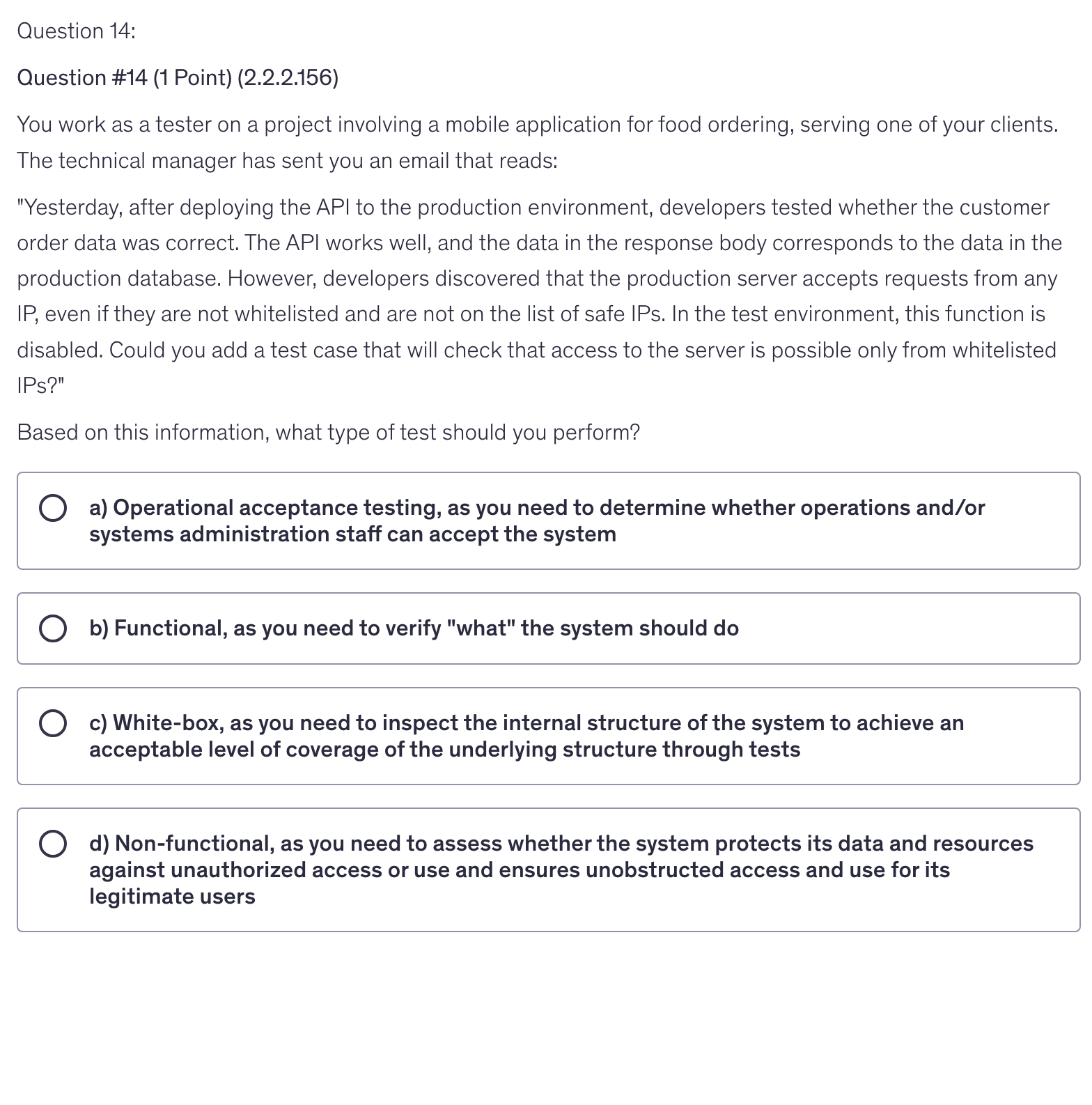
You work as a tester on a project involving a mobile application for food ordering, serving one of your clients. The technical manager has sent you an email that reads:
"Yesterday, after deploying the API to the production environment, developers tested whether the customer order data was correct. The API works well, and the data in the response body corresponds to the data in the production database. However, developers discovered that the production server accepts requests from any IP, even if they are not whitelisted and are not on the list of safe IPs. In the test environment, this function is disabled. Could you add a test case that will check that access to the server is possible only from whitelisted IPs?"
Based on this information, what type of test should you perform?
d) Non-functional, as you need to assess whether the system protects its data and resources against unauthorized access or use and ensures unobstructed access and use for its legitimate users
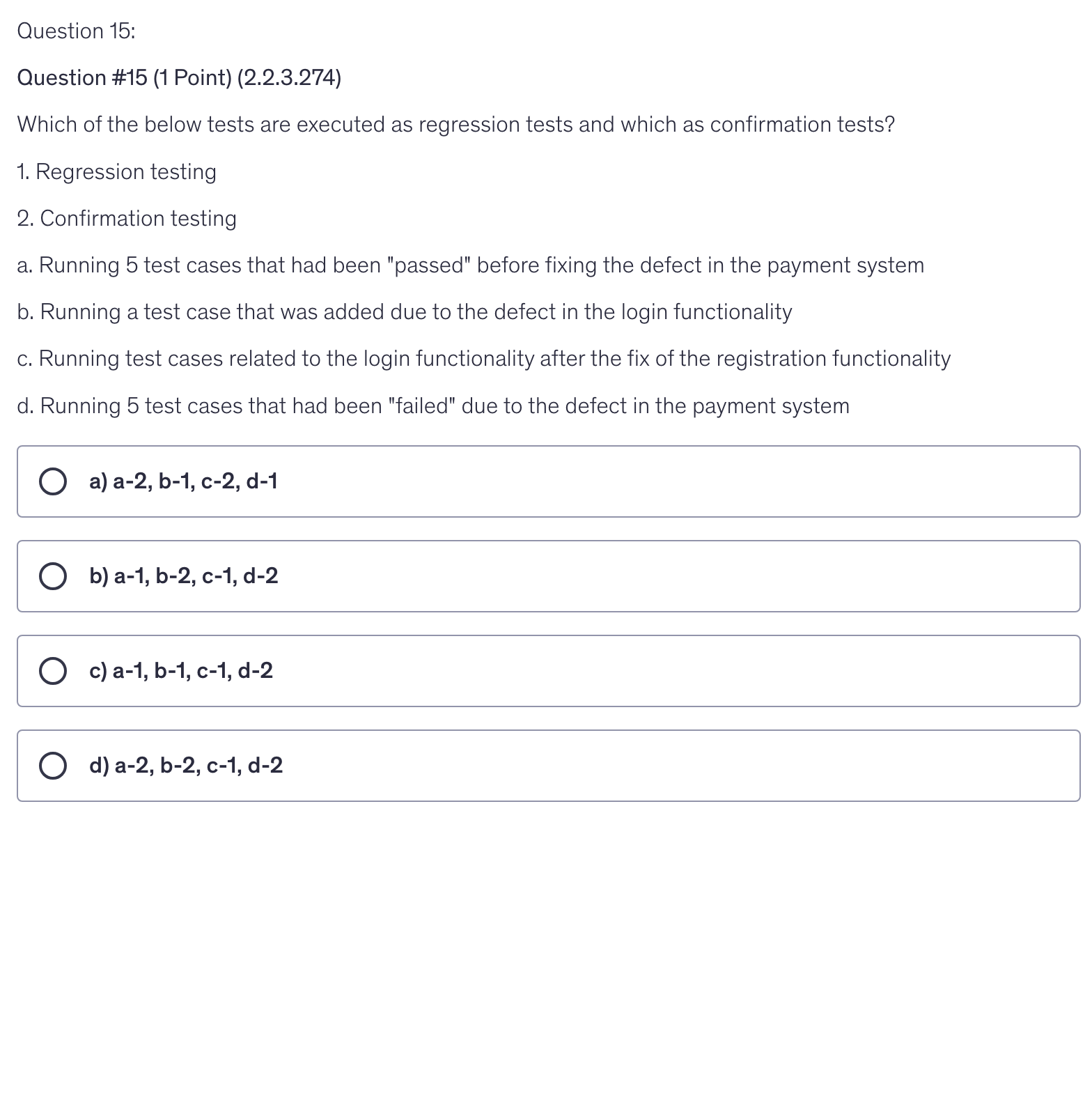
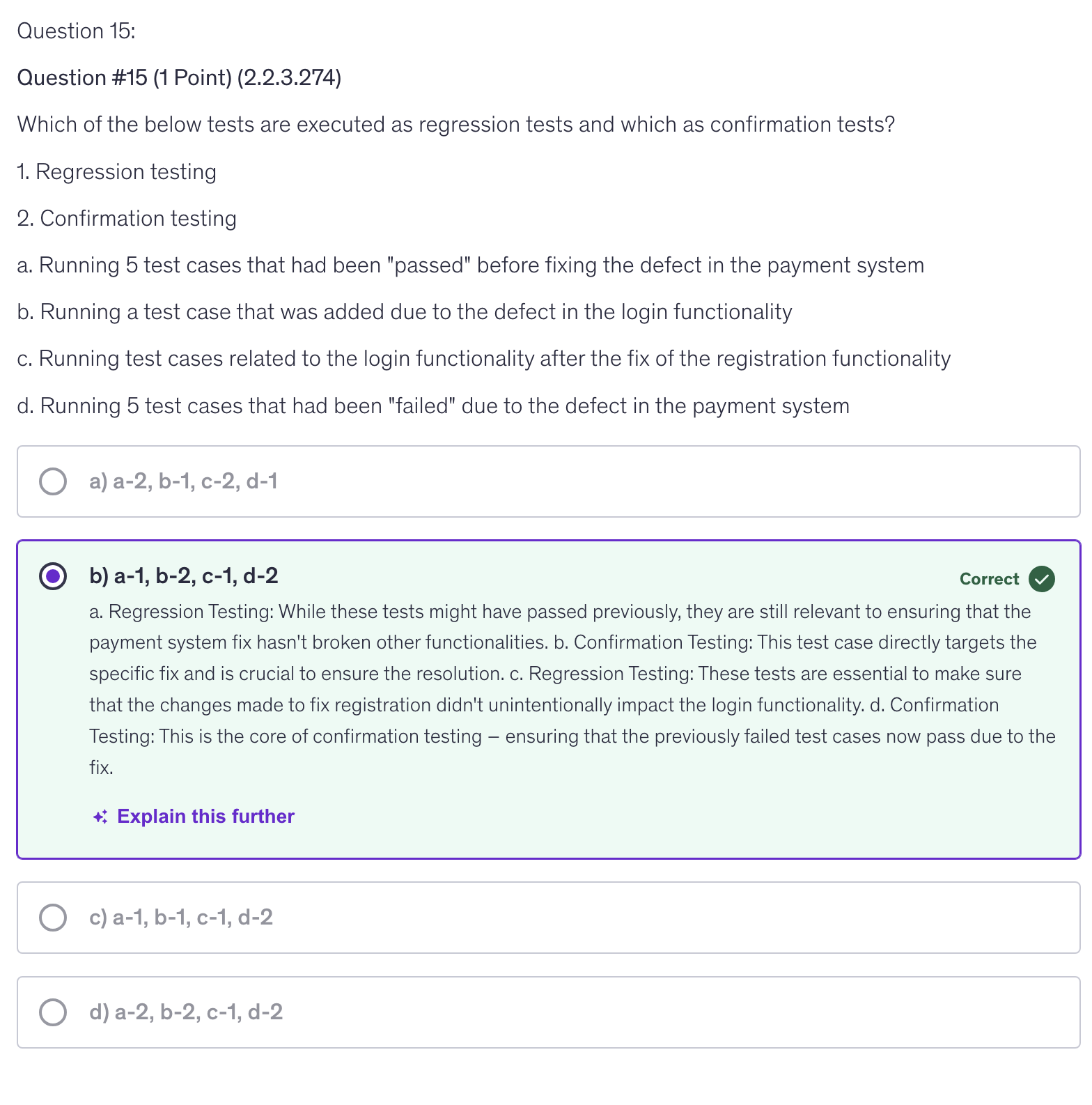
Which of the below tests are executed as regression tests and which as confirmation tests?
1. Regression testing
2. Confirmation testing
a. Running 5 test cases that had been "passed" before fixing the defect in the payment system
b. Running a test case that was added due to the defect in the login functionality
c. Running test cases related to the login functionality after the fix of the registration functionality
d. Running 5 test cases that had been "failed" due to the defect in the payment system
b) a-1, b-2, c-1, d-2
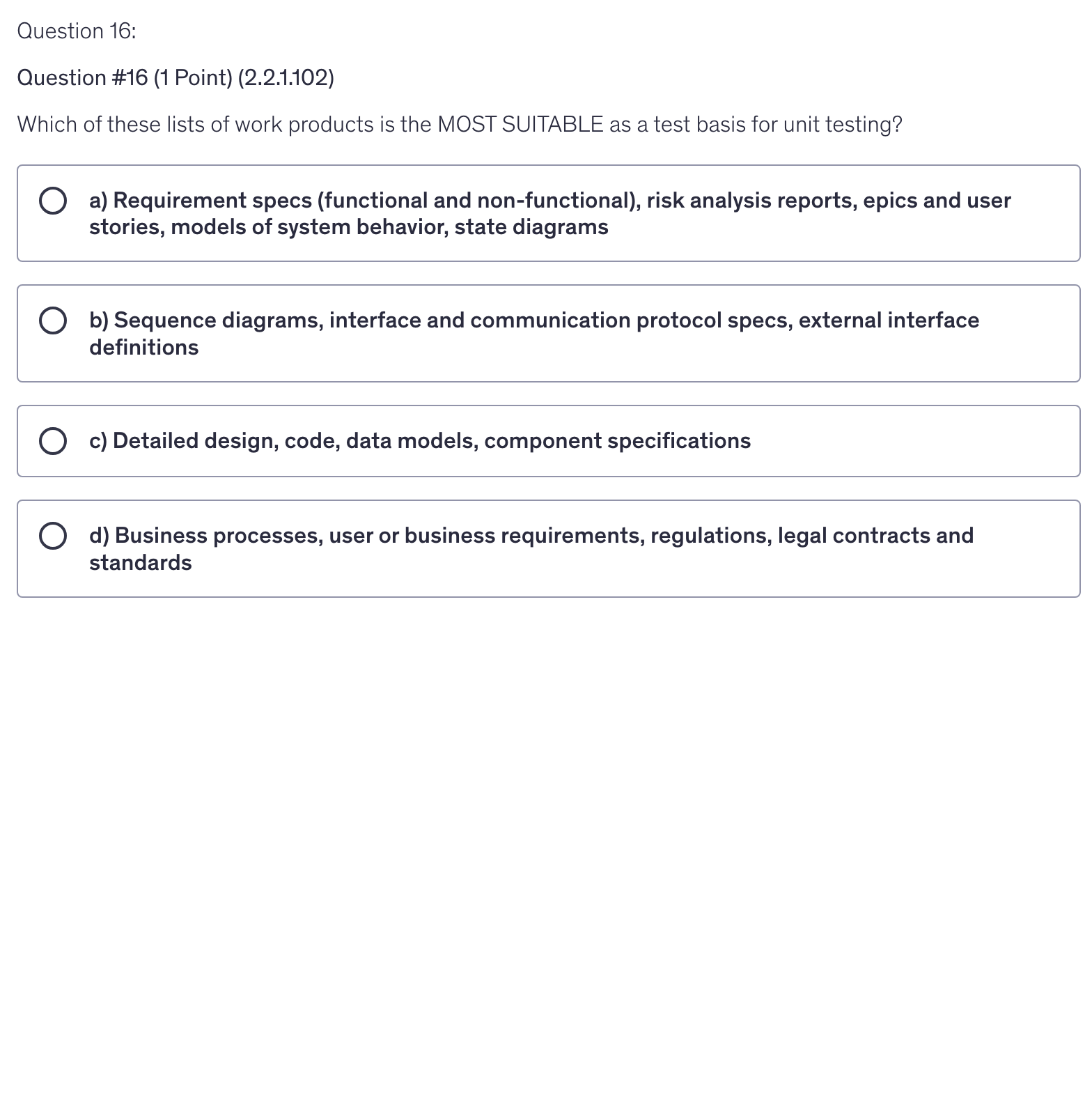
Which of these lists of work products is the MOST SUITABLE as a test basis for unit testing?
c) Detailed design, code, data models, component specifications
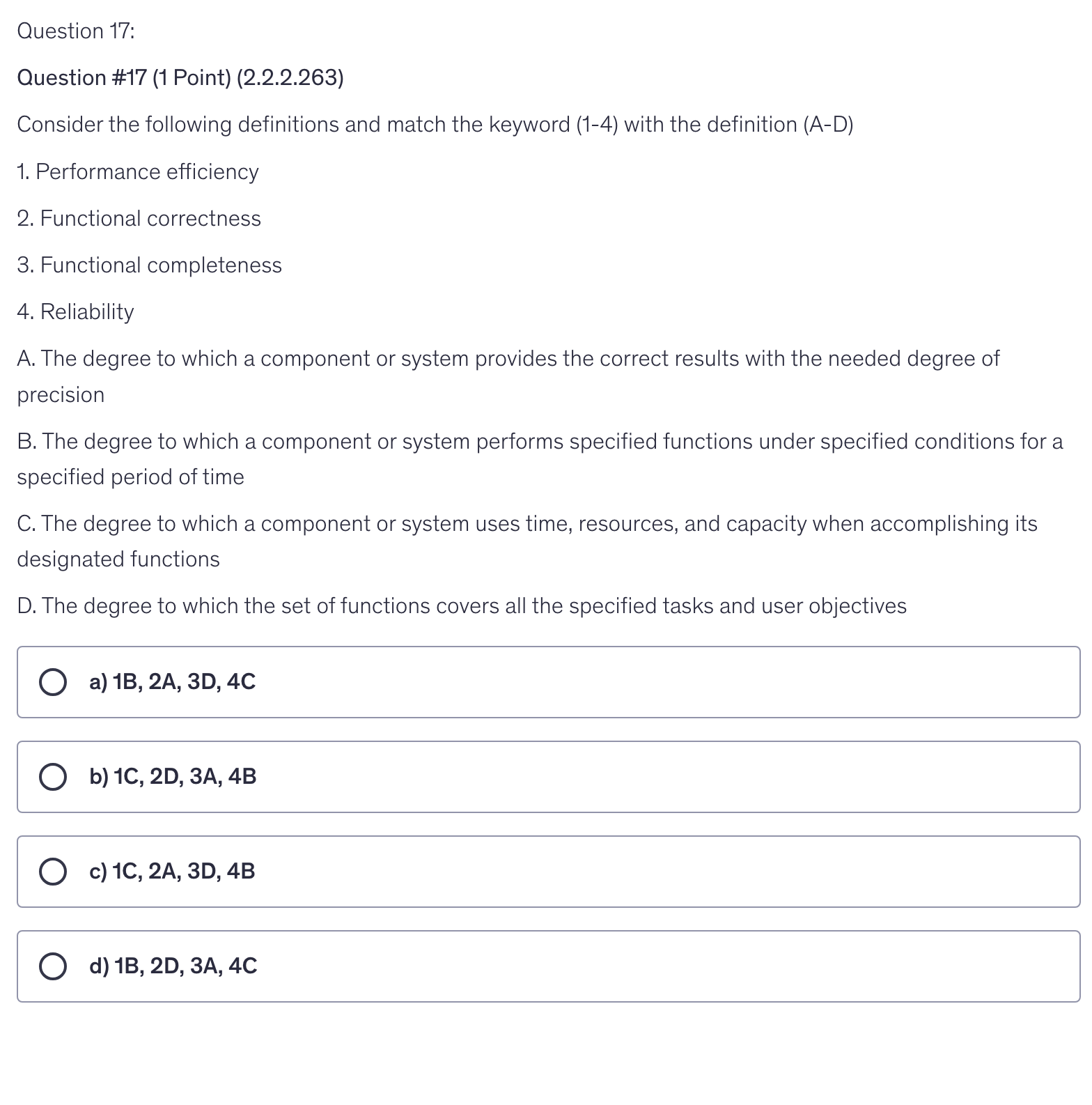
Consider the following definitions and match the keyword (1-4) with the definition (A-D)
1. Performance efficiency
2. Functional correctness
3. Functional completeness
4. Reliability
A. The degree to which a component or system provides the correct results with the needed degree of precision
B. The degree to which a component or system performs specified functions under specified conditions for a specified period of time
C. The degree to which a component or system uses time, resources, and capacity when accomplishing its designated functions
D. The degree to which the set of functions covers all the specified tasks and user objectives
c) 1C, 2A, 3D, 4B
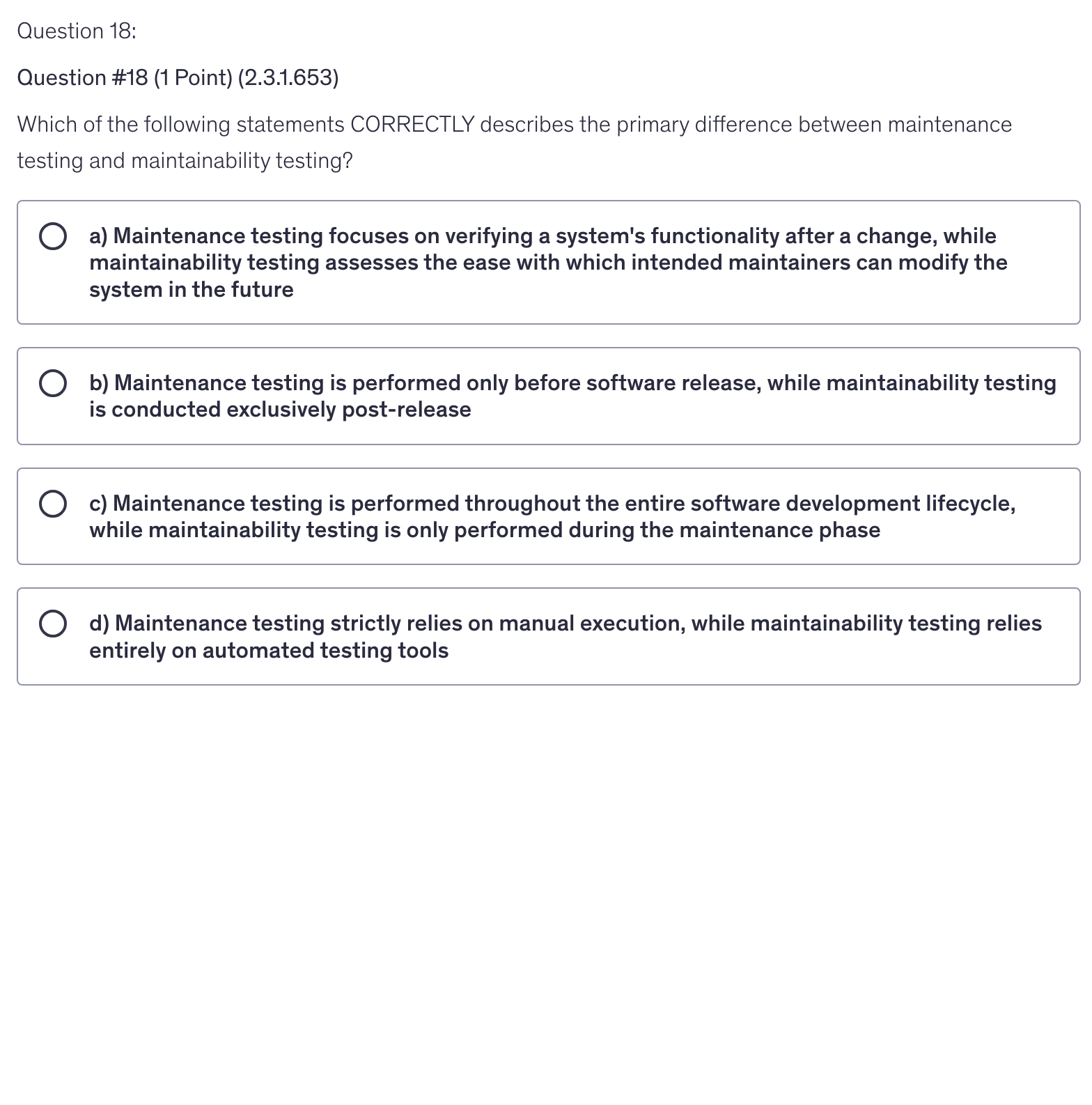
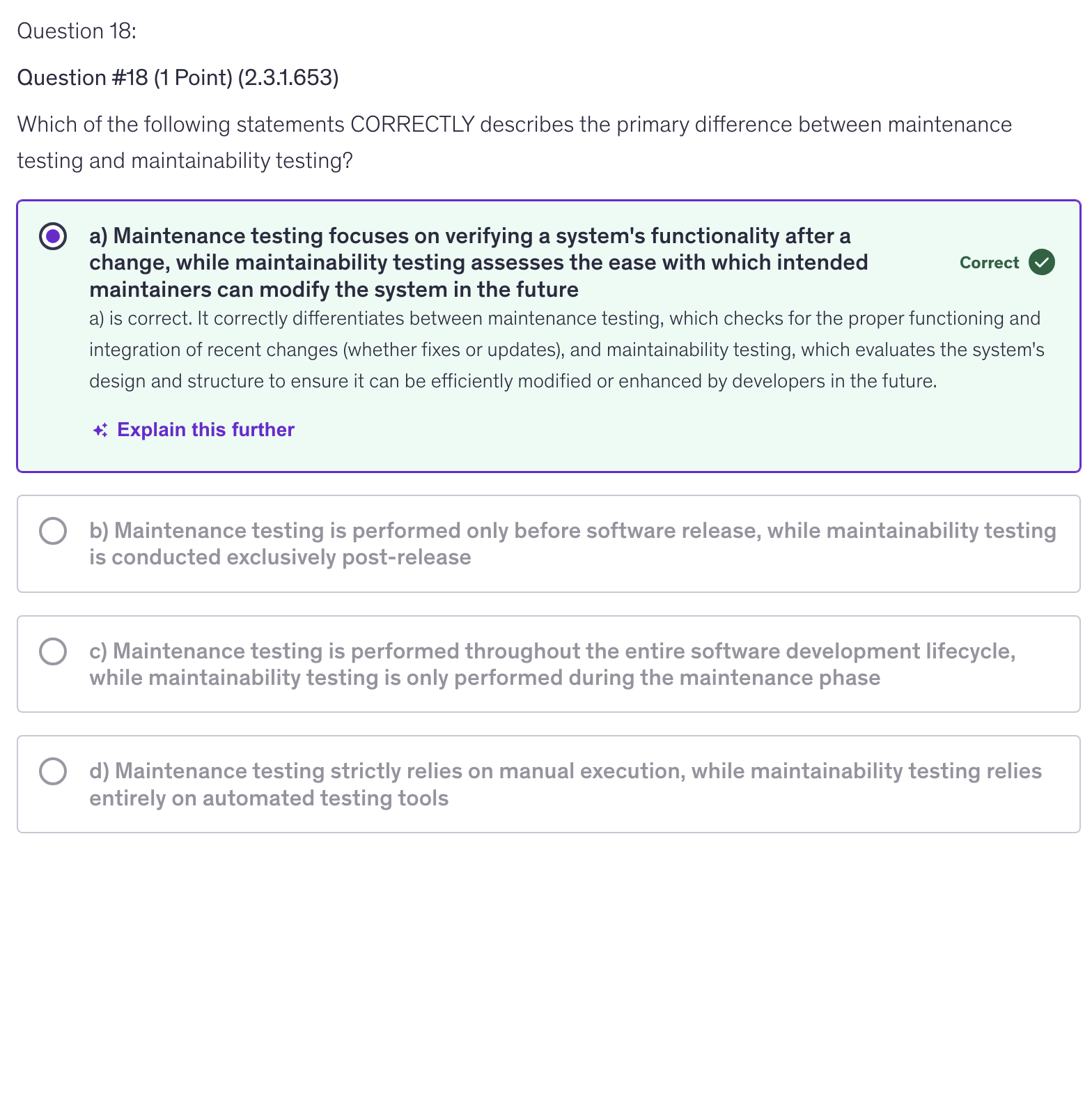
Which of the following statements CORRECTLY describes the primary difference between maintenance testing and maintainability testing?
a) Maintenance testing focuses on verifying a system’s functionality after a change, while maintainability testing assesses the ease with which intended maintainers can modify the system in the future
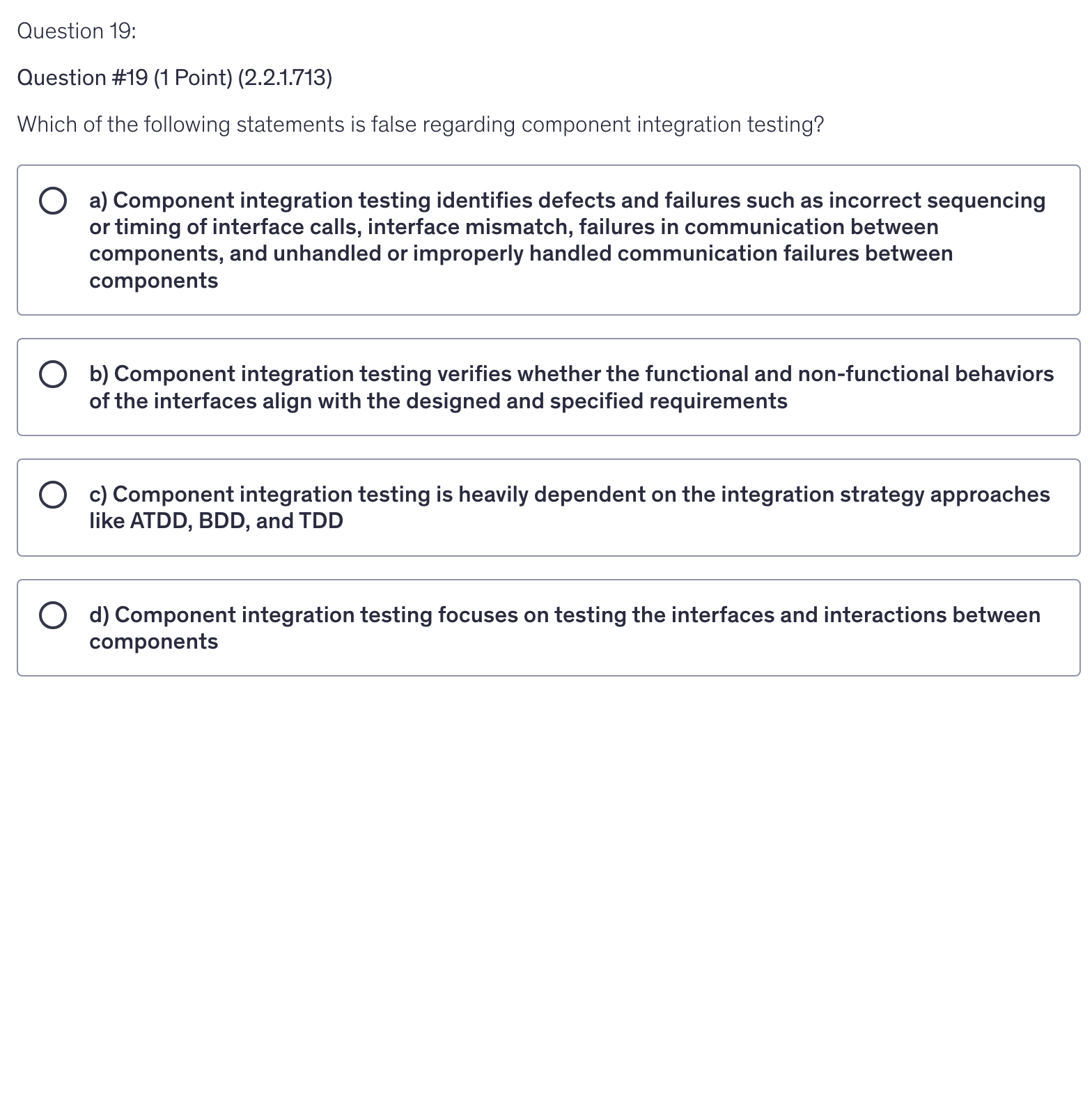
Which of the following statements is false regarding component integration testing?
c) Component integration testing is heavily dependent on the integration strategy approaches like ATDD, BDD, and TDD
During non-functional testing, what is the main focus of performance testing?
b) Evaluating the system’s behavior under specific load conditions
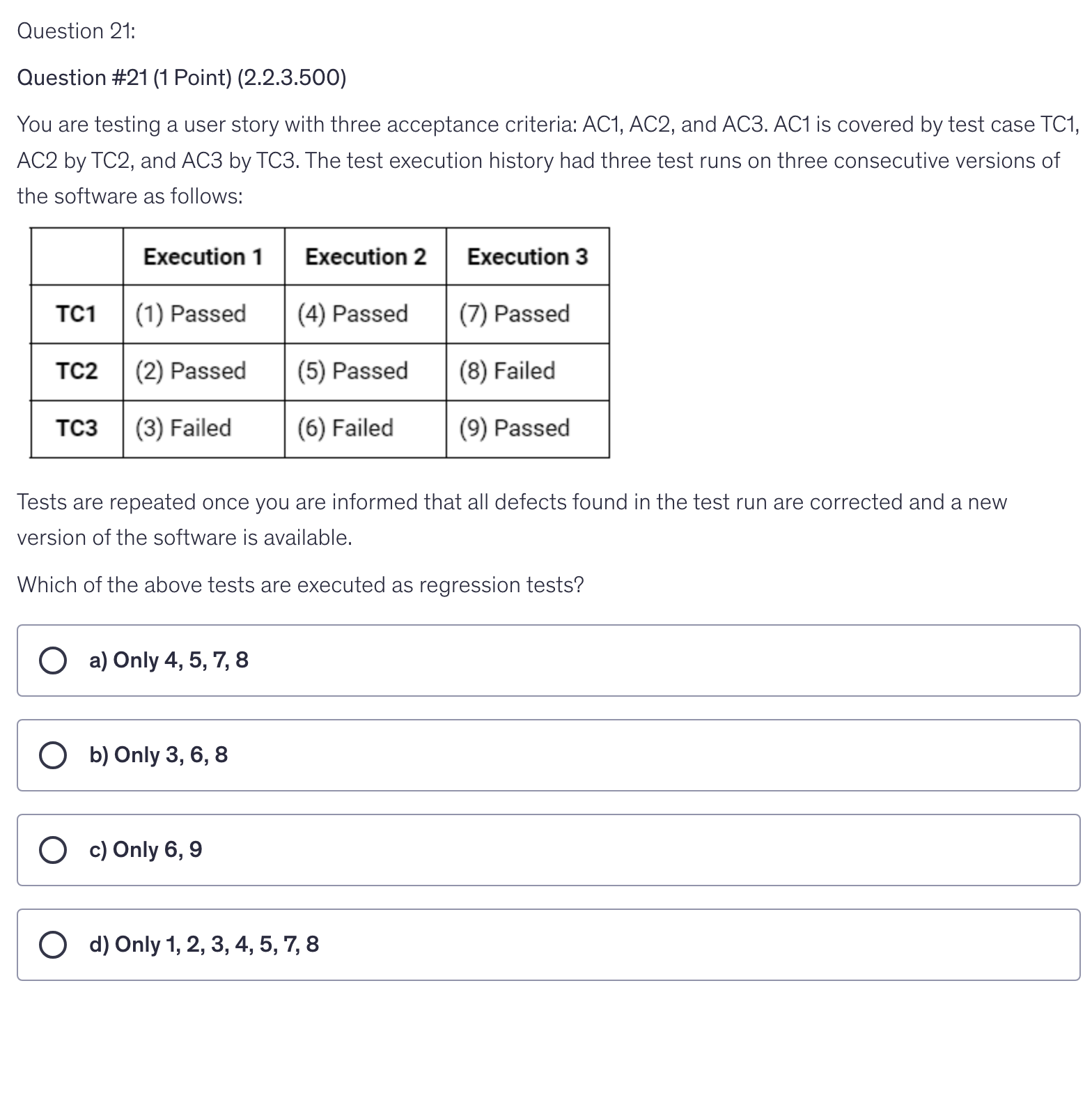
You are testing a user story with three acceptance criteria: AC1, AC2, and AC3. AC1 is covered by test case TC1, AC2 by TC2, and AC3 by TC3. The test execution history had three test runs on three consecutive versions of the software as follows:
Tests are repeated once you are informed that all defects found in the test run are corrected and a new version of the software is available.
Which of the above tests are executed as regression tests?
a) Only 4,5,7,8
Which of these is a functional test?
c) Checking the online bookings screen information and the database contents against the information in the letter to the customers
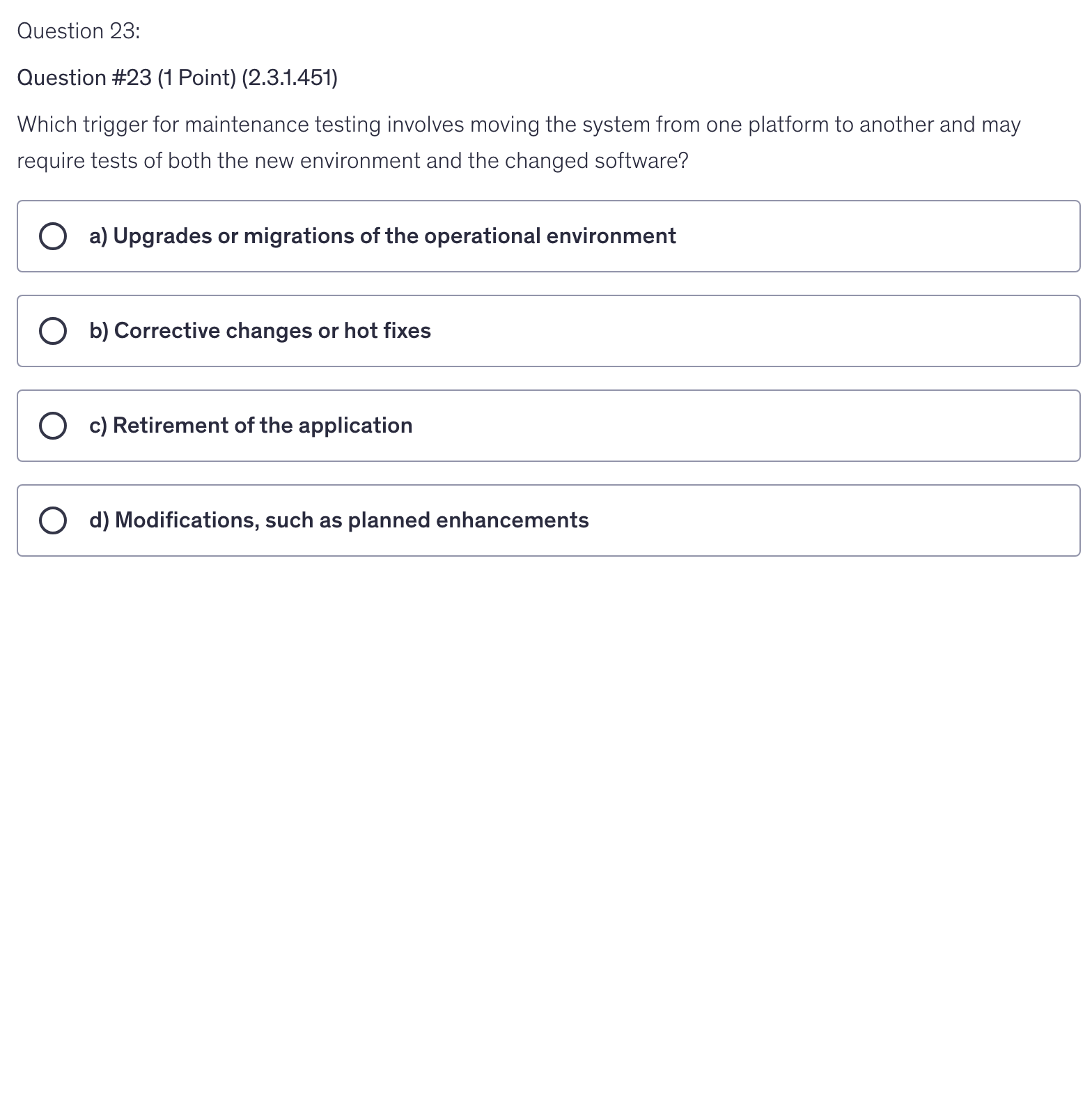
Which trigger for maintenance testing involves moving the system from one platform to another and may require tests of both the new environment and the changed software?
a) Upgrades or migrations of the operational environment
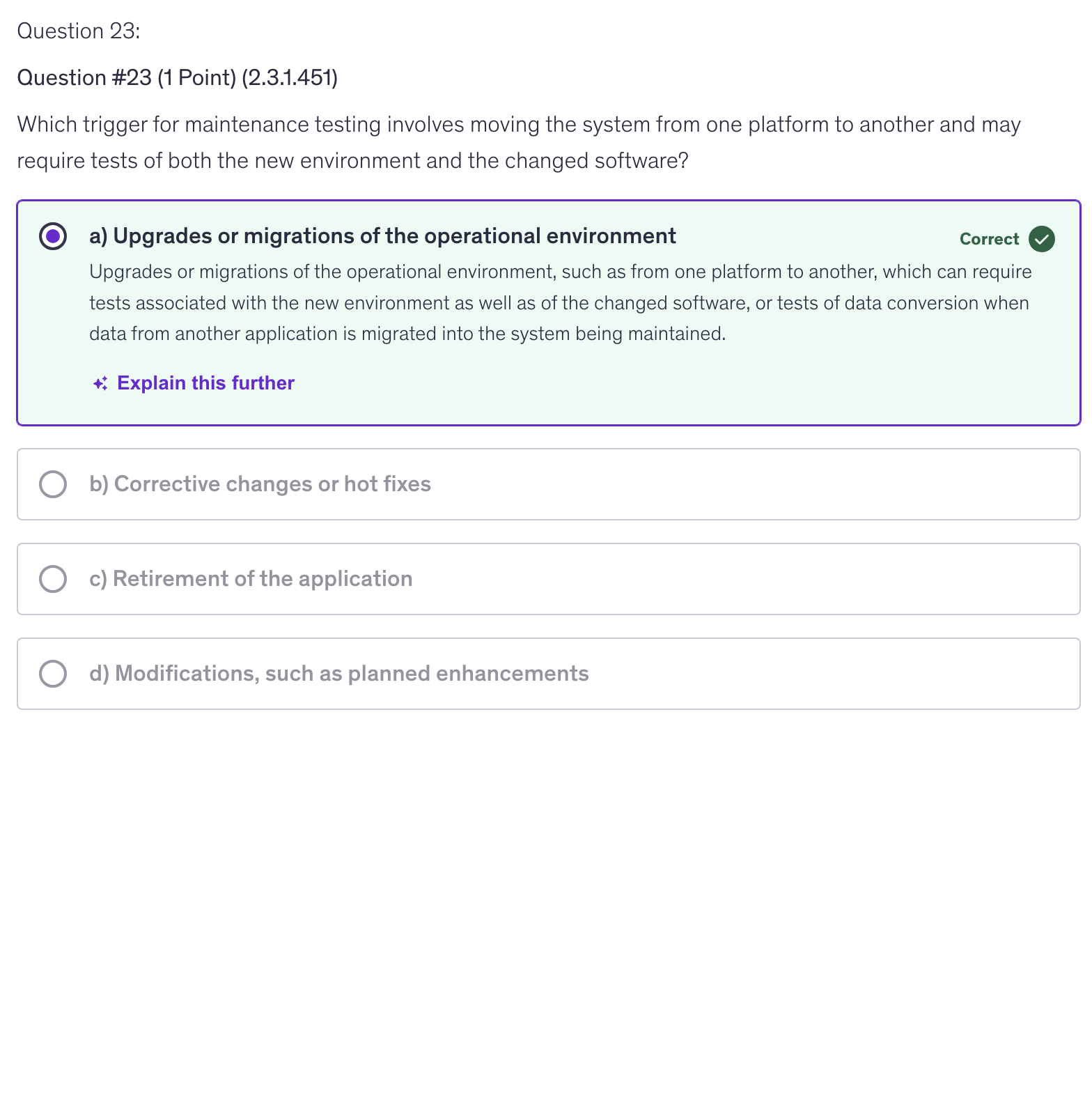
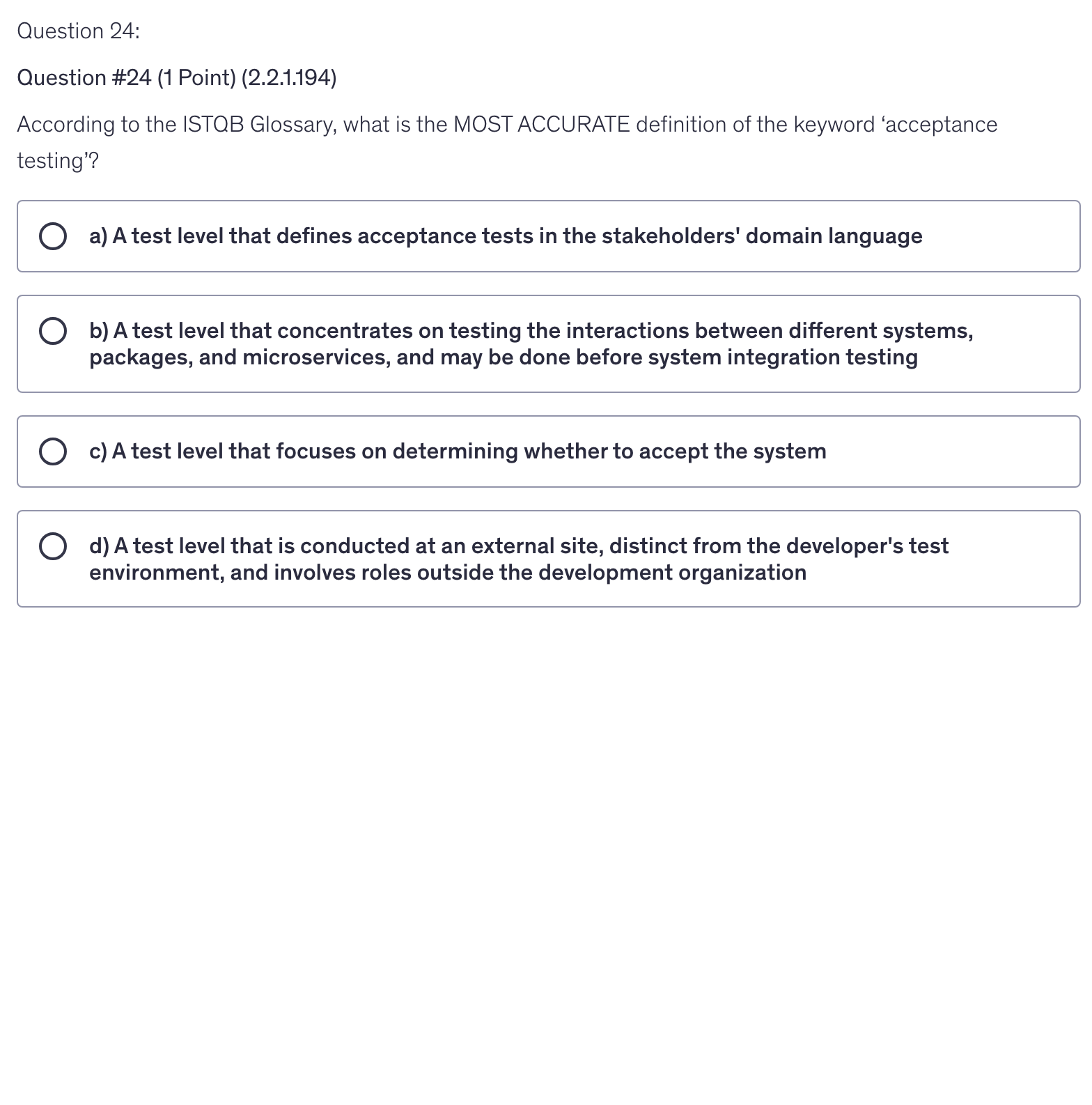
According to the ISTQB Glossary, what is the MOST ACCURATE definition of the keyword ‘acceptance testing’?
c) A test level that focuses on determining whether to accept the system

Your current project involves the development of a home workout app to support the services of a fitness coaching company.
Your task is:
“To check the degree to which a component or system can exchange information with other components or systems, and/or perform its required functions while sharing the same hardware or software environment”
What type of testing are you MOST LIKELY performing?
b) Non-functional testing

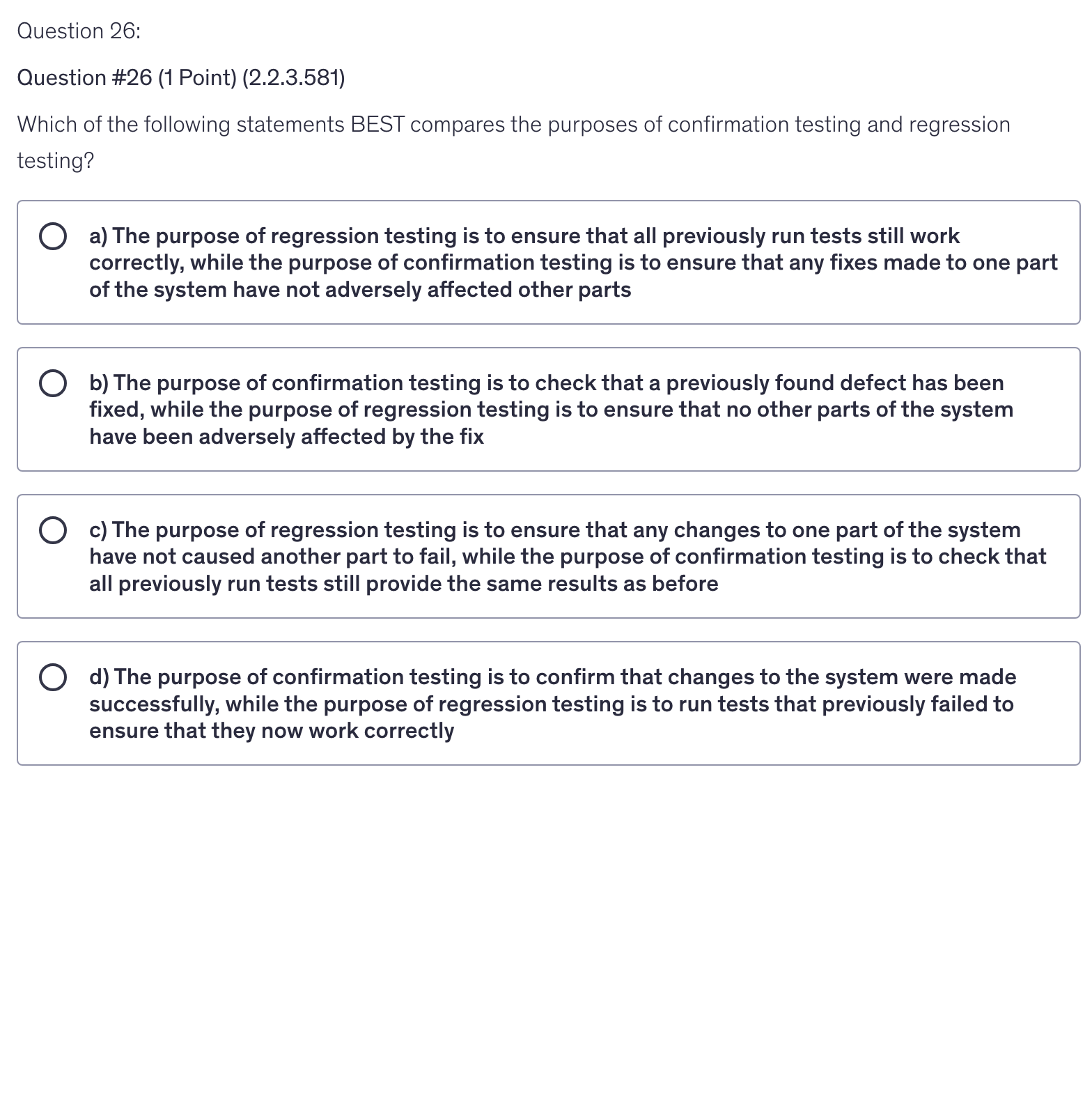
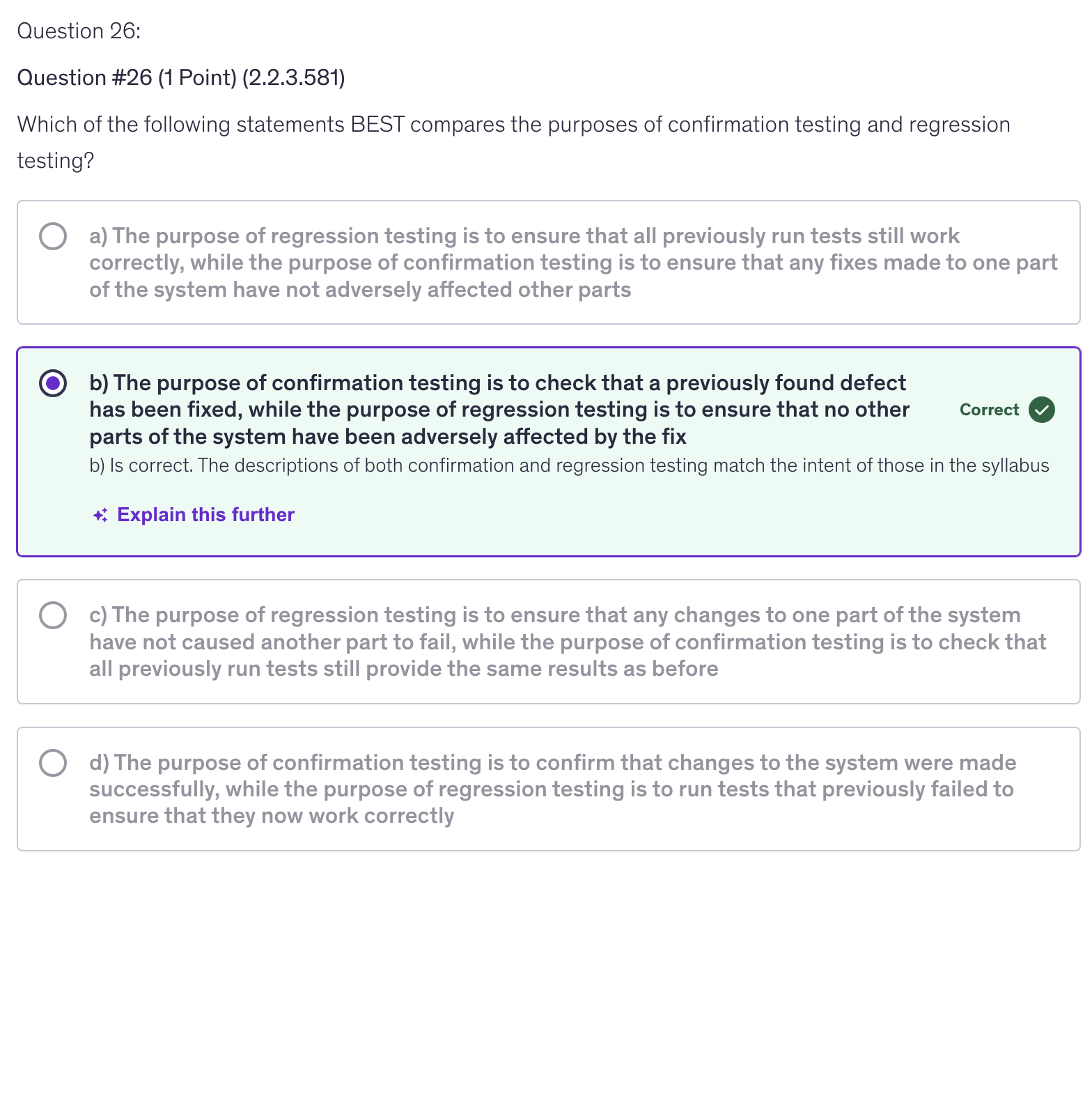
Which of the following statements BEST compares the purposes of confirmation testing and regression testing?
b) The purpose of confirmation testing is to check that a previously found defect has been fixed, while the purpose of regression testing is to ensure that no other parts of the system have been adversely affected by the fix

Which of the following statements is true regarding component integration testing?
d) Component integration testing focuses on testing the interfaces and interactions between components, rather than on the functional and non-functional characteristics of the components in isolation
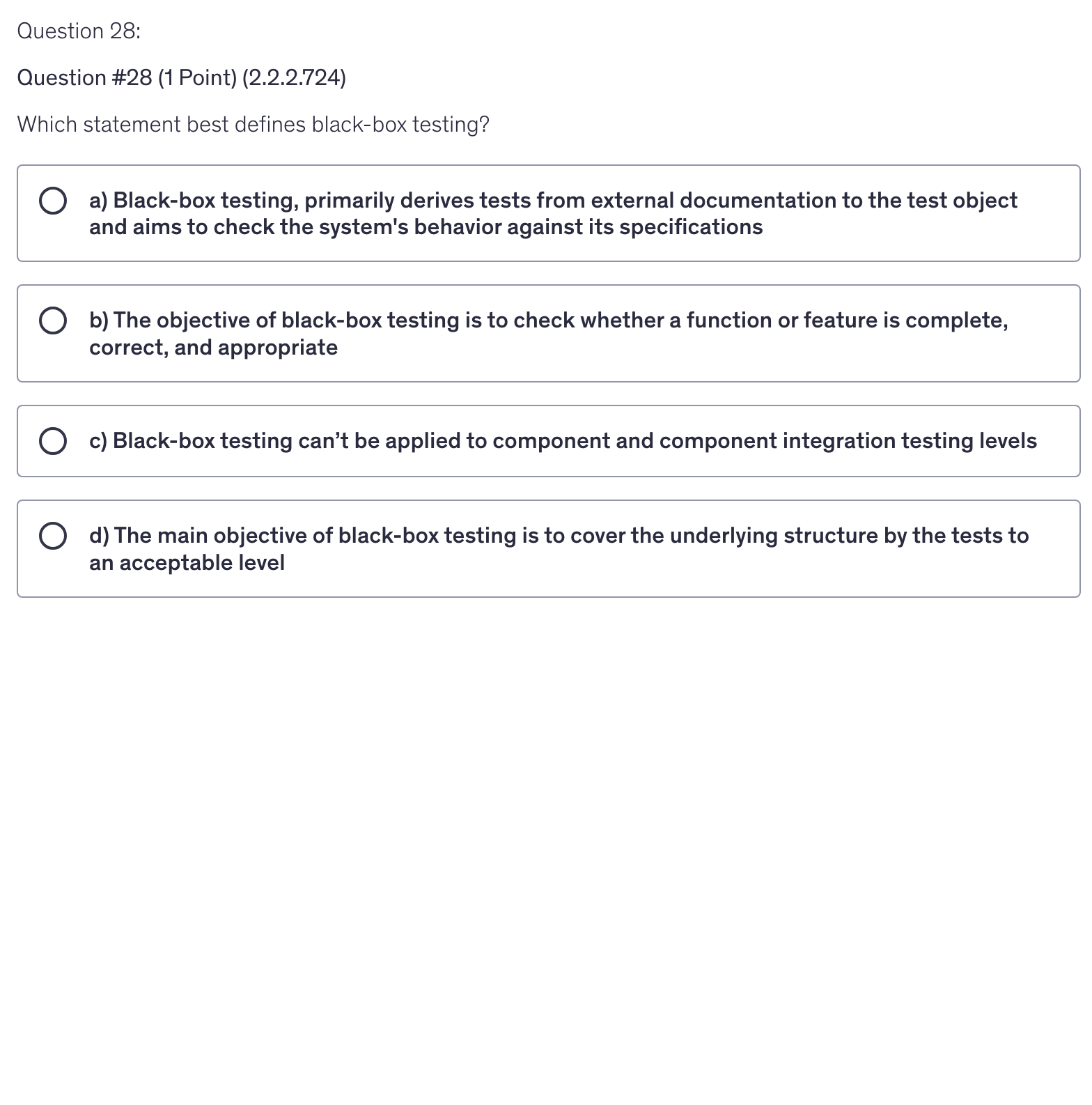
Which statement best defines black-box testing?
a) Black-box testing primarily derives tests from external documentation to the test object and aims to check the system’s behavior against its specifications
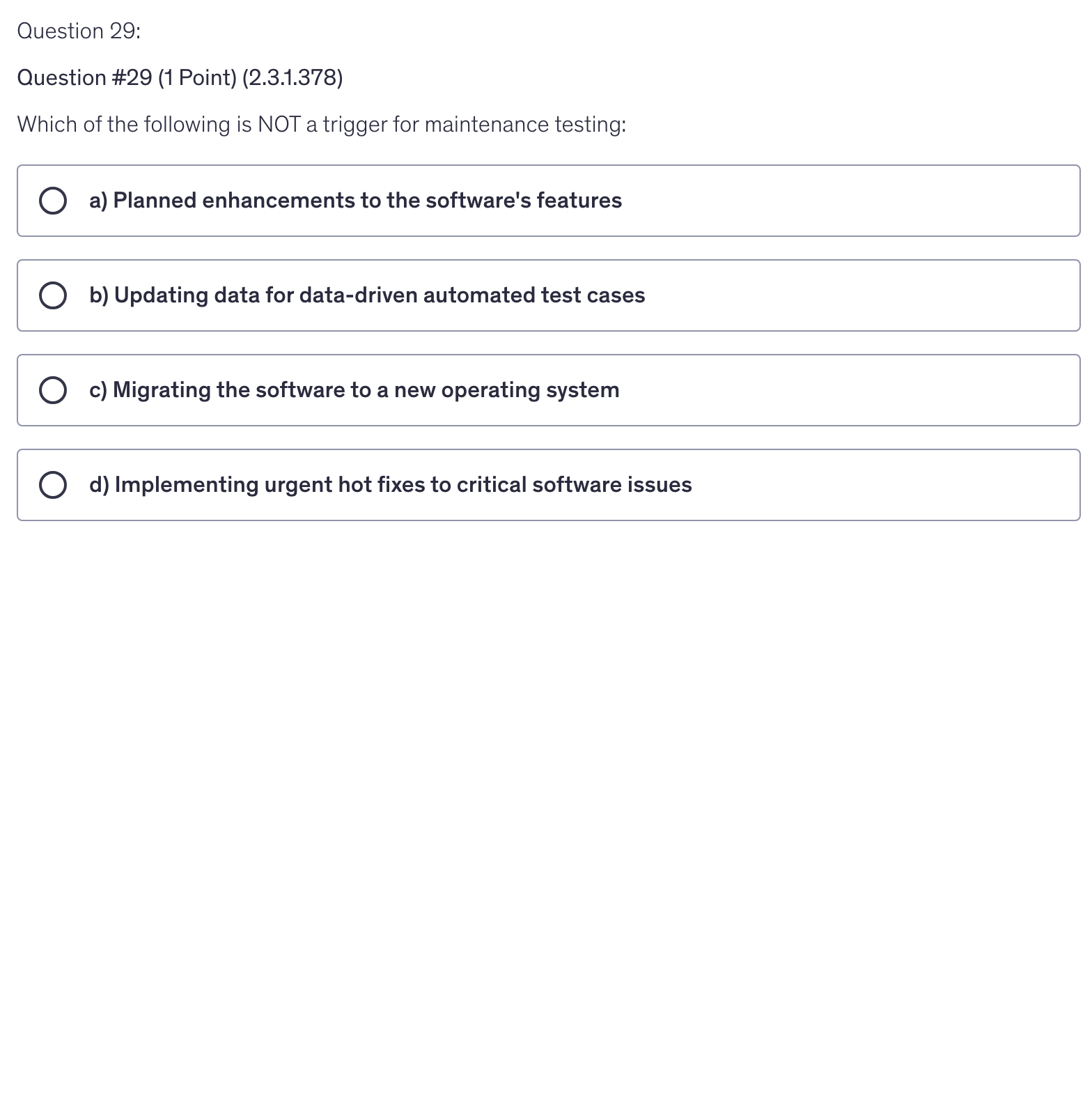
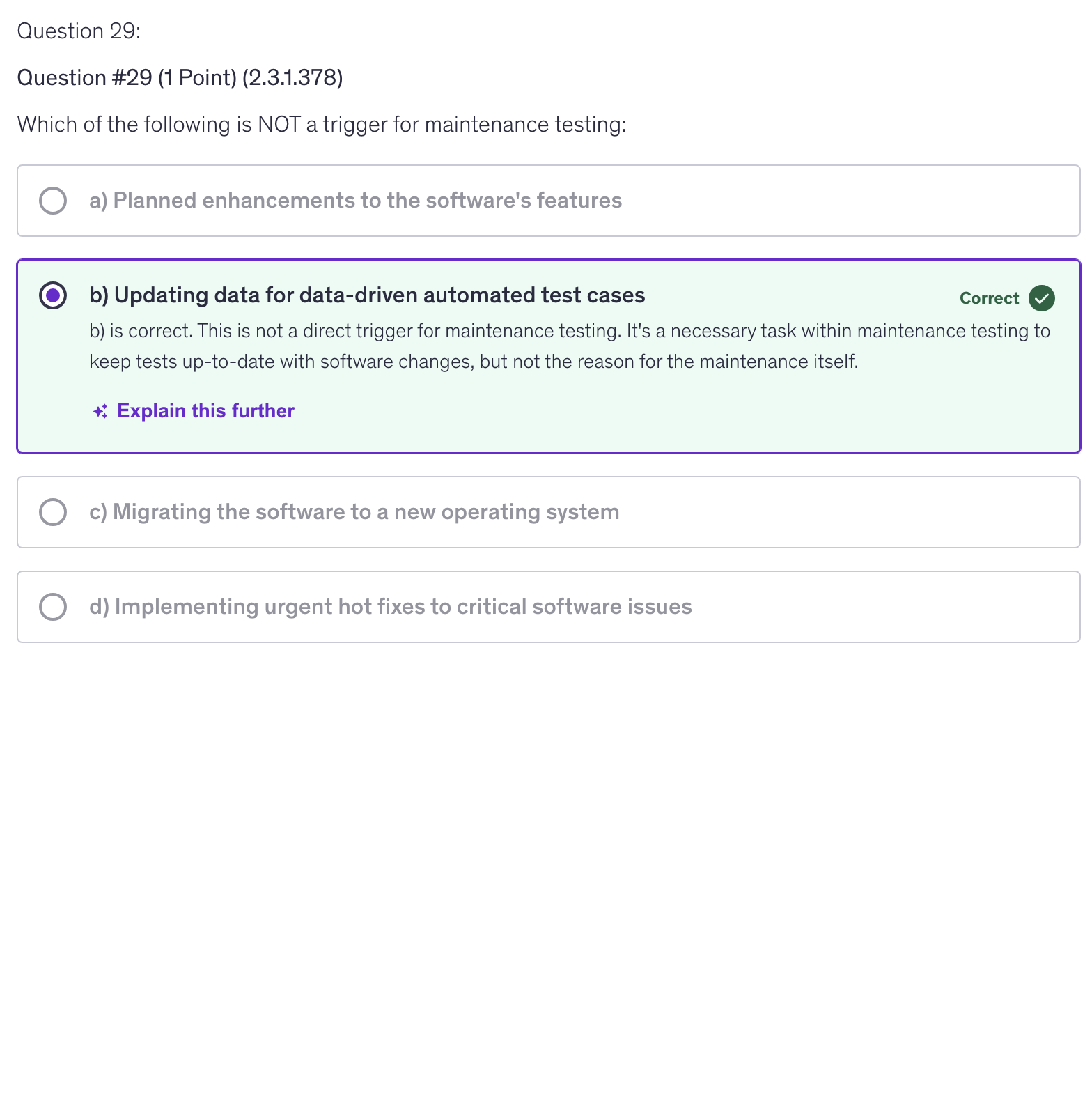
Which of the following is NOT a trigger for maintenance testing:
b) Updating data for data-driven automated test cases
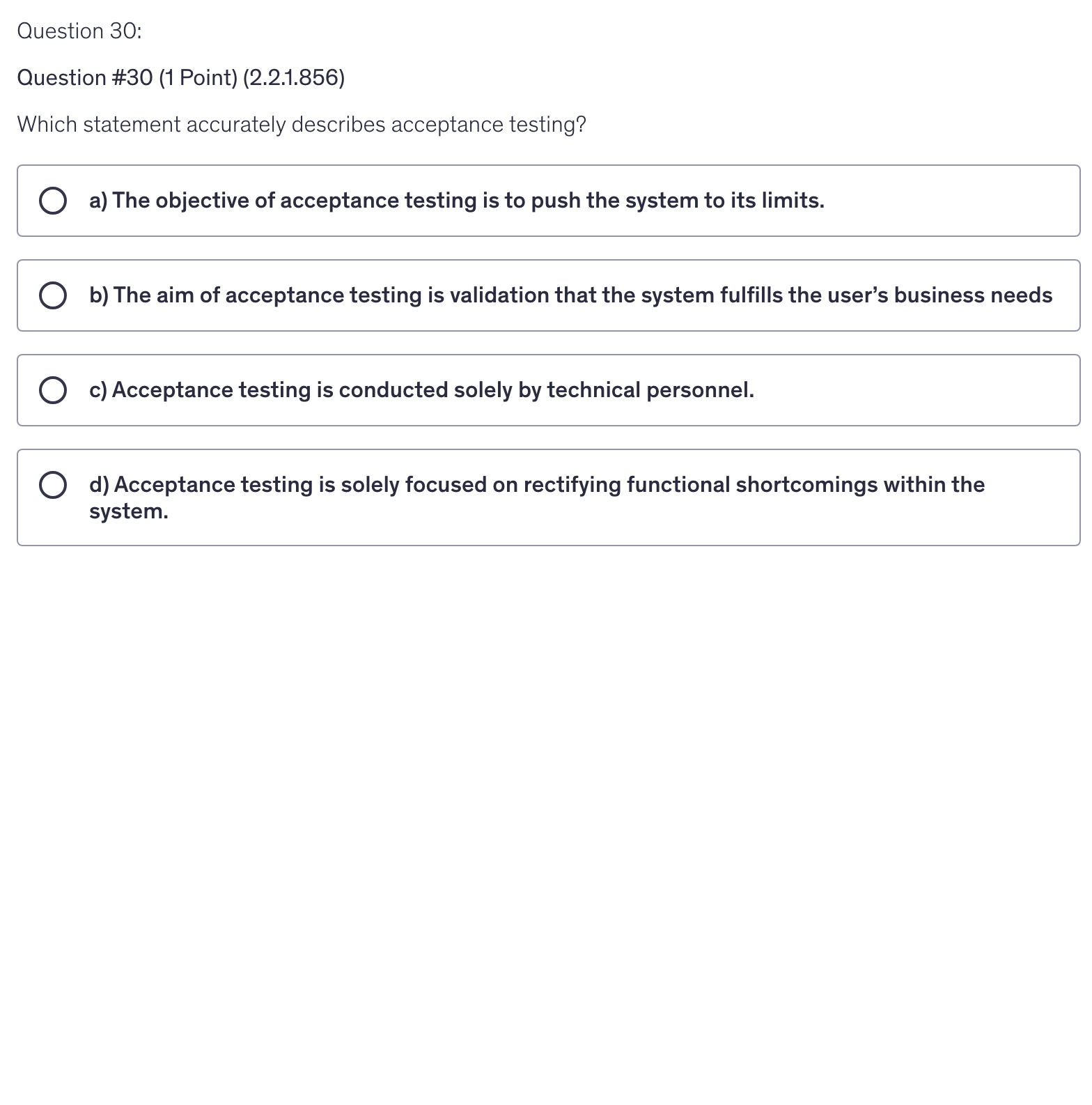
Which statement accurately describes acceptance testing?
b) The aim of acceptance testing is validation that the system fulfills the user’s business needs
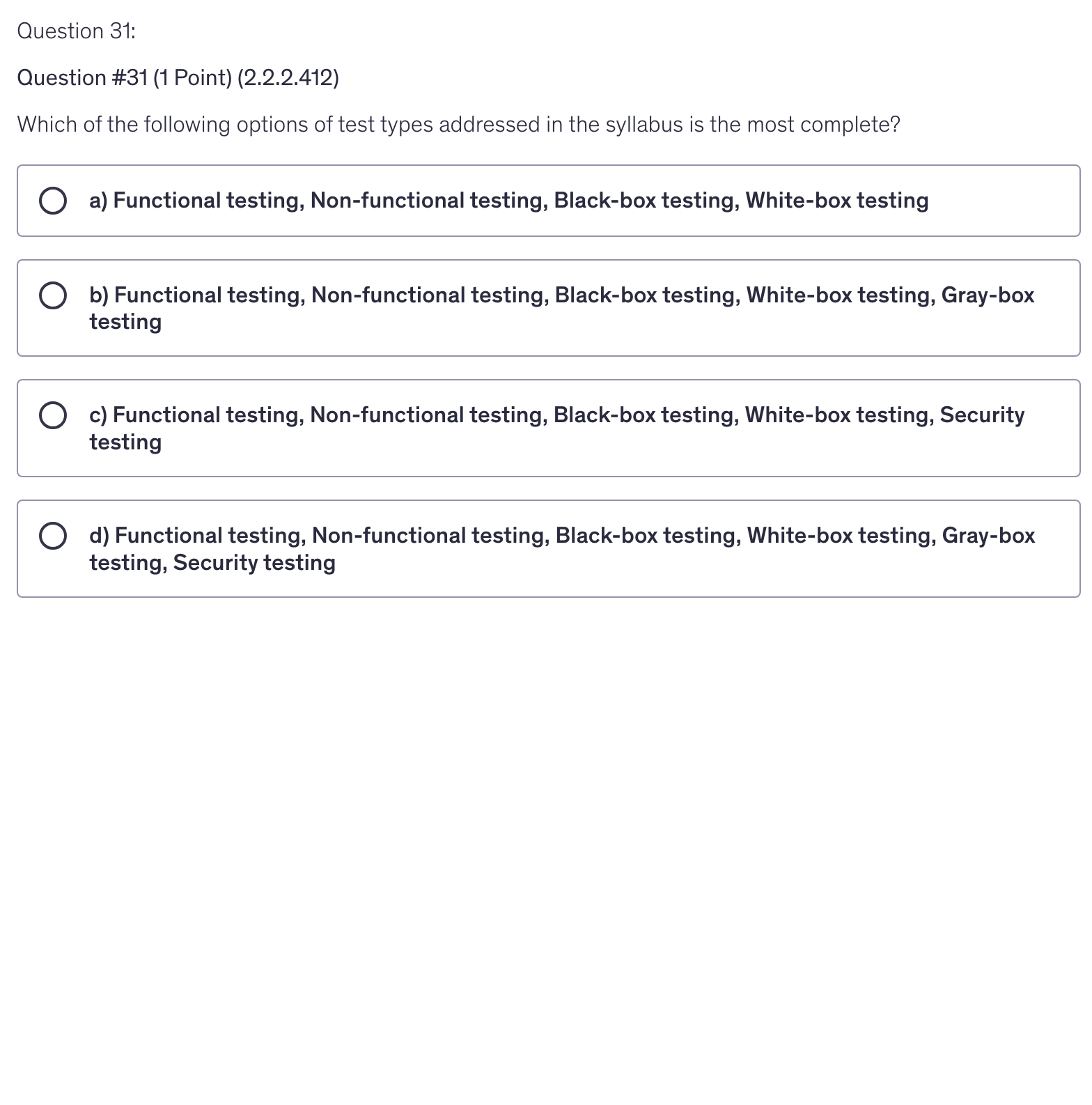
Which of the following options of test types addressed in the syllabus is the most complete?
a) Functional testing, Non-functional testing, Black-box testing, White-box testing
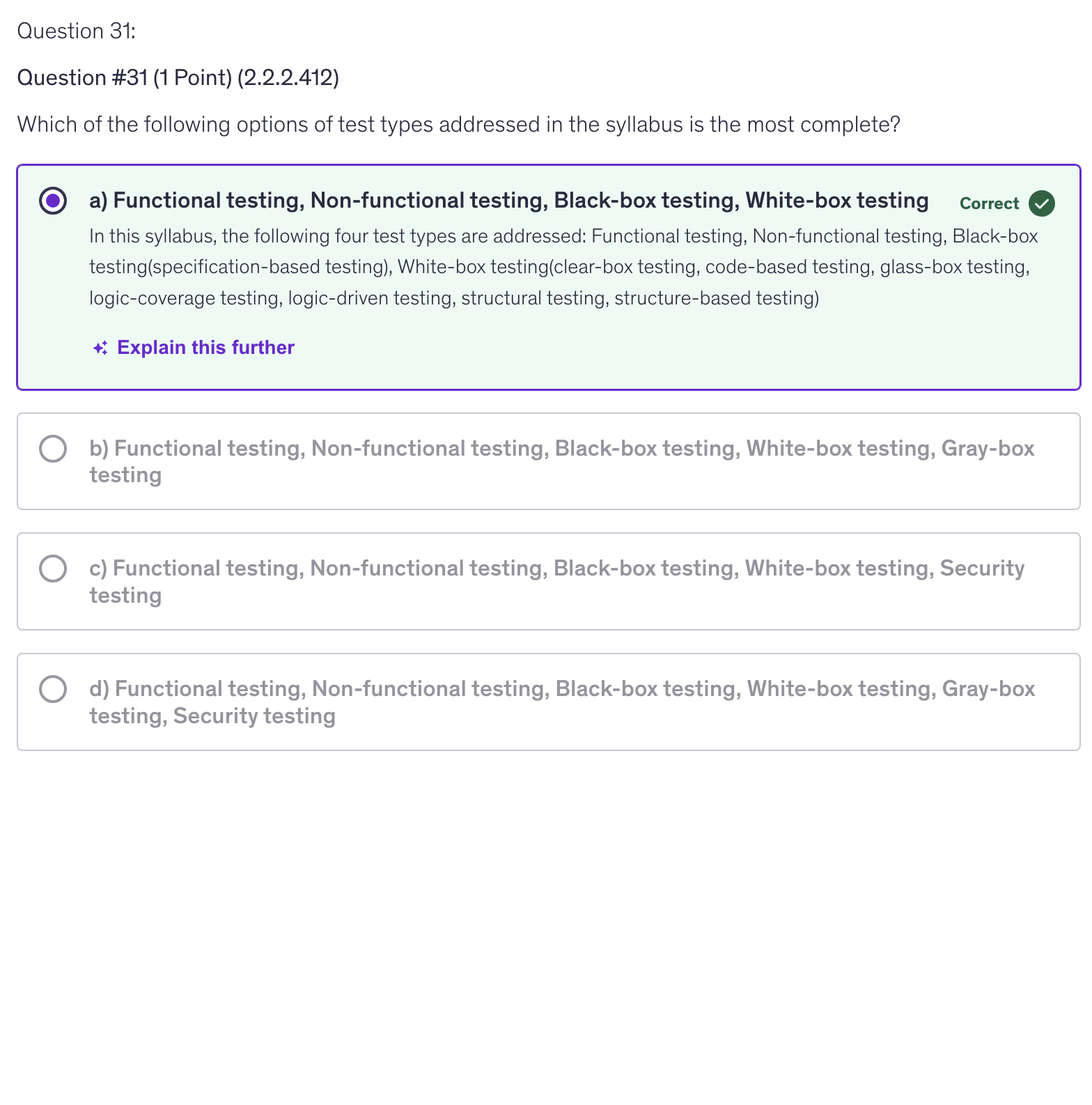
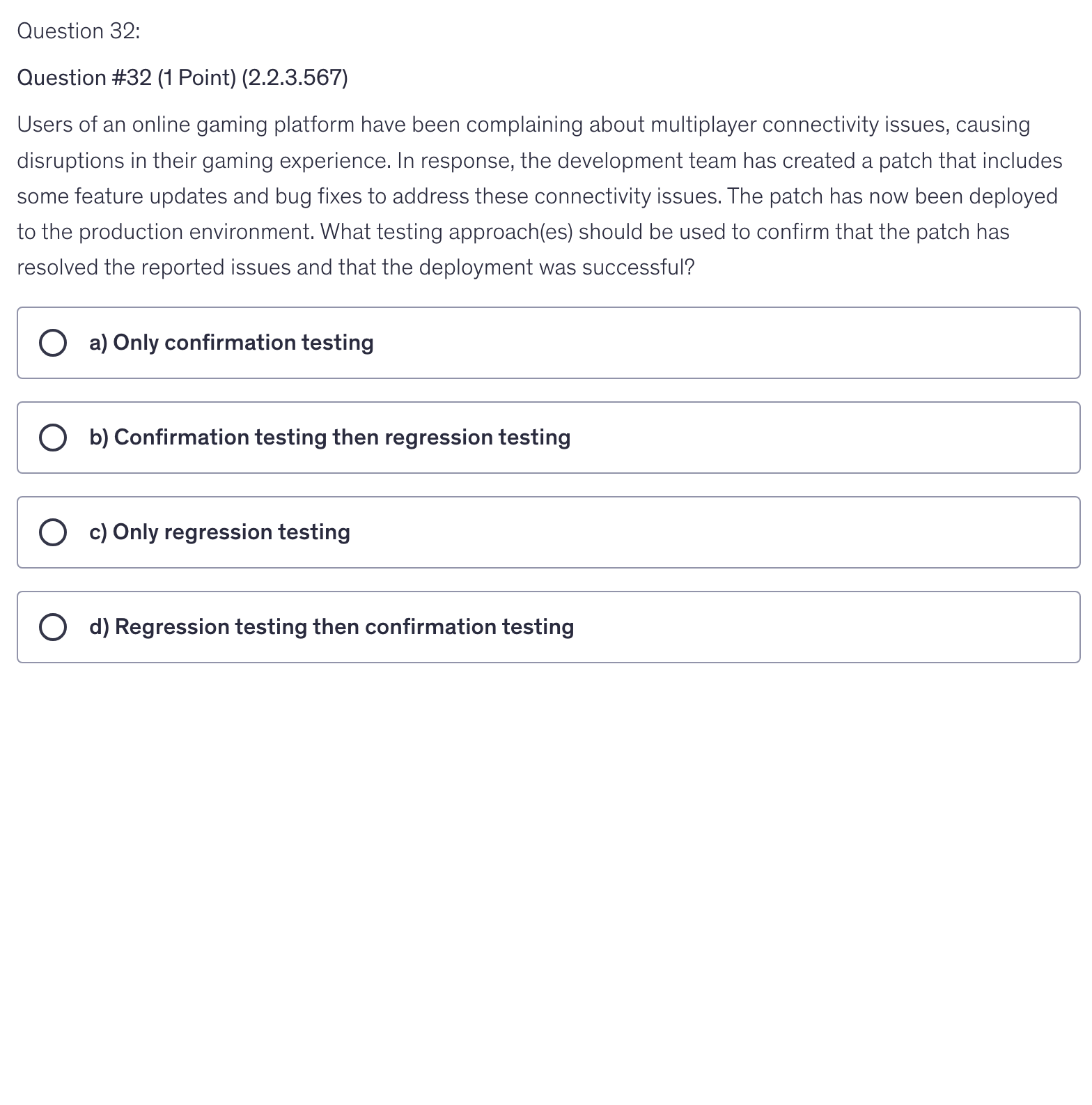
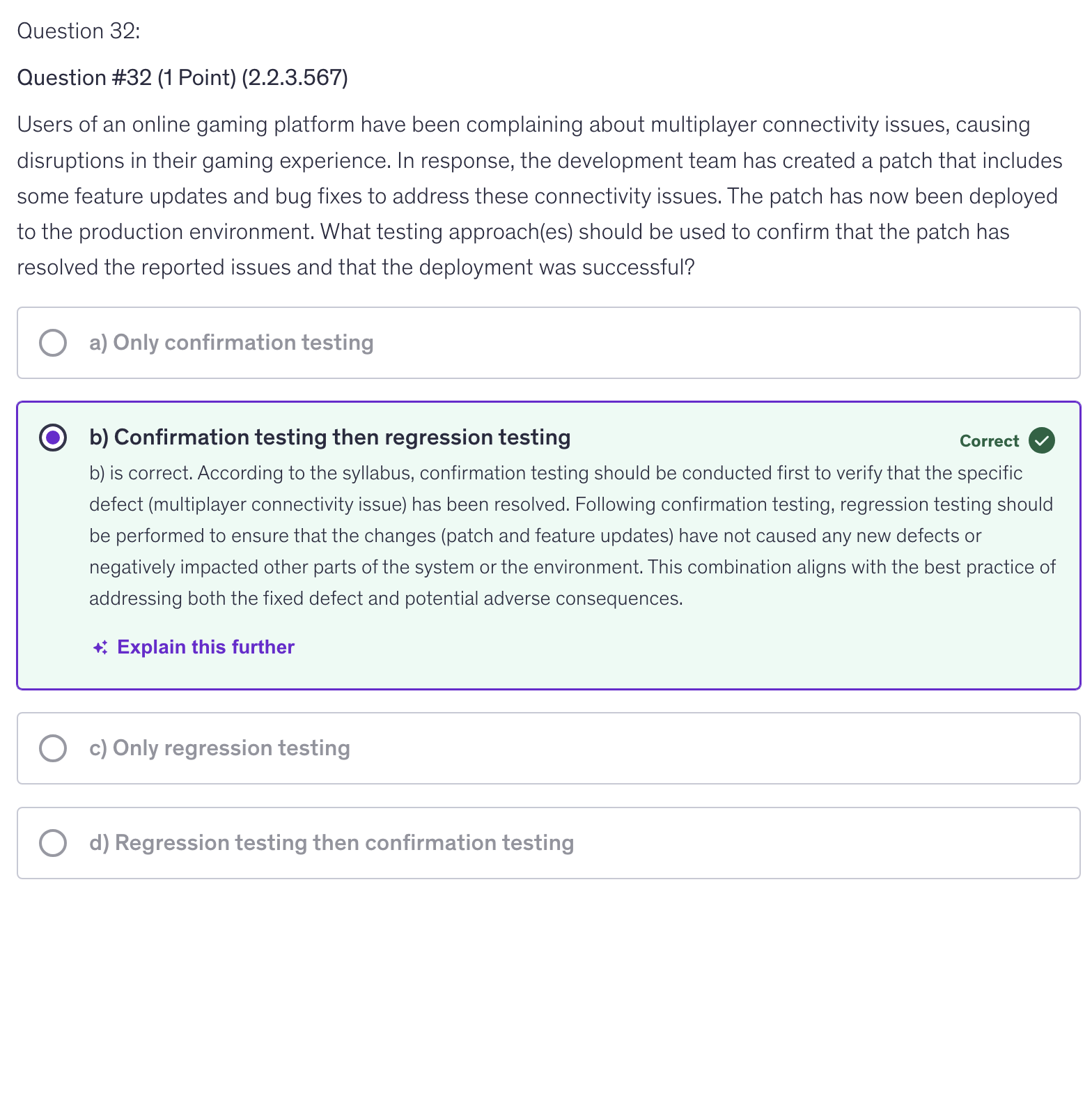
Users of an online gaming platform have been complaining about multiplayer connectivity issues, causing disruptions in their gaming experience. In response, the development team has created a patch that includes some feature updates and bug fixes to address these connectivity issues. The patch has now been deployed to the production environment. What testing approach(es) should be used to confirm that the patch has resolved the reported issues and that the deployment was successful?
b) Confirmation testing then regression testing
Consider the following explanation of the integration testing:
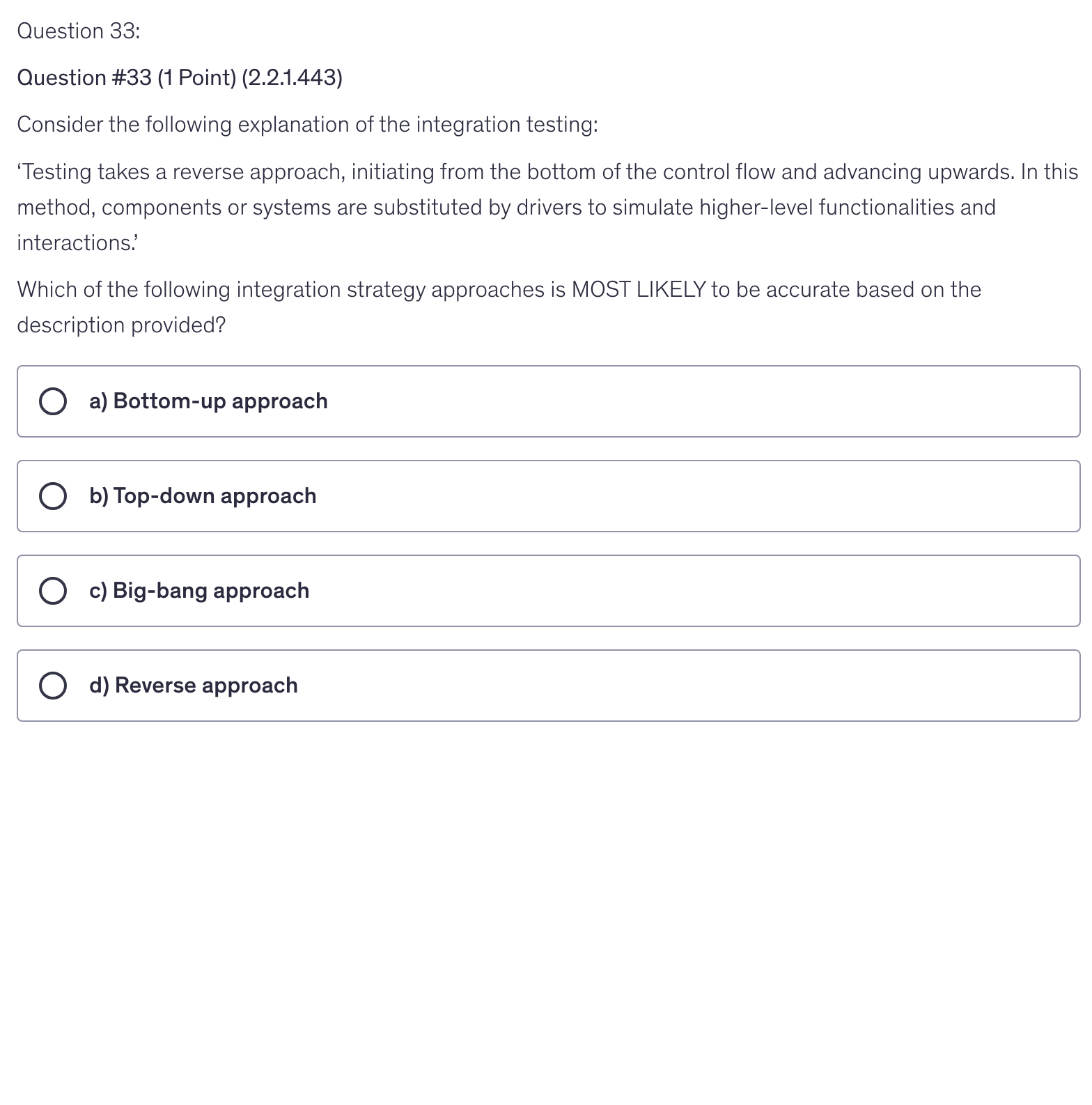
‘Testing takes a reverse approach, initiating from the bottom of the control flow and advancing upwards. In this method, components or systems are substituted by drivers to simulate higher-level functionalities and interactions.’
Which of the following integration strategy approaches is MOST LIKELY to be accurate based on the description provided?
a) Bottom-up approach

How are many non-functional tests derived from functional tests?
a) By using the same functional tests and checking non-functional constraints during their execution
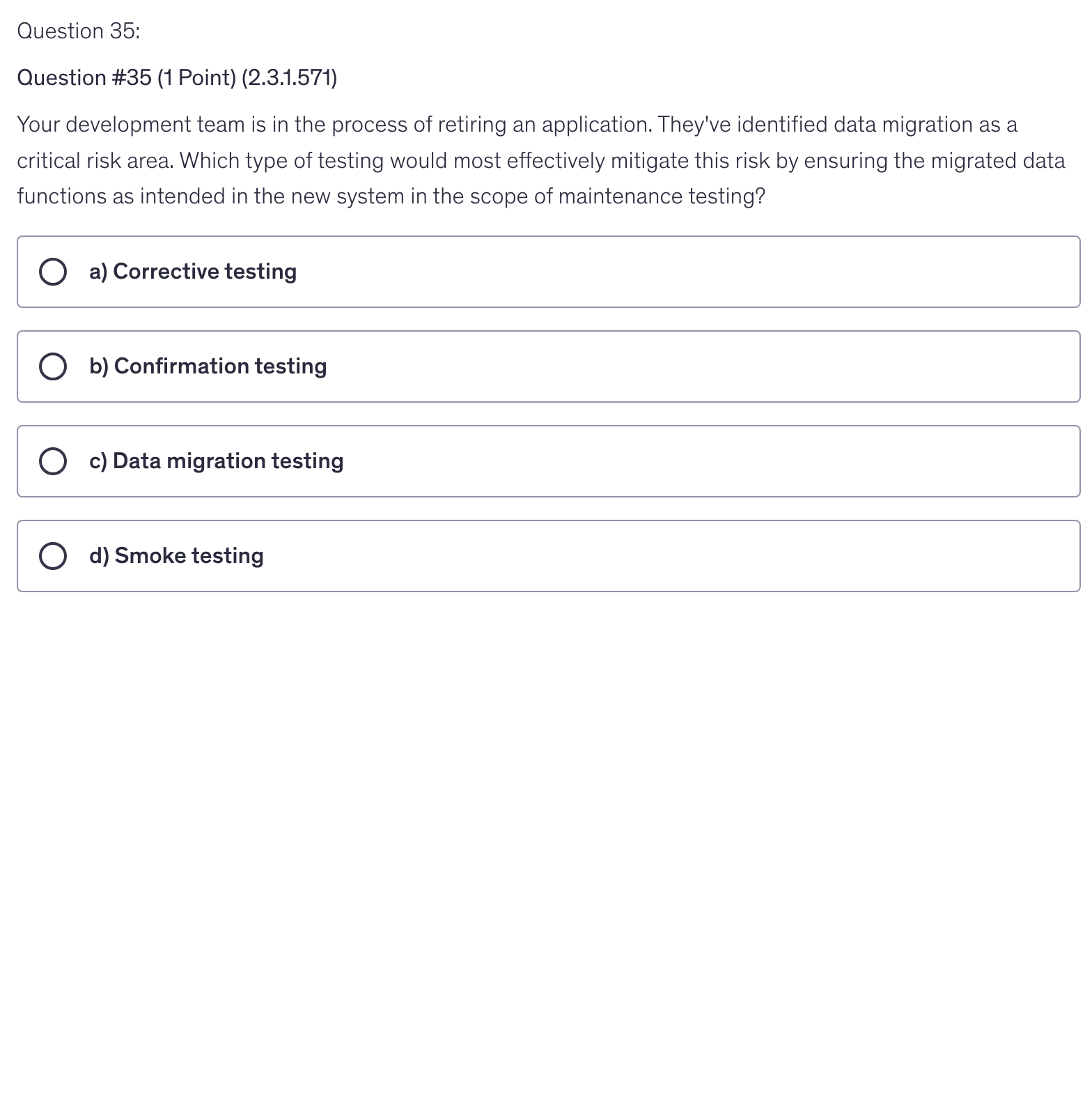
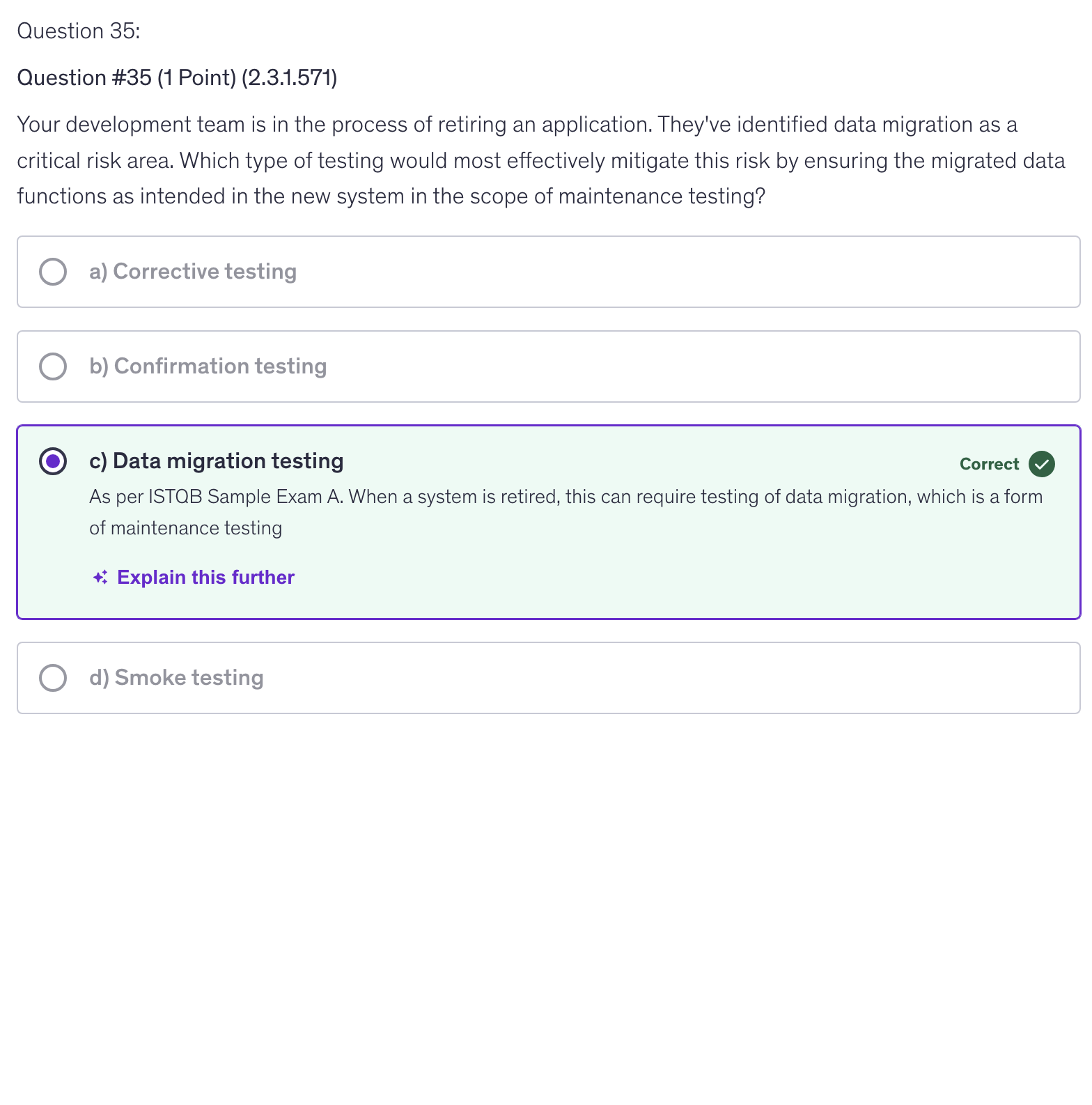
Your development team is in the process of retiring an application. They've identified data migration as a critical risk area. Which type of testing would most effectively mitigate this risk by ensuring the migrated data functions as intended in the new system in the scope of maintenance testing?
c) Data migration testing
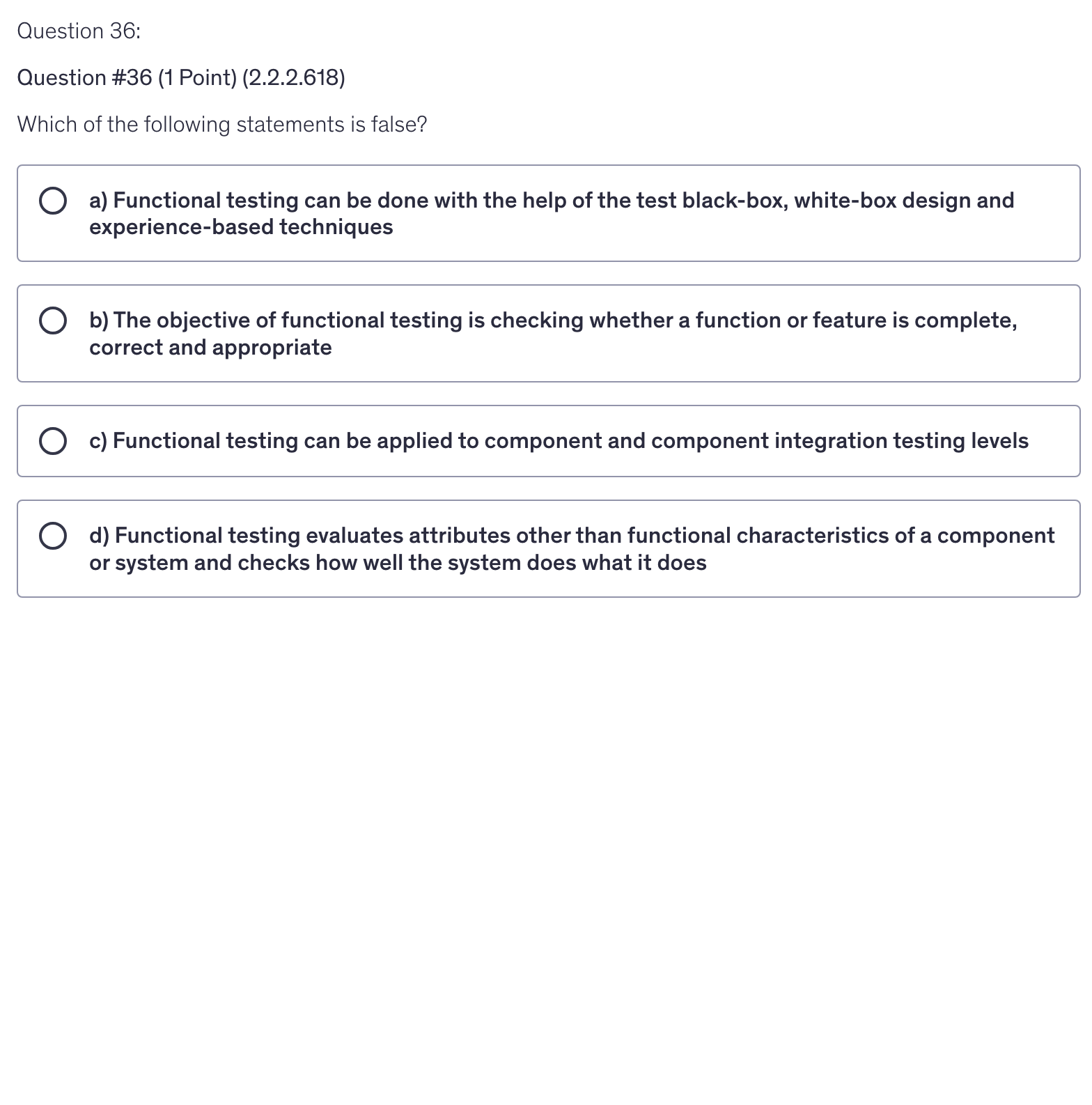
Which of the following statements is false?
d) Functional testing evaluates attributes other than functional characteristics of a component or system and checks how well the system does what it does
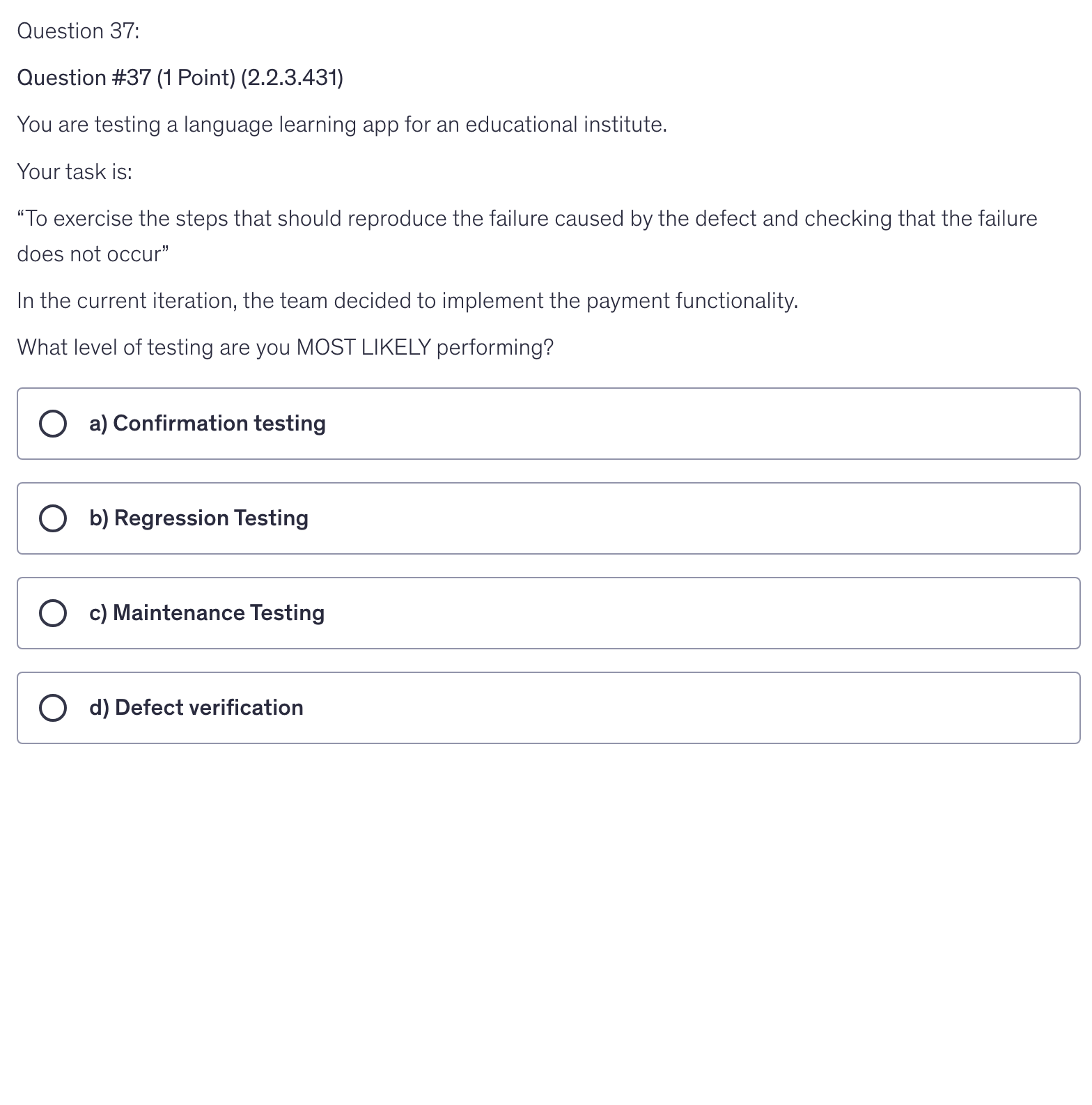
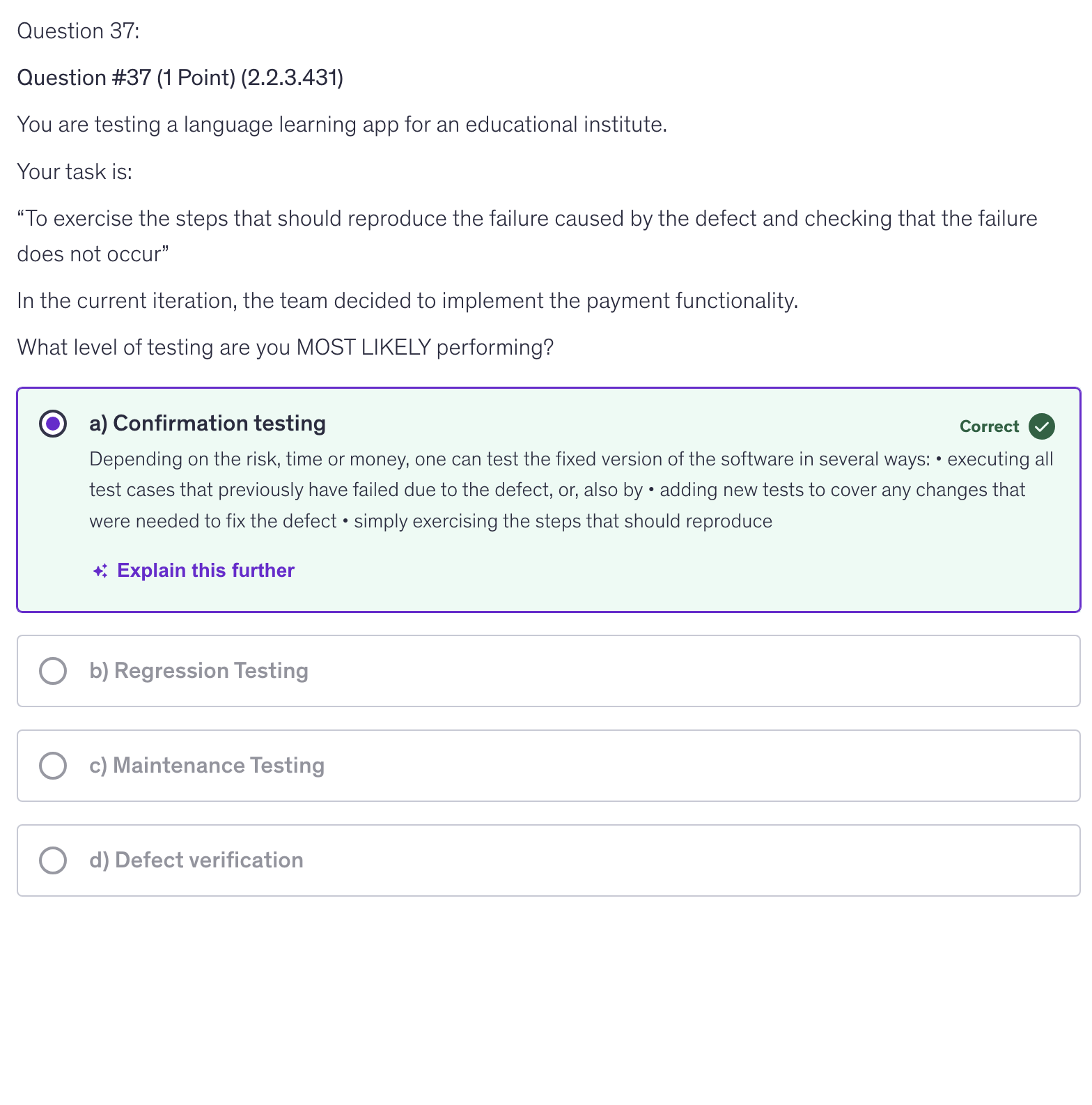
You are testing a language learning app for an educational institute.
Your task is:
“To exercise the steps that should reproduce the failure caused by the defect and checking that the failure does not occur”
In the current iteration, the team decided to implement the payment functionality.
What level of testing are you MOST LIKELY performing?
a) Confirmation Testing
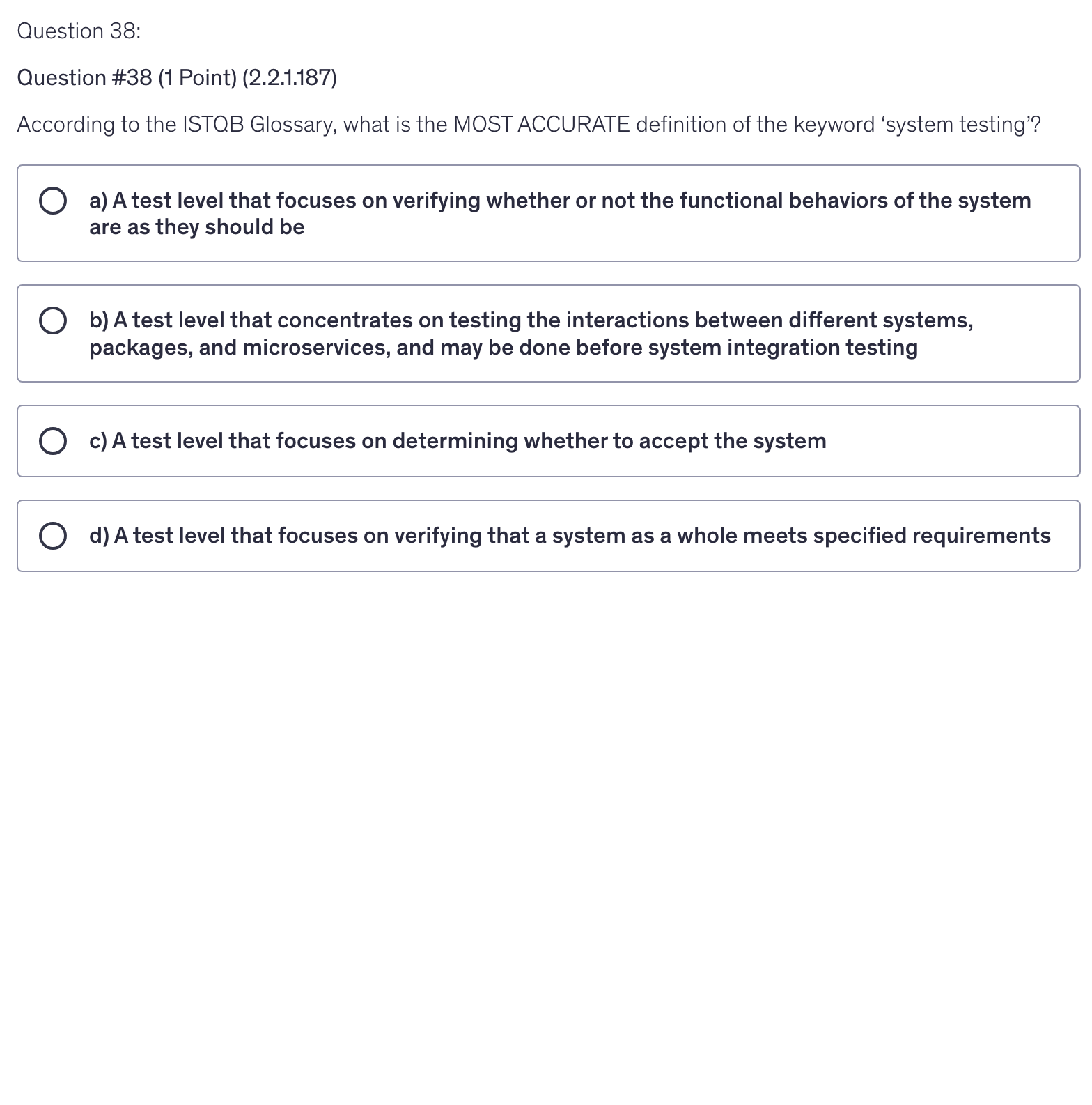
According to the ISTQB Glossary, what is the MOST ACCURATE definition of the keyword ‘system testing’?
d) A test level that focuses on verifying that a system as a whole meets specified requirements
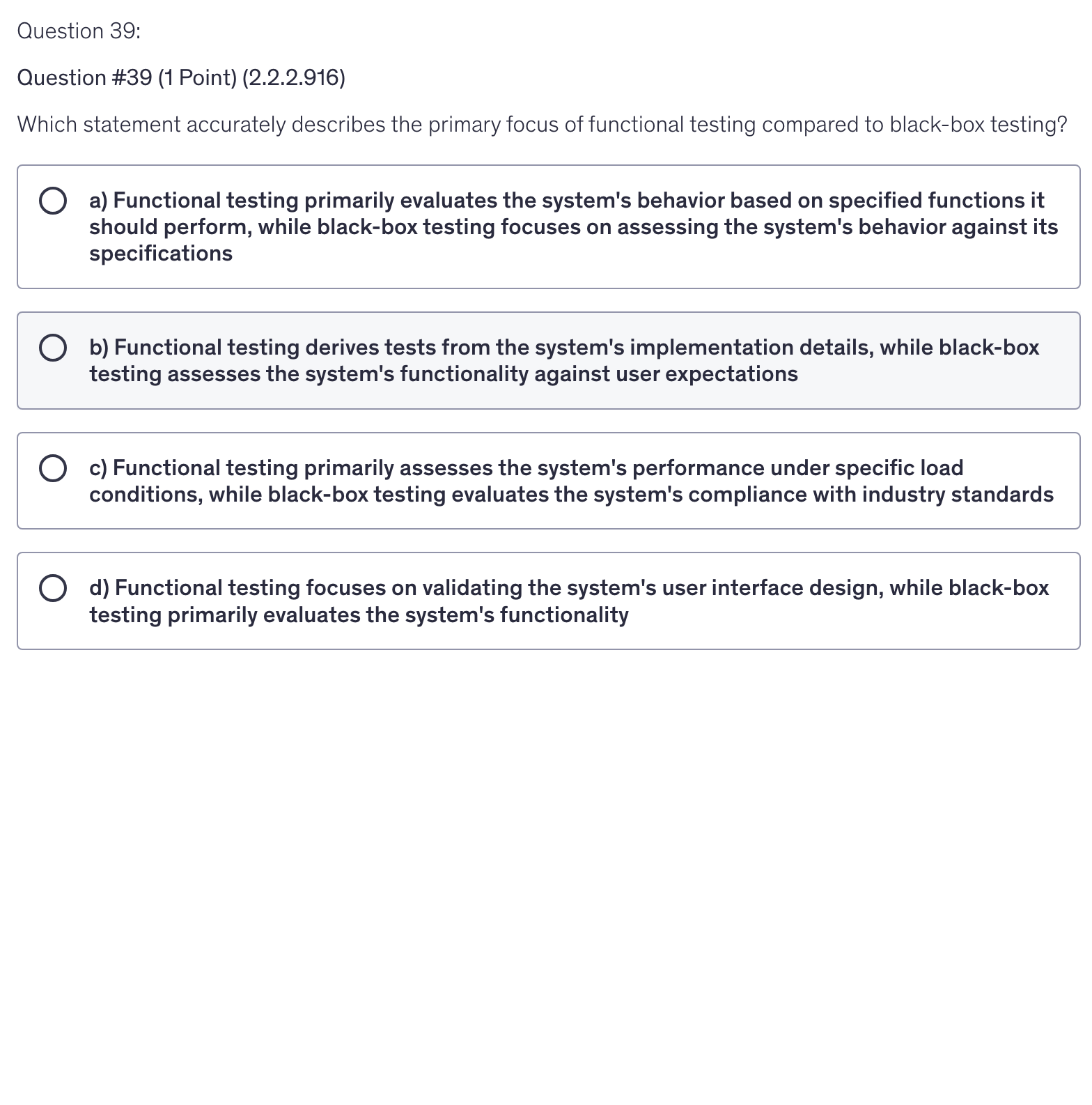
Which statement accurately describes the primary focus of functional testing compared to black-box testing?
a) Functional testing primarily evaluates the system’s behavior based on specified functions it should perform, while black-box testing focuses on assessing the system’s behavior against its specifications
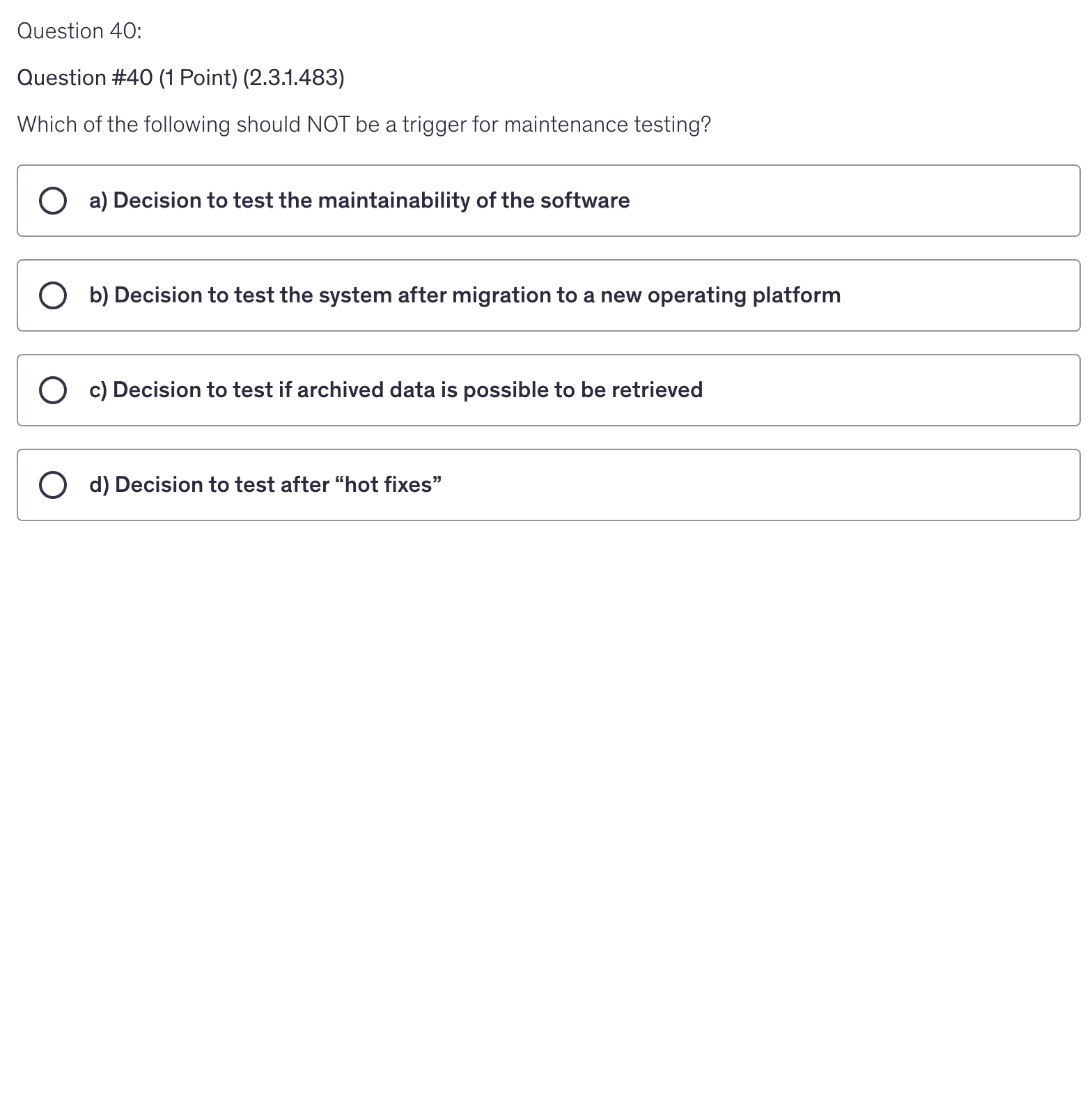
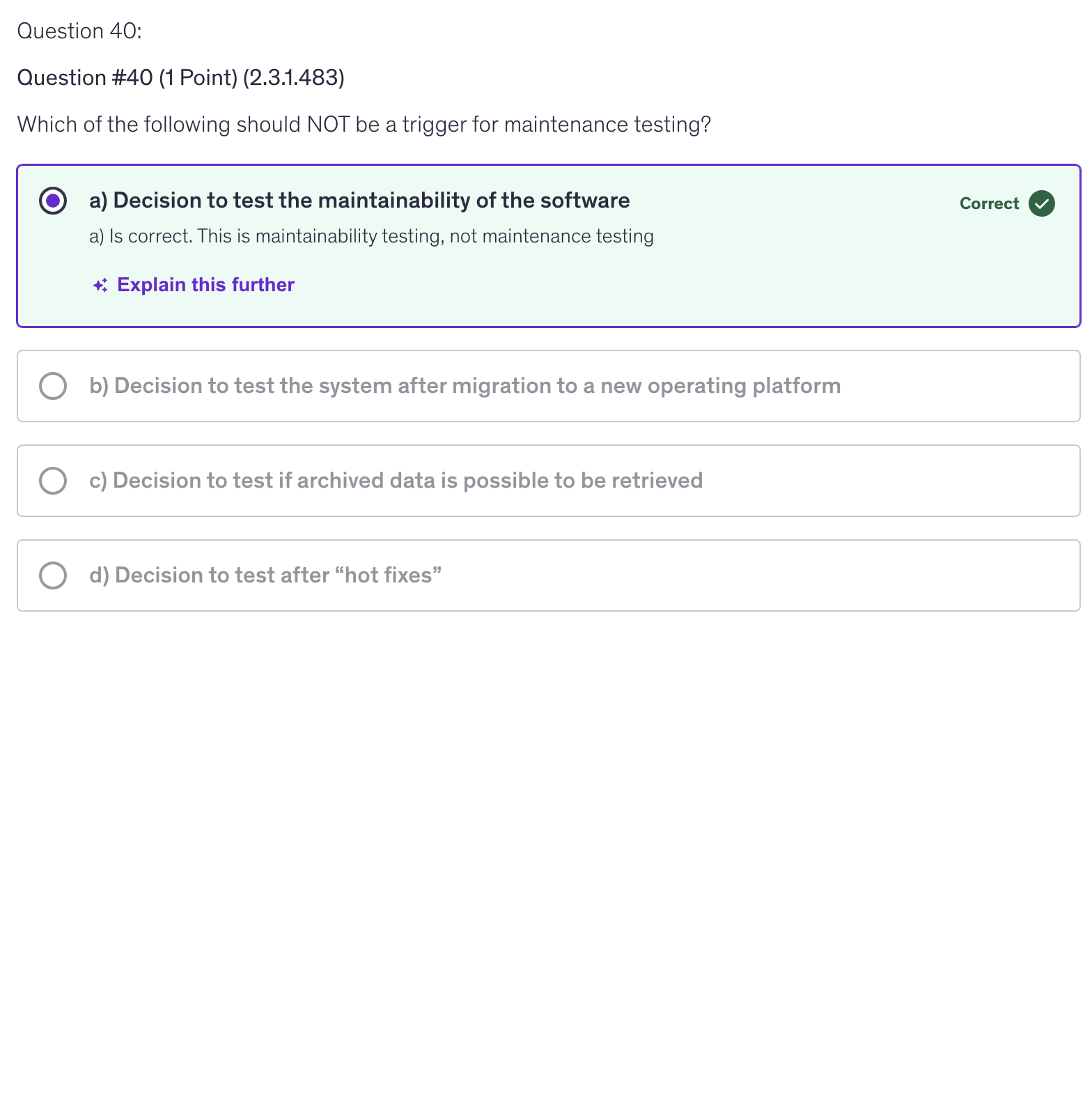
Which of the following should NOT be a trigger for maintenance testing?
a) Decision to test the maintainability of the software

Which characteristics (1-4) fit which test levels (A-D) BEST?
1. The main forms of testing include: user testing, operational testing, contractual and regulatory testing
2. Testing is heavily dependent on strategy approaches like bottom-up, top-down, or big-bang
3. Testing is normally performed by developers in their development environment
4. Testing may be carried out by an independent test team and is related to specifications for the system
A. Component testing
B. Component integration testing
C. System testing
D. Acceptance testing
c) 1D, 2B, 3A, 4C
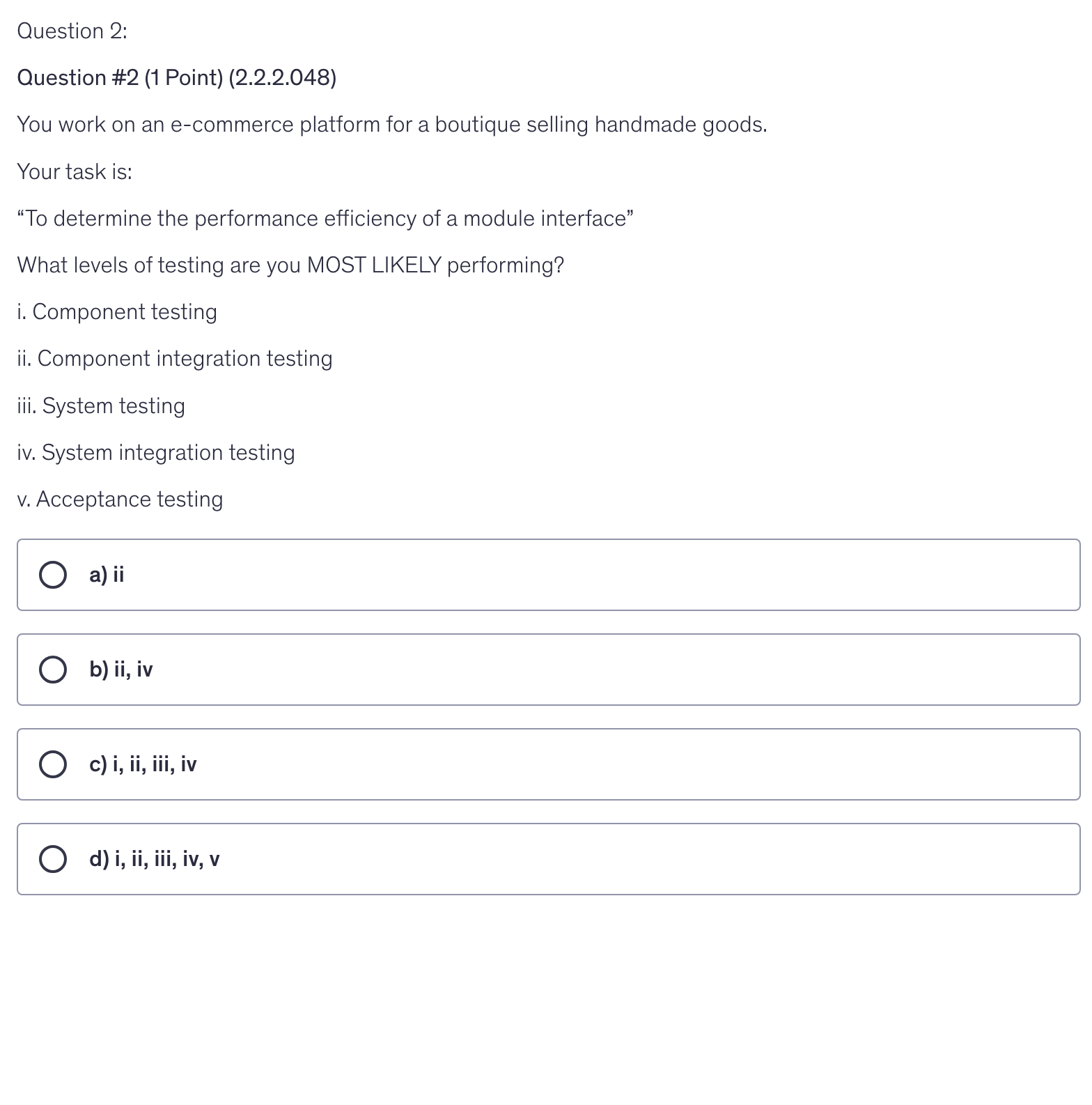
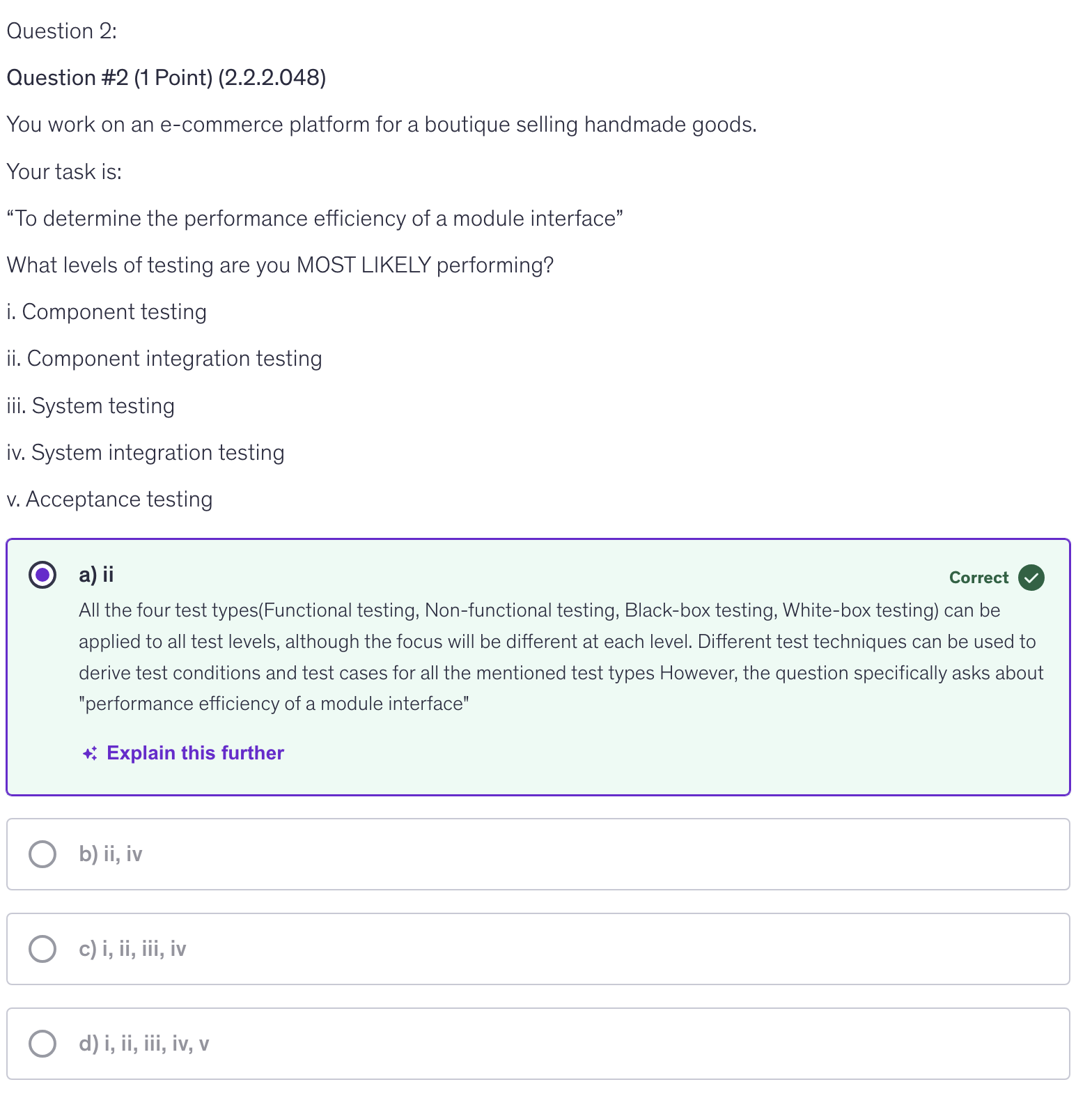
You work on an e-commerce platform for a boutique selling handmade goods.
Your task is:
“To determine the performance efficiency of a module interface”
What levels of testing are you MOST LIKELY performing?
i. Component testing
ii. Component integration testing
iii. System testing
iv. System integration testing
v. Acceptance testing
a) ii

You work on a fitness tracking app for a personal training company.
Your task is:
“To check whether defects have been introduced or uncovered in unchanged areas of the software”
In the current iteration, the team decided to implement the payment functionality.
What level of testing are you MOST LIKELY performing?
b) Regression testing
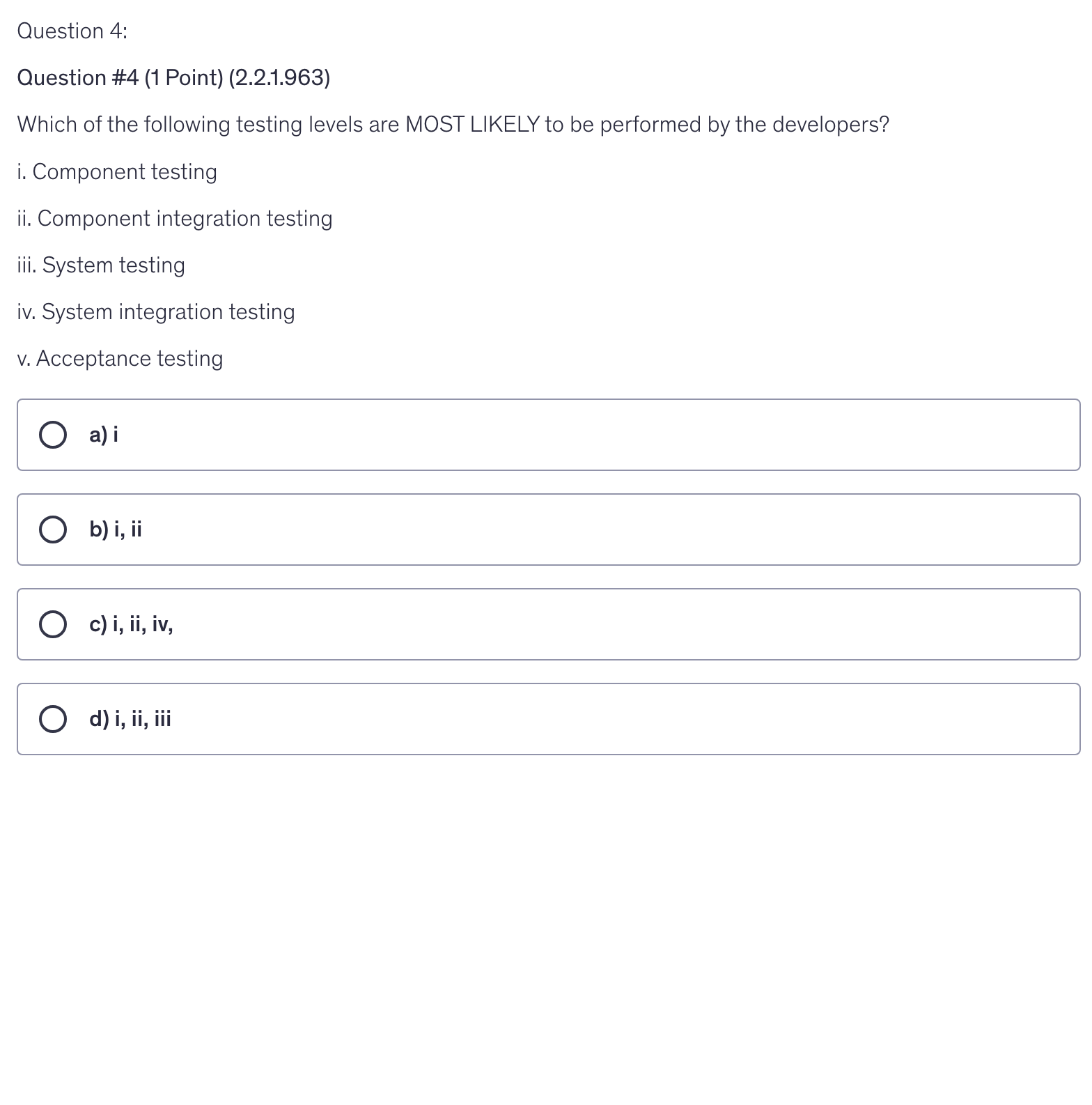
Which of the following testing levels are MOST LIKELY to be performed by the developers?
i. Component testing
ii. Component integration testing
iii. System testing
iv. System integration testing
v. Acceptance testing
b) i, ii
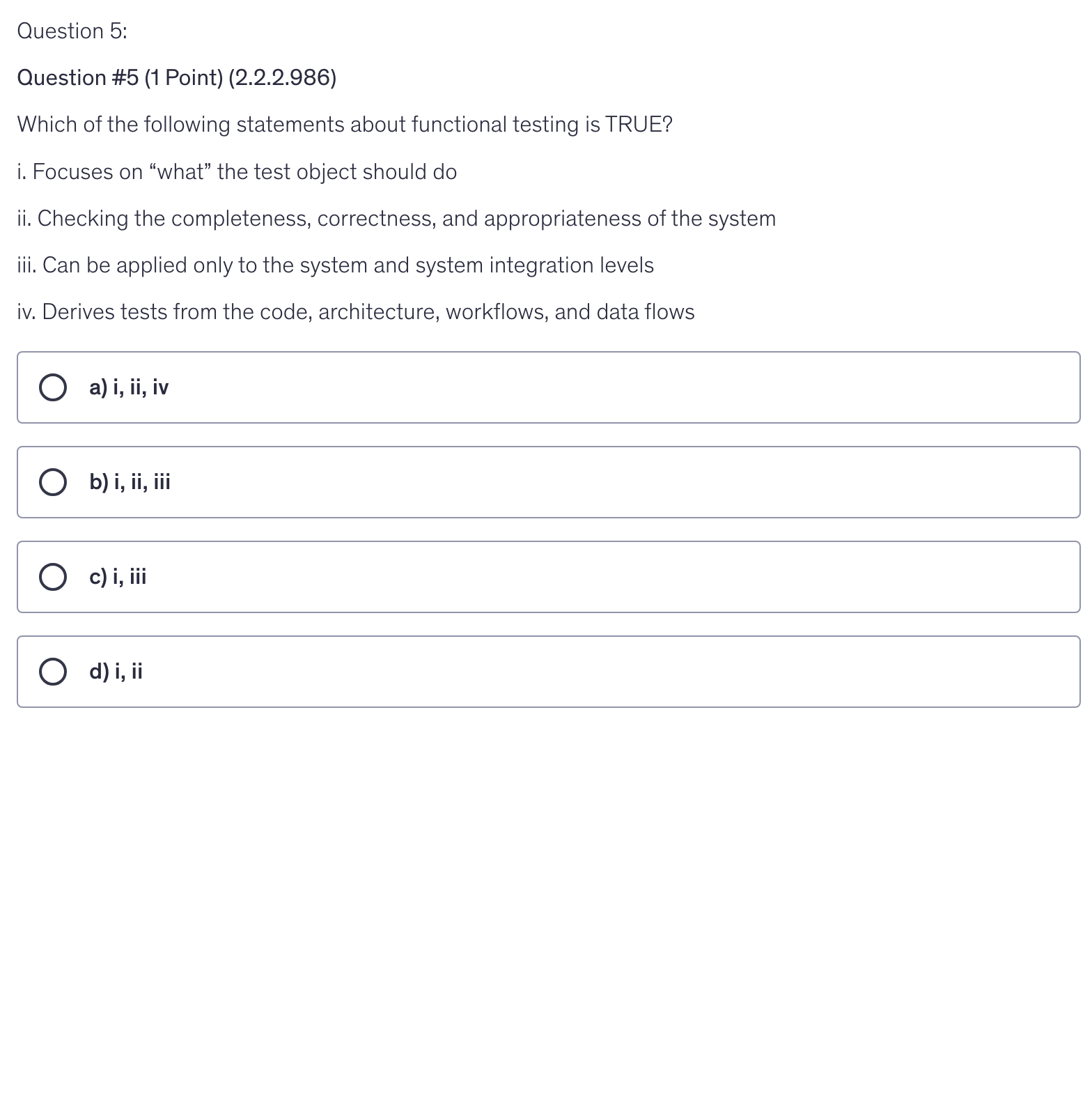
Which of the following statements about functional testing is TRUE?
i. Focuses on “what” the test object should do
ii. Checking the completeness, correctness, and appropriateness of the system
iii. Can be applied only to the system and system integration levels
iv. Derives tests from the code, architecture, workflows, and data flows
d) i, ii
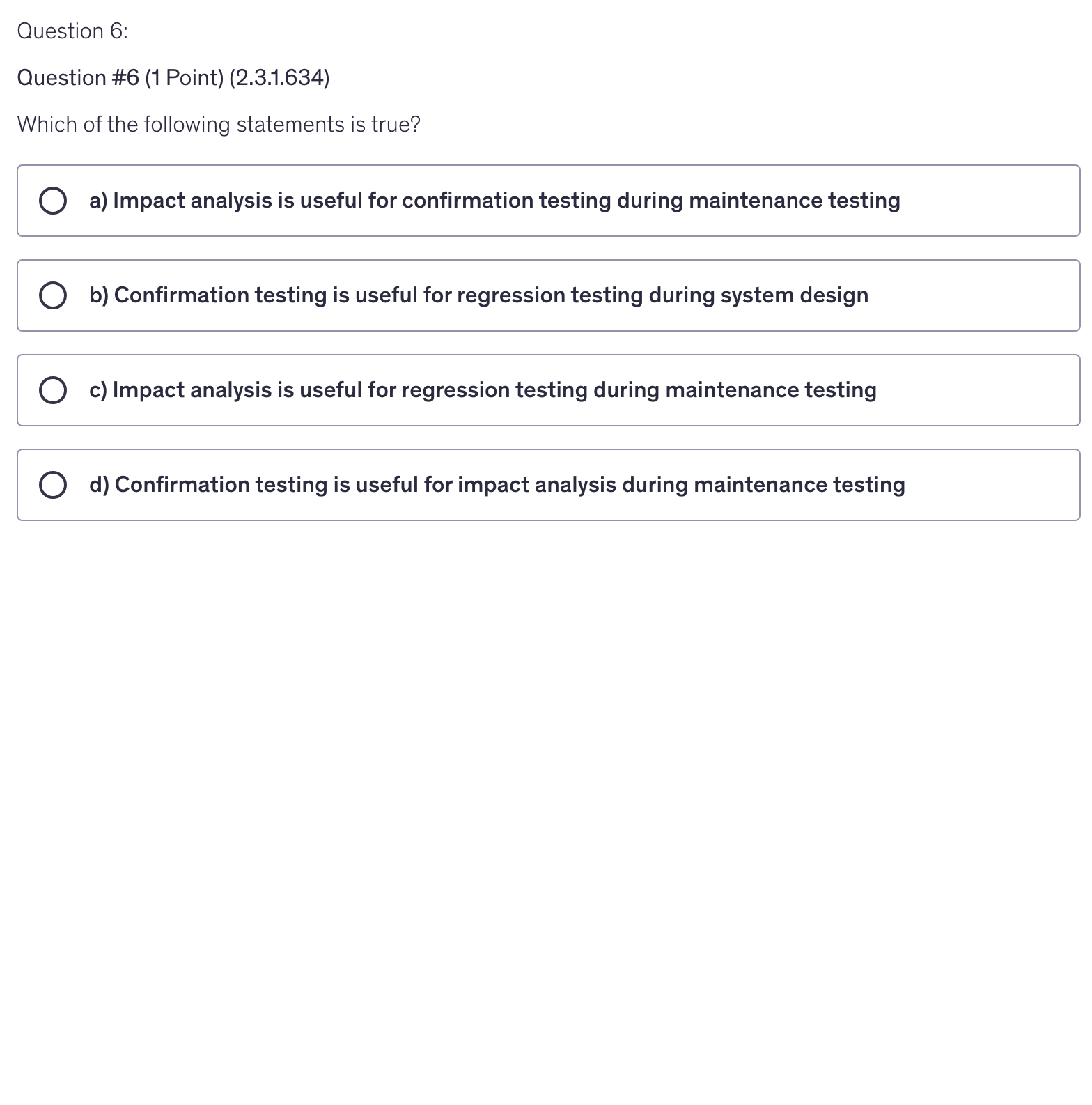
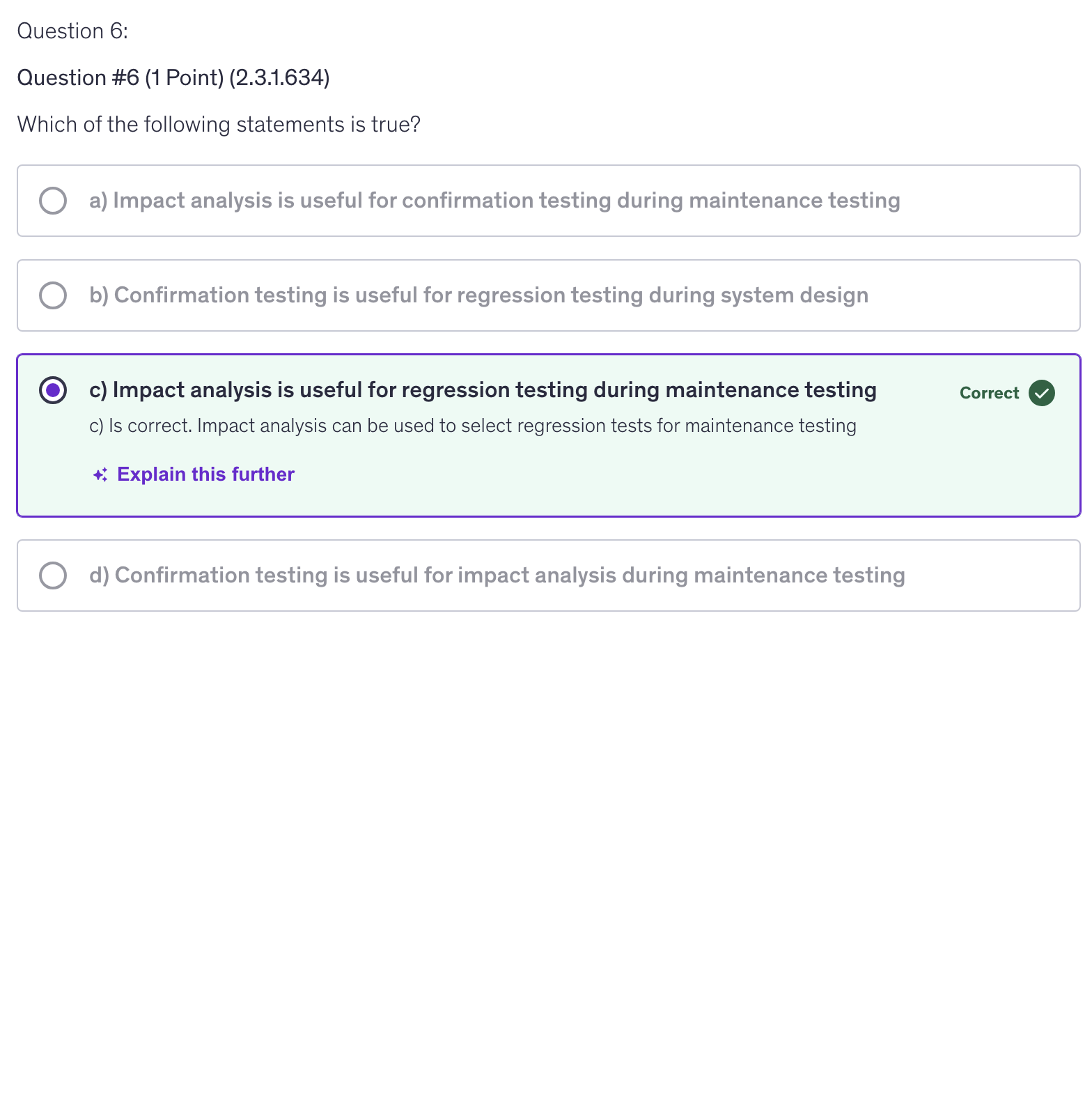
Which of the following statements is true?
c) Impact analysis is useful for regression testing during maintenance testing
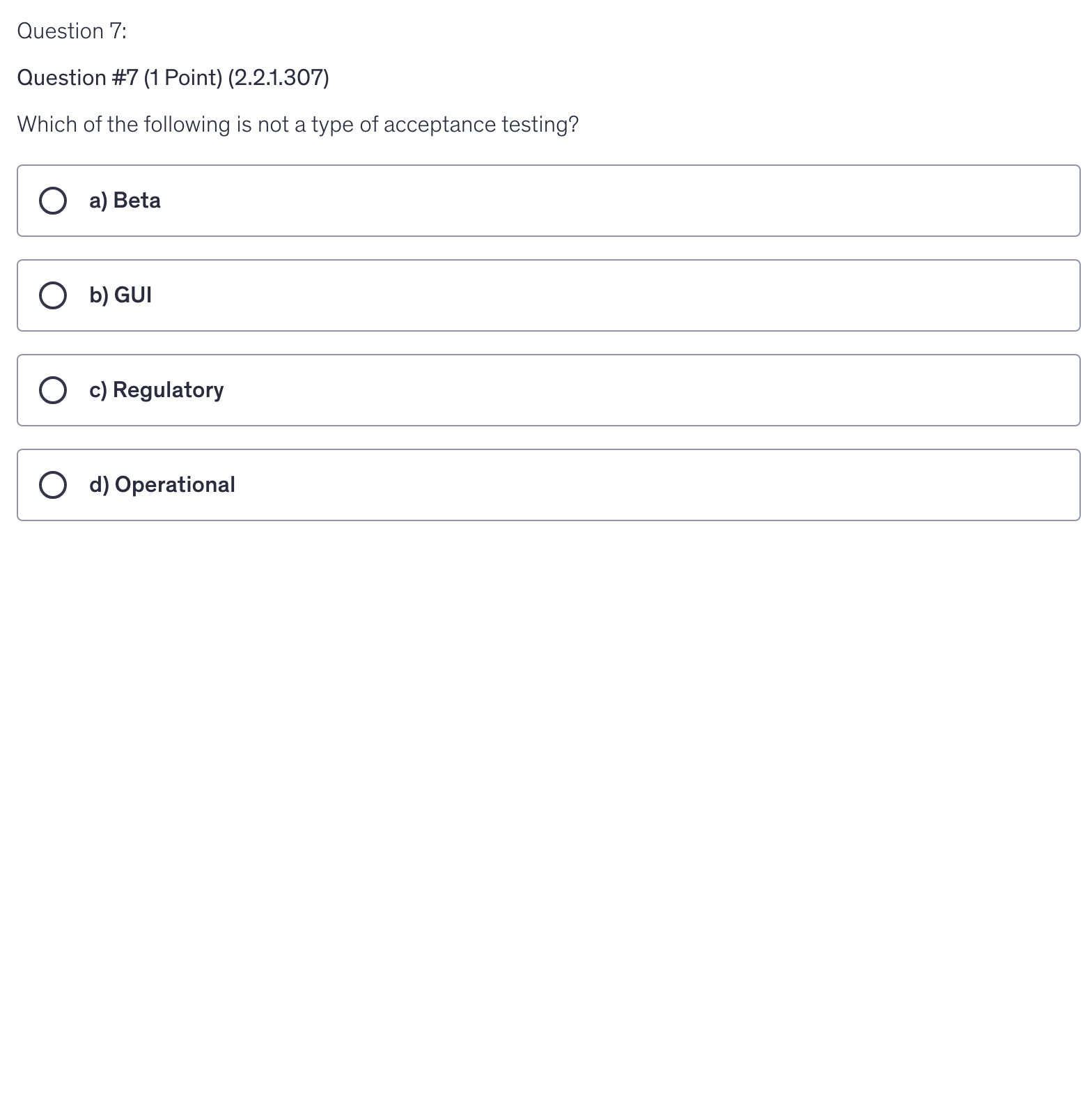
Which of the following is not a type of acceptance testing?
b) GUI
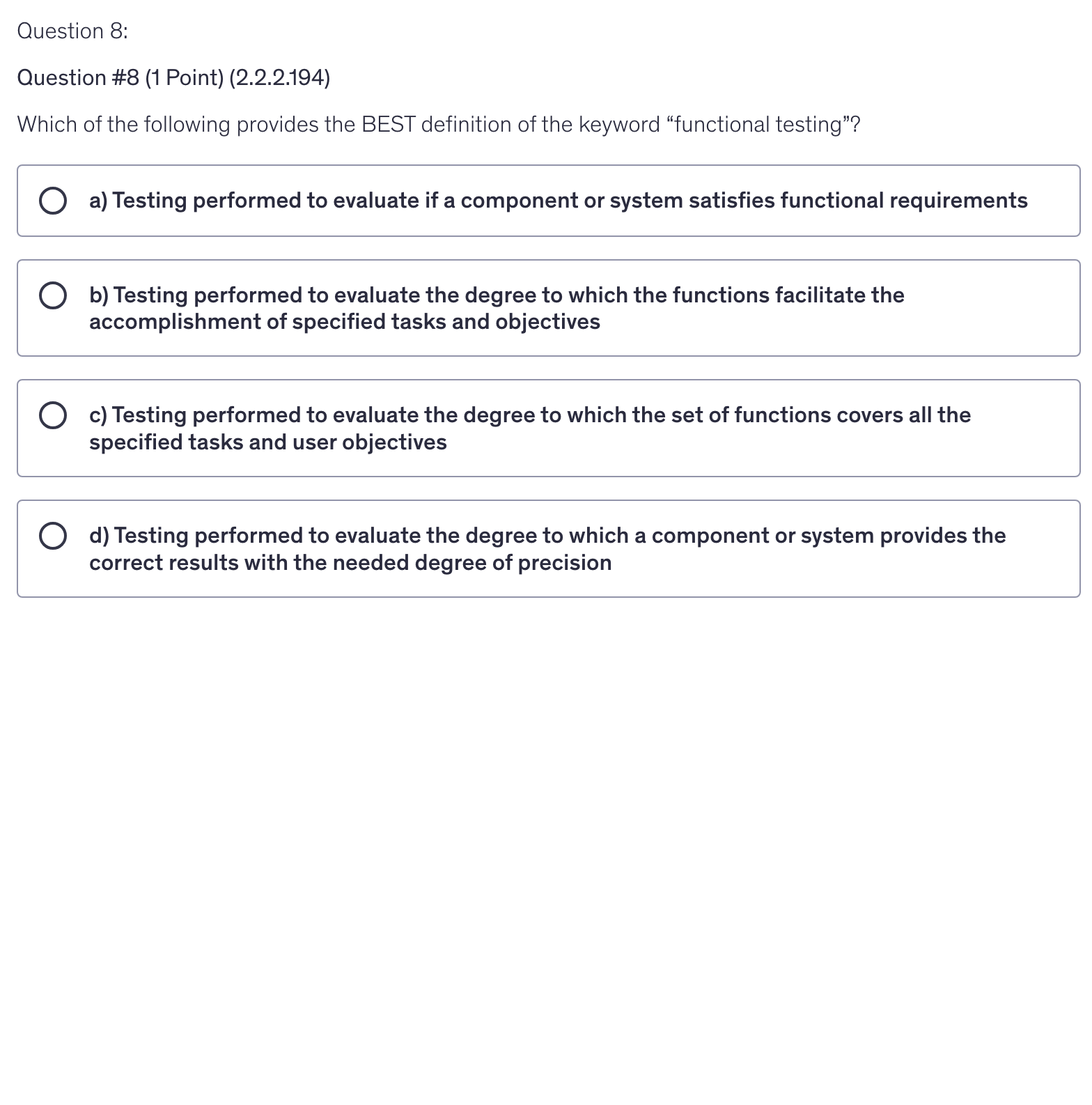
Which of the following provides the BEST definition of the keyword “functional testing”?
a) Testing performed to evaluate if a component or system satisfies functional requirements
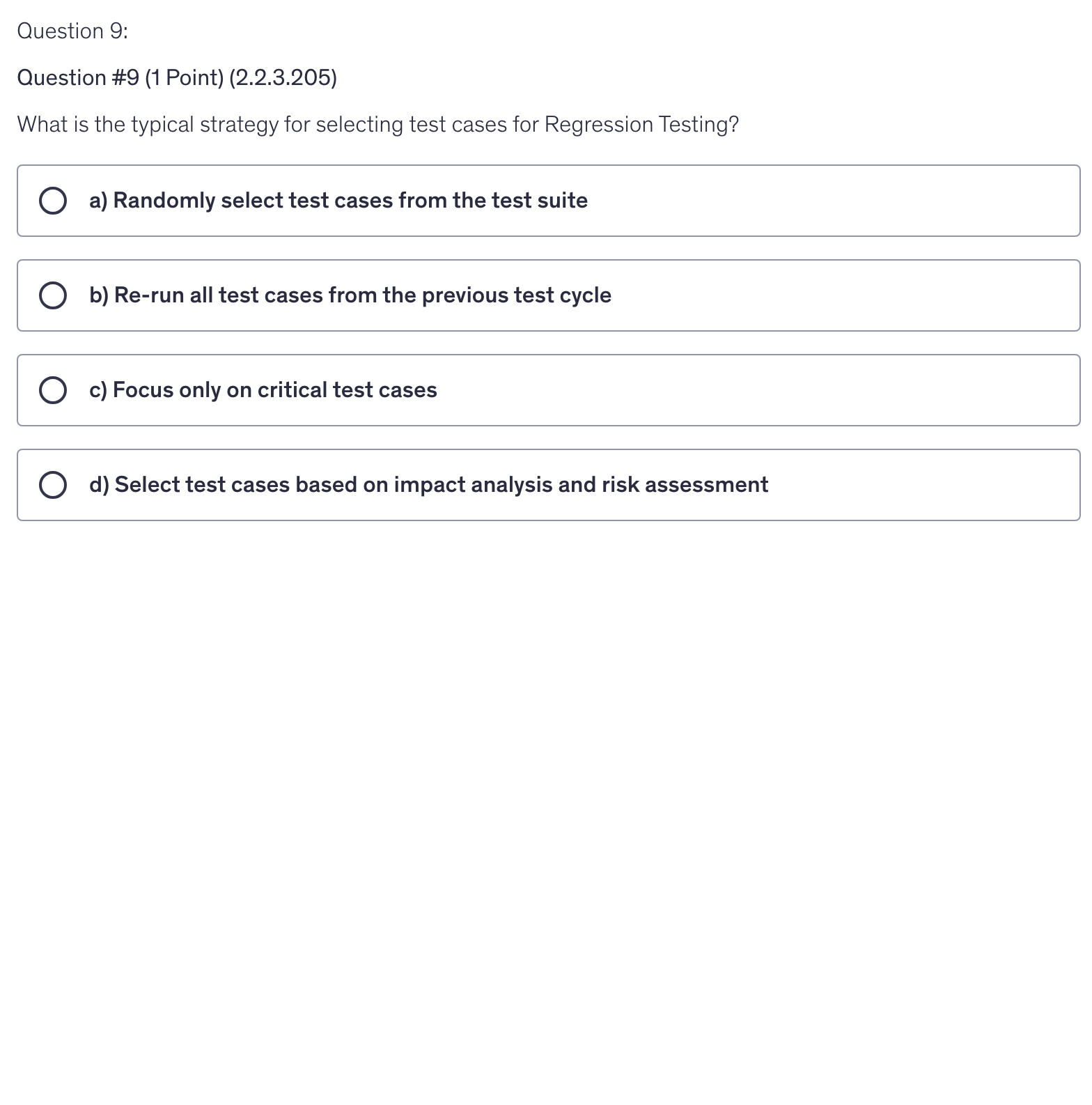
What is the typical strategy for selecting test cases for Regression Testing?
d) Select test cases based on impact analysis and risk assessment
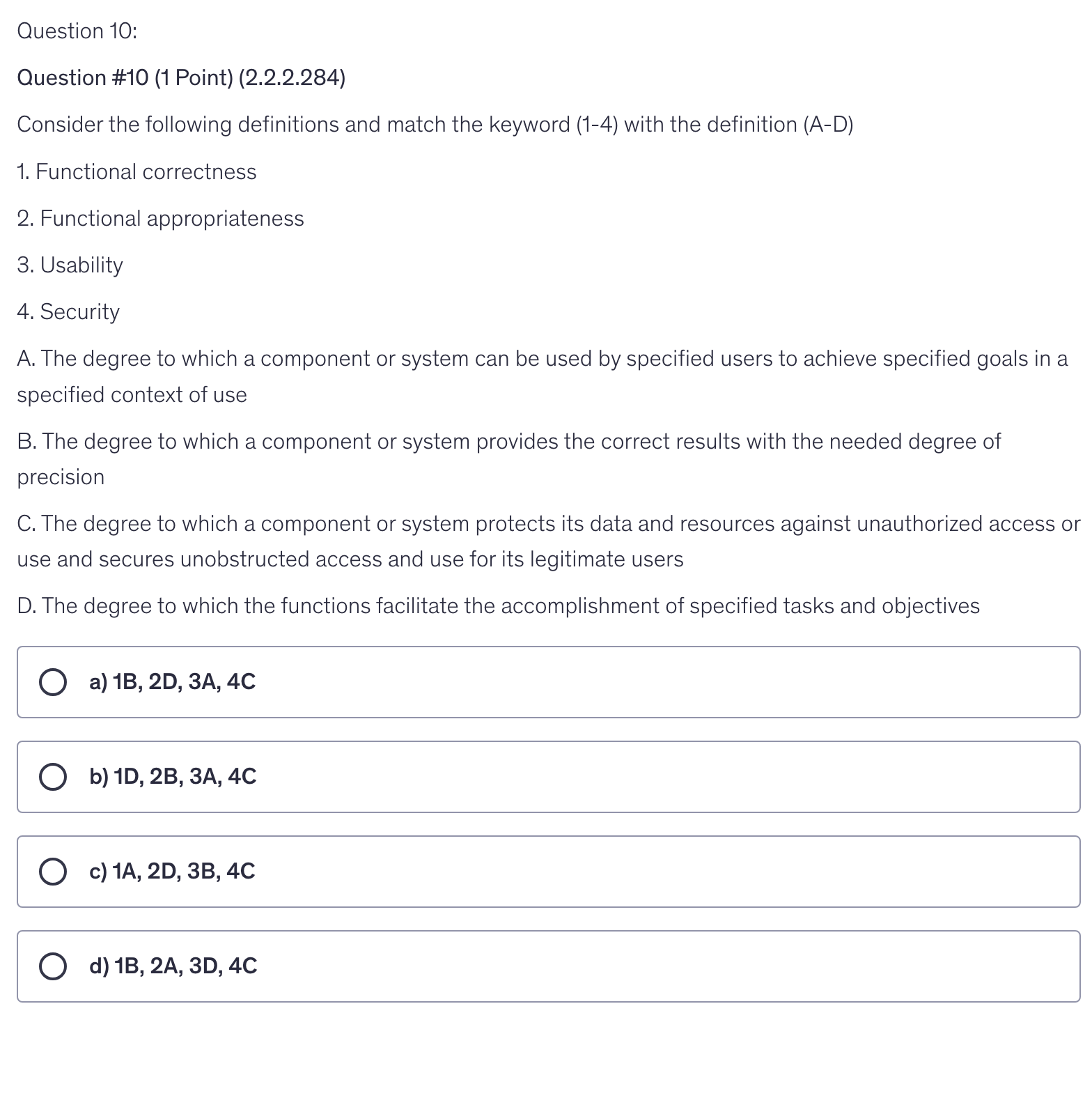
Consider the following definitions and match the keyword (1-4) with the definition (A-D)
1. Functional correctness
2. Functional appropriateness
3. Usability
4. Security
A. The degree to which a component or system can be used by specified users to achieve specified goals in a specified context of use
B. The degree to which a component or system provides the correct results with the needed degree of precision
C. The degree to which a component or system protects its data and resources against unauthorized access or use and secures unobstructed access and use for its legitimate users
D. The degree to which the functions facilitate the accomplishment of specified tasks and objectives
a) 1B, 2D, 3A, 4C
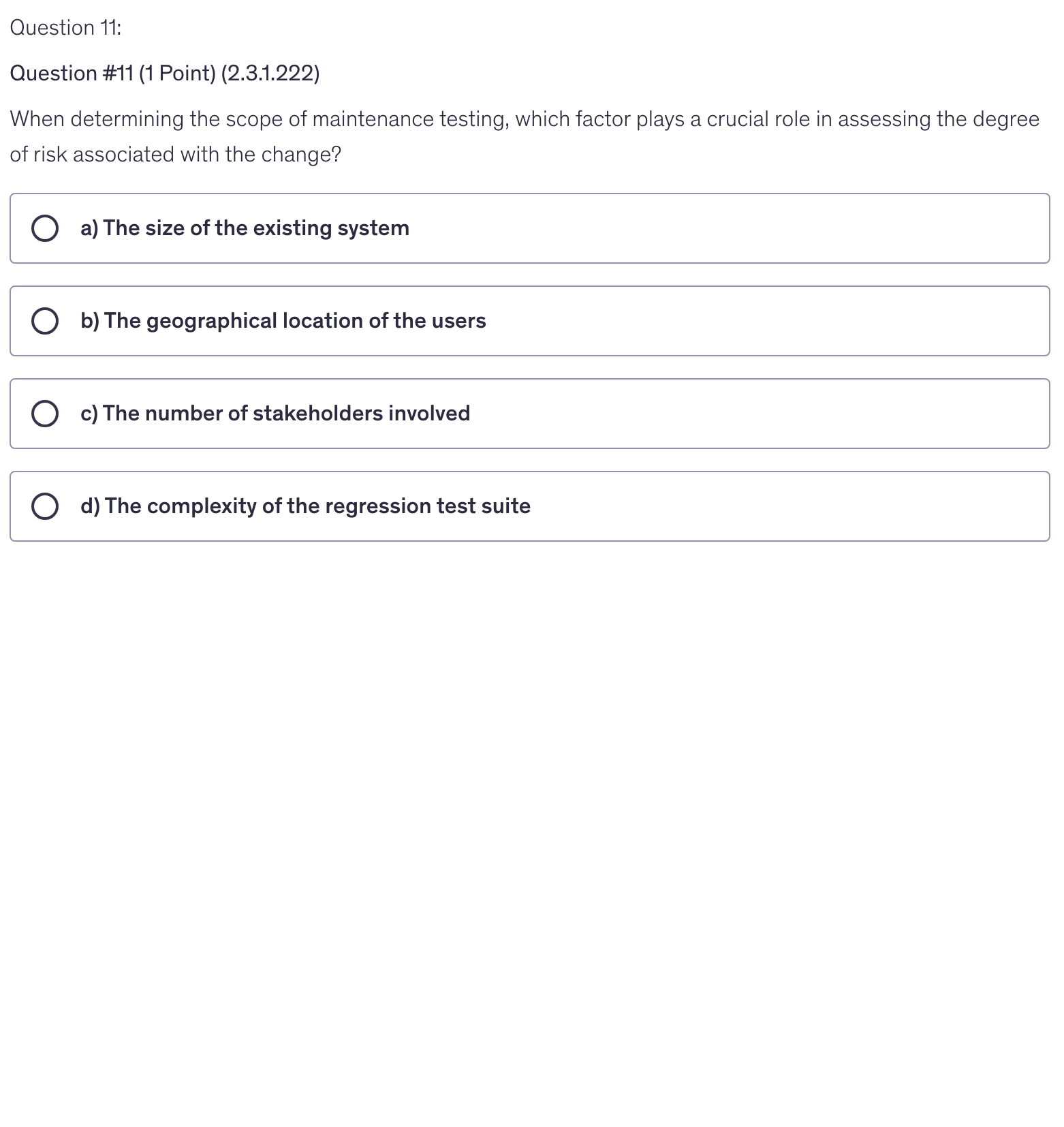
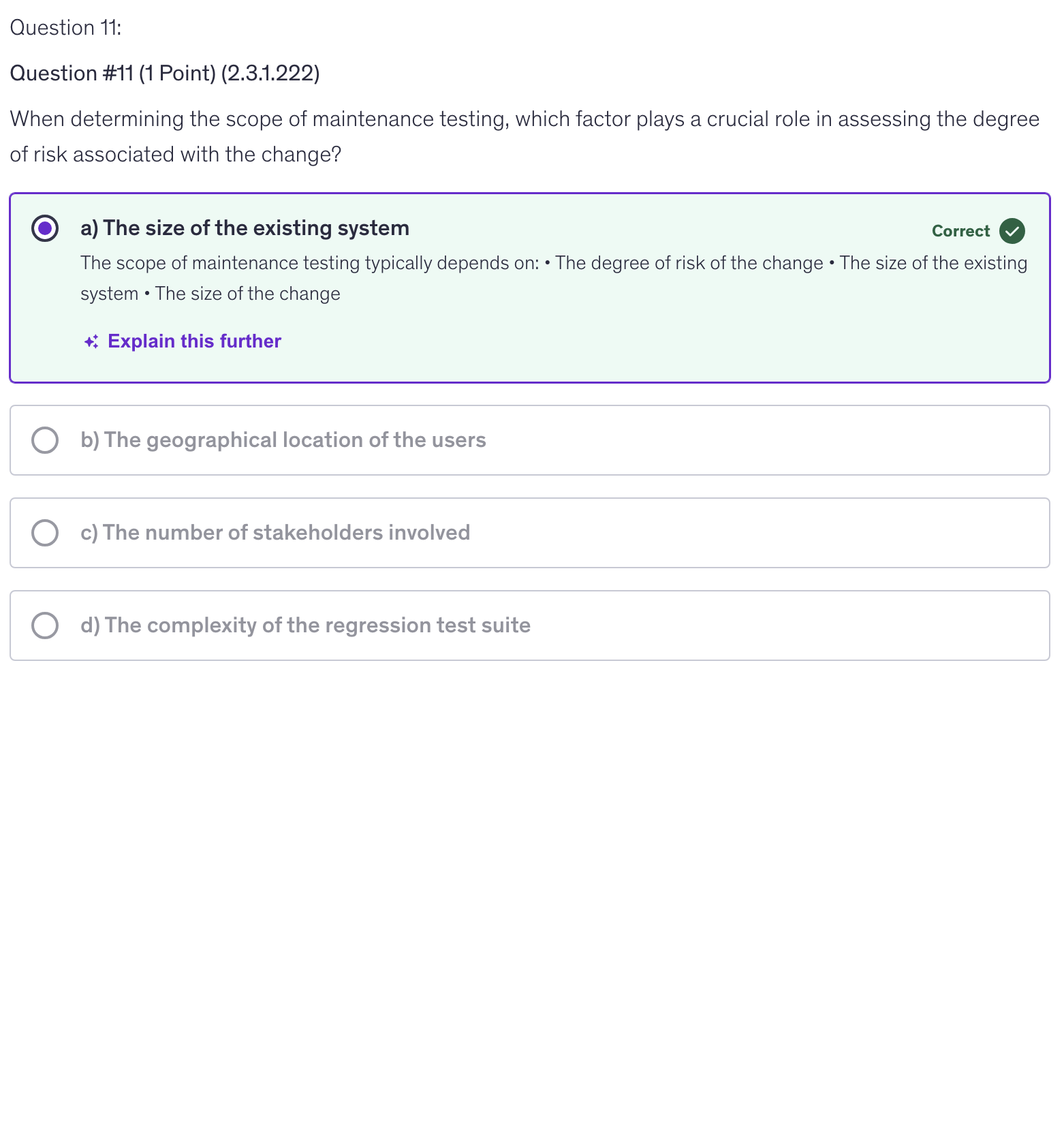
When determining the scope of maintenance testing, which factor plays a crucial role in assessing the degree of risk associated with the change?
a) The size of the existing system
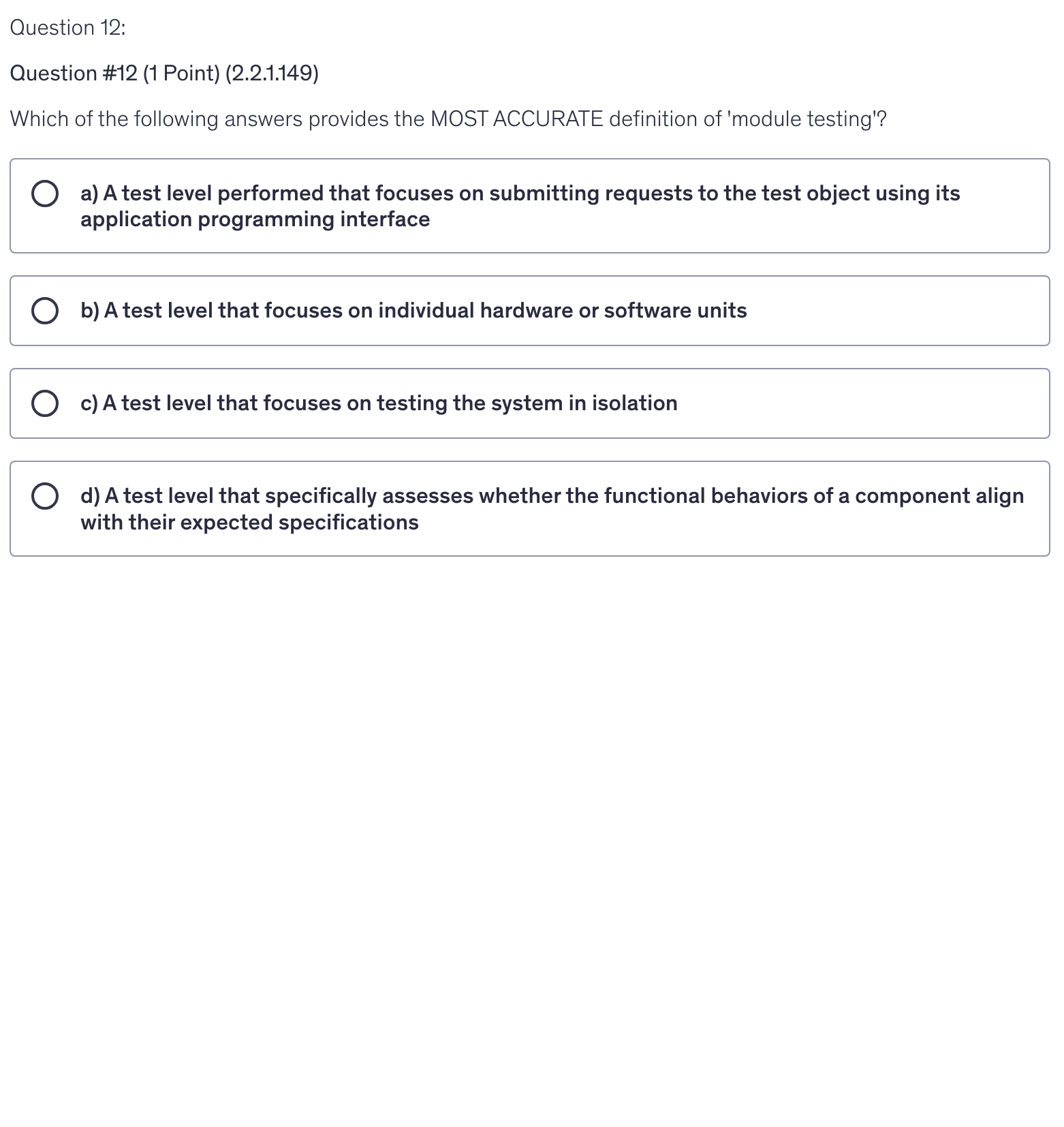
Which of the following answers provides the MOST ACCURATE definition of 'module testing'?
b) A test level that focuses on individual hardware or software units
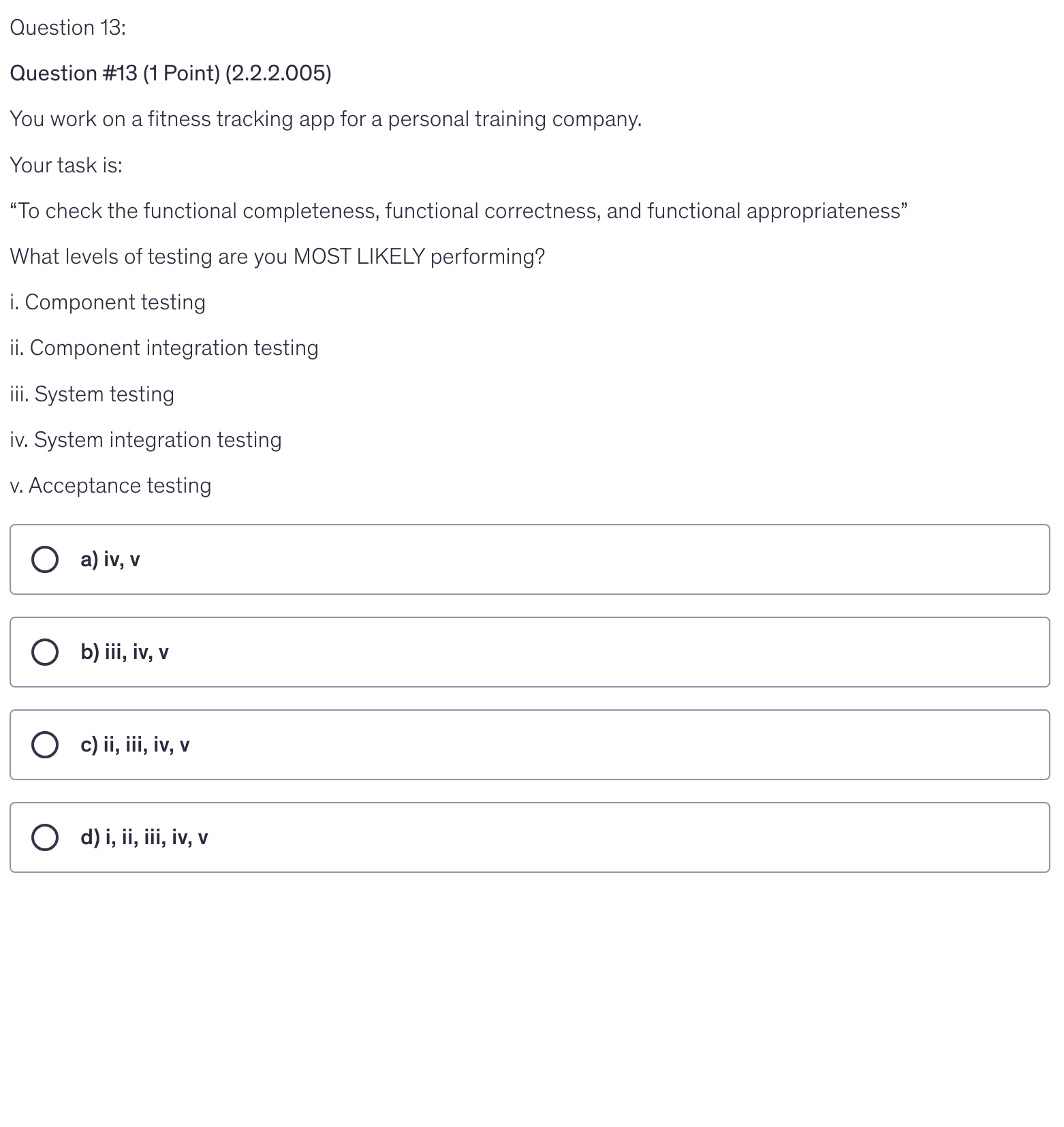
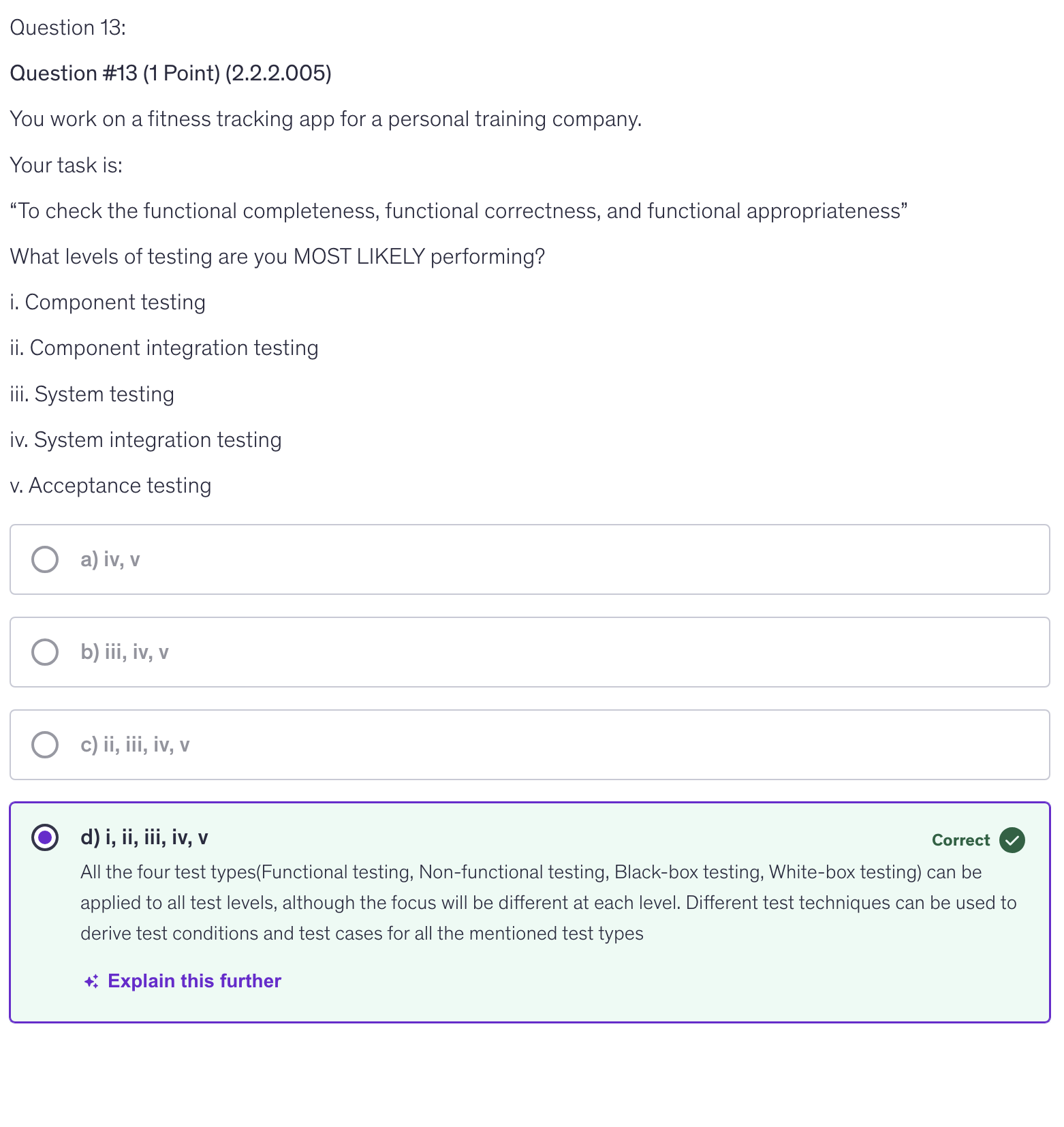
You work on a fitness tracking app for a personal training company.
Your task is:
“To check the functional completeness, functional correctness, and functional appropriateness”
What levels of testing are you MOST LIKELY performing?
i. Component testing
ii. Component integration testing
iii. System testing
iv. System integration testing
v. Acceptance testing
d) i, ii, iii, iv, v
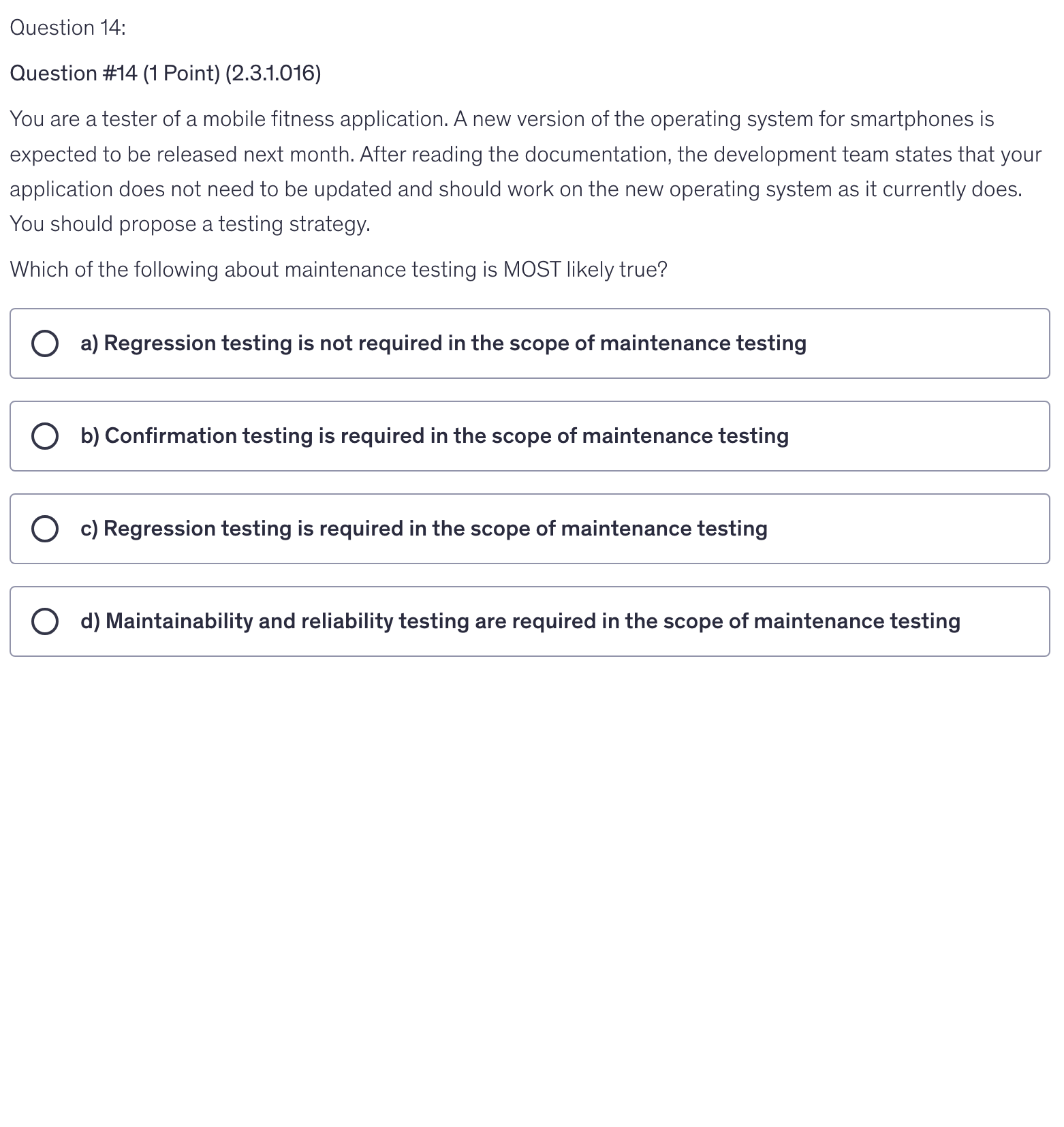
You are a tester of a mobile fitness application. A new version of the operating system for smartphones is expected to be released next month. After reading the documentation, the development team states that your application does not need to be updated and should work on the new operating system as it currently does. You should propose a testing strategy.
Which of the following about maintenance testing is MOST likely true?
c) Regression testing is required in the scope of maintenance testing
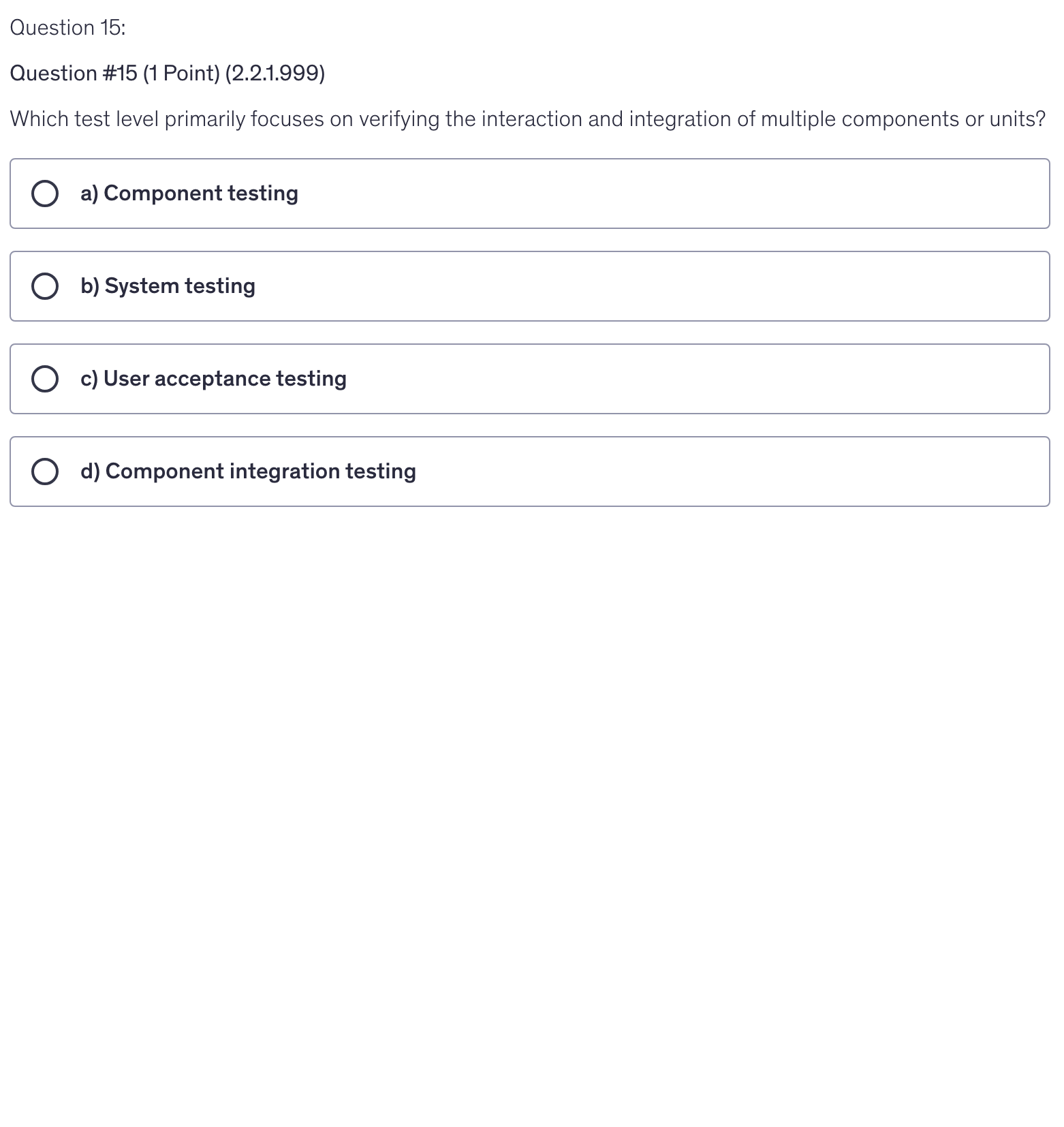
Which test level primarily focuses on verifying the interaction and integration of multiple components or units?
d) Component integration testing
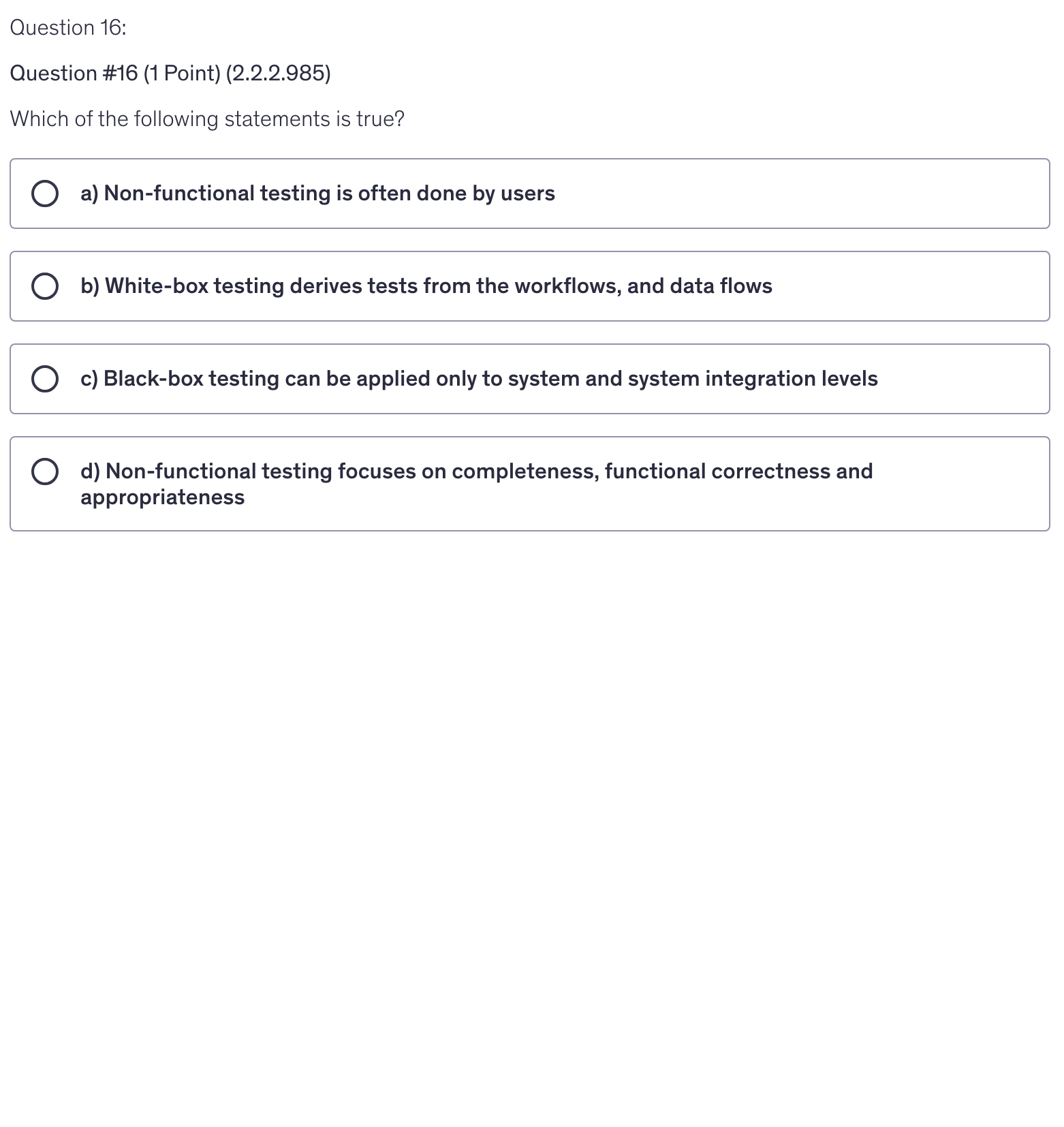
Which of the following statements is true?
b) White-box testing derives tests from the workflows, and data flows
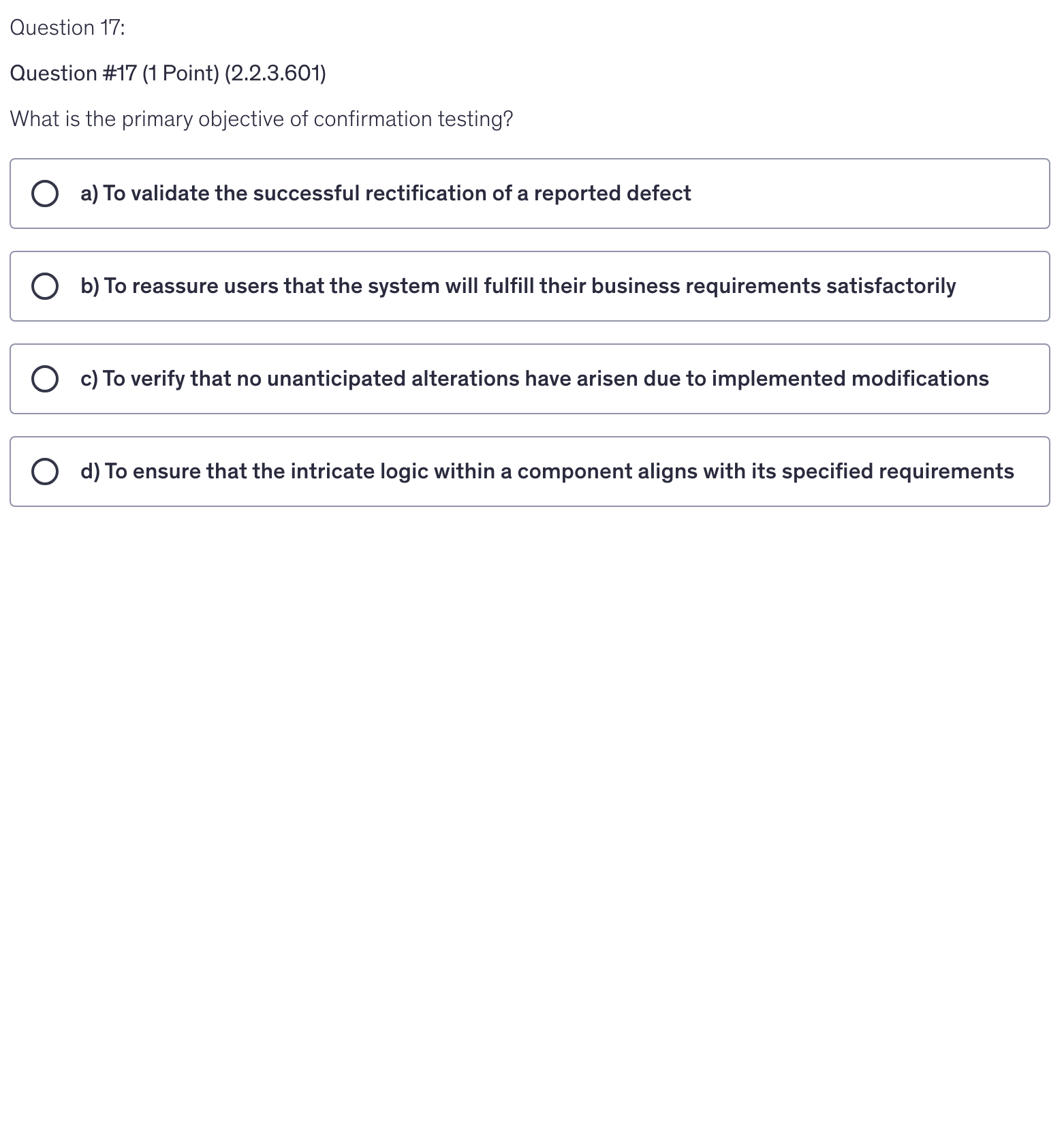
What is the primary objective of confirmation testing?
a) To validate the successful rectification of a reported defect
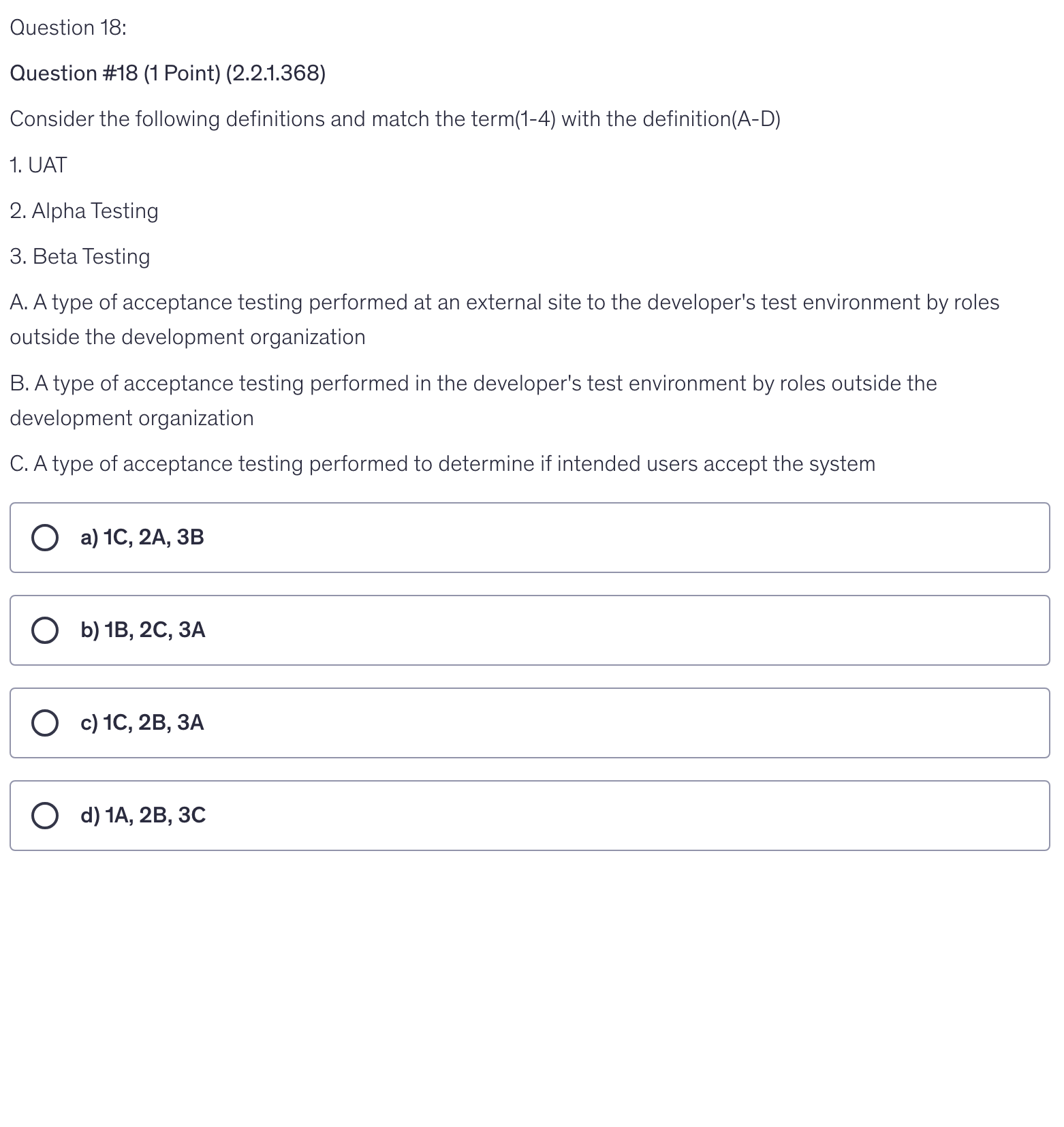
Consider the following definitions and match the term(1-4) with the definition(A-D)
1. UAT
2. Alpha Testing
3. Beta Testing
A. A type of acceptance testing performed at an external site to the developer's test environment by roles outside the development organization
B. A type of acceptance testing performed in the developer's test environment by roles outside the development organization
C. A type of acceptance testing performed to determine if intended users accept the system
c) 1C, 2B, 3A
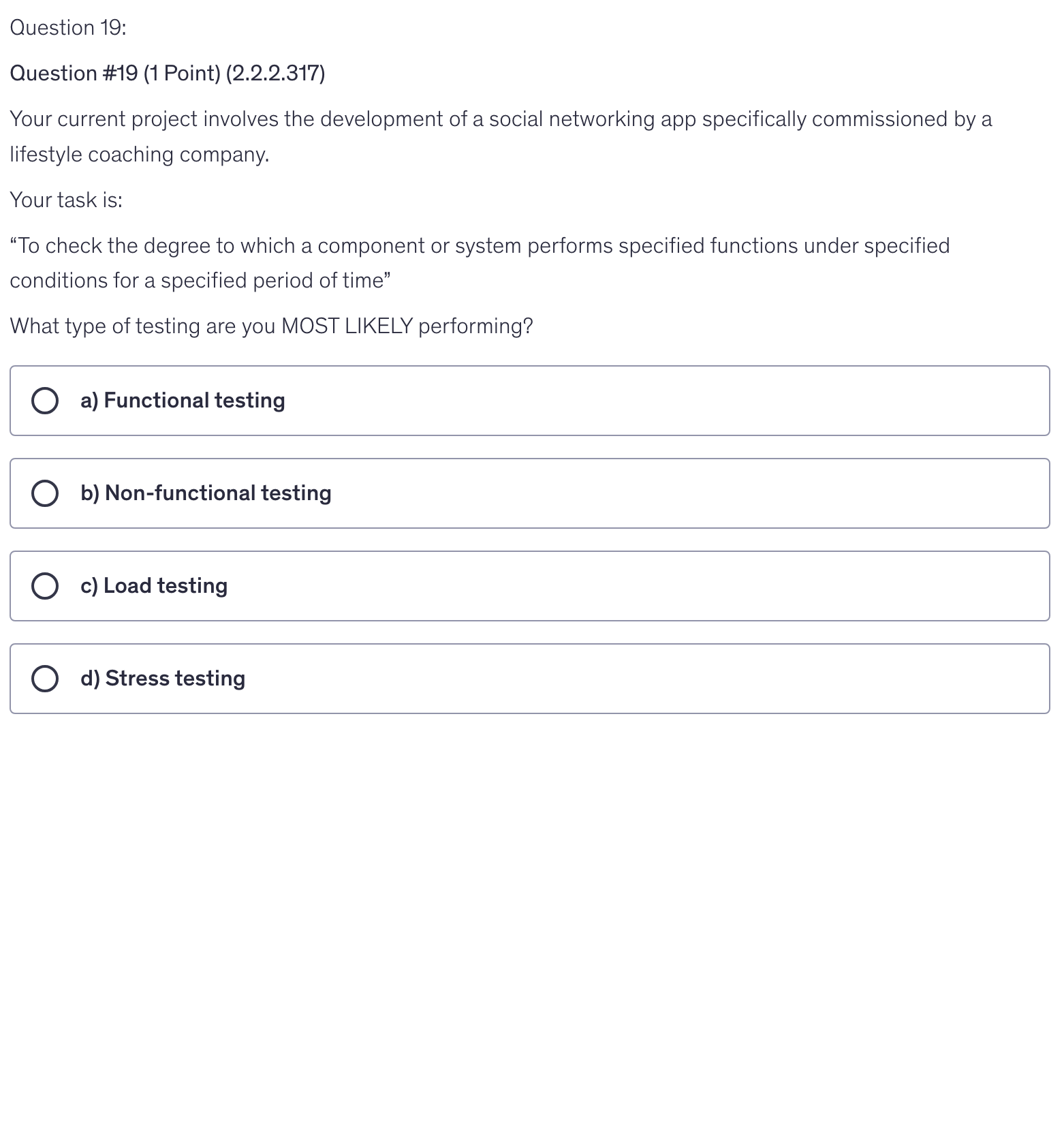
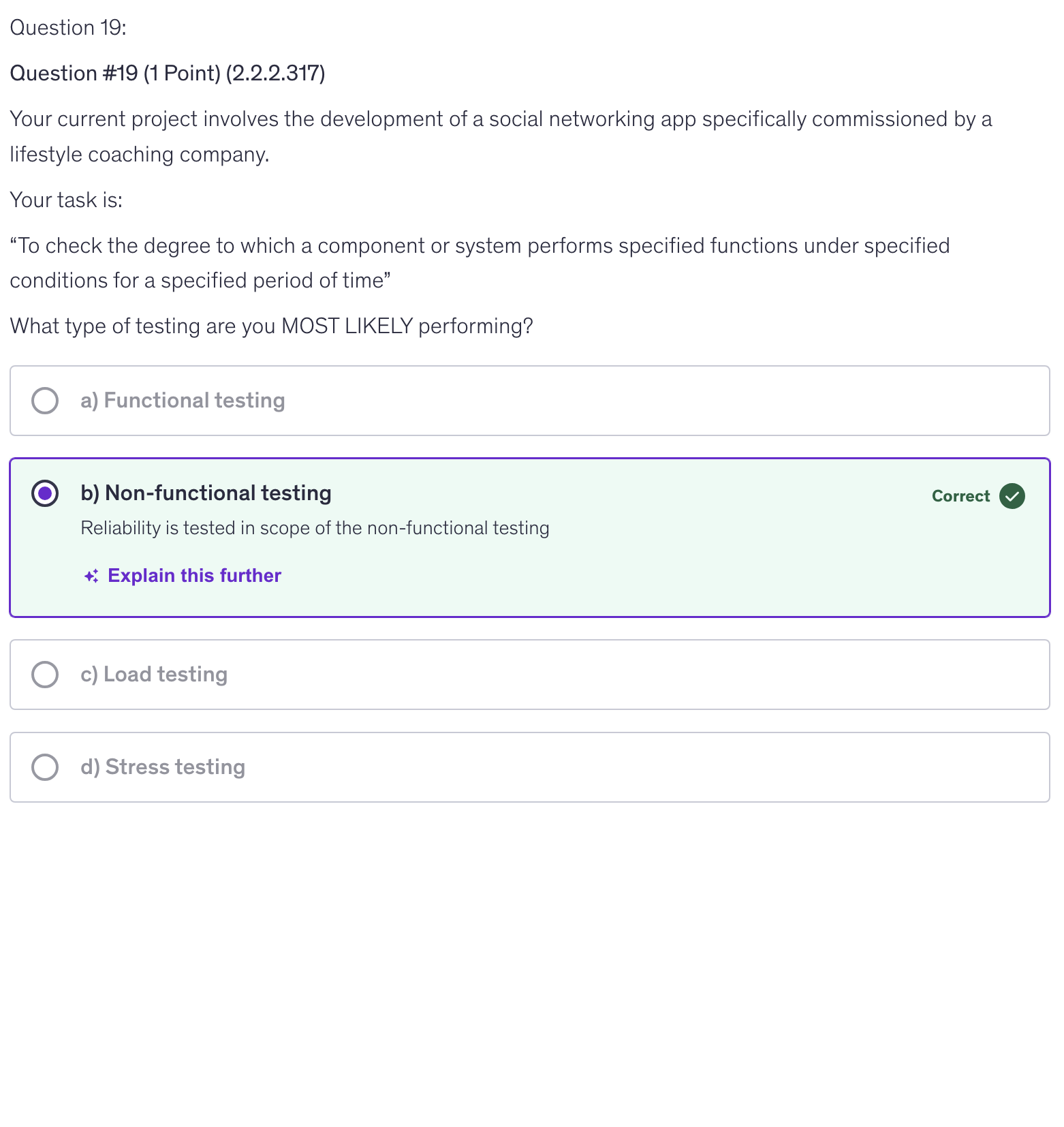
Your current project involves the development of a social networking app specifically commissioned by a lifestyle coaching company.
Your task is:
“To check the degree to which a component or system performs specified functions under specified conditions for a specified period of time”
What type of testing are you MOST LIKELY performing?
b) Non-functional testing
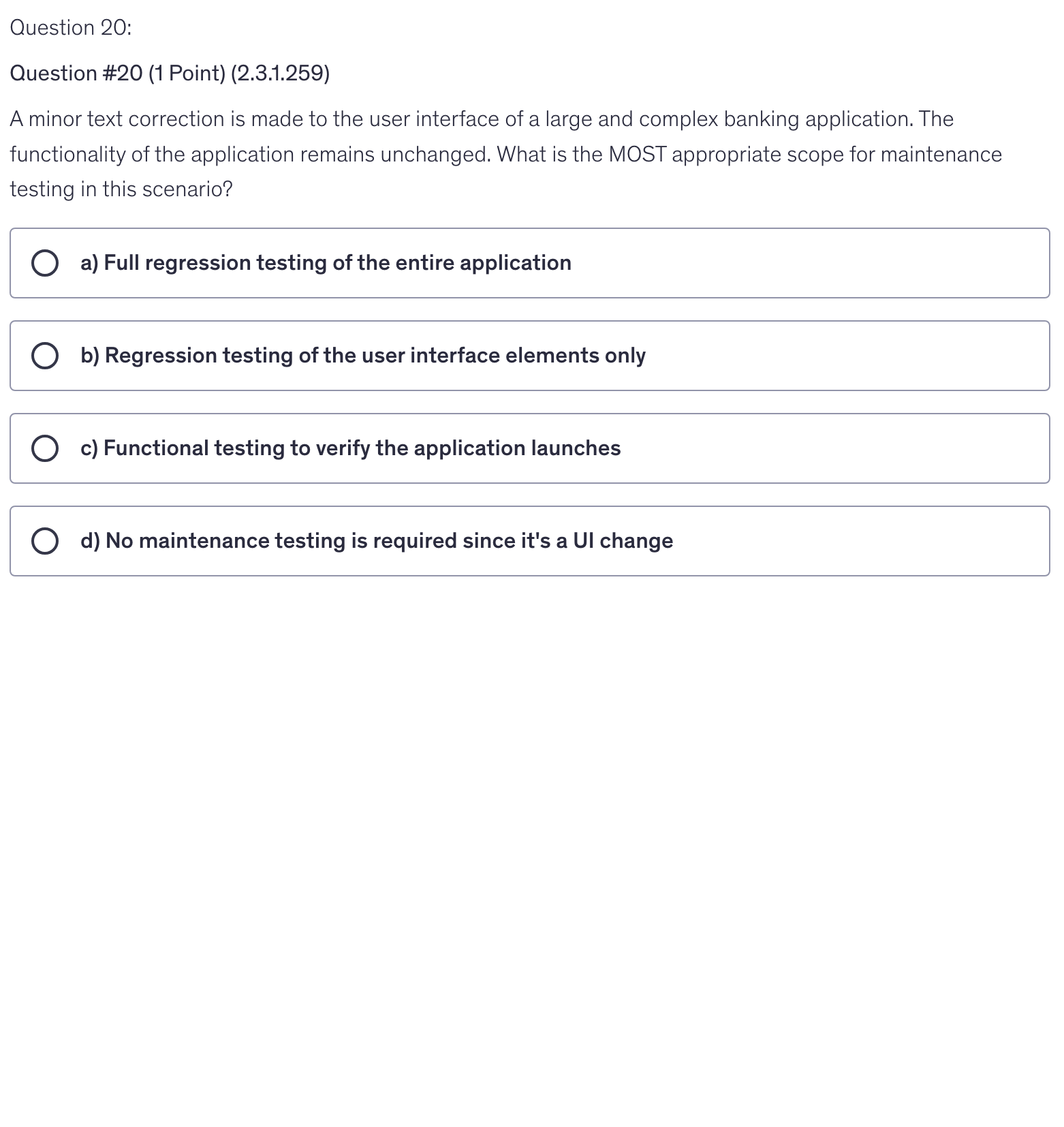
A minor text correction is made to the user interface of a large and complex banking application. The functionality of the application remains unchanged. What is the MOST appropriate scope for maintenance testing in this scenario?
b) Regression testing of the user interface elements only