7. External Insect Anatomy
 Call Kai
 Learn
Learn Practice Test
 Spaced Repetition
 Match
Match Flashcards
 Knowt Play
1/91

There's no tags or description
Looks like no tags are added yet.
Name | Mastery | Learn | Test | Matching | Spaced | Call with Kai | Chat |
|---|
No analytics yet
Send a link to your students to track their progress
92 Terms
What are the three main body regions of an adult insect?
Head, thorax and abdomen.
Why is external insect anatomy important in pest management?
It helps explain feeding, movement, sensing, moulting and how some insecticides enter the body.
Which body region mainly contains the sense organs?
The head.
Which body region is mainly responsible for movement?
The thorax.
Which body region mainly contains the digestive and reproductive organs?
The abdomen.
What is the integument?
The Insects body covering consisting of the basement membrane, epidermis and the cuticle
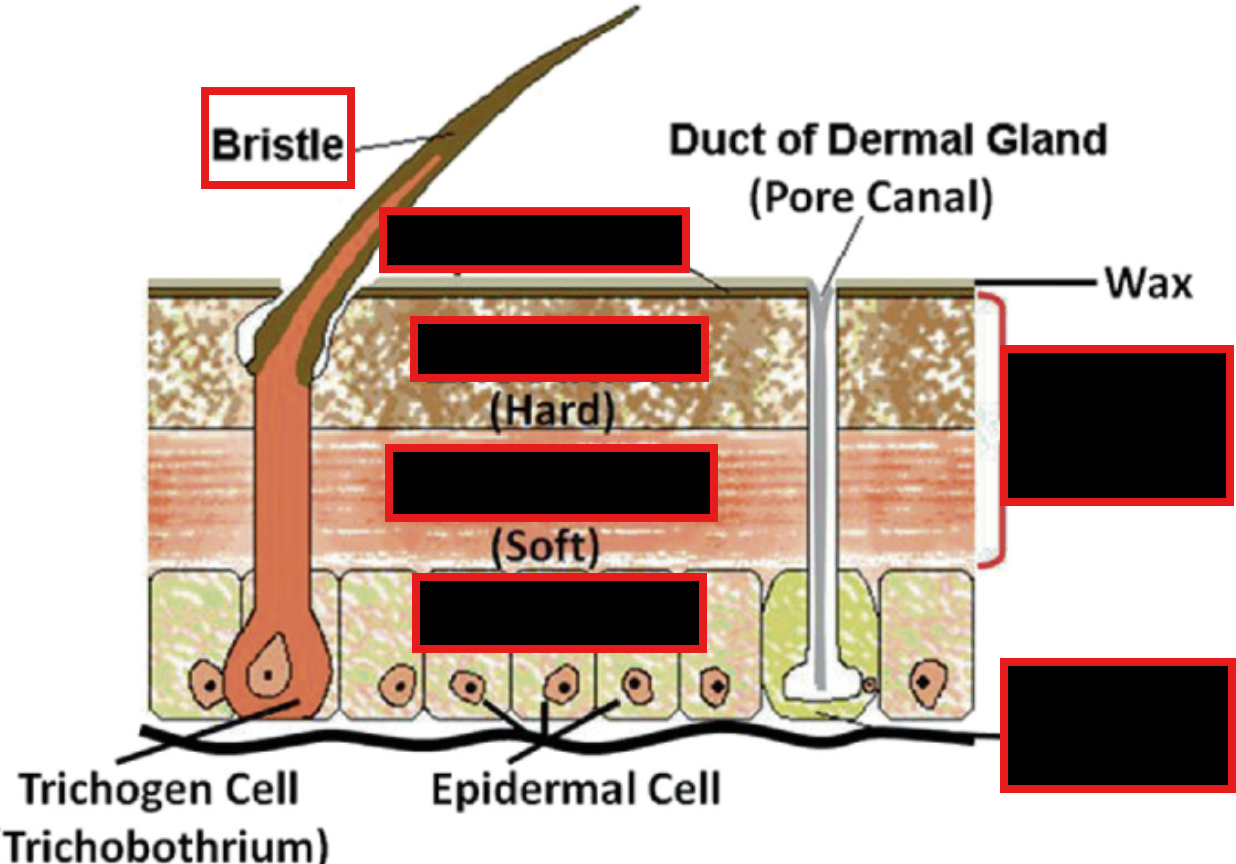
Label the diagram
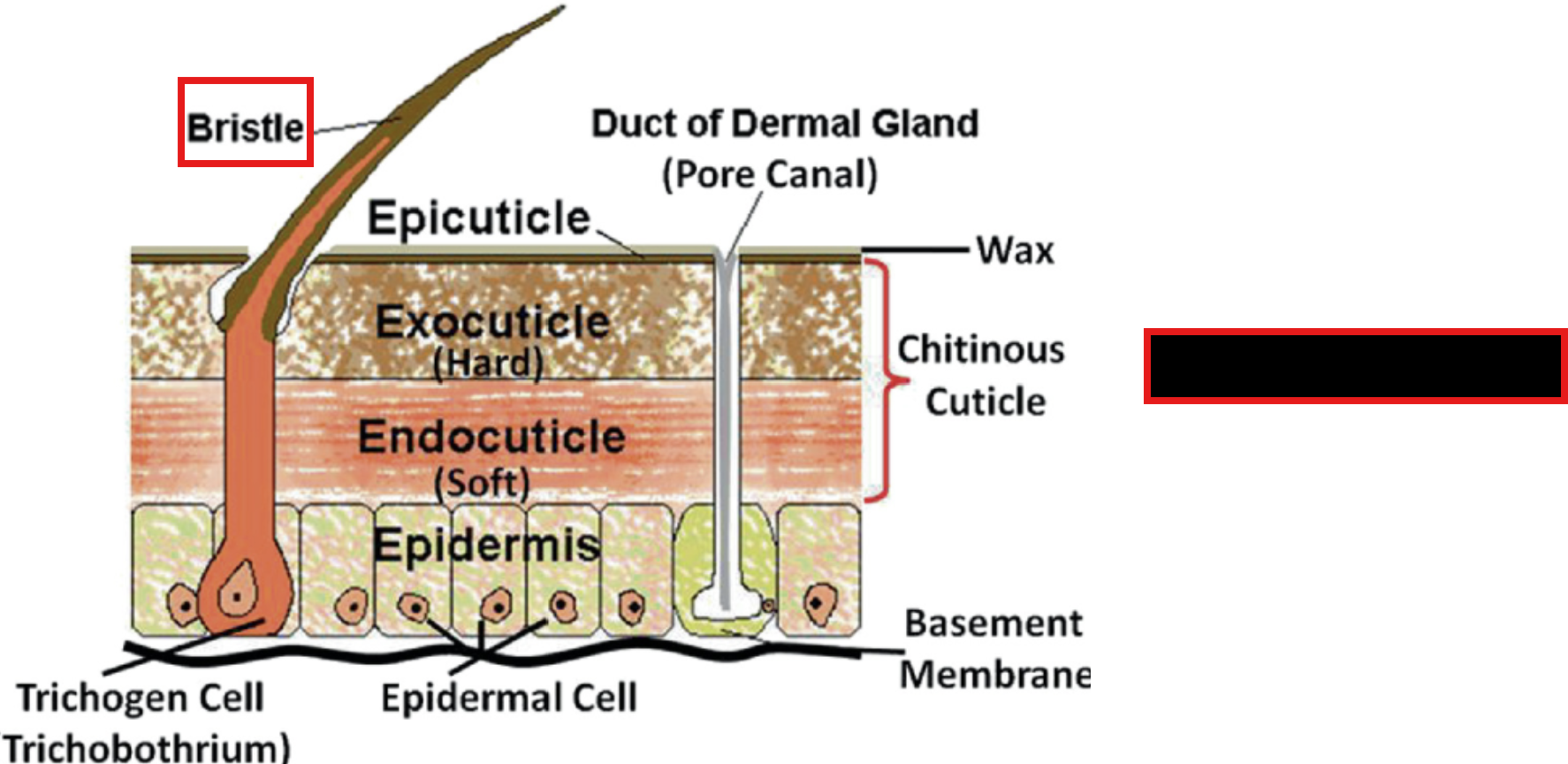
What is the cuticle?
The non-cellular outer layer of the insect body wall.
What are the four main functions of the exoskeleton?
Protects internal organs
Supports the body
Provides muscle attachment
Reduces water loss
how does the insect exoskeleton reduce water loss?
The waxy outer layer helps prevent water from evaporating.
What is the Basement membrane?
A thin inner sheath lining the body cavity.
What is the epidermis?
The living cell layer that produces the cuticle.
What are the two parts of the procuticle?
Endocuticle and exocuticle.
What is the epicuticle?
The thin waxy outer layer of the cuticle.
What is the main function of the epicuticle?
Preventing water loss.
What do dermal glands produce?
Wax, pheromones or defensive chemicals.
Why must insects moult?
Their rigid cuticle prevents continuous growth.
What happens during moulting?
A new cuticle forms underneath, the old cuticle splits and is shed, then the new cuticle expands and hardens.
Why is a newly moulted insect vulnerable?
Its new cuticle is soft until it hardens.
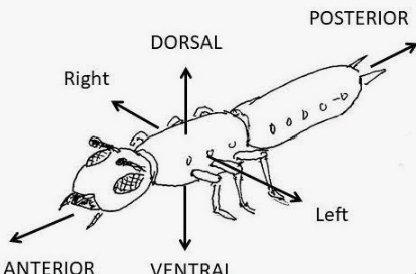
What does anterior mean?
Toward the head/front.
What does posterior mean?
Toward the rear.
What does dorsal mean?
The upper side.
What does ventral mean?
The underside.
What does lateral mean?
The side.
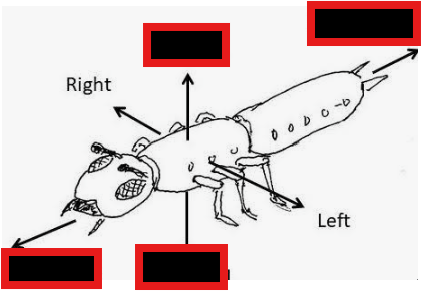
name the body orientations of insects
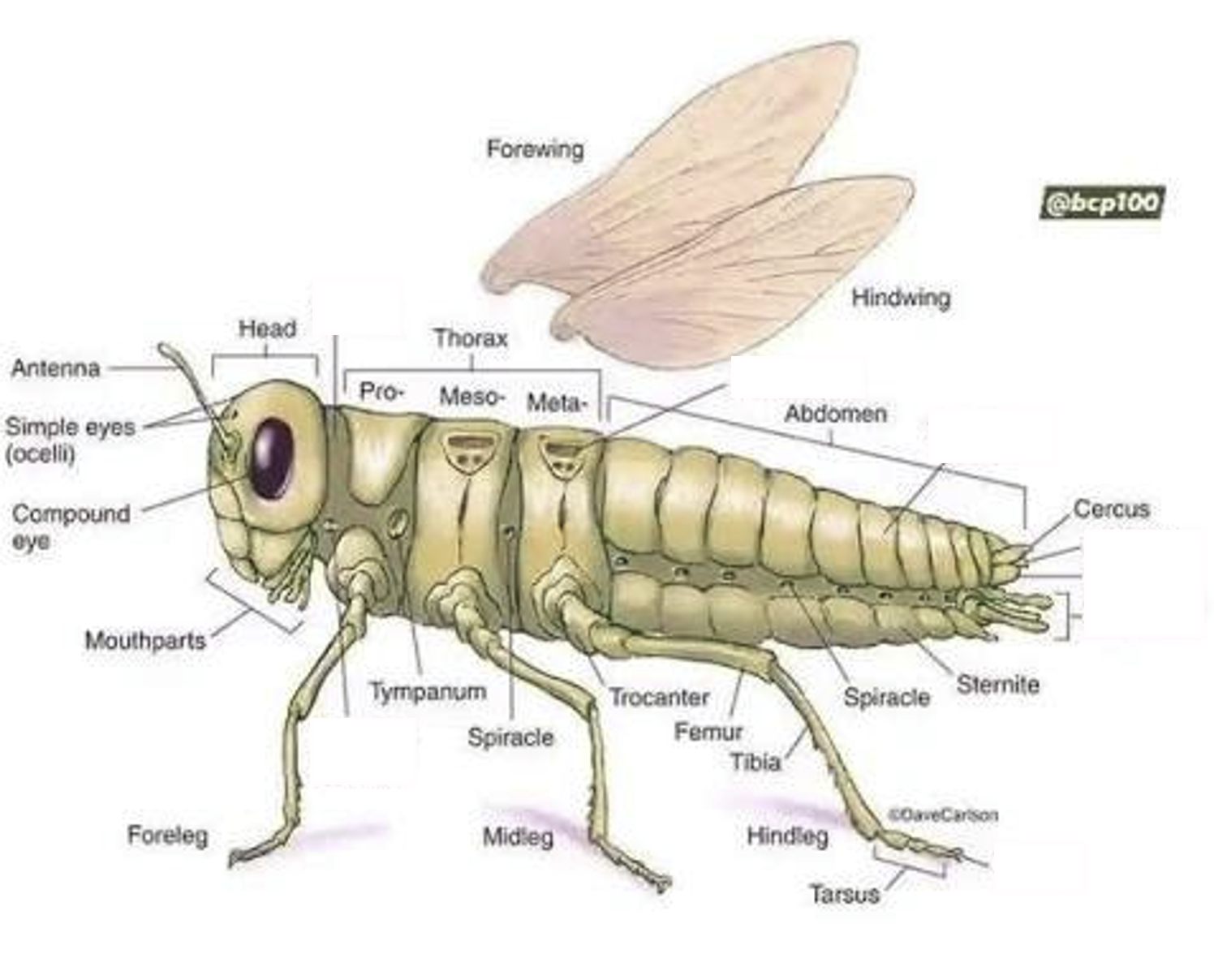
What structures are found on the insect head?
Antennae, eyes and mouthparts.
What is the main function of the head?
Sensing the environment and feeding.
What are antennae?
Movable, segmented sensory appendages.
What can antennae detect?
Touch
Smell
Taste
Sound
Other environmental cues
Why are antennae useful for identification?
Different insect groups have different antenna shapes.
What are compound eyes?
Large eyes made up of many small units called ommatidia.
What are the small units inside compound eyes called?
Ommatidia.
What is the main function of compound eyes?
Detecting movement.
Besides movement, what else can some compound eyes detect?
Colour and distance.
What are ocelli?
Simple eyes found on many adult insects.
What are stemmata?
Simple eyes found on many larvae with complete metamorphosis.
name the four most common mouth part
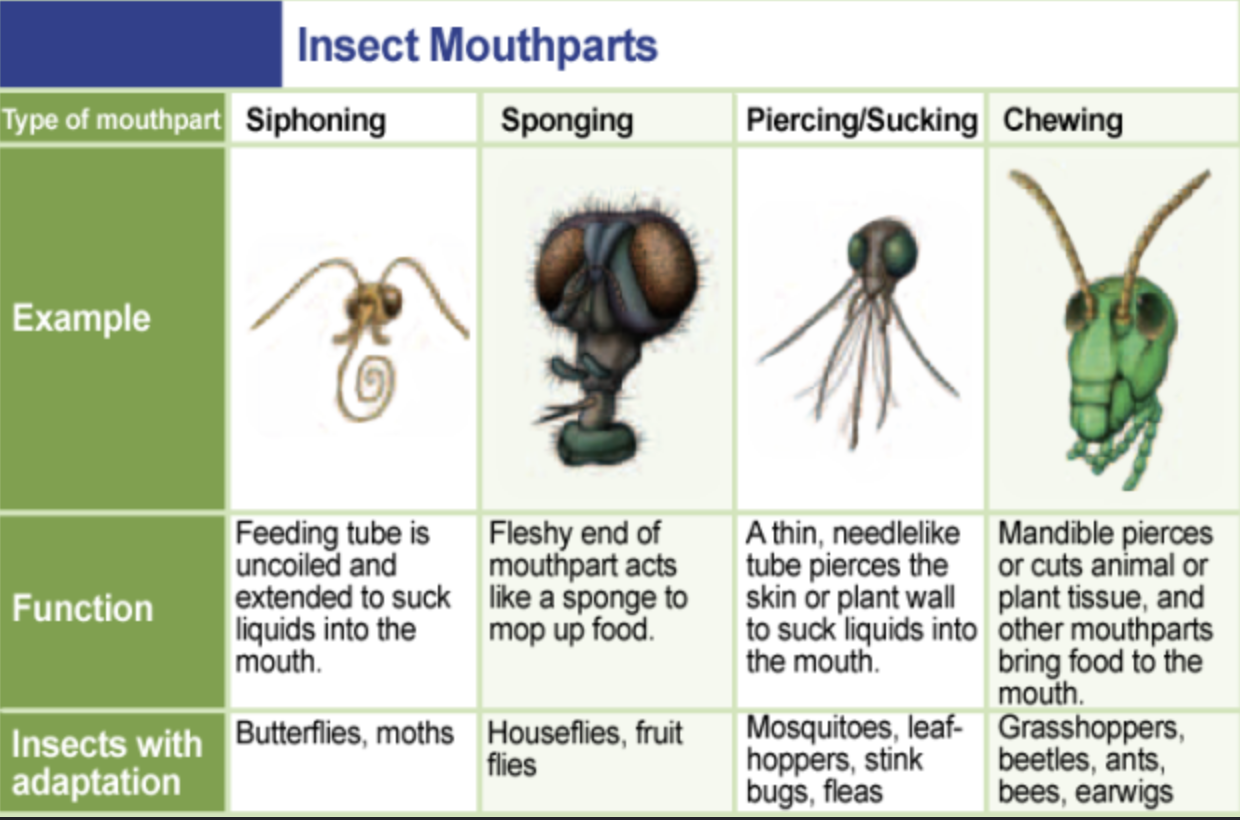
Why are mouthparts important in pest management?
They indicate how an insect feeds and the type of damage it causes.
What are mandibulate mouthparts?
Chewing mouthparts for solid food.
Which insects have chewing mouthparts?
Cockroaches
Termites
Beetles
Silverfish
Earwigs
Grasshoppers
Caterpillars
What type of damage do chewing insects usually cause?
Physical damage by eating solid materials.
What are piercing-sucking mouthparts?
Mouthparts that pierce tissue and suck fluids.
Which insects have piercing-sucking mouthparts?
Mosquitoes
Fleas
Bed bugs
Aphids
Scale insects
What are sponging-sucking mouthparts?
Mouthparts that absorb liquid food using a sponging pad.
Which insects have sponging-sucking mouthparts?
Houseflies and some adult flies.
Why do houseflies regurgitate digestive fluids?
To dissolve semi-solid food before feeding.
What are siphoning mouthparts?
A long coiled proboscis used like a straw.
Which insects have siphoning mouthparts?
Adult moths and butterflies.
Which insects have chewing-lapping mouthparts?
Bees.
Which insects have rasping-sucking mouthparts?
Thrips.
What mouthparts do maggots have?
Mouth-hooks.
What is the main function of the thorax?
Movement (locomotion).
How many segments make up the thorax?
Three.
Name the three thoracic segments.
Prothorax
Mesothorax
Metathorax
Which legs attach to the prothorax?
Forelegs.
Which legs attach to the mesothorax?
Middle legs.
Which legs attach to the metathorax?
Hind legs.
Which wings attach to the mesothorax?
Forewings.
Which wings attach to the metathorax?
Hindwings.
Name the five main parts of a typical insect leg.
Coxa
Trochanter
Femur
Tibia
Tarsus
How can insect legs be modified?
Running
Jumping
Digging
Catching prey
Swimming
Carrying pollen
How many pairs of wings do most adult insects have?
Two pairs.
What are membranous wings?
hin transparent wings.
What are tegmina?
Thickened forewings of cockroaches and grasshoppers.
What are elytra?
Hardened forewings of beetles.
Which insect order has elytra?
Coleoptera.
How many pairs of wings do flies have?
One pair.
What are halteres?
Modified hindwings used for balance during flight.
Which body region is the abdomen?
The posterior body region.
Approximately how many segments does the abdomen have?
Up to 11.
What organs are mainly found inside the abdomen?
Digestive and reproductive organs.
What are spiracles?
Openings used for breathing.
What are cerci?
Sensory appendages that detect touch, air movement and sound.
What is the function of the ovipositor?
To lay eggs.
What are male claspers used for?
Reproduction.
What are prolegs?
Fleshy appendages on caterpillars used for movement.
Which life stage has prolegs?
Caterpillars (larvae).
What is the anus?
The opening at the end of the digestive tract.
Which body region contains the antennae?
Head.
Which body region contains the wings?
Thorax.
Which body region contains most reproductive organs?
Abdomen.
Which cuticle layer prevents water loss?
Epicuticle.
Which cuticle layer produces the cuticle?
Epidermis.
Which eyes are made of ommatidia?
Compound eyes.
Which mouthparts chew solid food?
Mandibulate (chewing).
Which mouthparts pierce tissue?
Piercing-sucking.
Which mouthparts sponge liquid food?
Sponging-sucking.
Which mouthparts use a coiled proboscis?
Siphoning.
What are the three main body regions of an insect, and what is the primary function of each?
Head – sensing and feeding
Thorax – movement (legs and wings)
Abdomen – digestion, reproduction and respiration
Match the mouthpart type to its feeding style.
Mandibulate → Chews solid food
Piercing-sucking → Sucks fluids through stylets
Sponging-sucking → Sponges up liquid food
Siphoning-sucking → Drinks liquids through a coiled proboscis
What is the most important thing to remember about external insect anatomy for pest control?
The structure of an insect explains how it feeds, moves, senses its environment and responds to treatments. Understanding anatomy helps identify pests and choose the most effective control method.