intro to child psych
 Call Kai
 Learn
Learn Practice Test
 Spaced Repetition
 Match
Match Flashcards
 Knowt Play
1/69

There's no tags or description
Looks like no tags are added yet.
Name | Mastery | Learn | Test | Matching | Spaced | Call with Kai | Chat |
|---|
No analytics yet
Send a link to your students to track their progress
70 Terms
nature-nurture
nature: biological endowment, especially genes received from parents
nurture: physical and social environments that influence our development
they work TOGETHER to shape development
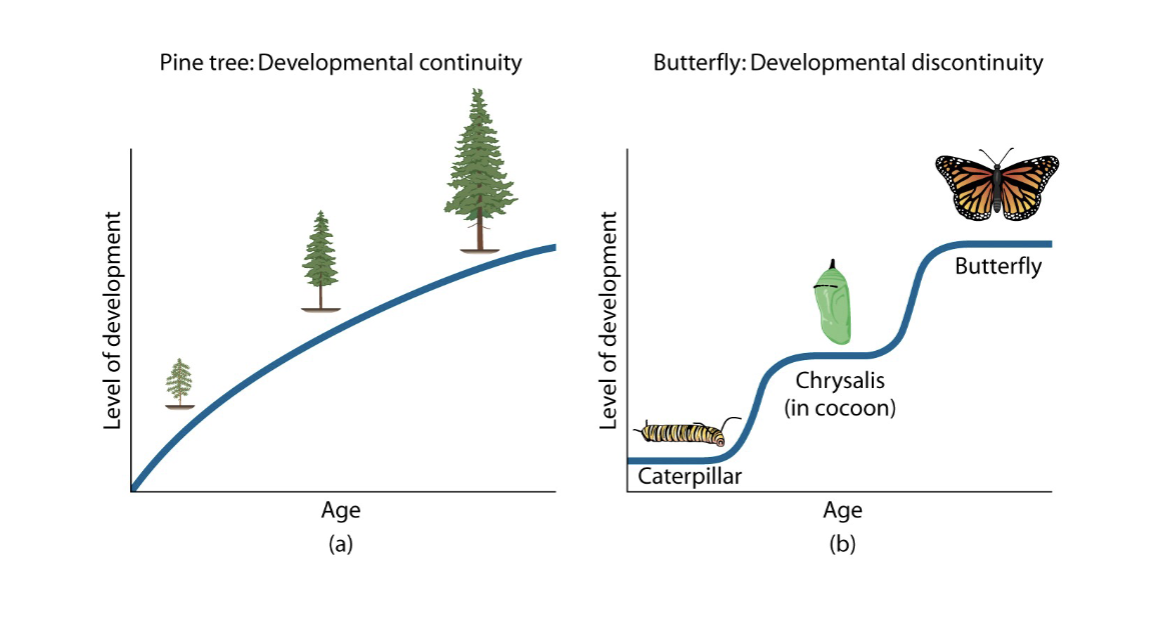
continuous-discontinuous
continuous: changes with age occur gradually in small increments; development occurs skill by skill, task by task: quantitative; learning theorists; Watson & Bandura
discontinuous: changes with age include occasional, large shifts; developmental shifts result in qualitative changes; stage theorists; piaget, freud, erikson, kohlberg
learning theories
emphasizes role of experience, rewards and punishment
nurture + continuous
behaviorism (john watson, b.f. skinner)
a learning theory
reinforcement: increases future likelihood of behavior
punishment: decreases future likelihood of behavior
social learning theory (albert bandura)
a learning theory
reinforcement and punishment are powerful, but people learn by watching others (imitation, observational learning)
imitation is not just mimicry
cognitive development theories
focus on mind: thought processes, construction of knowledge
how children think and how thinking changes over time
roots in nativism (Rousseau)
modern cognitive development theories: more interactionist
major figures: Piaget, Vygotsky
nature + discontinuous
piaget’s thinking
children are like scientists, they want to understand the world and how it works
children revise their theories radically at a few critical points, leading to new theories
revisions happen in a universal sequence at particular ages
evolutionary theories
applies concepts of natural selection and adaptation to human behavior
charles darwin
focus on functions of behaviors: how did behavior ensure survival of the species?
examine patterns of behavior across human societies and cultures
e.g. Kindchenschema (baby schema0l attachment
some propose “critical periods”
nature + discontinuous
ecological theories
stresses effects of context on development
and child’s active role in selecting and influencing the contexts
and child’s personal characteristics
most prominent: bronfenbrenner
nurture and unspecified between dis/continuous

hypotheses
educated guesses that need to be tested
hypotheses not supported by evidence are rejected
the scientific method steps
choose a question to be answered
formulate a hypothesis
develop a method for testing the hypothesis
use data acquired to draw a conclusion regarding hypothesis
interviews
structured interviews:
asking identical questions of may children for quick and straightforward answers
clinical interviews:
begin with prepped questions, but follow child’s lead for in-depth info about an individual child
observations
casually observe subjects and record how they behave in their usual environments
naturalistic observation: observe people as they behave in real-life situations
can yield detailed info about children’s everyday lives, behaviors
but behaviors may occur only rarely in everyday interactions, observer bias and influence, hard to know which factors are influential
structured observation
researcher creates setting (typically in lab) that is likely to bring out behavior of interest, observes behavior and relates it to other factors
structured setting may distort behavior, observer bias and influence
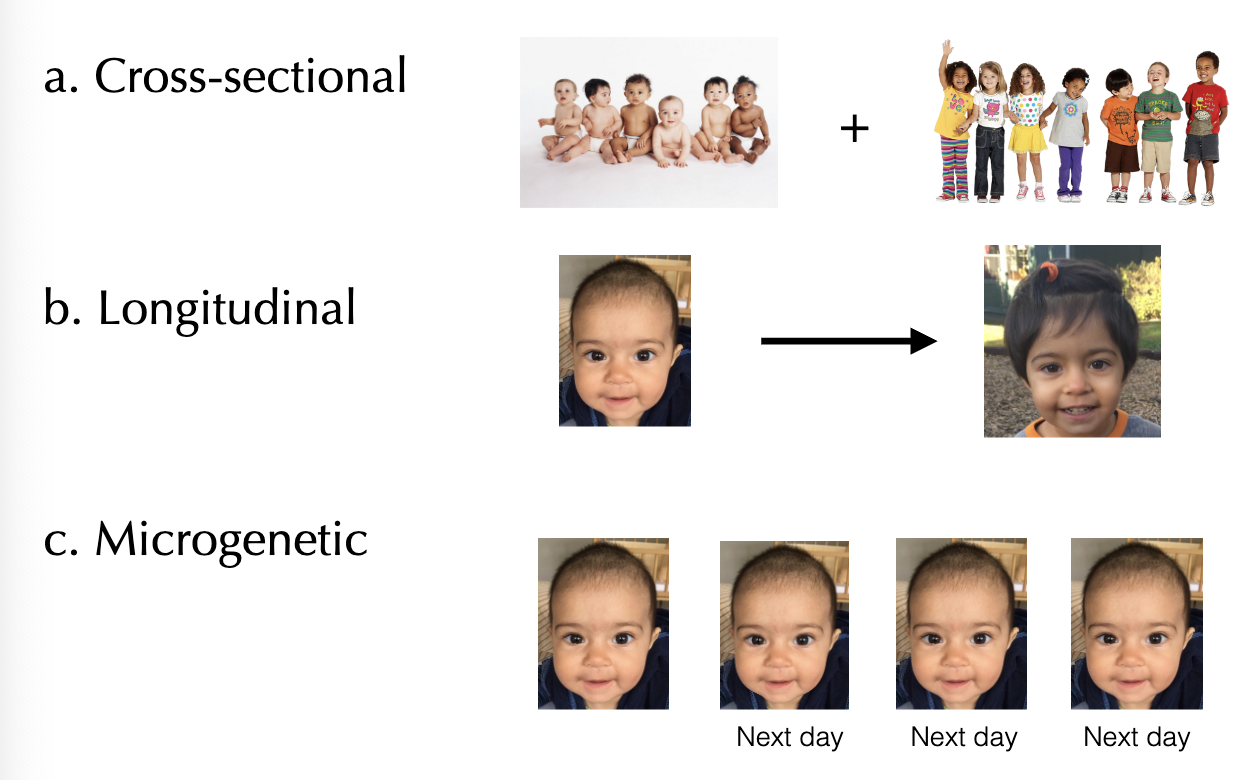
research designs
cross sectional, longitudinal, and microgenetic
reliability & validity
reliability: extent to which a measure provides a consistent index of a characteristic
validity: whether the measure truly measures what researchers think it measures
correlational studies
look at relations between variables as they exist naturally in the world
measure two variables for each person
see whether the two variables are related
example:
person’s intelligence and number of friends
two aspects of relations to measure:
whether the relation between two variables is positive, negative, or no correlation
the strength of the relation
does not address cause and effect, third-variable problem, but helps determine whether variables are related
experimental studies
a systematic way of manipulating the key factor(s) that the investigator thinks CAUSE a particular behavior
experimental designs
if children exposed to one experience and children exposed to a different or no experience subsequently behave differently, then those subsequent differences in behavior resulted from the differences in experience
if children exposed to one experience —> experimental group
children exposed to different or no experience —> control group —> independent variable
dependent variable
causal conclusion
two critical aspects of experimental design
random assignment: each child has an equal chance of being assigned to any of the groups → so groups are comparable at outset
experimental control: all children are treated identically except for the one factor (experience) that researcher is interested in
prenatal development
prenatal period: from conception (single cell) to birth (newborn baby); most rapid phase of development
past view: genetically-determined growth
current view: interactive process, environmental factors play a role
stages of prenatal development
average of 38 weeks; germinal, embyronic, fetal

germinal period
first 2 weeks after conception
conception: fusion of sperm and egg to form one fertilized egg (zygote)
sperm and egg each contain only 23 chromosomes → at conception, they form a single cell containing 23 pairs of chromosomes
zygote: fertilized egg. zygote divides and grows through mitosis. inner cell mass
embryonic period
3rd to 8th week
ball of cells differentiates
inner cell mass → embryo
all major organs begin to form
rest of cell → support system
amniotic sac, amniotic fluid
placenta
umbilical cord
brain development begins
fetal period
9th week to birth
continued growth and differentiation
all internal organs present but must develop further
by 28th week, fetus could survive outside womb (brain and lungs sufficiently developed)
newborn baby born after ~38 weeks
developmental process
mitosis: cell division
cell differentiation:
initially all cells are interchangeable, flexible → embryonic stem cells
then begin to specialize, become inflexible
cell death (apoptosis)
cephalocaudal growth
fetal experience and learning
uterus and amniotic fluid buffer fetus from too much stimulation
but fetus does experience sensory stimulation
touch:
first sense to develop (by 8 weeks)
fetus comes into contact with umbilical, parts of its own body
even shows some “intentional” touching (e.g., of twin vs. self or uterine wall)
taste:
amniotic fluid contains many flavors, fetus can detect the flavors, has a sweet tooth
learning:
newborns prefer tastes they experienced in womb, fetus becomes familiar with flavors in breastmilk, may contribute to cultural food preferences
smell:
amniotic fluid takes on odors of what mother has eaten
learning:
newborns prefer odor of their own amniotic fluid
hearing:
fetus hears mother’s heartbeat, blood flow, voice, etc.
recognize sound of their own mother’s voice, rhythm and pitch but not specific context and words
learning:
newborns remember sounds heard in womb → prefer to listen to own mother’s voice, prefer language and music they heard in womb
vision:
least likely to be stimulated prenatally; detect general changes in illumination, can open eyes and practice blinking, fetus will have visual preferences by third trimester
teratogens
an external agent that can cause damage or death during prenatal development
adverse effects: spontaneous abortion, structural abnormalities, growth retardation, impaired mental development
some effects apparent at birth, others emerge over development
duration and timing of exposure is critical (sensitive periods)
organ systems are more vulnerable when their basic structures are being formed
alcohol
most common human teratogen, leading cause of fetal brain injury
alcohol crosses placenta into fetus’ blood stream
fetus cannot metabolize alcohol quickly; stays in fetus’ system longer
interferes with delivery of oxygen and nutrition to fetus’ tissues, organs, brain
can lead to fetal alcohol syndrome
cigarettes
less oxygen for fetus
leads to slow fetal growth and low birth weight
higher risk of sudden infant death syndrome (SIDS)
SIDS (sudden infant death syndrome)
interaction between underlying biological issue + environmental stressor (limited oxygen)
several steps to reduce risk:
putting infants to sleep on their back
caregivers should not smoke
firm mattress, fitted sheets, no pillows
no big blankets
breastfeeding
chromosomes
threadlike structures that contain genetic material
egg and sperm each contain 23
at conception: combine to produce 23 pairs
chromosomes made of two twisted strands of DNA → carries your genetic code, hereditary information
genes
segments of DNA
provide biochemical instructions for formation and functioning of an organism
basis for all human characteristics and abilities
genes - functional units of heredity
genotype
complete set of genes that makes up a person’s heredity
phenotype
observable expression of genotype → physical, behavioral, and psychological features resulting from interaction of genes and environment
gene expression and regulation
genes have to be “switched on” in order to influence development and behavior → by regulator genes
e.g., during embryo development
role of environment
dominance patterns
many genes have two or more different forms: alleles
alleles of a given gene contribute to different developmental outcomes
some genes have two alleles: dominant and recessive → a person could inherit two of the same allele or one of each allele (homozygous vs. heterozygous)
homozygous: corresponding trait is expressed
heterozygous: dominant allele is expressed
behavior genetics
dominant-recessive pattern is relatively infrequent, does not pertain to complex phenotypes
phenotypes that behavioral scientists are interested in: polygenic - many different genes contribute to these
behavior genetics: to the extent that genetic factors are important for a trait/behavior, individuals who are more genotypically similar will be more phenotypically similar
twins (monozygotic vs. dizygotic), adoption studies, and adoptive twin studies
three principles of heredity-environment interactions
heredity and environment interact dynamically throughout development (effects of abusive parenting depend on genotype)
genes influence the kind of environment to which a person is exposed and the person seeks out → outgoing vs. shy child → niche picking
environment can alter the functioning of genes and gene expression (epigenetics)
epigenetics
study of how environment contributes to stable changes in gene expression
functions through methylation: a process that reduces expression of certain genes (“silences” gene expression)
e.g., stress responses in rats (cross-fostering studies → a pup that is raised by an anxious, low-nurturing mother becomes an anxious adult, vice versa)
similar effects in humans
neurodevelopment
read about basic brain structures (neuron and cortex) in textbook
prenatal brain development

neurogenesis
creation of neurons through cell division
begins ~42 days after conception, nearly complete mid-way through gestation, though adults continue to generate new neurons throughout life
after they are generated, neurons migrate: move outwards from center
at destination, they specialize in structure and function
synaptogenesis
creation of synapses with other neurons
each neuron forms synapses (connections) with thousands of others = trillions of synapses
rapid before birth, continues after birth
timing and rate vary by cortical areas
synaptic pruning
selective elimination of synapses
synaptogenesis results in far too many synapses
trimmed down through synaptic pruning
synapses that are weak (rarely activated) are eliminated (“use it or lose it” principle)
begins at birth, continues in waves through childhood into early adulthood
timing and rate vary by cortical areas
postnatal brain development
brain size: 25% at birth, 90% by age 5
plasticity
capacity of the brain to be affected by experience
two kinds of plasticity:
experience-expectant
experience-dependent
experience-expectant plasticity
brain is wired to develop “normally” given certain general experiences that have been present in our evolution
e.g., voices and other sounds, movement, patterned visual stimulation
brain can “expect” certain input for structuring and development (based on our evolutionary history)
experience-dependent plasticity
brain is also shaped by idiosyncratic experiences
e.g., musical training
sensitive periods
times when brain is especially sensitive to particular environmental stimuli
particular environmental input is especially important or influential for brain development and reorganization
window gradually closes
particularly relevant for experience-expectant development (e.g., language learning)
most common methods for measuring brain development
MRI (functional, structural)
EEG (functional)
MEG (functional)
fNIRS (functional)
ultrasound (structural, newly functional)
spatial resolution: where in the brain?
temporal resolution: when in the brain?
the human brain
frontal lobe, parietal lobe, occipital lobe, temporal lobe
frontal lobe
planning, decision-making, impulse control, voluntary movement, attention, memory, personality, language production, social cognition, etc.
how does the brain develop?
back (occipital) to front (frontal) → minimally complex (automatic) to most complex (slow and deliberate)
social perception develops very early across the brain
medial prefrontal cortex (mPFC)
mPFC responses to social smiles at 11 months → individual differences in sociability at 18 months
superior temporal cortex (STC)
STC responses to moving faces at 7 months → individual differences in sociability at 18 months
connectivity in the developing brain
brain regions that work together for common functions tend to have similar brain activity patterns (functional connectivity) and more white-matter tracts (structural connectivity)
default mode network
fronto-parietal network
sensorimotor network
visual network
infants with increased functional connectivity between two “social brain” regions (mPFC & STS) → more smiling and laughing during social interactions with caregivers
the role of experience in brain development
infants with history of caregiver maltreatment show perceptual biases for angry faces
infants with history of mothers with greater sensitive care have greater neural responses to happy faces in the prefrontal cortex
prenatal social disadvantage during pregnancy → excessive maternal immune activation → global decreases in brain volume and gyrification in infants starting in utero
brain development and genes (epigenetics)
infants with higher OXTRm (less oxytocin) show greater responses to anger and fear and attenuated responses to happiness in IFC
OXTRm as an epigenetic marker contributing to early brain function
brain, behavior, and genes
genetic variability in the oxytocin system (CD38) impacts infants’ brain (frontal assymetry) and behavioral (eye-tracking) social development
sensation
processing of basic information from the external world by the sensory receptors in the sense organs (eyes, ears, nose, etc.)
perception
processing of organizing and interpreting sensory information
habituation/dishabituation
respond with less attention (“boredom”) to stimuli that one has experienced repeatedly
dishabituation to new stimulus indicates infant has noticed that new stimulus is different from old
visual acuity
infants’ visual system is immature
cones: responsible for visual acuity: how clearly one can see fine details
infants have low visual acuity
prefer to look at: patterns than solid gray surfaces, high contrast patterns than low contrast patterns
but develops rapidly, close to adult acuity by 8 months, full adult acuity by 6 years
color perception
cones are also responsible for color vision, infants have poor color vision
but develops rapidly: 2-3 months → similar to adults
face perception
infants are drawn to faces from birth
newborns: general preference for top-heavy images
over the next 2-3 months:
recognize and prefer own caregiver’s face
prefer human faces
distinguish between different human faces
object perception
object segregation
important cue: common movement
2-4 months olds
not newborns
over development, use general knowledge, experience, and other cues (color, shape, texture)
depth perception
binocular disparity: retinal images of an object are not identical in both eyes (due to distance between eyes) → the closer the object, the greater the disparity between the two images
stereopsis: brain combines the differing neural signals, leading to perception of depth
emerges around 4 months
audition
auditory system is fairly well developed
but ears and auditory pathways in brain must still mature
other auditory improvements:
auditory localization → newborns are not great at localizing sounds, improves over the first few years
intermodal perception
integration of information from two or more sensory modalities
emerges in first few months
oral-visual, manual-visual, auditory-visual
contributors to development
nature-nurture interaction
2 examples: sensory deprivation and perceptual narrowing (other race effect and language perception)