BIO - Exam 1
 Call Kai
 Learn
Learn Practice Test
 Spaced Repetition
 Match
Match Flashcards
 Knowt Play
1/119

Earn XP
Name | Mastery | Learn | Test | Matching | Spaced | Call with Kai | Chat |
|---|
No analytics yet
Send a link to your students to track their progress
120 Terms
What is Biology the study of?
The scientific study of life
What are the characteristics of living organisms?
order, evolutionary adaptation, regulation, reproduction, response to the environment/ stimuli (sensitivity), energy processing, growth and development, homeostasis
What do all cells have in common?
Plasma membrane
Cytoplasm
DNA
Ribosomes for protein
5 key molecular materials: water, proteins, carbohydrates, lipids, nucleic acids
What is the structural levels in biological organization?
Atom, molecule, organelle, cell, tissue, organ, organism, population, community, ecosystem, biosphere
What is the lowest level of organization that can perform all activities
required for life- an organism’s basic unit of structure and function?
The Cell | the basic unit of life
Distinguish between prokaryotic and eukaryotic cells.
Eukaryotic: more complex, have membrane organelles, have a nucleus, bigger
Prokaryotic: less complex, no membrane bound organelles, no nucleus, smaller
Life requires ___________ transfer and transformation. The input of energy from the _______ makes life possible.
Living organisms use energy to carry out life’s work. Living things can transform energy from one form to another
energy, sun
What is the flow of information in the cell according to the “central Dogma”?
DNA → RNA → Protein
What is the heritable genetic material of organisms? What are Genes?
DNA, the units of inheritance
____________ is the branch of biology that names and classifies species into groups of increasing breadth.
_______________are the broadest units of classification.
Taxonomy, Domain
What are the three domains of life and their characteristics?
Bacteria - prokaryotes
Archaea - prokaryotes, can survive in extreme conditions
Eukarya - eukaryotes: plants, animals, fungi, protists
What is evolution?
Evolution is the concept that living things are modified descendants.
Explain how Evolution accounts for both the unity and diversity of life?
Unity because all life comes from a common ancestor.
Diversity comes from the natural selection of the environment and genetic variation (mutations).
Because of mutations and reproduction, living things' traits vary based on their environment
Who was the founder of modern Evolutionary Biology?
Charles Darwin
What type of variation is heritable?
Genetic
What causes Genetic variation?
mutations (greatest driver), gene flow, and reproduction
What is Natural Selection
The mechanism behind the descent with modification. Filters for the traits best suited for the environment
What are the steps in the scientific method?
Observation, question, hypothesis, experiment, analysis, conclusion
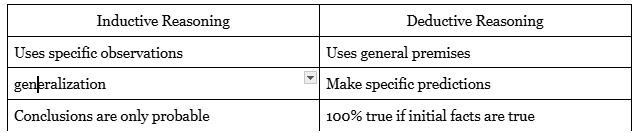
What is the difference between inductive and deductive reasoning?
Inductive Reasoning: making broad generalizations from a large # specific observations
Deductive Reasoning: a broad general premise used to test and predict localized results (make predictions)
How is a hypothesis different from a theory?
Hypothesis: a testable and falsifiable educated guess that can never be fully proven.
Theory: a new testable hypothesis supported by a large body of evidence.
More broader
Foundation explanation of the natural world
Survive every step of fafsification
Proved by many researchers
What is the independent and dependent variable, which axis is used for each
Independent variable: x-axis on graph, factor manipulated by researchers.
Dependent variable: y-axis on graph, variable predicted to be affected in response.
Chapter 2
What is matter
Anything that occupies space, has a mass, and is made up of elements.
What is an element?
a substance that can not be broken down by chemical reactions.
4 elements that make up 96% of living matter?
Carbon, Hydrogen,Oxygen, Nitrogen
What is an atom and what are the three subatomic particles
Atom: basic building block of elements. Subatomic particles: proton, neutron, electron.
Small unit of an element
Compare and contrast protons, neutrons and electrons in terms of 1) Location, Mass, Charge and other important information.
Neutron and protons have similar mass of 1 Da
Proton:+ Electron: - neutron: neutral
Neutron and proton located in the nucleus
Electron located outside the nucleus on shells
Which subatomic particle is involved in chemical reactions?
Electrons
Define atomic #
number of proton and number of electrons (neutral atom)
Define atomic mass
# of protons + neutrons
Atomic number tells?
# of protons, electrons, and its position on the periodic table
Explain why isotopes are similar and different
same atomic number / # of protons, different atomic mass / # of neutrons.
if same protons that means same electrons as well
Describe a few applications that uses radioactive isotopes.
Dating fossils, medical imaging (tracking metabolic activates), cancer therapy
Electrons occur in energy levels called electron shells.
Electrons closer to the nucleus have ________ (more/less) energy than those further from the nucleus?
less
Know how many electrons each shell can hold.
First shell is stable at 2 electrons, other shells are stable at 8 electrons.
3rd shell up to 8 (for the 1st 20 elements)
What is the octet rule?
a rule stating that atoms tend to bond in a way that lets them have eight valence electrons.
Except for the 1st shell which is most stable with 2 electrons.
8 electrons is the most stable
Valance electrons?
Valence electrons: the electrons in the outermost shell.
It also determines the chemical behavior of an atom
Atoms whose outer (valence) shell is full are stable are unreactive-these atoms do not form bonds, they are chemically
unreactive/inert
How many bond can an element formed if you the its VE
You can find how many bonds an atom forms by subtracting its valence electrons from eight. Or find is valence
What are the types of chemical bonds
1. Covalent : Polar or Non-polar
2. Ionic
3. Hydrogen
4. Van der Waals interactions
What is an covalent bond + example
sharing of one or more pairs of electrons. (nonpolar-equally shared, polar-unequally shared)
Example: Water - polar
What is a single bond, double bond, triple bond?
Types of covalent chemical bonds that form when atoms share pairs of electrons
What a molecule?
Molecule: group of two or more atoms. (covalently bonded)
What are Ions? Cations? Anions? Know what charge an atom gets when it loses or gains an electron
An ion is an atom or molecule with an electrical charge resulting from the complete loss or gain of electrons.
Charged particles
Caton gain a + charge when loosing an electron.
Anion gain a - charge when gaining an electron.
What are Ionic Bonds and give some examples
bonds formed between atoms with large electronegativity differences, where one steals electrons from the other. (typically metal to nonmetal)
The opposite charges of a cation and an anion attract each other
NaCl
NaF
What is an hydrogen bond + where do you see them
a hydrogen atom, already covalently bonded to an electronegative atom, is attracted to another electronegative atom in a different molecule
electronegative partners are usually oxygen or nitrogen atoms
See them in water, amino acids
What are van der Waals Interactions and where would you observe them?
weak attractions between molecules (only occur when atoms and molecules are close together).
We see them in gases, liquids, solids, and biological systems
What kind of bond holds together the atoms in H2? H2O? O2? NaCl?
Bonds for these atoms: H2 = nonpolar, H2O = polar, O2 = nonpolar, NaCl =ionic.
What is electronegativity?
An atom’s attraction for the electrons of a covalent bond. The tendency for losing or gain electrons
F > O > N > C > H
The more electronegative an atom, the more strongly it pulls shared electrons toward itself.
Oxygen (O) and fluorine are very electronegative, hydrogen (H) and Carbon are not.
Electronegativity depends on nuclear pull (the positive charge of protons) and atomic size,
If you know one atom is electronegative and the other one is not, could you predict what kind of bond would form between them?
A polar covalent or ionic bond will form when one atom strongly pulls shared electrons, and the other does not. Polar when both are nonmetals, ionic when large difference in electronegativity or metal + non metal
1) A molecule’s shape is very important to its biological function
2) Biological molecules recognize and interact with each other with a specificity based on molecular shape. Molecules with similar shapes can have similar biological effects
True
True
The starting molecules of a chemical reaction are called _______________. The final molecules of a chemical reaction are called _______________.
reactants, products
Chapter 3
Explain why water molecules are polar and capable of hydrogen bonding with neighboring water molecules?
Polarity allows water molecules to form hydrogen bonds. They are polar because the overall charge is unevenly distributed.
Distinguish between a solute, a solvent, and solution.
Solute: dissolved substance, solvent: dissolving agent, solution: a liquid homogeneous mixture of substances.
Cohesion & surface tension
Water molecules stick together and create high surface tension
A raft spider can walk across the surface of a small pond.
Adhesion
Water molecules stick to other charged substances
High Specific Heat
Heat required to raise 1g of water by 1 degree celsius. 4.18 j/c
Heat is absorbed when hydrogen bonds break (AB)
Heat is released when hydrogen bonds form (RF)
Water resists changing temperature because of this
Organisms can resist temperature changes, although they give off heat due to chemical reactions
High heat of vaporization
Absorbed heat required to convert 1g to gas
Ex: Sweat can evaporate from the skin, helping to keep people from overheating.
As a liquid evaporates, its remaining surface cools, through a process called evaporative cooling
Expansion on Freezing
Water molecules move farther apart to make ice. Ice is less dense than liquid water.
Crystal lattice
Lakes cannot freeze solid in winter, despite low temperatures.
Water is a universal solvent because?
Because of it polarity
Substances that dissolve in water are __________ or “water loving” These substances includes polar molecules, acids, bases & ionic compounds.
Hydrophilic.
Substances that do not dissolve in water are ______________-water hating (oils)
hydrophobic
pH: The molar concentration of hydrogen ions, [H + ], in a solution: pH = ________________
The pH is a ___________ (linear/log) scale and goes from 0-14, with 0 being most_____________ (acidic/basic) and 14 the most (acidic/basic).
The lower the pH, the _________ (lower/higher) the [H+ ] in that solution
-log [H + ] , log , acidic, basic, higher
A solution with a pH of 2 has ___ ___ [H+] than a solution with a pH of 3. A solution with a pH of 9 has ___ ____ [H+] than a solution with a pH of 7.
10x more , 100x less
For example, the hydrogen ion concentration in a solution is 10-2 M, what is the pH?
The hydrogen ion concentration in a solution is 0.001 M, what is the pH?
2 and 3
The pH is 4, what is the hydrogen ion concentration? Concentration of OH - ?
H+= 10^ -4 OH-= 10^-10
Acid, base, neutral solution
acid: solutions with ph< 7
base: solution ph>7
neutral: solutions ph=7
Most biological fluids have pH values in the range of 6 to 8. Be able to give one or two examples of acidic and basic everyday items
Bases: seawater, inside the small intestine. Acids: Rainwater, saliva.
Bufers are substances that __________ changes in concentrations of H + and OH– in a solution. Most buffers consist of an ____________ pair that can donate or accept H + ions
minimizes, acid-base

Chapter 4
What is an organic compound?
A compound containing carbon and hydrogen
These compounds have carbon-to-carbon linkages and contain hydrogen and sometimes other atoms such as oxygen and nitrogen

What is so special about carbon?
Valence Electrons (VE), so it can form 4 covalent bonds with a variety of atoms
Single or double bonds
Carbon can form a diverse group of macromolecules
What are isomers?
Compounds with the same molecular formula but different structures and properties
Structural Isomers
They have different covalent arrangements of their atoms
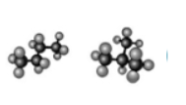
Cis-trans isomers (also called geometric isomers)
They have the same covalent bonds but differ in their spatial arrangements

Enantiomers
They are isomers that are mirror images of each other

What are functional groups
The components of organic molecules that are most commonly involved in chemical reactions.
The number and arrangement of these groups give each molecule its unique properties.
What is the hydroxyl group?
Alcohol group
Molecular formula: -OH
Polar
Neutral
What is the carbonyl group?
Ketone Aldehyde
Molecular Formula: C=O
Polar
Neutral
What is the carboxyl group?
Carboxylic Acid or organic acid
Molecular formula: -COOH
Polar
Acidic
Found in amino acids
What is the amino group (amine)
Molecular formula: -NH2
Polar
Basic
Found in amino acids
What is the Sulfhydryl group
Thiol
Molecular formula: -SH
Polar
Neutral
What is the Phosphate group (Organic Phosphate)
Role in energy transfer
Molecular formula: PO4^-3
Polar
Acidic

What is the Methyl group (Methylated compound)
Non-polar
Neutral
Molecular formula: -CH3
The only functional group that decreases water solubility
What is a condensation (dehydration) reaction.
Dehydration (condensation)
Link 2 molecules together
Removes a molecule of water
If a long DNA molecule were synthesized from nucleotides, this would be the reaction
Requires energy
What is a hydrolysis reaction?
Breaks the bond between monomers
Adds a molecule of water
When digesting a protein into its amino acid subunits, this will be the reaction
Releases energy
How many water molecules are released when making a 6-carbon carbohydrate consisting of 30 monomers?
29
How many water molecules are needed to hydrolyze a DNA molecule consisting of 200 nucleotides? (search for explanation)
198
There are 4 major classes of macromolecules. What are they?
Carbohydrates, lipids, proteins, nucleic acid
Monomers vs Polymers
Monomores
Repeating units that serve as building blocks (this is key).
Easier def: Repeating building blocks
Polymers: molecules with many monomers linked together or molecules with repeating monomers.
Which macromolecule does not form a polymer?
lipids
What is the building block of carbohydrates, the primary function, and the type of bond
Monosaccharides
Energy source and structural support
Glycosidic linkage
What is the building block of lipids, the primary function, and the type of bond
Glycerol and fatty acids
Energy storage and membrane structure
Ester bonds
What is the building block of proteins, the primary function, and the type of bond
Amino acids
Catalysts, defense, transport, support, motion
peptide bonds
What is the building block of nucleic acids, the primary function, and the type of bond
Nucleotides
Storing & transmitting hereditary information
phosphodiester linkage
Distinguish between monosaccharides, disaccharides, and polysaccharides? What are the functions of each?
Monosaccharides - one sugar, simple sugars
disaccharides - 2 sugar
polysaccharides- polymers of monosaccharides
Mono. and disac. both have the function as fuel (energy) for the cell & raw material for building cells
Polysaccharides: Provide structure and energy storage
The covalent bond that links monosaccharides together is called a __________ linkage.
___________ is a polysaccharide, composed of glucose monomers, and used by plants for energy storage.
____________ is a polysaccharide, composed of glucose monomers, and used by animals for energy storage. Glycogen is found especially in liver and muscle cells
____________ is a polysaccharide of glucose and is a major component of the tough cell wall of plant cells.
glycosidic, strach, glycogen, cellulose
Know which group (monosaccharide, disaccharide or polysaccharide) each of the following molecules belongs to: ribose, deoxyribose, glucose, starch, fructose, sucrose, galactose, maltose, cellulose, lactose, glycogen
Monosaccharides:
Glucose
Fructose
Galactose
Ribose:
Deoxyribose:
Disaccharides (SML)
Sucrose
Maltose
Lactose
Polysaccharides
Starch
Cellulose
Glycogen
Lipids are a diverse group of ______________ molecules.
Lipids are the one class of large biological molecules that do not form polymers-The unifying feature of lipids is having little or no affinity for _____________.
Lipids are hydrophobic because they consist mostly of hydrocarbons, which form __________ covalent bonds
The most biologically important lipids are fats, phospholipids, and steroids.
hydrophobic, water, nonpolar
Fats (also called triacylglycerol or triglycerides) are constructed from two types of smaller molecules: glycerol and fatty acids. In a fat, _____ fatty acids are joined to a __________by ester linkage
3, glycerol molecule

Distinguish between saturated and unsaturated fats?
Saturated fatty acids have the maximum number of hydrogen atoms possible and no double bonds
Animal fats
Unsaturated fatty acids have one or more double bonds
Fish and plant fats
Healthier
What is the relationship between fluidity and double bonds in the fatty acid chains of fats?
More double bonds in a fatty acid chain increase the fluidity of fats