Chapter 1: What is Organizational Behaviour
 Studied by 0 people
 Call with Kai
 Learn
Learn Practice Test
 Spaced Repetition
 Match
Match Flashcards
 Knowt Play
 Podcast
1/32

There's no tags or description
Looks like no tags are added yet.
Name | Mastery | Learn | Test | Matching | Spaced | Call with Kai |
|---|
No study sessions yet.
33 Terms
What is Organizational Behaviour (OB)?
A field of study that looks at the impact that individuals, groups, and structure have on behaviour within organizations for the purpose of applying such knowledge toward improving an organization’s effectiveness.
Using evidence as much as possible to inform management and employee intuition and experience.
Can be applied to topics such as job satisfaction, absenteeism, employment turnover, productivity, human performance and management.
Organization
A consciously coordinated social unit, composed of a group of people, that functions on a relatively continuous basis to achieve a common goal or set of goals.
Organizations include everything from schools, to hospitals, stores and facilities.
Contingency Approach
An approach taken by OB that considers behaviour within the context in which it occurs.
Systemic Study
Looking at relationships, attempting to attribute causes and effects, and drawing conclusions based on scientific evidence. On data gathered under controlled conditions and measured and interpreted deeply.
Evidence Based Management
The basing of managerial decisions on the best available scientific evidence. It complements the systemic study by basing managerial decisions on the best available scientific evidence.
Intuition
An instinctive feeling not necessarily supported by research. Systemic study and evidence based management can support intuition.
However, solely relying on intuition can be problematic because we may only have half the data about the potential risk and reward.
Big Data
Means using very large amounts of employee-related data to understand, predict, and influence how people behave at work. Lots of information, collected quickly, from many sources, that can be analyzed to find patterns.
Can be limited in predicting behaviour, curtailing risk and preventing catastrophes.
Discipline Contributions to OB
OB is an applied behavioural science that builds upon contributions from a number of behavioural disciplines: mainly psychology, social psychology, sociology, and anthropology.
This includes areas from psychology, social psychology, sociology, and anthropology.
Workforce Diversity
The mix of people in organizations in terms of gender, race, ethnicity, ability, gender orientation, age, and demographic characteristics such as education and socio-economic status.
Different generations in Canada also contribute to workplace diversity through their different life experiences.
Workforce diversity itself is an important challenge for organizations to address, managing various types of people.
Customer Service Challenges
Challenges in OB
Many an organization has failed because its employees failed to please customers.
People Skills Organizations Require
Challenges in OB
Organizations require staff that are motivated, have listening skills and work effectively in teams.
Networked organizations
Challenges in OB
Allowing people to communicate and work together even though they may be thousands of kilometres apart.
This can mean team members that are working virtually, that require a different management style.
Social Media
Pros and Cons
Challenges in OB
Many organizations continue to struggle with employees’ use of social media in the workplace, which presents both a challenge and an opportunity for OB.
Social media can contribute to employee wellness through connectivity, or decrease employee wellness through overuse.
Positive Organizational Scholarship
Studies how organizations develop human strengths, foster vitality and resilience, and unlock potential. Studying what is good about organizations, as opposed to only focusing on the negative.
These areas include looking at engagement, hope, optimism and resilience in the face of strain.
Researchers hope to help practitioners create positive work environments for employees.
Ethical dilemmas and Ethical Choices
Situations in which individuals are required to define right and wrong conduct.
Ethics
The study of moral values or principles that guide our behaviour and inform us whether actions are right or wrong.
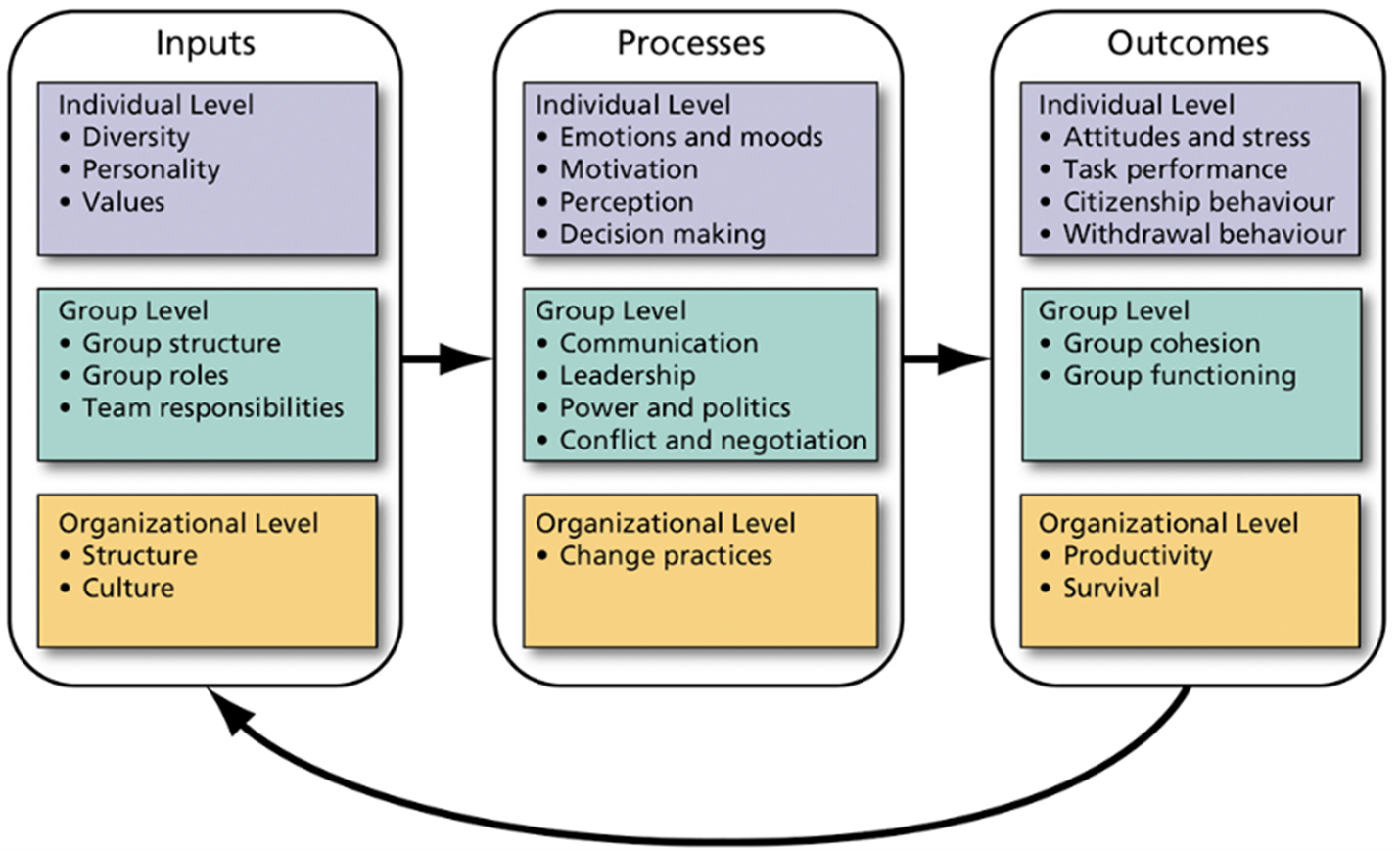
OB Model
An abstraction of reality, a simplified representation of some real-world phenomenon.
The model illustrates that inputs lead to processes, which lead to outcomes.
There are interrelationships at each level of analysis.
The model shows that outcomes can influence inputs in the future, which highlights the broad-reaching effect OB initiatives can have on an organization’s future.
3 Variables in the Model
Inputs
Processes
Outcomes
3 Levels of Analysis in the Model
Individual level
Group level
Organizational level
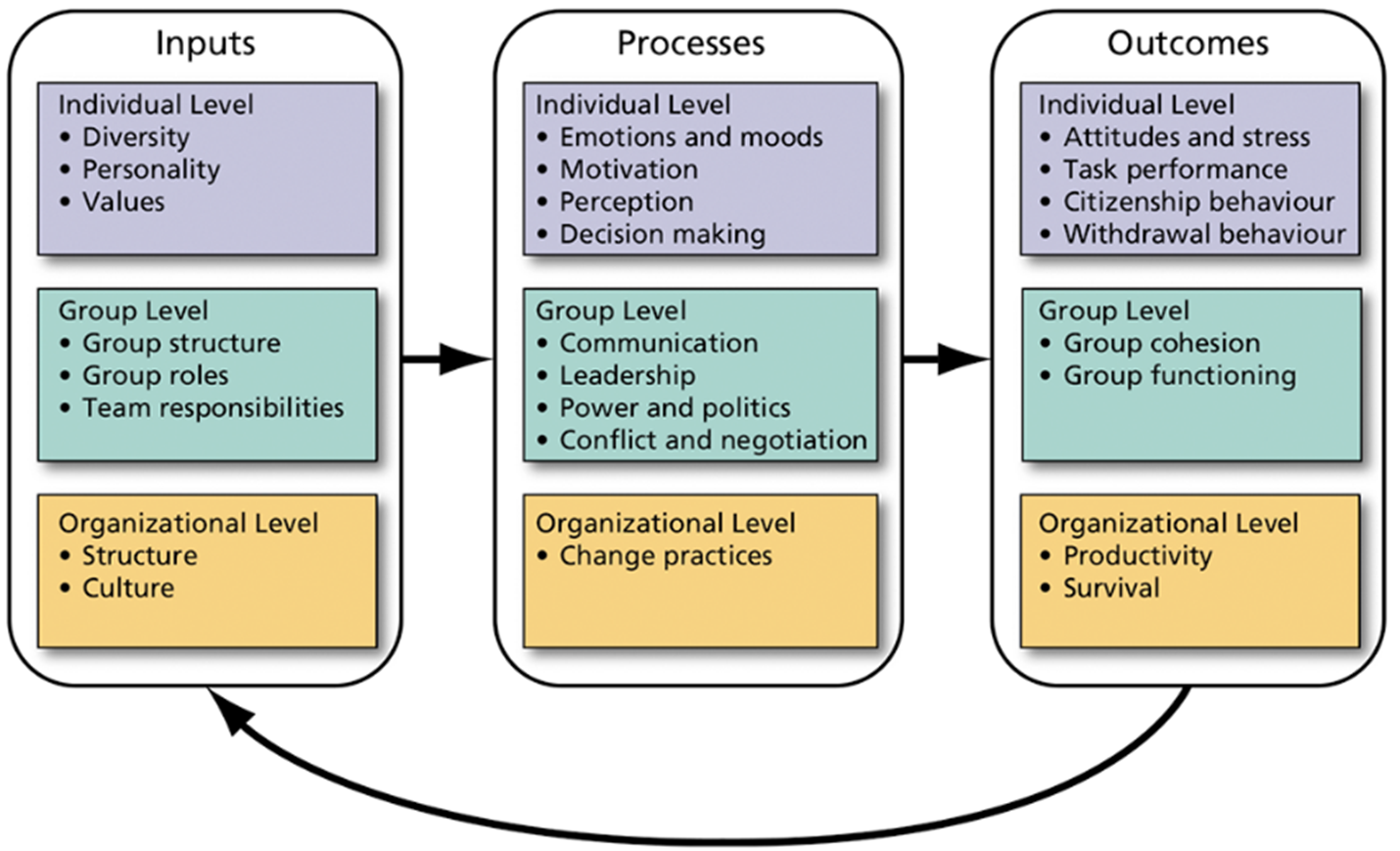
Inputs & 3 Levels
The variables like personality, group structure, and organizational culture that led to processes. These variables effect what will occur in the organization later.
Individual level: Diverse characteristics, personality, and values are shaped by a combination of an individual’s genetic inheritance and childhood environment.
Group level: Group structure, roles, and team responsibilities are typically assigned immediately before or after a group is formed
Organizational level: Usually the result of years of development and change as an organization adapts to its environment and builds up customs and norms.
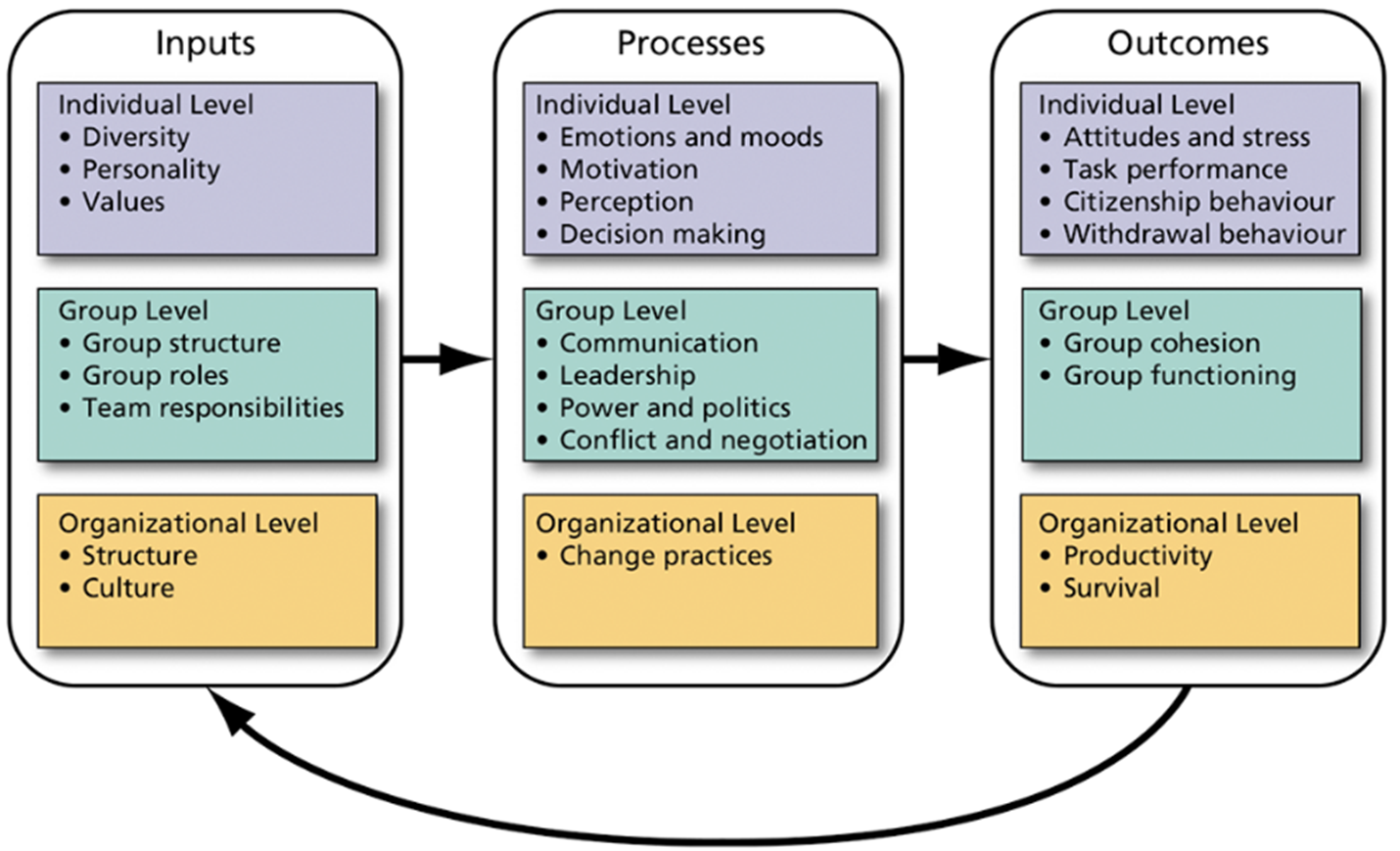
Processes & 3 Levels
Are actions that individuals, groups, and organizations engage in as a result of inputs and that lead to certain outcomes.
Individual level: Include emotions and moods, motivation, perception, and decision making.
Group level: Include communication, leadership, power and politics, and conflict and negotiation.
Organizational level: Include change practices.
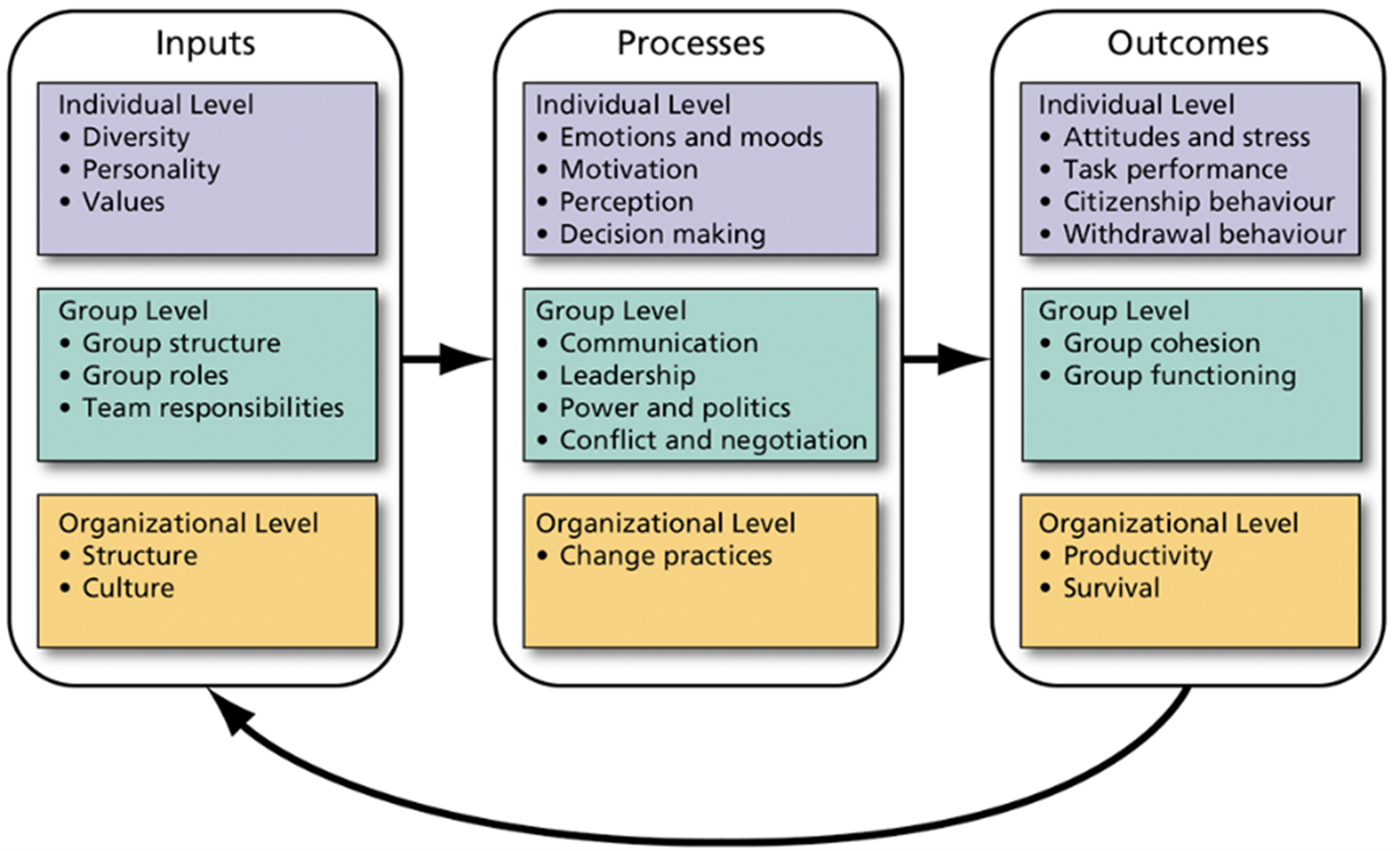
Outcomes & 3 Levels
The key variables that you want to explain or predict, and that are affected by some other variables.
Individual level: Emphasize outcomes such as attitudes and stress, task performance, citizenship behaviour, and withdrawal behaviour.
Group level: Cohesion and functioning are the dependent variables
Organizational level: Look at overall productivity and survival.
Attitudes
The evaluations employees make, ranging from positive to negative, about objects, people, or events.
Attitudes can have behavioural consequences that directly relate to organizational effectiveness.
Stress
An unpleasant psychological process that occurs in response to environmental pressures.
Task Performance
The combination of effectiveness and efficiency at doing your core job tasks. Task performance is the most important human output contributing to organizational effectiveness and employee productivity.
Organizational Citizenship Behaviour
Discretionary behaviour that is not part of an employee’s formal job requirements, but that nevertheless promotes the effective functioning of the organization. This is a growing area of research in the OB.
Withdrawal Behaviour
The set of actions employees take to separate themselves from the organization. There are many forms of withdrawal, ranging from showing up late or failing to attend meetings to absenteeism and turnover. This can have negative impacts on the organization.
Group Cohesion
The extent to which members of a group support and validate one another while at work. This relates to the way groups operate.
When employees trust one another, seek common goals, and work together to achieve these common ends, the group is cohesive
When employees are divided among themselves in terms of what they want to achieve and have little loyalty to one another, the group is not cohesive.
Group Functioning
Refers to the quantity and quality of a group’s work output.
Productivity
The combination of the effectiveness and efficiency of an organization to create outputs.
The highest level of analysis in OB is the organization productivity. An organization is productive if it achieves its goals by transforming inputs into outputs at the lowest cost.
Effectiveness
The degree to which an organization meets the needs of its clientele or customers.
Efficiency
The degree to which an organization can achieve its ends at a low cost.
Organizational Survival
Evidence that the organization is able to exist and grow over the long term. The survival of an organization depends not just on how productive the organization is, but also on how well it fits with its environment.