Thermodynamics
 Call Kai
 Learn
Learn Practice Test
 Spaced Repetition
 Match
Match Flashcards
 Knowt Play
1/7

There's no tags or description
Looks like no tags are added yet.
Name | Mastery | Learn | Test | Matching | Spaced | Call with Kai | Chat |
|---|
No analytics yet
Send a link to your students to track their progress
8 Terms
AS Level Enthalpy Definitions:
Standard Enthalpy Change - The change in heat energy when a change occurs at constant pressure.
Standard Enthalpy of Formation - The enthalpy change when one mole of substance is formed from its constituent elements under standard conditions.
Standard Enthalpy of Combustion - The enthalpy change when one mole of substance is completely burnt in oxygen under standard conditions.
Standard Enthalpy of Neutralisation - The enthalpy change when one mole of water is formed in a reaction between an acid and an alkali under standard conditions.
Bond Dissociation Enthalpy - The enthalpy change required to break a covalent bond with all species in the gaseous state.
Mean Bond Enthalpy - The average value of the bond dissociation enthalpy for a given type of bond taken from a range of compounds.
First Ionisation Enthalpy - The standard enthalpy change when one mole of gaseous atoms is converted into one mole of gaseous ions, each with a single positive charge.
Second Ionisation Enthalpy - The standard enthalpy change when one mole of gaseous ions, with a single positive charge, is converted into one mole of gaseous ions, each with two positive charges.
A Level Enthalpy Definitions:
Standard Enthalpy of Atomisation - The enthalpy change when one mole of gaseous atoms is formed from the element in its standard state under standard conditions.
First Electron Affinity - The standard enthalpy change when a mole of gaseous atoms is converted to a mole of gaseous ions, each with a single negative charge.
Second Electron Affinity - The standard enthalpy change when a mole of gaseous ions, each with a single negative charge, are converted to gaseous ions each with two negative charges.
Lattice Enthalpy of Formation - The standard enthalpy change when a mole of a solid ionic compound is formed from its gaseous ions.
Lattice Enthalpy of Dissociation - The standard enthalpy change when one mole of solid ionic compound dissociates into its gaseous ions.
Enthalpy of Hydration - The standard enthalpy change when one mole of gaseous ions are converted into aqueous ions/solution.
Enthalpy of Solution - The standard enthalpy change when one mole of solute dissolves completely in water to form an infinitely dilute solution.
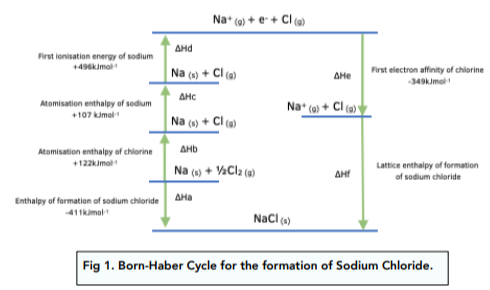
What are Born-Haber Cycles and how do you construct them?
A thermochemical cell that includes all the enthalpy changes involved in the formation of an ionic compound. They are constructed by starting all elements in their standard states, which have zero enthalpy by definition.
What are the trends in Lattice Enthalpies?
The larger the ion, the smaller the lattice enthalpy (eg LiF is much greater than CsI)
The lattice enthalpy increases with the size of the charge so similar sized atoms have varied charges (eg BeO has ~4 times more than LiF, double charge ~2x the energy)
What is Covalent Character and the Perfect Ionic Model?
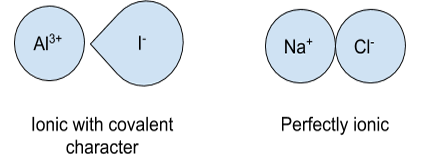
Covalent Character - The extent to which an ionic bond exhibits electron sharing between atoms rather than complete electron transfer. It occurs in ions when two joined ions have varying sizes or charges meaning the distribution of charge is not even.
Perfect Ionic Model:
All the ions are perfectly spherical. The ions display no covalent character.
A more distorted a bond, and the more covalent character it has, the more polarised it is. Polarisation increases with smaller size and higher charge (Cation-Positive Ion) and larger size and higher charge (Anion-Negative Ion).
What is Entropy?
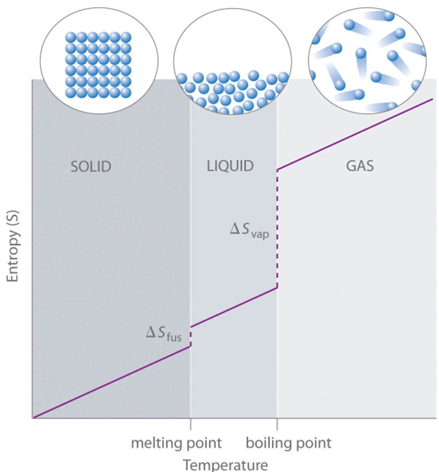
Entropy (∆S) is the measure of disorder of a system / JK-1mol-1. The more disordered a substance is, the greater its entropy value. Entropy increases as temperature increases because the particles gain energy and move further apart (Less ordered). This means that gases have the greatest entropy.
When a substance melts or vibrates, it increases in entropy. The entropy change of vaporisation is much greater than of fusion as a gas is much more distorted than a liquid or solid.
∆Stotal = ∆Sproducts - ∆Sreactants
As all things tend towards a state of disorder, all spontaneous reactions have a positive entropy value.
What are Feasible and Spontaneous Reactions?
Feasible - A reaction that is possible in theory, given the right conditions. It can only occur if the proportions of the reactions are right or their is the necessary energy.
Spontaneous - A reaction that can occur without any external input once it has started. The rate at which it occurs can be influenced by temperature, pressure and catalysts.
What is Gibbs Free-Energy (∆G)?
A measure of the feasibility of a chemical reaction. It is determined with the formula: ∆G = ∆H - T∆S where ∆H is the enthalpy change, T is the temperature of the reaction and ∆S is the entropy change.
Free-Energy is measured in KJmol-1. The equation takes the form y=mx+c so it can be represented graphically with a straight line graph of ∆G against ∆S.
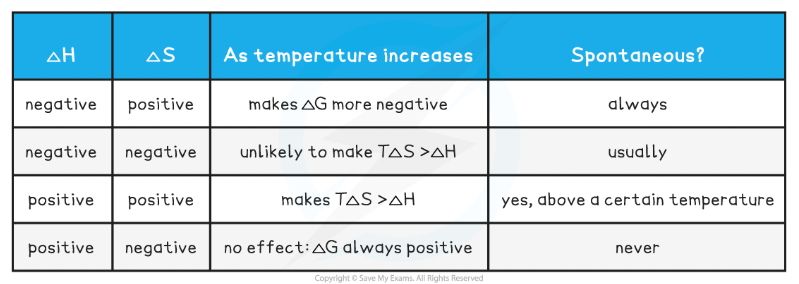
∆G is negative for all spontaneous/feasible reactions. This becomes true at a certain temperature which can be found by putting ∆G equal to 0. Changing the temperature or the type of reaction occurring will change the feasibility of the reaction.