08b - Anti-Hypertensive Drugs
 Call Kai
 Learn
Learn Practice Test
 Spaced Repetition
 Match
Match Flashcards
 Knowt Play
1/12

There's no tags or description
Looks like no tags are added yet.
Name | Mastery | Learn | Test | Matching | Spaced | Call with Kai | Chat |
|---|
No analytics yet
Send a link to your students to track their progress
13 Terms
hypertension
chronically elevated blood pressure that can damage blood vessels, kidneys, heart, brain, and eyes
prevalence increases strongly with age
defined as BP > 140/90 or receiving antihypertensive treatment
dangerous because it can be silent while causing organ damage
anti-hypertensive drug classes
first-tier → diuretics, renin-angiotensin inhibitors, calcium channel blockers
second-tier → β-adrenergic blockers, sympathoplegics, direct vasodilators, ⍺1-adrenergic blockers
add-on drugs for when first-tier is not enough or when patient has special conditions
recommended treatment scheme
JNC 8 panel and ASH guidelines
non-African-American population:
any of the following → thiazide diuretics, ACE inhibitors, ARBs, calcium channel blocker (except in heart failure)
African-American population:
thiazide or calcium channel blocker; or thiazide + ACE inhibitor / ARB as initial therapy
stage 2 hypertension:
start with two drugs, with one being a diuretic
diuretics for hypertension
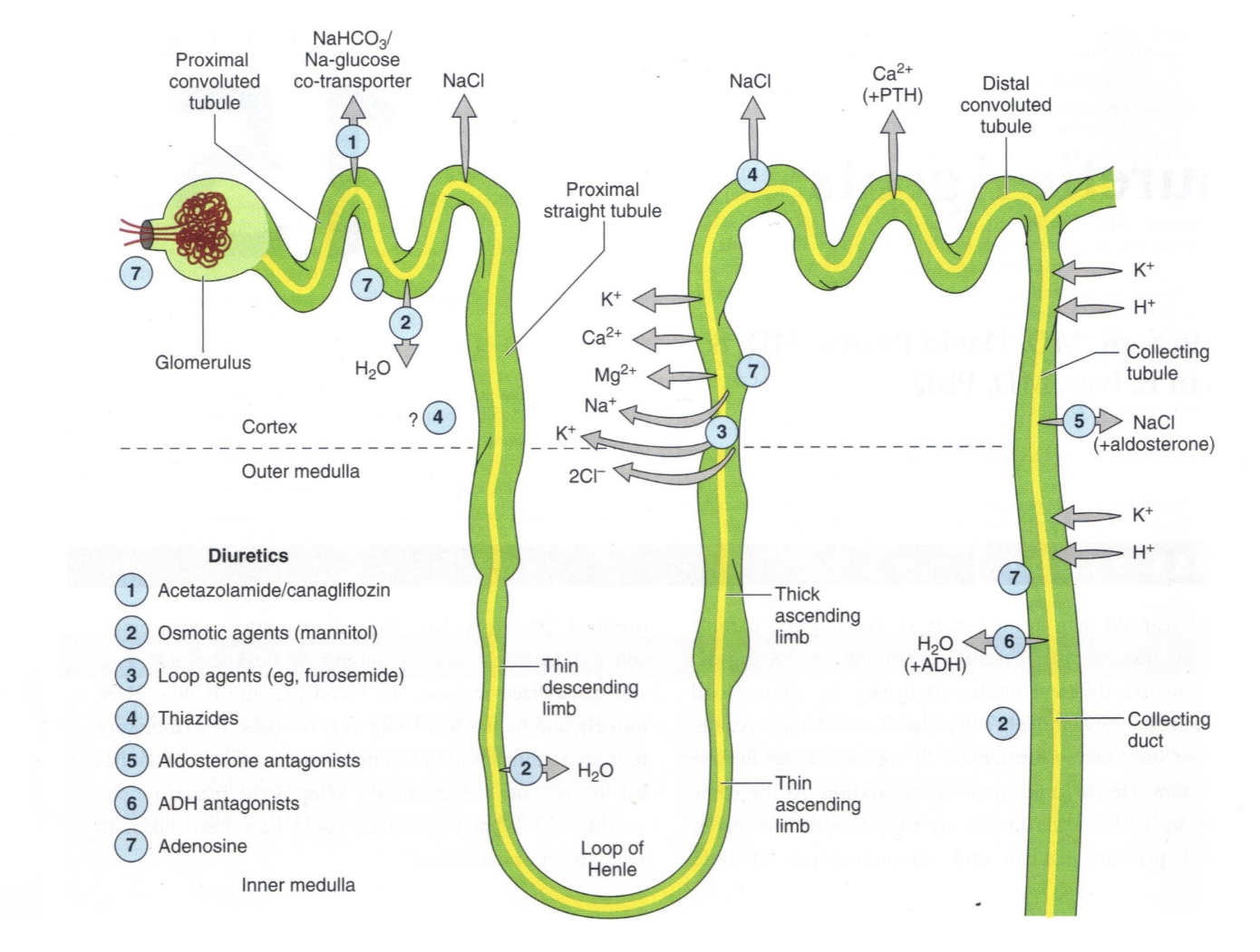
diuretics lower BP by inhibiting sodium reabsorption, causing diuresis to reduce blood volume and venous pressure for reduction of cardiac output and blood pressure
furosemide (loop agents) work on thick ascending limb
thiazides work on distal convoluted tubule
initially reduces cardiac output by reducing ECF and plasma volume
chronic use will cause ECF volume return to baseline
at steady state, predominant effect is reduction of peripheral vascular resistance rather than reduced blood volume
may be combined with potassium-sparing drugs, since thiazides can waste potassium
aldactazide = sprionolactone + hydrocholorothiazide
dyazide/maxzide = triamterene + hydrocholorothiazide
moduretic = amiloride + hydrocholorothiazide
aldosterone antagonists work on collecting duct
RAAS inhibitors — ACE inhibors + ARBs
RAAS inhibitors lower blood pressure by blocking angiotensin II formation or action
angiotensin converting enzyme (ACE) inhibitors:
oldest class and most generic choice
decreases production of vasopressor peptide angiotensin II
angiotensin receptor blockers (ARBs):
second class of RAAS inhibitors, generally more expensive
blocks angiotensin I vascular receptor, where angiotensin II acts
direct renin inhibitors (DRIs):
ALISKIREN → single drug in class that blocks production of angiotensin I
ACE inhibitors
inhibit conversion of angiotenin I to angiotensin II; have same effectiveness in lowering BP, but some may be more effective than others in preventing/delaying adverse renal, cardiac, and vascular remodeling
benazepril (lotensin), captopril (capoten), enalapril (vasotec), fosinopril (monopril), LISINOPRIL (prinivil, zestril), moexipril (univasc), perinodopril (aceon), quinapril (accupril) RAMIPRIL (altace), trandolapril (mavik)
lisinopril → most widely used (generic)
ramipril → best effect of remodeling
adverse reactions:
cough → common in 25% of patients due to increased bradykinin in lungs
angioedema → swelling of lips and eyelids due to accumulation of bradykinin in tissues
hyperkalemia with potassium-sparing diuretics, increased creatinine or blood urea nitrogen, symptomatic hypotension
contraindications:
history of angioedema, bilateral renal-artery stenosis, pregnancy
angiotensin I receptor blocers (ARBs)
block vasoconstrictor and aldosterone-secreting efects of angiotensin II by blocking angiotensin I receptor where angiotensin II acts
candesartan (atacand), eprosartan (teveten), irbesartan (avapro), LOSARTAN (cozaar), olmesartan (benicar), TELMISARTAN (micardis), VALSARTAN (diovan)
losartan → most widely used (generic)
telmisartan / valsartan → best effect of remodeling
will increase angiotensin II levels above baseline due to angiotensin 1 blckade, due to uncoupling a negative feedback loop
adverse reactions:
headache, dizziness, hyperkalemia (if used with K-sparing diuretic), orthostatic hypotension, increased creatinine or blood urea nitrogen
contraindications:
history of angioedema (although it does not increase bradykinin), bilateral renal-artery stenosis, pregnancy
summary of RAAS inhibitor side effects
hyperkalemia → serum potassium concentration > 5.5 mEq/L
consequence of decreased aldosterone secretion and secondary renal potassium secretion into urine
dual RAAS inhibitors → increase frequency and severity
loop diuretics → can reduce hyperkalemia tendency
pregnancy → absolute contraindication due to likelihood of fetal malformations (limbs) and defects (kidneys)
angioedema and cough → unique to ACE inhibitors due to bradykinin, with angioedema occurring more common with ACE inhibitors
kidney failure → possible with all agents, especially when renal blood flow and GFR (<50%) are compromised
calcium channel blockers
reduce systemic vascular tone by inhibiting Ca2+ influx through voltage-gated L-type calcium channels, causing less smooth muscle contraction
non-dihydropyrimidines (major cardiac effects):
DILTIAZEM (benzothiazepine) → slows SA node firing to reduce heart rate, slows AV node conduction, modest negative inotropy
VERAPAMIL (phenylalkylamine) → slows SA node firing to reduce heart rate, moderate negative inotropy
not suitable for heart failure
half-lives of 2.5-7 hours; special formulations for once daily dosing
side effects:
heart failure → exacerbated from negative inotropy
constipation → major side effect of verapamil
reduce elimination / increased blood levels of carbamazepine (tegretol), simvastatin, atorvastatin, lovastatin
dihydropyridines (negligible cardiac effects):
block L-type channels on vascular smooth muscle and cardiac myocytes to prevent excitation-contraction coupling and to decrease vasoconstriction (and HR/contractility)
direct vasodilation, minimal negative inotropy and heart rate effects
AMLODIPINE, felodipine, isradipine, NICARDIPINE, NIFEDIPINE, nisoldipine
amlodipine (generic) most commonly used, in combination formulas; gradual BP lowering with mild sympathetic stimulation
side effects:
leg edema → prominent with amlodipine, dose-dependent
mechanism — pre-capillary arteriolar dilation without venous dilation that increases capillary pressure
not treatable with diuretics, but ameliorated with concomitant ACE inhibitors / ARB
tachycardia → varies with degree of reflex sympathetic stimulation causing increased oxygen consumption
side effects → ankle edema, headache, orthostatic hypotension
contraindications:
cardiogenic shock, ventricular dysfunction, SA node or AV conduction disturbances, Wolfe-Parkinson-White arrhythmia
beta-blockers for hypertension (tier 2)
beta-blockers lower blood pressure by decreasing cardaic output and renin release
selectivity:
selective → β1 >> β2 receptor blockade
ATENOLOL (tenormin), betaxolol (kerlone), bisoprolol (zebeta), METOPROLOL (lopressor, toprol XL)
non-selective → β1 = β2 receptor blockade
nadolol (corgard), PROPRANOLOL (inderal), timolol (blocadren)
intrinsic sympathomimetic activity (ISA):
ISA → partial agonist and blocker, blunts bradycardia
non-ISA → majority of drugs, induces bradycardia
vasodilating:
⍺1-receptor blockade → labetalol, CARVEDILOL (coreg; non-selective β)
nitric oxide stimulation → NEBIVOLOL
side effects:
fatigue, exercise intolerance → major due to prominent effect on heart rate
dyspnea → at higher doses, β1-cardiac specific drugs spill over onto β2-bronchial receptors causing bronchospasm
heart block → most likely when given with non-dihydropyridines (verapamil, diltiazem) that also affect nodal function
peripheral vasoconstriction → ischemia in pre-existing peripheral vascular disease
metabolic → non-vasodilating beta-blockers impair glucose tolerance and may mask the effects of hypoglycemia
depression, insomnia, and nightmares → occur with use of propranolol; should switch to atenolol
less lipophilic and does not get into brain as well
contraindications:
AV conduction block (with verapamil/diltiazem), bradycardia, cardiogenic shock, asthma/COPD
alpha-blockers for hypertension (tier 2)
selective ⍺1 blockers → PRAZOSIN, DOXAZOSIN, TERAZOSIN
mechanism — specific ⍺1-receptor blockade to inhibit NE-mediated vasoconstriction
ancillary action — block smooth muscle contraction in prostate (⍺1A), reducing symptoms of hypertrophy
tamsulosin is selective for ⍺1A receptor but is ot used for treating hypertension; less likely to cause orthostatic hypotension because used to treat benign prostatic hyperplasia
side effects — postural hypotension (marked with first dose)
non-selective ⍺ blockade → PHENTOLAMINE, PHENOXYBENZAMINE
usage — specifically for pheochromocytoma-associated hypertension from NE production (adrenal tumor)
direct vasodilators for hypertension (tier 2)
HYDRALAZINE has exclusive arterial effect (opens arteries), with no venodilation
mechanism — inhibits IP3-dependent Ca2+ release from vascular smooth muscle sarcoplasmic reticulum
co-therapy:
beta-blockers to blunt tachycardia
diuretic (often loop) to control ECF volume
target population:
blacks → high response rate
pregnancy → proven safety to fetus
side effects:
quick development of tolerance due to reflex sympathetic nerve activation that causes tachycardia (increased cardiac output) and ECF volume increase
lupus-like syndrome → complication related to high dose
MINOXIDIL is most powerful anti-hypertensive drug used in resistant hypertensive as fourth or fifth drug
mechanism — inhibits IP3-dependent Ca2+ release from vascular smooth muscle sarcoplasmic reticulum
side effects:
fluid accumulation → causes peripheral edema
pleural and pericardial effusions
hypertrichosis → hair growth; problematic in women of dark complexion
co-therapy:
must treat with loop diuretic and often with beta-blocker
central sympathoplegics for hypertension (tier 2)
lower blood pressure by decreasing sympathetic nervous system output
⍺2 receptor agonist inhibits presynaptic NE release by decreasing presynaptic Ca2+, decreasing NE binding to smooth muscle ⍺1 receptor that mediates vasoconstriction
CLONIDINE is an ⍺2 agonist (should never be used as first line therapy)
mechanism — decrease of NE discharge by central ⍺2 receptors and imidazoline receptors
reduction in peripheral sympathetic tone → lowers arterial tone and BP
increase in peripheral parasympathetic tone → lowers heart rate
side effects:
rebound hypertension → sudden and sever rise in BP after missed doses of drug (administration by cutaneous patch)
drowsiness → very common
METHYLDOPA is similar to clonidine but have high side effect profile
very common use in pregnancy due to high safety profile
side effects — dry mouth, dizziness, headache, GI distress, weight gain, joint swelling