Chapter 11 (unit 1) A&P II
 Call Kai
 Learn
Learn Practice Test
 Spaced Repetition
 Match
Match Flashcards
 Knowt Play
1/17

There's no tags or description
Looks like no tags are added yet.
Name | Mastery | Learn | Test | Matching | Spaced | Call with Kai | Chat |
|---|
No analytics yet
Send a link to your students to track their progress
18 Terms
Nervous system does what three things?
Help detect environment (sensory input: information gathered by sensory receptors about internal and external changes)
Integration: interpretation of sensory input (complex vs simple integration)
Motor output: activation of effector organs (muscles and glands) produces a response
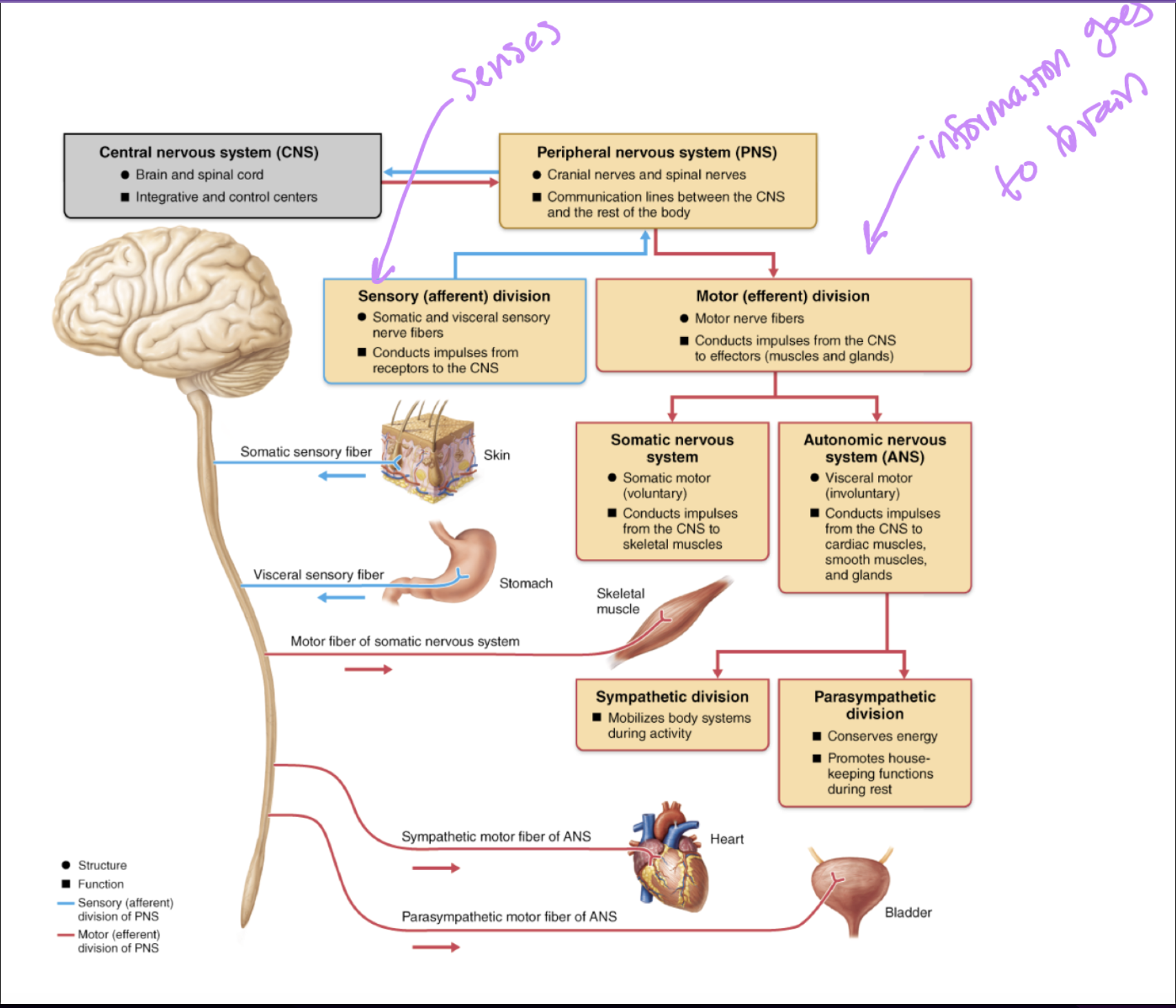
What comprises the nervous system?
Afferent: towards central nervous system
Efferent: to move away from the central nervous system (always motor, can be voluntary or involuntary)
Somatic nervous system: voluntary nervous system: ex: used in order to write things down, targets skeletal muscle
Visceral motor: (involuntary)
Autonomic: operates below levels of consciousness (true for entire body, regulates blood pressure and vessels, secretion of hormones, digestion, pupils, sweating, etc)
Parasympathetic division: regulate a lot of processes below levels on consciousness, inhibits heart rate
Sympathetic division: regulate a lot of processes below levels on consciousness, flight or fight, increases heart rate excites it
Some nervous system activity is inhibitory: exerted yourself, heart rate is elevated, heart rate slows down once you sit, this is bc nervous system is inhibiting heart rate
Histology of nervous tissue
Two principal cell types in the nervous system
1. Neuroglia (glial cells)- supporting cells, support function for neurons and protects them
2. Neurons: excitable cells that transmit information at synapses signals
Astrocyte
Only found in central nervous system:
Most abundant,versatile, and highly branched glial cells
Cling to neurons, synaptic endings, and capillaries
Support and brace neurons
Help determine capillary permeability
Regulate capillaries that supply the rest of the nervous system to get or restrict nutrients, they allow the capillaries to open or close, prevents pathogens from accessing the nervous system
Microglia
Only found in central nervous system
move towards site of injury and promote localized inflammation
Small, ovoid cells with thorny processes
Migrate toward injured neurons
Phagocytize microorganisms and neuronal debris
Ependymal Cells
Range in chape from squamous to columnar, may be ciliated
Line the central cavities of the brain and spinal cord
Separate the CNS interstitial fluid from cerebrospinal fluid
Produce CSF at choroid plexus
Depending on their function, they have different features
Oligodendrocytes
Produce myelin in the cns
Processes wrap around multiple axons in CNS forming undulating myelin sheaths
Multiple sclerosis (demyelation of CNS)
Speeds up rate at which information is communicated
Schwann cells are like this but not in CNS
Satellite Cells
Equivalent of astrocyte just in PNS
Surround neuron bodies in PNS
Regulate blood flow to cells
Schwann Cells: (neurolemmoncytes)
In PNS, to speed up rate in which information is communicated in the PNS
Most common neuron is the multipolar neuron then the unipolar neuron (pseudo unipolar) then bipolar
Trigger zone varies depending upon type of cell we are looking at
- multipolar: trigger zone right next to the soma (cell body)Unipolar: trigger zone is next to dendritic endings
Bipolar: trigger zone right next to next to the axon hillock and just before the start of the first myelin-forming glial cell

Multipolar Neuron
Every neuron has a cell body (referred to as soma)
Surrounding the soma is dendrites (region of neuron that receives information from other sources- feeling something at fingertips is receptors associated with dendrites)
Both soma and dendrites are receptive regions of multipolar cell, dendrites just have more surface area
Axon: extends off of soma
Axon pilla: where axon interfaces with soma, generates activation potential
Axonal branches: branches off of axon
Boutons (axonal terminals): end of axon branches
Neurons can form relationships with other type of cells such as skeletal muscle and glands
Synapse: presynaptic neuron forms relationship with target cell or post synaptic neuron
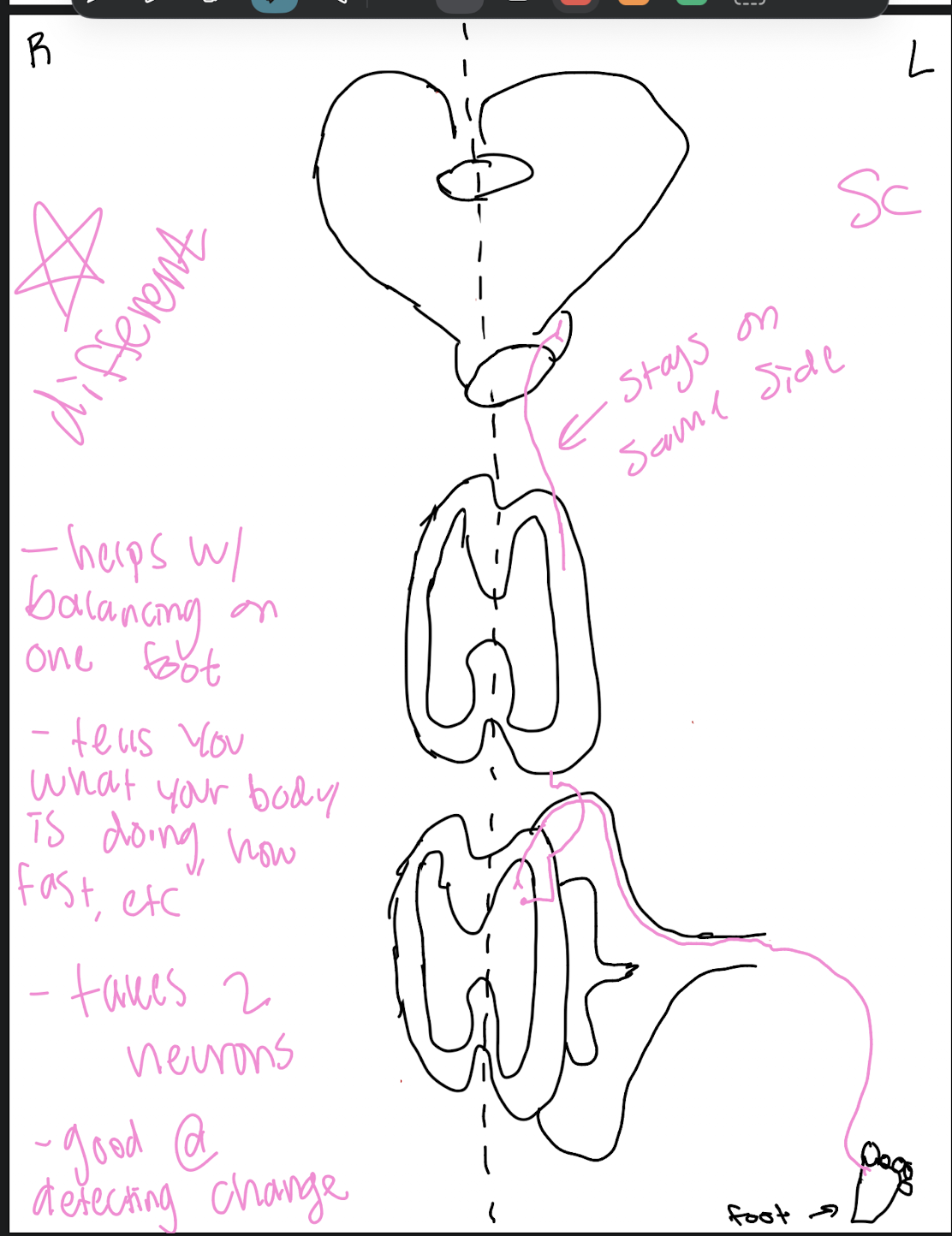
Neural Pathways: Spinocerebellar (SC)
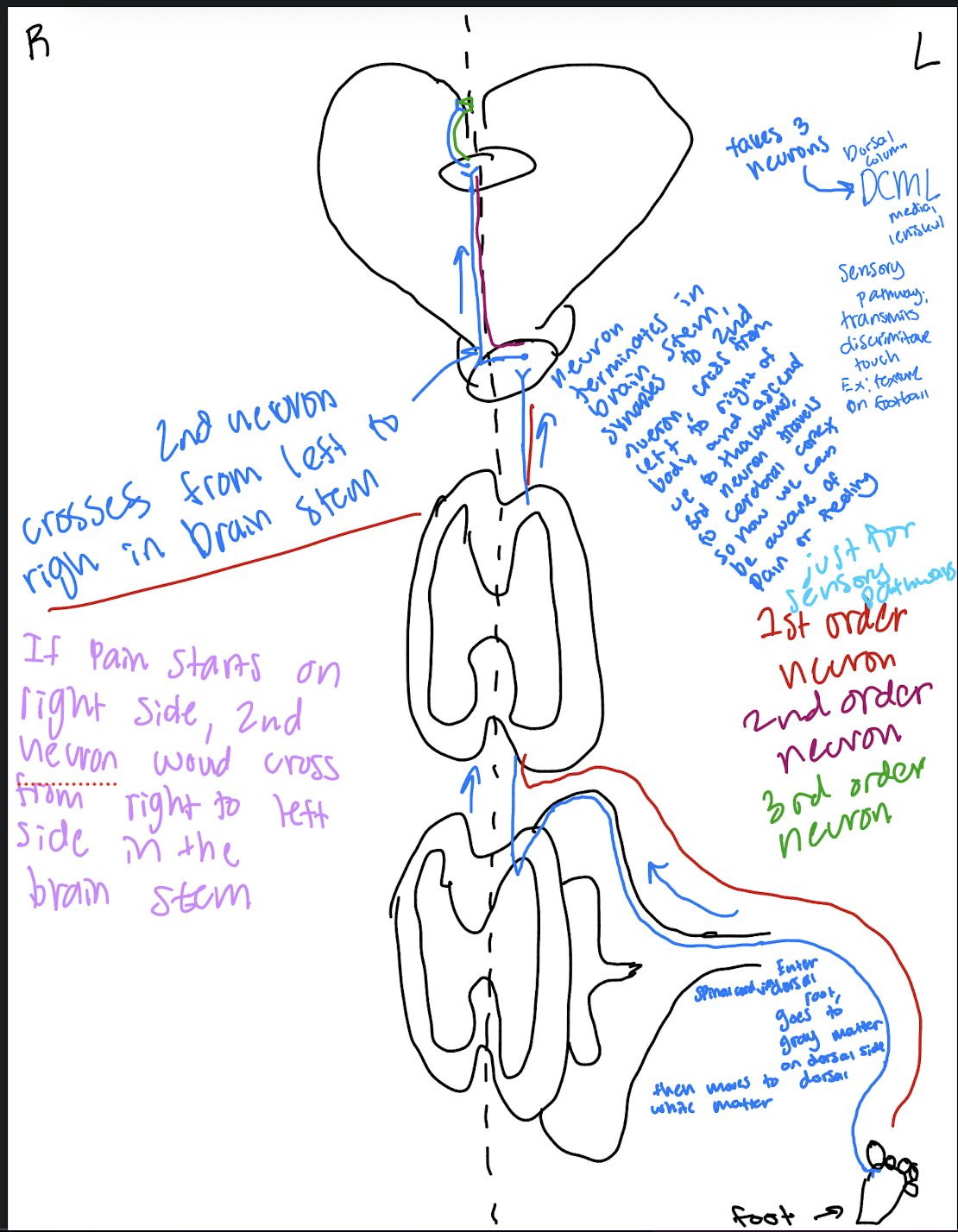
Neural Pathways: Dorsal Column–Medial Lemniscus (DCML)
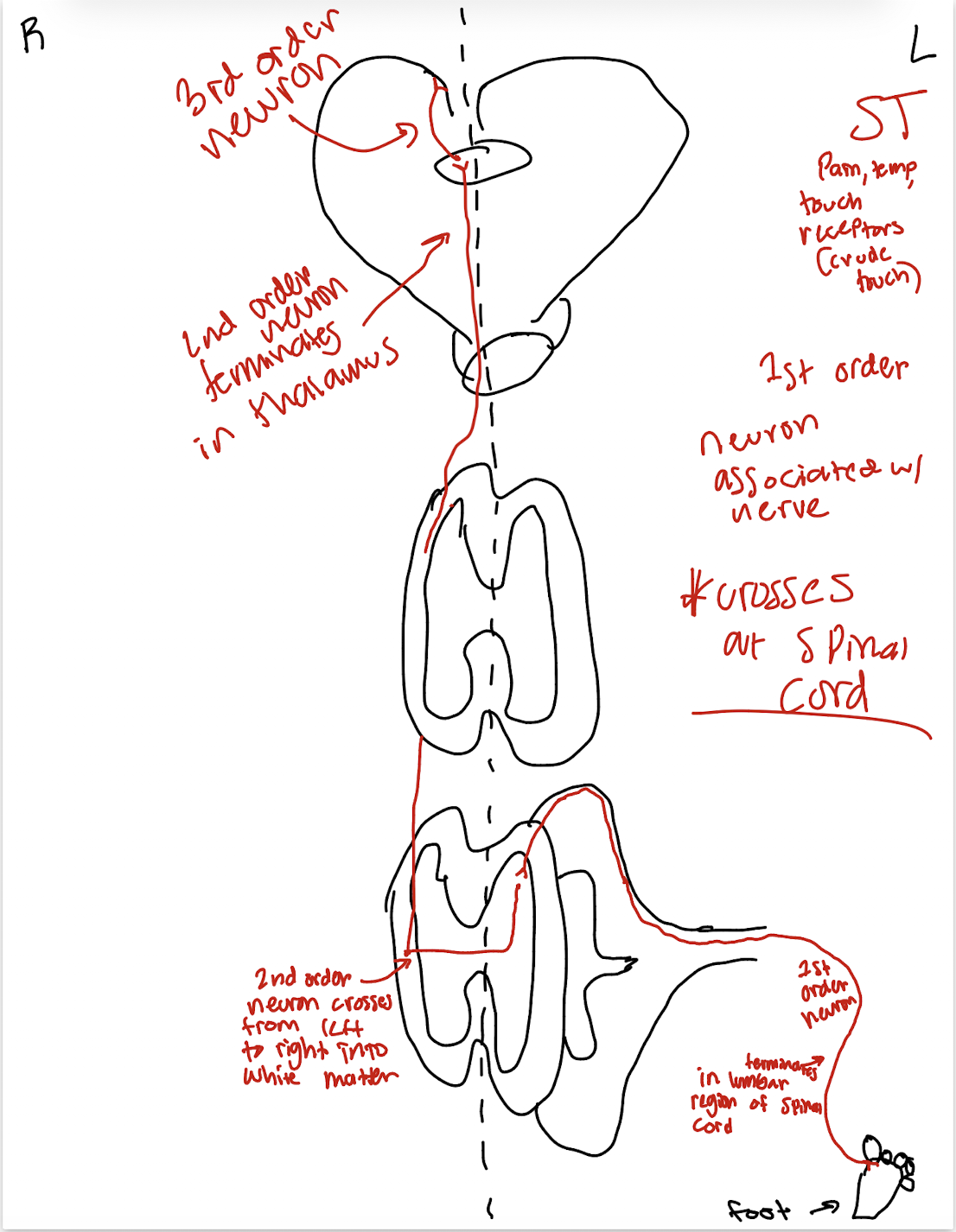
Neural Pathways: Spinothalamic (ST)
Lateral corticospinal (pyramidal) pathway
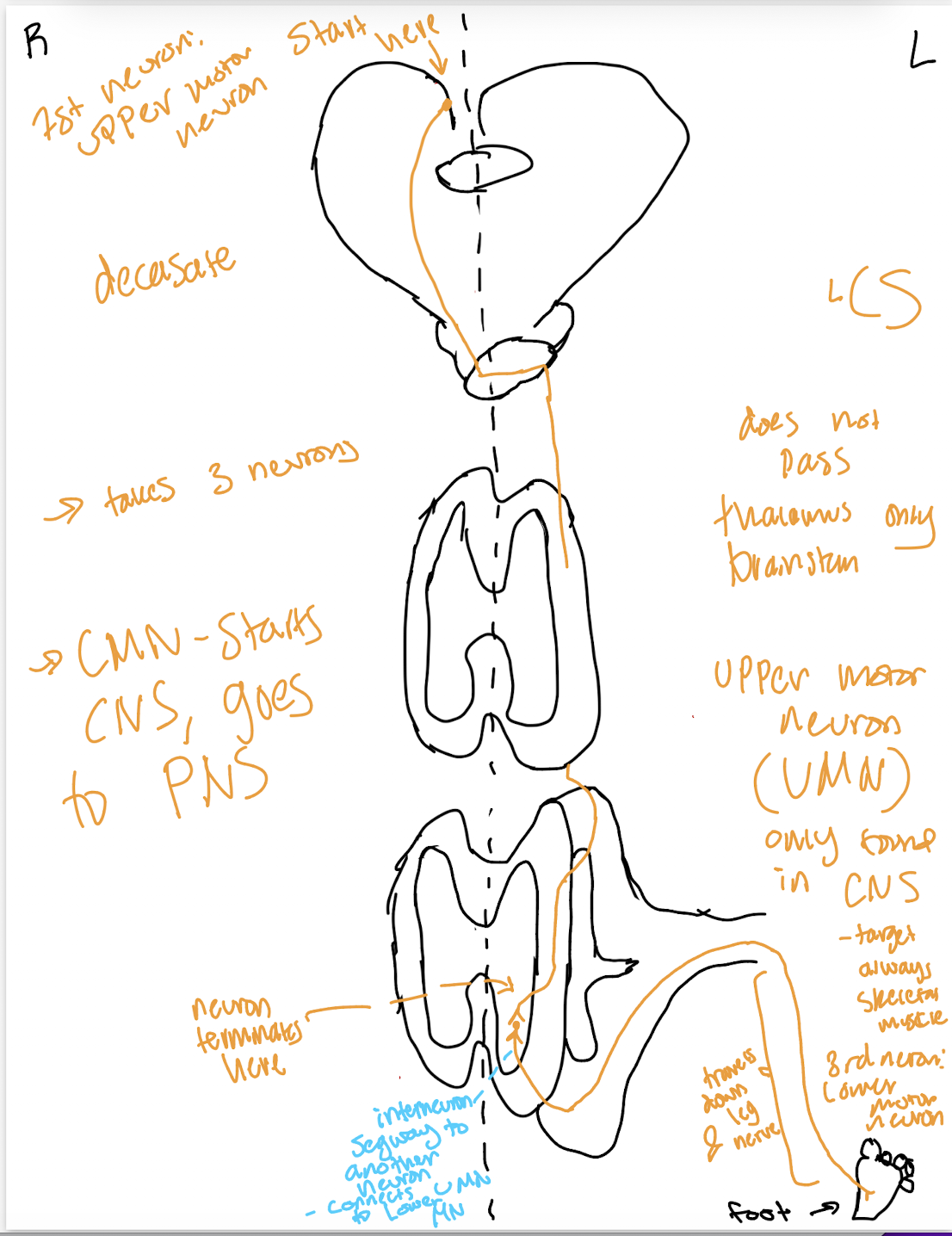
What would happen if a patient has a partial injury to spinal cord between cervical and lumbar, either on the right or left side?
They won’t loose spinal thalamic pathway on left side of body
White Matter
- has myelin
- dense collection of myelinated axons
- myelin is specifically associated with axons
- when talking about white matter, we are talking about axons
- myelin is used to speed up the conduction of action potentials from the axon hillock to boutons
- when we see myelin we have insulator (no channels in membrane)
Gray Matter
- mostly neuron cell bodies and dendrites
- may contain unmyelinated axons
- where we see exposed membrane (nodes of ranvier), it has lots of channels