VO 3+4 Parameterization I
 Call Kai
 Learn
Learn Practice Test
 Spaced Repetition
 Match
Match Flashcards
 Knowt Play
1/43

There's no tags or description
Looks like no tags are added yet.
Name | Mastery | Learn | Test | Matching | Spaced | Call with Kai | Chat |
|---|
No analytics yet
Send a link to your students to track their progress
44 Terms
What is not parameterization?
the dynamical core
(it solves numerically the fundamental/primitive equations of fluid dynamics)
In wich aspects can model physics be divided in?
Processes with fluid dynamic description, but that cannot be resolved by the model grid (zb turbulence) → subgrid processes
Processes with no fluid dynamic description (zb radiation)
What is dynamics?
abbreviation for “computational fluid dynamics”
What is Parameterization?
Parameterization is to express something in terms of parameters. In mathematics, it is the process of finding parametric equations for a curve, surface, or manifold.
What is model physics?
makes no sense, but has become an established term
Which sub grid processes need to be parameterized?
Processes that occur on scales smaller than the model grid must be parameterized:
turbulence
convection (cumulus)
deep convection (cumulonimbus)
microphysics
Resolution vs. effective resolution for local NWP, global NWP and Climate
Local: dx = 1-3 km → 10 km
Global: dx = 10-30 km → 100 km
Climate: dx = 50-150 km → 500 km
What can local, global and climate NWPs resolve?
Local:
turbulence (within and above BL)
shallow convection, both dry and moist (cumulus)
Global:
deep convection (cumulonimbus)
Climate:
mesoscale convective systems (they’re not parameterized separately from deep convection)
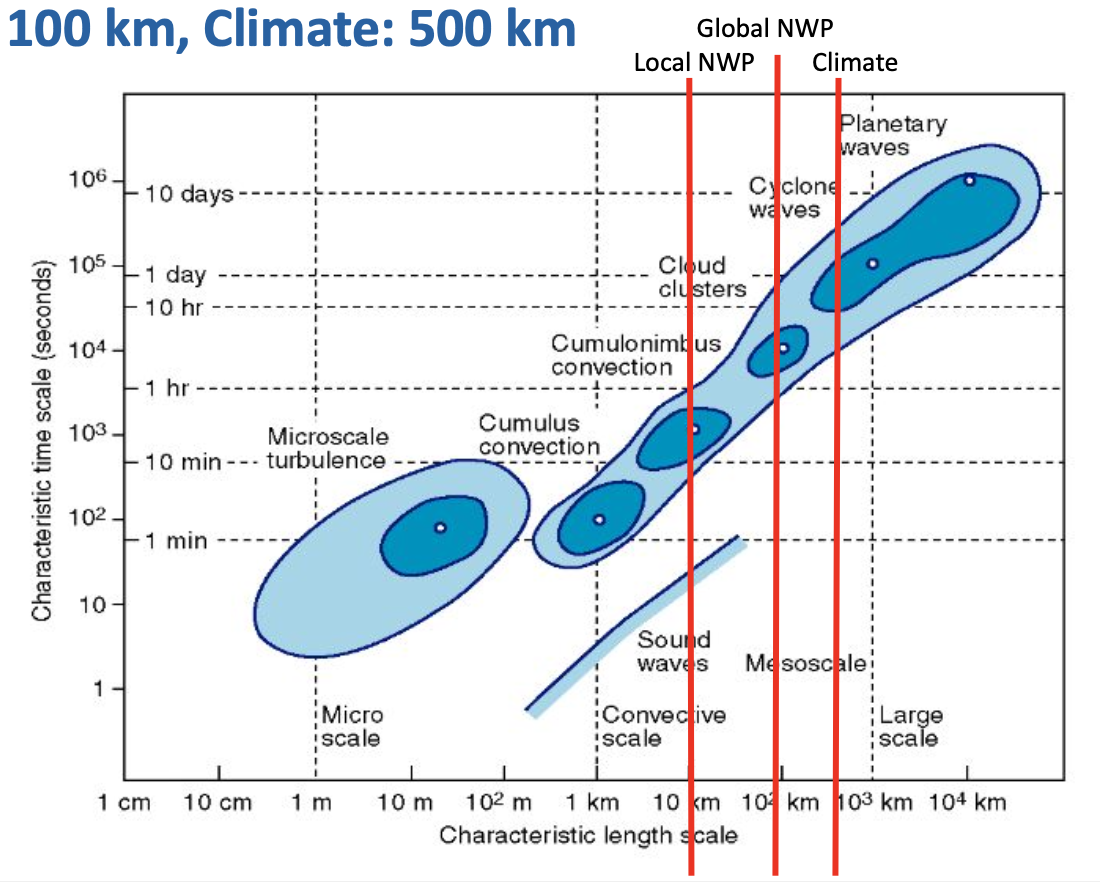
How many grid spacings are approximately required to a) obtain first useful information and b) fully resolve a wave?
a) about 4*dx
b) about 8*dx
Which non-subgrid processes have to be parameterized?
ice, aerosols and their interactions with water
radiation
plants and other surface processes
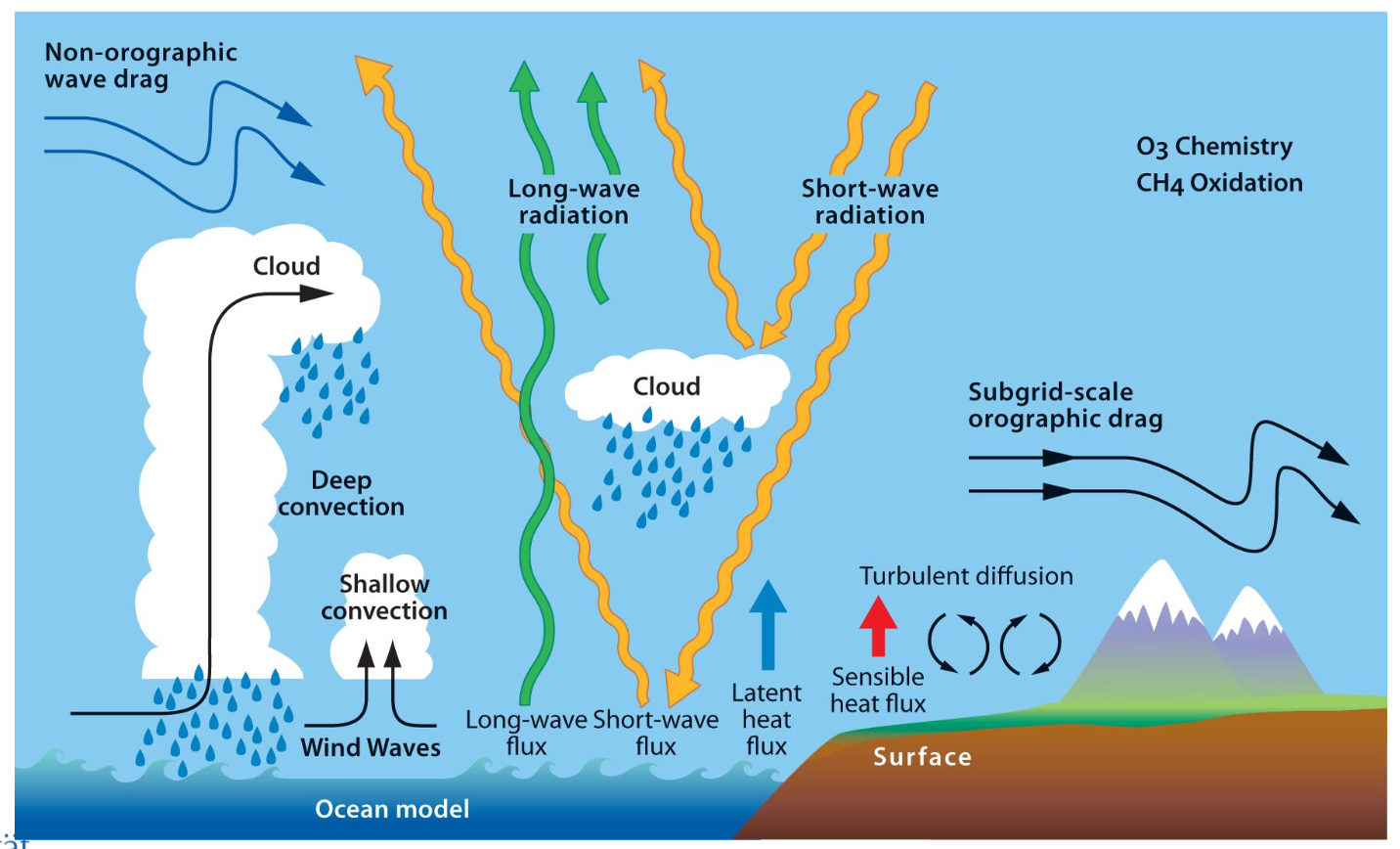
What are the key parameterizations of ECMWF?
clouds
deep and shallow convection
radiation
turbulent diffusion
surface heat fluxes
orographic and non orographic wave drag
chemistry
ocean processes
Do all parameterizations follow universal principles or laws?
No. Every process can be parameterized in a lot of different of ways
What are common approaches for parameterizations?
1D column approximation
Scale separation
Explain 1D column approximation
based on the assumption that the horizontal effects of processes can be neglected
→ simplifies problem conceptually and computationally
Explain Scale separation
assumption that the spatial and temporal scale of a parameterized process is significantly smaller than the model grid spacing and time step
→ so we parameterize the mean net effect of the process on the grid box
What are the core variables of NWP models and how are they summarized?
T, u, v, w, q, p
temperature
3D wind
humidity
pressure
summarized as model state X
On what does the dynamic tendency depend?
only on the core variables
What is one of the main tasks of parameterization?
to quantitatively estimate the net effect of a process on the core variables
What is the simplest case of parameterization?
Tendency X = dynamic tendency (X) + parameterized tendency (X)
X_(n+1) = X_n + Tendency X *delta t
Why is physics–dynamics coupling complicated in real models?
Because models use many interacting parameterizations with additional prognostic variables (zb. cloud water, TKE, convective updrafts)
The parameterizations may:
depend on other prognostic variables
parameterized tendencies depend on other variables or tendencies of core/other variables
define and calculate the same quantities differently
use different grids and time steps than the dynamics
must also be coupled to the land surface and ocean
Why can core variables also require parameterization? Give example
When their value is needed in between grid points
example: 2m Temperature & 2m Humidity
What happens in sequential splitting?
Dynamics and physics are calculated one after another, the updated state from one process is passed to the next

What happens in parallel splitting?
Dynamics and physics calculate their tendencies independently from the same initial model state
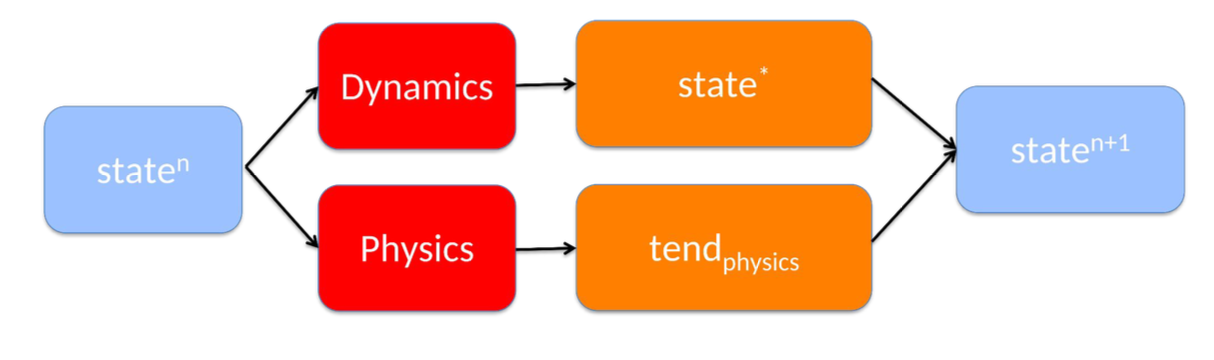
Main characteristics for sequential splitting?
conservation is ensured
the order of parameterization has a significant effect → swapping order can lead to significantly different climate sensitivity within the same model
recommended to compute the fastest processes first
numerically less effective (waiting for the preceding process)
Main characteristics of parallel splitting?
conservation issues , zb mass conservation
numerically more effective
requires a shorter time step to remain stable
Lecture example liquid cloud fraction definition:
the fraction of a model grid cell that is covered by water clouds, defined in each vertical grid cell (3D field)
cloud cover is similar but over entire column (2D field)
liquid clouds are much simpler than ice, cloud droplets are commonly in thermal equilibrium
by assuming equilibrium → cloud fraction (almost) a sub grid process
→ meaning its value at a given model level is determined by the statistical distribution of moisture within the grid box rather than by a time-evolving prognostic equation
What is an advantage of sub grid parameterizations?
Higher-resolution simulations can be used as reference truth
How is a LES (Large Eddy Simulation) used as a reference truth for a parameterization?
it’s split into many individual slices, the statistical properties of the variables in the slice are used as input for parameterization
parameterized cloud fraction (cf) can be directly compared to cf of LES slice
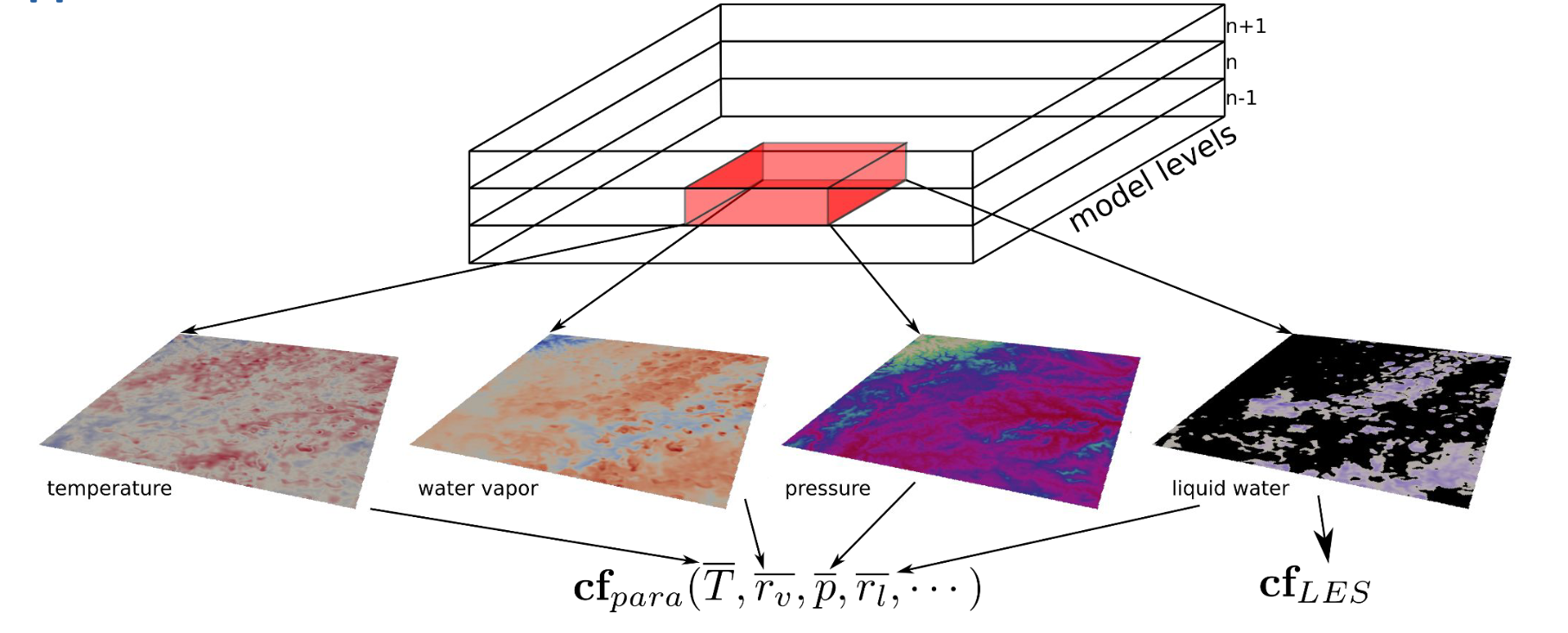
Types of parameterization for cf? (4)
all or nothing (used in LES)
relative humidity from Sundqvist
Beta PDF without skew (symmetrical)
Beta PDF with variable skew
All or nothing assumptions, input variables, calculation, tuning parameters?
Assumptions:
there is no subgrid-scale variability in moisture in the grid box (every point same moisture as box mean)
the grid box is in thermal equilibrium
Input variables:
temperature
pressure
total moisture (= water vapor + cloud water {ohne ice})
Calculation:
calculate saturation water content from temperature and pressure
if total moisture >= saturation content
then cloud fraction = 1 (100% bewölkt)
else cloud fraction = 0 (0% bewölkt)
Tuning parameters: 0
Relative humidity from Sundqvist assumptions, input variables, calculation, tuning parameters?
Assumptions:
cloud fraction is a function of relative humidity (eta) and is 0 below a critical value
wenn rh = 1, cloud cover = 1
Input variables:
temperature
pressure
total moisture (= water vapor + cloud water {ohne ice})
surface pressure
Calculation:
cfrel=1−1−ηcrit1−η
Tuning parameters: 3
in ICON there is a fourth parameter over the ocean (siehe Bild)
→ C2 is critical value at surface, C1 and C3 determine how value eta_crit changes with height
What is total water PDF parameterization?
replaces all or nothing with more physical approach
Assumption:
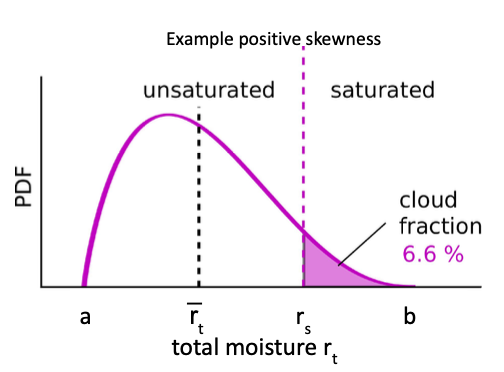
the distribution of total moisture (r_t) in the grid cell is described by an analytical distribution
there is a uniform saturation value throughout the grid cell (r_s=f(p_quer,T_quer))
cf=∫rsbPDF(rt)drt
Beta distribution
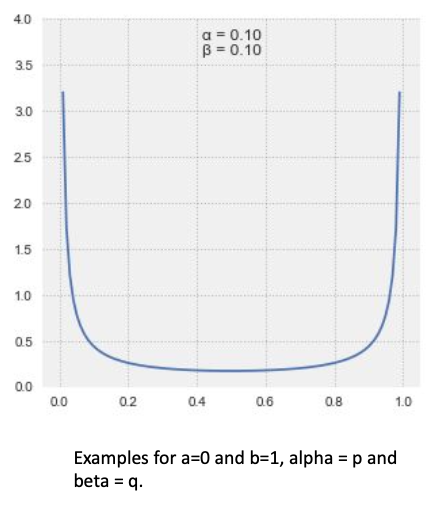
4 degrees of freedom: min and max value (a,b), two shape parameters (p>0, p<0)
if p and q > 1 , it starts and ends at 0
advantage: doesn't go to infinity
symmetric when p=q
complicated formula
Beta PDF symmetric closures, input variables, calculation, tuning parameters?
Two closures → two remaining degrees of freedom:
from (q-1)(p-1)=2 and p=q, p and q are given
only a and b remain undetermined
Input variables:
temperature
pressure
water vapor
cloud water
Calculation.
saturation value calculated from T and p
a,b determined iteratively
cloud fraction calculated from saturated area of distribution
Tuning parameters: 0
Beta PDF with skewness closures, input variables, calculation, tuning parameters?
One closure, 3 remaining degrees of freedom:
(q-1)(p-1)=2
Input variables:
temperature
pressure
water vapor
cloud water
total water skewness
Calculation.
saturation value calculated from T and p
a,b determined iteratively
cloud fraction calculated from saturated area of distribution
Tuning parameters: 0
Meaning of positive skewness
means there are small regions with very high total moisture
caused by convection
leads to a smaller cloud fraction for a given amount of cloud water
Meaning of negative skewness
means there are small regions with very low moisture
less common
leads to a higher cloud fraction for a given amount of cloud water
Meaning of no skewness
means that the distribution is symmetric, high values as common as low values
What variables besides pressure, temperature, and humidity are needed, and how many tuning parameters exist?
"All or nothing": No additional variables
Relative humidity from Sundqvist: No additional variables, 3 tuning parameters
Beta PDF without skewness (Symmetric): Cloud water
Beta PDF with variable skewness: Cloud water, skewness of the total water PDF
What is the most difficult aspect of Beta PDF?
they require additional variables
these variables can be obtained from LES in offline test, but in a model they must be provided by other parameterizations
cloud water would be provided by the microphysics parameterization
skewness is deduced by convection and BL parameterizations
What is this?
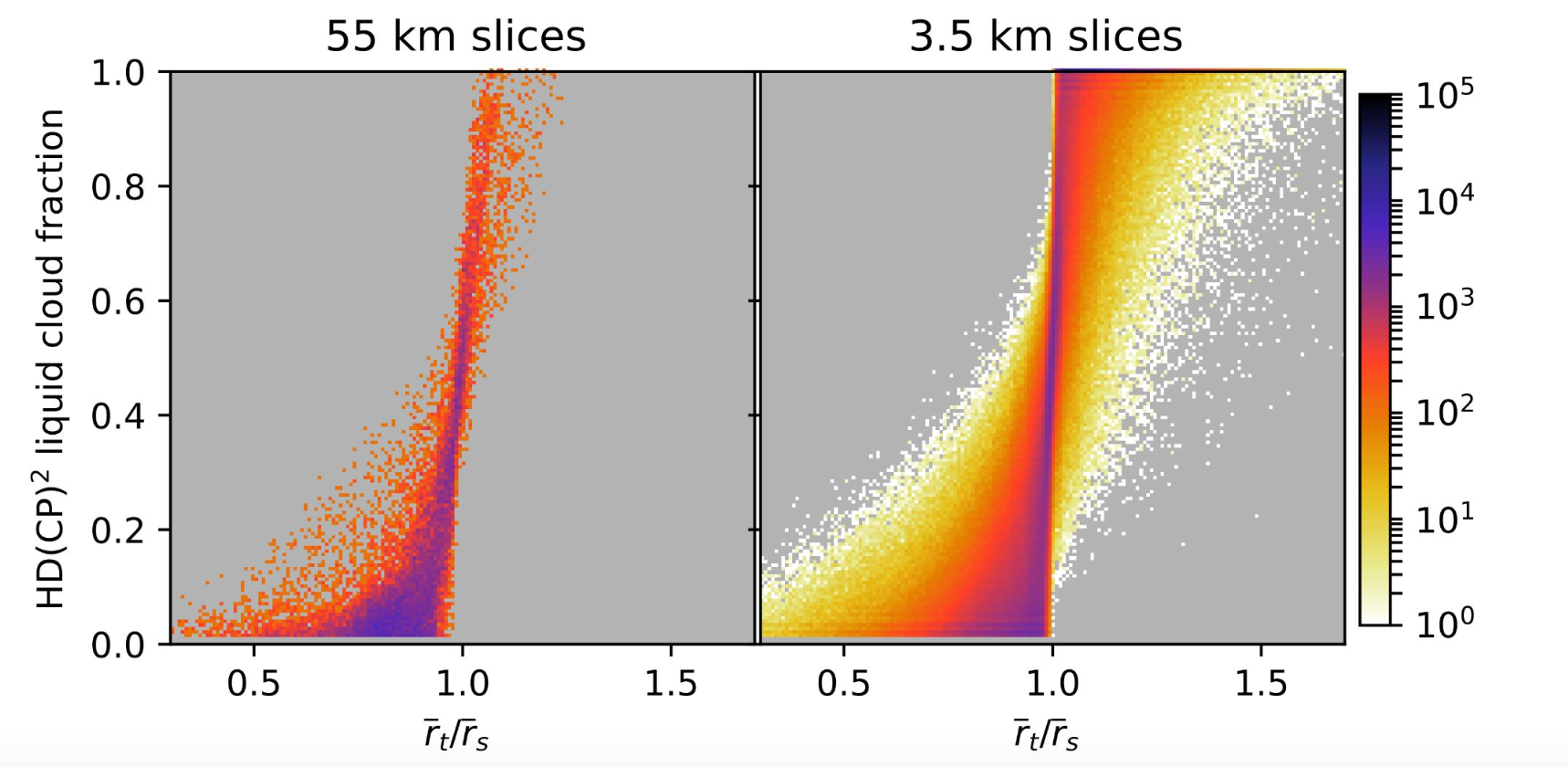
cloud fraction in the LES slices
y-axis: LES cloud fraction
x-axis: total water vs. saturation
Evaluation of the parameterizations against the LES cloud fraction:
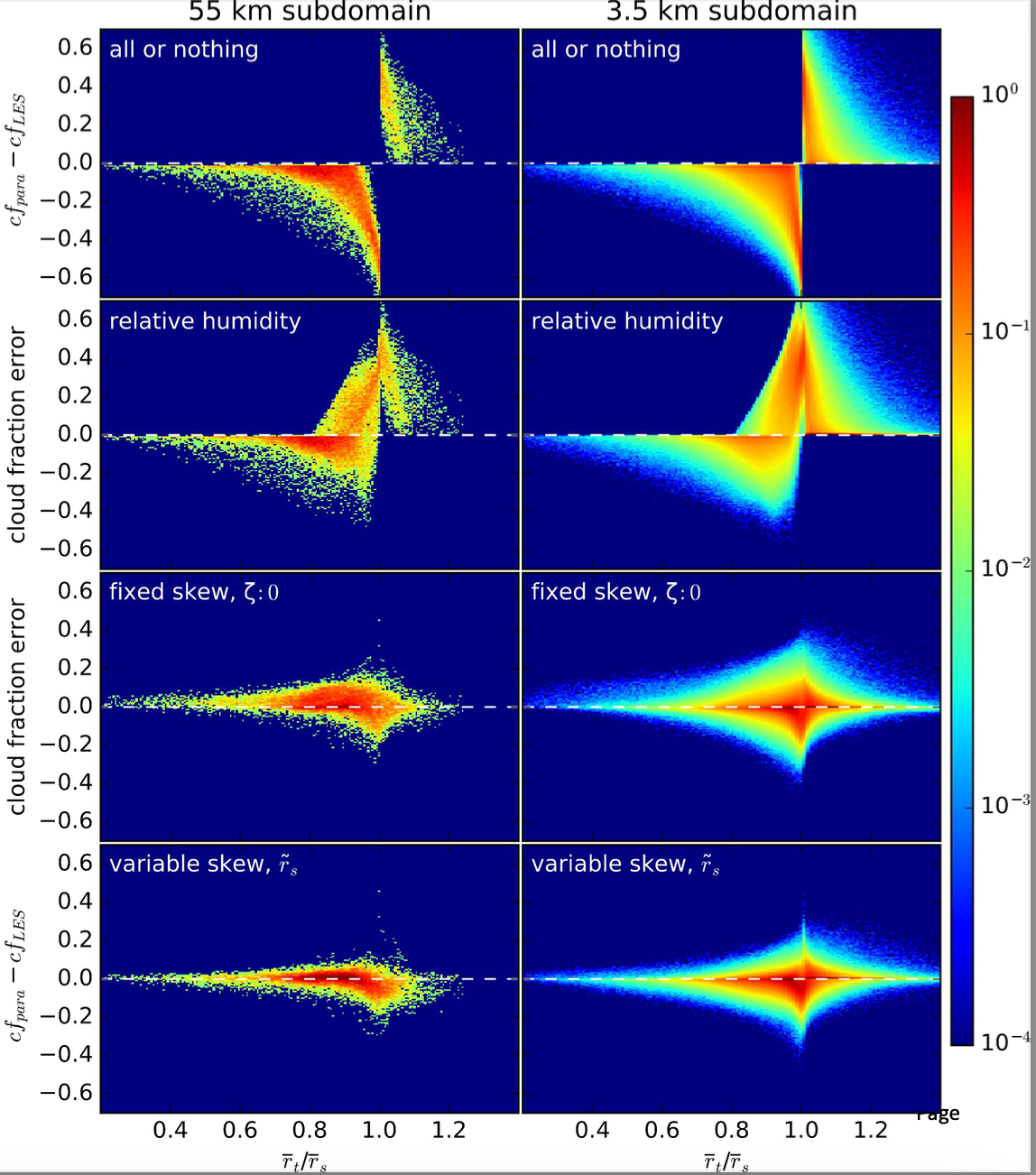
Y-axis: Error in the parameterized cloud fraction
Errors are largest at relative humidity near 1
"All or nothing" performs poorly.
Relative humidity needs to be retuned for
each grid size. The CMIP5 values had a very small mean error for 100x100 km boxes, but a relative absolute error of 100% (GSN2018)
The Beta PDF approach has much smaller errors, and the variable skewness provides an additional improvement
Code example: diagnostic cloud fraction, stratiform liquid cloud
ccturb=(BΔqqv+qc+AΔq−qsat)2
delta q: variance of the total-water PDF, determined by the turbulence scheme
A: tunable parameter, determines asymmetry of total water distribution
B: tunable parameter, scales the cloud cover for a determined PDF asymmetry (more or less clouds with same critical relative humidity, B=A+1 im code)
Why so much code for something so simple?
lots of limiting things within safety margins
tuning parameters A and B adjusted on height
delta q adjusted for layer thickness
specific tweaking to enhance cloud fraction in stratocumulus region
adjusts cloud liquid water under specific conditions