WH: L19 normal/abnormal labor and delivery
 Call Kai
 Learn
Learn Practice Test
 Spaced Repetition
 Match
Match Flashcards
 Knowt Play
1/94

There's no tags or description
Looks like no tags are added yet.
Name | Mastery | Learn | Test | Matching | Spaced | Call with Kai | Chat |
|---|
No analytics yet
Send a link to your students to track their progress
95 Terms
Braxton Hicks Contractions
- irregular, generally painless contractions
- can occur throughout 3rd trimester
- no dilation of cervix
- relieved with ambulation and hydration
Lightening
- lighter sensation from fetal head descending further into pelvis
- baby "drops"
- typically in last 2-4 weeks of pregnancy
Passage of mucus plug
- mucus forms in cervical canal during pregnancy that acts as a barrier against infection
- cervix softens and thins in days/weeks prior to labor and plug passes
- may be blood tinged "bloody show"
How many stages of labor are there?
Three
First Stage of Labor
- interval between onset of labor and complete cervical dilation
- latent/early and active phases
First Stage of Labor: Latent/Early phase
- onset of labor
- longest stage of labor: lasts several hours
- contractions more mild, less frequent, and can be irregular
- cervix gradually softens, opens and gets thinner
First Stage of Labor: Active phase
- once cervix is ~6cm
- more rapid cervical change to get to 10cm (~3-5hr)
- contractions more frequent, painful, and regular
Second Stage of Labor
interval between complete cervical dilation and delivery of baby
Third Stage of Labor
interval between delivery of baby and delivery of the placenta
When should you go to the hospital
When contractions are 3-5min apart for >1hr and last longer than 45-60sec each
What should be done at the hospital? (6)
- review prenatal records to confirm gestational age
- determine any development of new issues
- check pt vitals
- check fetal HR and assess frequency, qualify, and duration of contractions
- perform exam to determine fetal lie, presentation, and position
When should you perform a digital vaginal exam once at the hopsital?
After placenta previa and prelabor rupture of membranes excluded
What do you confirm with digital vaginal exam?
Cervical dilation/effacement and fetal station
Placenta Previa
placenta extends over the internal cervical os, can cause bleeding
Rupture of membrane
- "my water broke"
- may report leaking/gushing of fluid
- can increase infection risk if contractions haven't begun
When should you admit a patient into the hospital for labor?
Those in active labor
Active Labor 3 Criteria
- regular contractions that require patient's focus and attention
- significant cervical effacement (>80%)
- dilation between 4-6cm
3 P's of Successful Labor and Delivery
- power
- passenger
- passage
Power
Force generated by uterine contractions
Passenger
Characteristics of the fetus including size, weight, lie, presentation, and position
Passenger: Lie
- relation of fetal long axis to the maternal axis
- longitudinal mc
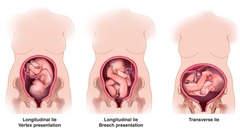
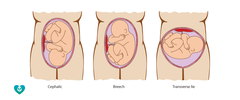
Passenger: Presentation
- part of fetus that presents itself lowest in birth canal
- mc cephalic
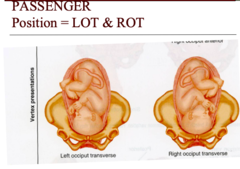
Passenger: position
fetal presenting part either to the right or left side of the pelvis
Passage
- Bony pelvic and soft tissue of the birth canal
- different pelvic types can make delivery easier or more challenging
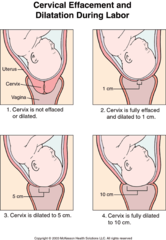
Passage: Dilation
- cervix opens
- need to be at 10cm for delivery
Passage: Effacement
- thinning and shortening of the cervix
- must be 100% effaced for delivery
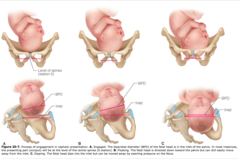
Passage: Station
- position of baby's head in relation to the ischial spines (in cm)
- from -5 to +5; 0 being at the spines
hospital admission Check list (5)
- CBC, STI (high risk)
- restrict PO intake
- IV access
- In GBS + patient: IV PCN G
- perform vaginal exams at 2-4hr intervals, prior to analgesia, or with FHR abnormalities
1st stage of labor: pain
- all visceral
- uterine contractions and cervical dilation
2nd stage of labor: pain
- visceral and somatic
- contractions and vaginal/perineal tissue distention
- more severe than 1st stage
Nonpharm Pain Management Options (7)
- massage
- movement
- applying heat or cold
- breathing techniques
- taking a shower
- TENS unit
- Aromatherapy
Pharm Pain Management Options (3)
- opioids
- nitrous oxide
- neuracial analgesia
When should opioids be avoided
If birth is imminent
Nitrous oxide monitor
monitor for Respiratory depression
What's the most effective pain management option?
Neuraxial analgesion (epidural or spinal)
when can Neuraxial analgesion be initiated
At any point during labor
Neuraxial analgesion: mc techniques
Epidural and combined spinal-epidural (CSE)
Neuraxial analgesion should be considered in what patients?
Those at high risk for C section
Neuraxial analgesion ADE (5)
- hypotension
- pruritus
- fever
- risk of postpartum puncture HA
- doesn't work
Neuraxial analgesion C/I (4)
- coagulopathy
- thrombocytopenia
- infection of lower back
- increased intracranial pressure
Neuraxial analgesion most effective form
Epidural
Epidural Neuraxial analgesion, where is it places, and what remains intact
- catheter present for continuous analgesia through labor
- placed below L2 to L3 lumbar space
- sense of touch and motor ability is intact
Combined Spinal Epidural (CSE) Neuraxial analgesion
- faster onset of analgesia
- catheter present for continuous analgesia
- reduced need for rescue analgesia
Alternative Neuraxial analgesion
Pudendal Nerve Block
Pudendal Nerve Block ID
- alleviating vaginal and perineal pain during 2nd stage
- supplement with an epidural
mc Obstetric procedure for Fetal Monitoring during labor
Intrapartum electronic FHR monitoring
Intrapartum electronic FHR determine
if fetus is well-oxygenated
Intrapartum electronic FHR type of monitoring
intermittent or continuous
Intermittent Intrapartum electronic FHR
- low-risk pts
- not as practical
Intrapartum electronic FHR Continuous
- more common
- high-risk pts
How often should Intrapartum electronic FHR tracings be reviewed?
every 15-30min
Intrapartum electronic FHR What is shows (4)
- Variability
- Baseline rate
- acceleration/Deceleration
- Sinusoidal pattern
Intrapartum electronic FHR: Variability
- fluctuations that are irregular in amplitude and frequency
- 10min window
Intrapartum electronic FHR Reassuring variability
amplitude of 6-25 bpm
Intrapartum electronic FHR Baseline normal
110-160bpm
Baseline Bradycardia FHR
-
Baseline Tachycardia FHR
- >160 bpm
- >200 bpm usually due to fetal tachyarrhythmia
Intrapartum electronic FHR: Acceleration
- abrupt increase in FHR for ≥15sec and ≥15bpm above baseline
- associated with reassuring fetal status and absence of hypoxia
- can occur with fetal movement or contractions
Intrapartum electronic FHR: Deceleration benign
- early
- gradual decrease in FHR and return to baseline during a contraction
Intrapartum electronic FHR: Deceleration needs prompt attention
- late
- gradual decrease in FHR and return to baseline after a contraction
- concern for transient hypoxemia during contraction
Intrapartum electronic FHR: Deceleration Variable
- abrupt decrease in FHR ≥ 15bpm below baseline and lasting
Intrapartum electronic FHR: Prolonged
decrease in FHR ≥15bpm below baseline lasting at least 2min
Intrapartum electronic FHR: Sinosoidal pattern
- rare but ominous
- high rate of fetal morbidity and mortality
- smooth sine wave that occurs 2-5 cycles per minute
- amplitude of 5-15bpm
- indicates severe fetal anemia
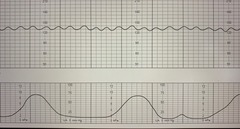
Intrapartum electronic FHR Category 1
normal tracing
Intrapartum electronic FHR: Normal Tracing
- baseline normal range
- moderate variability
- no late or variable decelerations
- early decelerations or accelerations may be absent or present
Intrapartum electronic FHR Normal Tracing management
- intermittent or continuous monitoring
- review q30min in 1st stage
- review q15min in 2nd stage
Intrapartum electronic FHR Category 2
Indeterminate tracings
Intrapartum electronic FHR: Indeterminate tracings
Tracings don't meet criteria for category 3 or 1
Intrapartum electronic FHRL Indeterminate Management
- address underlying issue
- delivery indicated if tracing doesn't improve
Intrapartum electronic FHR Category 3
Abnormal
Intrapartum electronic FHR: Abnormal
absent baseline FHR variability + recurrent late decelerations, recurrent variable decelerations, bradycardia, or sinusoidal pattern
Intrapartum electronic FHR: Abnormal management
- prepare for delivery
- reposition patient
- IV fluid bolus
- fetal scalp stimulation
- if no improvement after conservative: then delivery is advised (cesarean or operative vaginal delivery)
Uterine Contraction Monitoring
External tocodynamometry
Uterine Contraction Monitoring: Normal
- regular and painful
- cause progressive dilation and effacement of the cervix
- cause descent and eventual expulsion of the fetus
Abnormal Uterine Contractions: Hypocontractile
- contractions not sufficiently frequent and/or strong or aren't coordinated to dilate the cervix
- mc risk factor for protraction or arrest disorders
- mc reason for intrapartum cesareans
Abnormal Uterine Contractions: Tachysystole
- more than 5 contractions over 10min averaged over 30min
- associated with oxytocin administration and lead to FHR abnormalities
- uterine rupture rare complication
Abnormal Uterine Contractions: protraction disorders
Labor is slow to progress
protraction disorders: prolonged latent phase
exceeds 20hr (nullparous) or 14hr (multiparous)
protraction disorders: prolonged latent phase management
observe, rest, +/- oxytocin
protraction disorders: prolonged active phase
rate of cervical dilation is
protraction disorders: prolonged active phase tx
administer oxytocin or perform amniotomy (artificial rupture of membranes)
protraction disorders: prolonged second stage
exceeds 2hr if no regional anesthesia or 3hr with regional anesthesia
protraction disorders: prolonged second stage tx
give oxytocin, possible indication for cesarean or operative vaginal delivery
Abnormal Uterine Contractions: arrest disorders
labor ceases to progress
arrest disorders: active phase
no cervical change for ≥4hr or ≥6hr if oxytocin administered
arrest disorders: active phase tx
cesarean delivery
arrest disorders: second phase
no fetal descent after 1hr of pushing
arrest disorders: second phase tx
- coaching
- oxytocin administration
- operative delivery
When does the active phase of 1st stage of labor end?
- Once cervix is fully dilated
- time to push
Labor progression: 2nd stage
- interval between complete cervical dilation and delivery of baby
- can last less than an hour or 2-3hr
Labor progression: 3rd stage
interval between delivery of baby and delivery of placenta
Hallmarks of placenta-uterus separation (3)
- gush of blood at vagina
- lengthening of the umbilical cord
- globular shaped uterine fundus on palpation
When does expulsion of placenta usually occur?
Within 30min
Expulsion of placenta takes longer increases the risk of what; indicated what
- Postpartum hemorrhage
- indication for manual removal
Labor progression: 4th stage
first 1-2hr after placental expuslion
- monitor for abnormal postpartum bleeding
- assess for perineal lacerations and repair