12 Toric SCL Anatomy
 Call Kai
 Learn
Learn Practice Test
 Spaced Repetition
 Match
Match Flashcards
 Knowt Play
1/114

There's no tags or description
Looks like no tags are added yet.
Name | Mastery | Learn | Test | Matching | Spaced | Call with Kai | Chat |
|---|
No analytics yet
Send a link to your students to track their progress
115 Terms
How common is astigmatism in patients, and why is this clinically important for contact lens fitting?
Astigmatism is very common, with an estimated prevalence of about 40%. Clinically, this means many patients may benefit from astigmatic correction rather than being fit only with spherical lenses.
What proportion of contact lens fits involve toric soft lenses in the United States?
Toric soft lenses represent about 27% of all contact lens fits in the United States.
Among standard single-vision lenses prescribed in the United States, about what percentage are toric soft lenses?
About 42% of standard single-vision soft lenses prescribed are toric lenses, suggesting toric correction is common in routine clinical practice.
In low-to-moderate astigmatism, how do patients typically compare toric soft lenses with spherical soft lenses?
Patients with cylinder powers around -0.75 to -1.75 D often prefer toric soft lenses over spherical soft lenses. One study reported about 85% preference for toric lenses, likely because toric lenses provide clearer astigmatic correction.
What type of lens did many patients prefer over toric soft lenses, and what was the reported preference rate?
Many patients preferred larger-diameter rigid gas permeable lenses, or RGPs, over toric soft lenses. The reported preference was about 75%.
What is the high-yield clinical takeaway about patient lens preference in astigmatism?
Correcting astigmatism usually improves patient satisfaction compared with leaving astigmatism undercorrected in spherical soft lenses, but some patients may still prefer larger-diameter RGPs over toric soft lenses depending on comfort, vision quality, and fit.
How does astigmatism change with advancing age?
Astigmatism generally increases with age, especially due to an increase in against-the-rule astigmatism.
What happens to cylinder magnitude as patients age?
Cylinder magnitude increases with advancing age, meaning older patients are more likely to require meaningful astigmatic correction.
What type of astigmatism becomes more common with age?
Against-the-rule astigmatism increases with age.
What is the clinical implication of increasing astigmatism with age?
Clinicians should expect astigmatic correction needs to increase in older patients and should be alert for shifts toward against-the-rule astigmatism, which may affect lens selection and visual outcomes.
What are the major factors that can cause a contact lens to rotate on the eye?
Contact lens rotation can be caused by:
Surface tension / tear film quality
Back surface toricity aligning with corneal toricity
Lid-lens interaction
Lens thickness differences from cylinder power
Patient lid position, especially during examination or fitting
How does back surface toricity affect lens rotation?
A lens with back surface toricity tends to rotate to align with corneal toricity.
This can influence the final resting position of a toric lens on the eye.
Why are eyelids important in contact lens rotation?
Eyelids interact mechanically with the lens and can induce rotation through:
Lid pressure
Lens movement during blinking
Interaction with thicker or thinner lens meridians
Patient-specific lid position
What is the “watermelon seed principle” in contact lens rotation?
The watermelon seed principle describes how eyelids can “squeeze” or push a contact lens, causing both:
Vertical movement
Rotation
Like a wet watermelon seed slipping when compressed, the lens can shift or rotate due to lid pressure.
How can lens design reduce lid-induced rotation from the watermelon seed effect?
To decrease lid-lens interaction, the lens should have thinner and steeper peripheral or mid-peripheral areas.
What is the clinical takeaway of the watermelon seed principle for fitting toric lenses?
If the eyelids are excessively interacting with the lens, the lens may rotate or move unpredictably. Adjusting lens design, especially the peripheral or mid-peripheral profile, can improve rotational stability.
How does cylinder power affect contact lens rotation?
Cylinder power alone can affect lens rotation because cylinder creates thickness variations in the lens. These thickness differences can interact with the eyelids and influence how the lens rotates.
Where do thickness variations come from in toric lenses?
Thickness variations can come from either:
Toric power curve, or
Toric back surface curvature / toric BCR
Both can create meridional thickness differences that affect lens orientation.
How does lens thickness vary by astigmatism axis?
Thickness pattern depends on the axis:
With-the-rule astigmatism: thicker lens in the vertical meridian
Against-the-rule astigmatism: thicker lens in the horizontal meridian
Oblique astigmatism: asymmetric thickness
Why are oblique-axis toric lenses more prone to rotation than lenses at 90° or 180°?
Oblique lenses have thicker meridians that are neither parallel nor perpendicular to the upper eyelid.
Because the eyelid encounters the thick edge at an angle, lid pressure can create a rotational force on the lens.
What is the key lid-lens interaction principle for oblique toric lens rotation?
The upper eyelid tends to push against the thicker oblique edge, creating rotation as the lens attempts to move away from the lid force.Oblique axes often rotate more unpredictably than 90° or 180° axes.
For an oblique toric lens near axis 135°, where does the upper lid encounter the thicker edge, and what rotation is expected?
For an oblique lens near axis 135°, the upper lid encounters the thicker edge around 2:00.
Expected rotation:
OD: temporal rotation
OS: nasal rotation
For an oblique toric lens near axis 45°, where does the upper lid encounter the thicker edge, and what rotation is expected?
For an oblique lens near axis 45°, the upper lid encounters the thicker edge around 10:00.
Expected rotation:
OD: nasal rotation
OS: temporal rotation
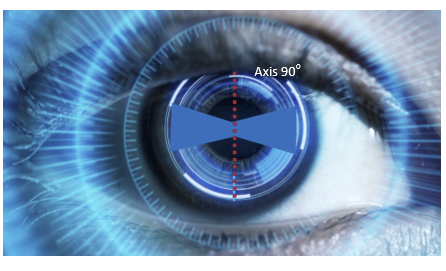
Why does a toric lens with an axis near 90° often have little rotation?
With an axis near 90°, the thicker meridian is approximately parallel to the upper eyelid.
Because the lid does not strongly push against an angled thick edge, there is often minimal rotational force and little rotation.
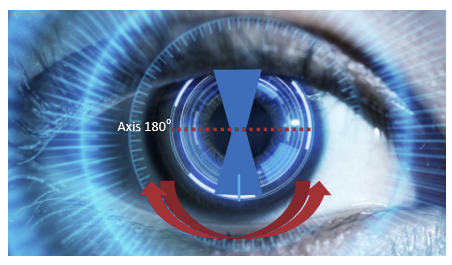
Why can a toric lens with an axis near 180° rotate temporally or nasally?
With an axis near 180°, the thicker meridian is approximately perpendicular to the upper eyelid.
The eyelid can push against the thicker vertical lens profile, creating rotation that may be either temporal or nasal depending on eye/lid interactions.
High-yield comparison: how does rotation tendency differ for 90°, 180°, and oblique toric axes?
Axis ~90°: thicker meridian parallel to upper lid → often little rotation
Axis ~180°: thicker meridian perpendicular to upper lid → may rotate temporal or nasal
Oblique axes: thicker meridian angled to lid → more likely to rotate based on which thick edge the lid encounters
What is the general rule for predicting rotation in oblique-cylinder toric lenses?
Rotation tends to be downward on the side with the greatest lens thickness.
The upper lid pushes on the thicker oblique edge, causing the lens to rotate away from that side.
Which cylinder axes tend to have the least toric lens rotation?
Axes within about ±20° of 90° or 180° tend to have the least rotation.
These axes place the thicker meridian closer to being either parallel or perpendicular to the upper eyelid, reducing oblique lid-induced torque.
Which toric lenses are most likely to rotate, and when is rotation especially likely?
Oblique-cylinder lenses are most likely to rotate, especially when the lens has higher cylinder power.
Higher cylinder power creates greater thickness differences, increasing lid interaction and rotational force.
What assumption limits the oblique-axis rotation prediction rule?
The rule assumes the upper eyelid is not angled.
If the upper lid is slanted or positioned atypically, rotation may differ from the expected pattern.
How does back surface toricity affect toric contact lens rotation?
A lens with a toric back surface/BCR that contacts the cornea tends to rotate to align with corneal toricity.
Mechanism: the posterior lens surface conforms to the toric corneal shape.
Why do toric soft contact lenses conform to the cornea rather than creating a tear-lens effect?
Toric soft lenses drape over and conform to the cornea, so there is no significant lacrimal lens.
What is the benefit of keeping toricity only in the central optic zone?
Central optic zone toricity can reduce peripheral lens thickness and decrease lid interaction.
This may improve comfort and rotational stability by minimizing peripheral mechanical forces from the eyelids.
What are the typical BCR and OAD ranges for soft toric contact lenses?
BCR: about 8.4 to 8.9 mm, similar to spherical soft lenses
OAD: about 14.4 to 14.5 mm, which is usually larger than spherical soft lenses
Spherical soft lenses are often about 13.8 to 14.2 mm
Why are toric soft lenses often larger in overall diameter than spherical lenses?
A larger OAD increases sagittal depth, which helps the lens sit deeper and improves centration and rotational stability.
How does BCR selection differ between standard toric soft lenses and custom toric lenses?
Standard toric soft lenses usually have limited BCR options, often only one available base curve. More BCR customization is generally available with custom lenses.
What is clinically important about toric BCRs in soft toric lenses?
The BCR is often toric, though exact values may not be published. Studies suggest a toric BCR may improve rotational stability compared with a spherical BCR because the back surface better aligns with the corneal shape.
How does sagittal depth compare between toric and spherical soft lenses?
Toric soft lenses generally have greater sagittal depth than spherical soft lenses because toric lenses often have a larger diameter.
Typical ranges:
Spherical lens sag: about 3.37 to 4.02 mm
Toric lens sag: about 3.50 to 4.16+ mm
Why does increased sagittal depth improve toric lens performance?
Increased sagittal depth helps the lens fit more deeply and stably on the eye, improving:
Lens centration
Rotational stability
Consistent cylinder axis alignment
What are the two major front-surface stabilization strategies used in soft toric lenses?
Ballasted designs, including prism ballast or peri-ballast
Thin-zone designs
What should a clinician do if one toric lens stabilization design fails?
Change the stabilization strategy, often by switching lens brand or company. Different manufacturers use different stabilization designs, so another toric lens may rotate less or fit more predictably.
How does a prism-ballast toric lens stabilize rotation?
Prism ballast stabilizes the lens by making the inferior portion thicker, which shifts the center of gravity downward and increases lid/lens interaction through the watermelon seed effect. Weight plays only a minimal role.
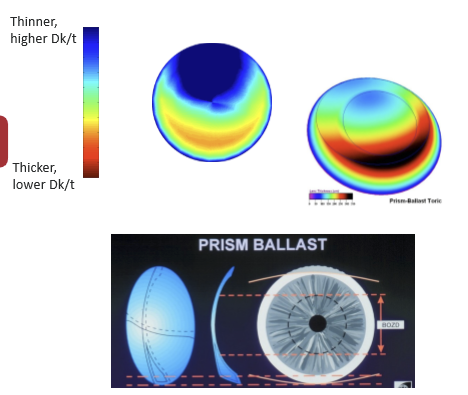
What are the main disadvantages of prism-ballast toric lens designs?
Lower inferior Dk/t because the inferior lens is thicker
Possible lower lid discomfort
Unequal vertical prism if fit unilaterally
In prism ballast, how does lens thickness relate to oxygen transmissibility?
Thicker areas have lower Dk/t, while thinner areas have higher Dk/t.
So the inferior thickened prism zone has relatively reduced oxygen transmissibility.
How does peri-ballast stabilize a toric contact lens?
Peri-ballast stabilizes similarly to prism ballast by using:
Watermelon seed effect
Minimal contribution from weight
A downward-shifted center of gravity
But peri-ballast modifies the lens design to reduce optical zone prism.
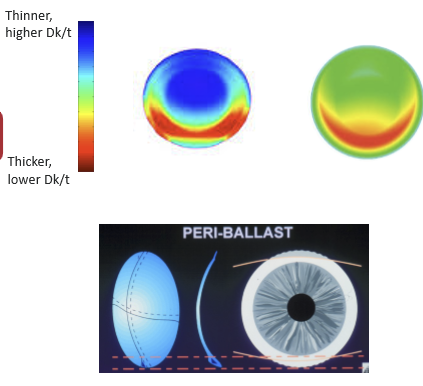
What design feature distinguishes peri-ballast from traditional prism ballast?
Peri-ballast uses a minus carrier over the entire lens and is thinned superiorly, with no or minimal prism in the optic zone.
This helps maintain stabilization while reducing unwanted optical prism effects.
What is the clinical advantage of peri-ballast compared with prism ballast?
Peri-ballast can provide rotational stability while reducing optic zone prism, which may improve visual quality and reduce prism-related issues.
How do dual slab-off or dual thin-zone toric lenses stabilize rotation?
Dual thin-zone lenses are blink stabilized. They use thinner superior and inferior zones that interact with both eyelids through the watermelon seed principle, helping the lens settle into a stable orientation.
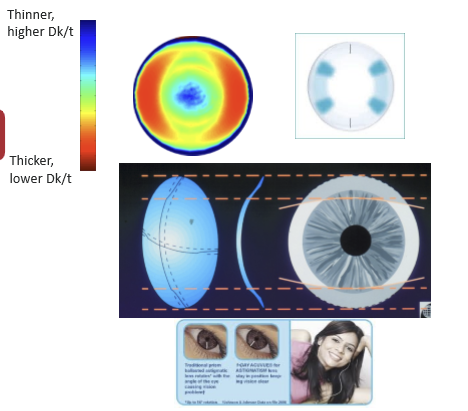
Why are dual thin-zone designs often stable in tilted head positions?
ecause stabilization depends more on eyelid interaction during blinking than gravity.
This makes the lens more stable when the head is tilted compared with designs relying more on inferior ballast.
What thickness pattern does a dual slab-off design resemble?
Dual slab-off thickness resembles an against-the-rule lens pattern, with relatively thicker areas horizontally and thinner areas superiorly and inferiorly.
What are some less common or not-yet-widely marketed toric lens stabilization strategies?
Truncation
Superior-only lenticular / lid-attached designs
How does a truncated toric soft contact lens stabilize rotation?
A truncated lens has the inferior edge cut off, allowing the flat edge to line up with the lower eyelid.
This mechanical alignment helps reduce lens rotation.
What is the main disadvantage of truncation as a toric lens stabilization method?
Truncated lenses are often uncomfortable because the cut inferior edge interacts with the highly innervated lower lid.
How does a lid-attached toric lens design stabilize lens rotation and movement?
A lid-attached design uses a superior-only lenticular zone with additional thick zones around 4:00 and 8:00.
The lens is designed so the upper eyelid attachment controls lens rotation and movement.
What is required when inserting a lid-attached toric lens?
The lens must be inserted in the proper orientation, because stabilization depends on the intended relationship between the lens design and the upper eyelid.
When should a patient wearing a spherical soft contact lens be considered for a toric soft contact lens?
Consider a toric SCL when the patient has poor visual acuity with a spherical soft lens, especially if there is a meaningful amount of uncorrected cylinder.
Why might a patient who cannot tolerate RGPs be a good toric soft lens candidate?
Toric soft lenses are useful when RGPs are difficult to fit or poorly tolerated, such as in patients with discomfort or challenging alignment.
How does the sphere-to-cylinder relationship affect toric soft lens candidacy?
Toric SCLs are more beneficial when cylinder meaningfully affects vision. If the cylinder is very small relative to the sphere, such as approximately cylinder < 25% of sphere, a spherical equivalent may sometimes be acceptable.
What basic exam factors should be evaluated for toric SCLs, similar to spherical SCLs?
Patient selection and exam are similar to spherical soft lenses and should include:
Anterior segment health
Tear film quality
General contact lens suitability
Comfort, handling, and wearing needs
What additional factor is especially important when selecting a toric soft contact lens patient?
Evaluate the consistency between refractive cylinder and corneal cylinder, or the lack of consistency.
Why it matters:
Refractive cylinder reflects the total astigmatic correction needed.
Corneal cylinder helps predict lens-cornea alignment and possible rotation behavior.
Mismatch may suggest internal/lenticular astigmatism or fitting complexity.
What are the basic steps for fitting a toric soft contact lens?
Select a toric soft contact lens
Disposable/common lens or custom lens
Assess fit and vision
Troubleshoot if vision, comfort, rotation, or stability is poor
When selecting an initial toric SCL, what broad lens categories should be considered?
Start with a commonly fitted disposable toric SCL when parameters are available. Consider a custom toric SCL when standard disposable parameters do not meet the patient’s needs, such as unusual cylinder powers, axes, base curves, or fit requirements.
What should be considered when choosing the refractive power for a toric soft contact lens?
Determine the needed Rx and vertex each meridian separately if needed, especially for higher prescriptions.
This helps ensure both the spherical and cylindrical components are accurately converted from spectacle plane to contact lens plane.
Why should corneal sagittal depth be evaluated when selecting a toric SCL?
Corneal sagittal depth helps guide whether the lens should be deeper or shallower, similar to spherical soft lens fitting.
What lens availability issue is important when selecting cylinder power and axis?
ot every cylinder power or axis is available in disposable toric lenses.
The clinician may need to choose the closest available DC/axis combination or move to a custom toric lens.
Why do lid configurations matter in toric SCL fitting?
Lid anatomy and lid-lens interaction influence:
Lens rotation
Rotational stability
Comfort
Effectiveness of stabilization design
What cylinder powers are commonly available in disposable toric soft contact lenses?
−0.75 D
−1.25 D
−1.75 D
−2.25 D
Sometimes −2.75 D
If the exact cylinder power is not available in a disposable toric SCL, what should be selected?
Choose the selected/closest available cylinder power, then check the sphere with over-refraction to maintain the spherical equivalent and optimize vision.
Why should sphere power be checked during over-refraction when cylinder power is adjusted?
Changing cylinder power changes the spherical equivalent, so the sphere may need adjustment to preserve the overall refractive balance.
How might symptomatic low cylinder, such as -0.50 DC, be handled?
Some practitioners fit symptomatic -0.50 DC patients in a -0.75 DC disposable toric lens if the patient notices blur with spherical correction.
What cylinder axis options are commonly available in disposable toric soft contact lenses?
Disposable toric soft contact lenses commonly offer cylinder axes in 10° steps.
What is the main difference between disposable and custom toric SCLs for axis selection?
Disposable toric SCLs: limited to commonly available axes, usually every 10°
Custom toric SCLs: can be made in any axis
If the exact cylinder axis is not available, how should the clinician choose the trial axis?
Choose the closest available axis, but when the needed axis is near 90° or 180°, bias the selection toward 90° or 180°.
If a patient needs axis 175° and available axes are 170° and 180°, which should be chosen?
Choose 180°. Although both are 5° away, choosing toward 180° is preferred because 180° is a principal axis and tends to be more stable.
How should oblique axes be rounded when exact disposable toric axes are unavailable?
Round towards 90 or 180.
What should be done if the desired toric lens exists but is missing from the trial lens inventory?
Select a trial lens with the same desired:
Cylinder power
Cylinder axis
But use the closest available sphere power.
Why can a trial lens with a different sphere power still be useful for toric lens assessment?
A different sphere power still has the same cylinder power and axis, so the lens should have similar meridional thickness differences that affect rotation. You can still assess rotation and stabilization even if the sphere power is not exact.
After assessing rotation with a trial lens that has the wrong sphere power, what should be ordered?
Order trials with:
The correct sphere power
The correct cylinder power and axis
Any needed rotation correction
Why do lid positions matter when selecting a toric soft contact lens?
Lid position affects lens rotation, stability, and comfort because toric SCLs rely heavily on lid-lens interaction for stabilization.
How can a lower eyelid positioned above the limbus affect toric SCL fit?
A lower eyelid positioned above the limbus may interact more with a ballasted lens, especially the thicker inferior portion.
If this causes poor comfort or instability, consider trying a thin-zone design.
How can a slanted upper eyelid affect toric SCL rotation?
A slanted upper eyelid may encounter thick lens regions asymmetrically, creating uneven lid forces and unpredictable rotation.
This may require troubleshooting to find the best stabilization design.
What lid features should raise concern for toric SCL rotation problems?
Lower lid positioned above the limbus
Slanted upper lid, either temporal or nasal
Lid anatomy that contacts thick lens zones unevenly
What is the correct initial procedure when applying a toric SCL trial lens?
Apply the lens with the toric markings at the desired position, usually 6:00 for most lenses.
Patients should also be taught to insert the lens in the proper orientation.
How long should toric soft lenses settle before assessing fit?
Allow the lenses to settle for 10 to 15 minutes before assessing fit and vision.
What features should be assessed after a toric SCL has settled?
Centration
Coverage
Movement
Orientation
Need to compensate for rotation
Over-refraction
Which aspects of toric soft contact lens fit are assessed similarly to spherical soft lenses?
Centration, coverage, and movement with blink are assessed the same way as with spherical soft lenses.
What two orientation features should be measured when assessing a toric SCL?
Measure:
Stability: Does the lens sit in one place or swing with each blink?
Rotation: What is the exact amount and direction of lens rotation?
Why is rotational stability more important than simply having zero rotation?
A toric lens can work well even if it rotates, as long as the rotation is stable and predictable.
Unstable rotation, such as swinging with each blink, causes fluctuating vision and is harder to compensate for.
How should a toric SCL behave during the push-up test?
The lens should move with push-up similarly to a spherical soft lens, showing that it is not too tight or immobile.
How can the push-up test be used to assess toric lens stability?
The clinician can gently push up and slightly rotate the lens, then observe how quickly the lens returns to its resting orientation.
Clinical interpretation:
Quick return = better rotational stability
Slow or inconsistent return = poorer stability
What should be documented before performing the push-up stability test?
Note the lens orientation before unsettling the lens, because the push-up test can temporarily disturb the resting rotational position.
How is toric SCL rotation assessed clinically?
Compare the laser marking to the expected position, usually 6:00, then measure the amount and direction of rotation in degrees.
When should toric lens rotation usually be compensated for?
Rotation should generally be adjusted if it is greater than 5°.
Small rotations around 5° or less may not require adjustment if the lens axis effectively ends up where desired.
What does the LARS rule mean in toric SCL fitting?
LARS tells the clinician which axis to select next when a toric lens rotates:
Left rotation → Add degrees to the axis
Right rotation → Subtract degrees from the axis
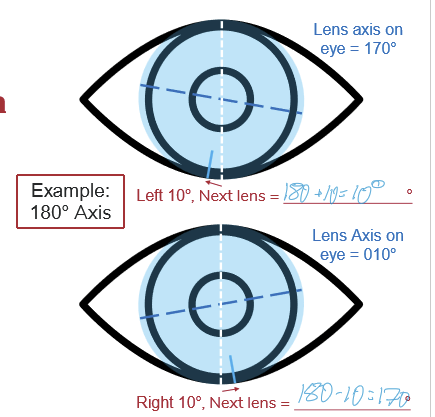
What does LARS tell you, and what does LARS not tell you?
LARS tells you which lens axis to select next to compensate for rotation.
LARS does not tell you where the axis was sitting on the eye when the first lens rotated.
Should the laser marking position change after applying LARS?
No. The marking position should not change with LARS.
The first lens and second lens should have the laser mark in the same position if the lens rotates the same way. LARS changes the cylinder axis location within the lens, not the physical resting position of the lens marking.
Why does LARS work if the lens marking position does not change?
LARS works because it changes the ordered cylinder axis so that after the lens rotates to its usual resting position, the effective lens axis on the eye lands in the correct location.
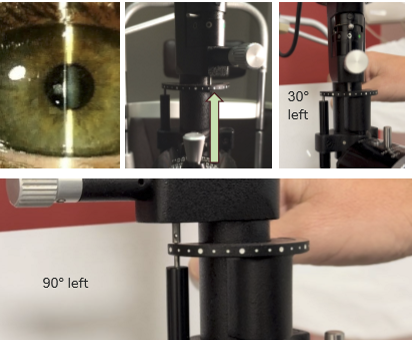
How is toric SCL rotation measured at the slit lamp?
Use a tall, narrow vertical beam, then rotate the slit lamp tower until the beam aligns with the toric lens marking. Measure the rotation in degrees.
What do the slit lamp tower markings represent when measuring toric lens rotation?
On the slit lamp scale:
Large dots = 30°
Small dots = 10°
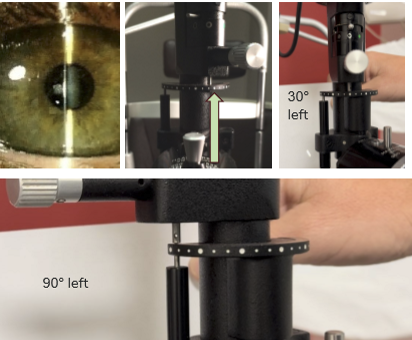
What is the slit lamp procedure for measuring toric lens rotation?
Create a vertical, tall, narrow beam.
Align the beam with the toric lens marking.
Rotate the slit lamp tower until the beam matches the mark.
Read the amount and direction of rotation using the slit lamp scale.
Apply LARS if the rotation is clinically significant.