Surface Anatomy of Forebrain - The Parietal Lobe
 Call Kai
 Learn
Learn Practice Test
 Spaced Repetition
 Match
Match Flashcards
 Knowt Play
1/12

There's no tags or description
Looks like no tags are added yet.
Name | Mastery | Learn | Test | Matching | Spaced | Call with Kai | Chat |
|---|
No analytics yet
Send a link to your students to track their progress
13 Terms
Name the 3 major areas of the lateral surface of the parietal lobe.
Postcentral gyrus
Superior parietal lobule
Inferior parietal lobule
Describe the anatomical position of the postcentral gyrus in relation to adjacent structures.
The postcentral gyrus sits just behind the central sulcus
It is separated from the precentral gyrus (motor cortex) by the central sulcus
It is the most anterior part of the parietal lobe on the lateral surface
Which functional area is housed within the postcentral gyrus?
Primary somatosensory cortex
This cortex processes touch, proprioception, pain and temperature from the contralateral body
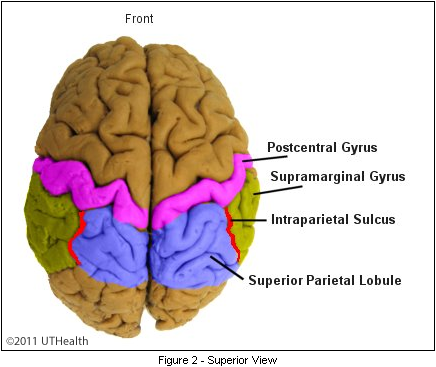
Describe the anatomical position of the superior parietal lobule.
The superior parietal lobule sits behind the postcentral gyrus
It lies above the inferior parietal lobule
The two parietal lobules are separated by the intraparietal sulcus
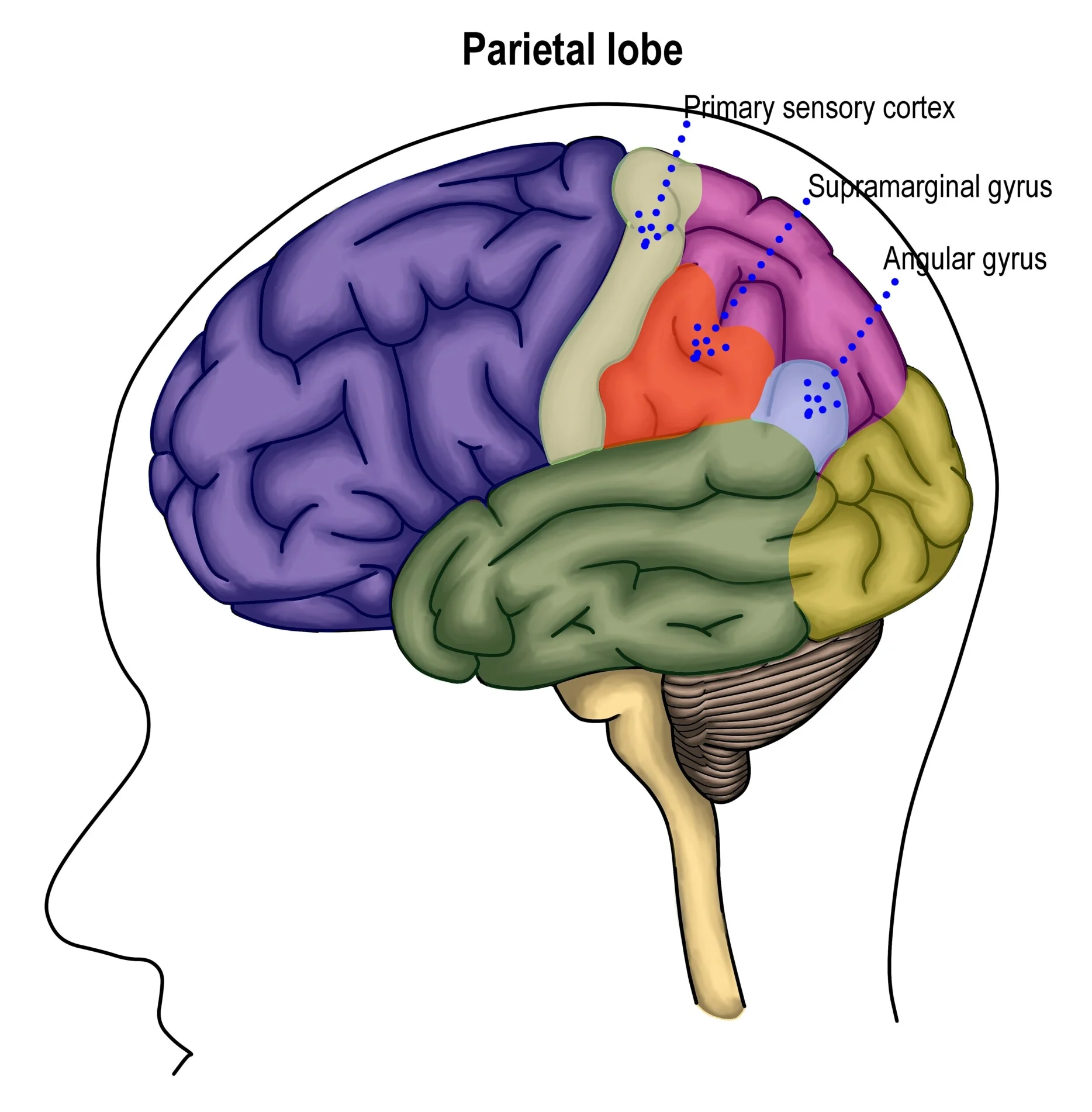
Name the two gyri into which the inferior parietal lobule is divided.
The inferior parietal lobule is divided into:
Supramarginal gyrus — anterior
Angular gyrus — posterior
Describe the language-related function of the inferior parietal lobule and which hemisphere is predominantly responsible.
The inferior parietal lobule (plus nearby temporal regions) in the dominant left hemisphere — is crucial for language comprehension
This region contains Wernicke’s area
Damage here causes Wernicke’s aphasia → fluent but meaningless speech with poor comprehension
What is Wernicke's area, where is it located, and what is the clinical consequence of its damage?
Wernicke’s area is the brain’s language comprehension centre
It sits in the dominant (usually left) hemisphere, mainly in the inferior parietal lobule and extending into the superior temporal gyrus
Damage causes Wernicke’s aphasia → fluent but meaningless speech with severely impaired comprehension
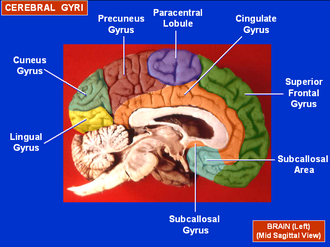
What structures are found on the medial surface of the parietal lobe?
The medial surface of the parietal lobe contains two key structures:
Posterior paracentral lobule
Medial extension of the postcentral gyrus (sensory leg/foot area)
Precuneus
Large medial parietal region behind the paracentral lobule
List the three main general functions of the parietal lobe.
The parietal lobe has three major functions:
Somatosensory processing & localisation
Primary somatosensory cortex in the postcentral gyrus
Language comprehension
Inferior parietal lobule in the dominant (usually left) hemisphere
Spatial orientation & attention
Superior parietal regions handling where things are and where to direct attention
Which parietal region is responsible for processing and localising somatosensory information, and how is it organised?
Region: Primary somatosensory cortex in the postcentral gyrus
Role: Processes and localises touch, pain, temperature, and proprioception
Organisation: Arranged as a sensory homunculus, mapping the contralateral body with precise spatial detail
Correlate each of the three general parietal functions to its specific anatomical location within the lobe.
Somatosensory processing
→ Postcentral gyrus (primary somatosensory cortex)Language comprehension
→ Inferior parietal lobule (Wernicke’s area, dominant/left hemisphere)Spatial orientation & attention
→ Superior parietal lobule and intraparietal sulcus
What deficits might you expect from a large left parietal lobe lesion and why?
A big left parietal lesion can cause:
Contralateral sensory loss
→ Damage to the postcentral gyrus (primary somatosensory cortex)Wernicke’s (receptive) aphasia
→ Damage to the inferior parietal lobule / Wernicke’s area in the dominant (left) hemispherePossible spatial/attentional problems
→ Parietal regions also support attention and spatial processing
A patient suffers a stroke affecting the postcentral gyrus. Which function is most directly impaired?
Somatosensory processing
The postcentral gyrus houses the primary somatosensory cortex; damage causes contralateral hemisensory loss