2A1 Chapter 12 Fluid Mechanics
 Call Kai
 Learn
Learn Practice Test
 Spaced Repetition
 Match
Match Flashcards
 Knowt Play
1/85

There's no tags or description
Looks like no tags are added yet.
Name | Mastery | Learn | Test | Matching | Spaced | Call with Kai | Chat |
|---|
No analytics yet
Send a link to your students to track their progress
86 Terms
What is the study of the behavior of fluids, either liquids or gases?
Fluid mechanics
What is the study of fluids at rest?
Fluid statics
What is the study of fluids in motion?
Fluid dynamics
How do liquids behave in a container?
Liquids are generally incompressible and take the shape of the container.
How do gases behave in a container?
Gases are compressible and usually fill the entire container.
What is the amount of mass (m) per unit volume (V) of a fluid?
Density (ρ)
What is the equation for density?
ρ = m/V
What is the ratio of a fluid's density to the density of water at standard conditions?
Relative density
What is the equation for relative density?
RD = ρ / 1000 kg/m³.
What is the weight (w) of a fluid per unit volume?
Specific weight
What is the equation for specific weight?
γ = w/V.
What is the specific weight of water?
9.81 kN/m³.
What is the reluctance to flow by a fluid acted upon by an external force?
Viscosity
What is the unit of dynamic viscosity in the SI system?
Pascal second (Pa·s) or millipascal second (mPa·s).
What is the ratio of absolute viscosity to mass density?
Kinematic viscosity
What is the unit of kinematic viscosity in the SI system?
Square meter per second (m²/s) or square millimeter per second (mm²/s).
What is the force (F) applied by a fluid on a unit area (A)?
Pressure
What is the equation for pressure?
p = F/A.
Pressure acts in all directions in a fluid, and pressure acts perpendicular to a solid surface where a fluid meets it are the two principles of _____.
Pascal's laws
How does elevation affect pressure in fluids?
Changes in elevation have a greater effect on pressure in liquids than in gases.
What is the equation for pressure at a specific elevation in a fluid?
p = hw, where h is the height of the fluid above.
How do you calculate the mass of a fluid in a tank?
m = ρV
What is the viscosity of water compared to molasses?
Water is much less viscous than molasses.
What is the common standard for gas density measurements?
15°C and atmospheric pressure.
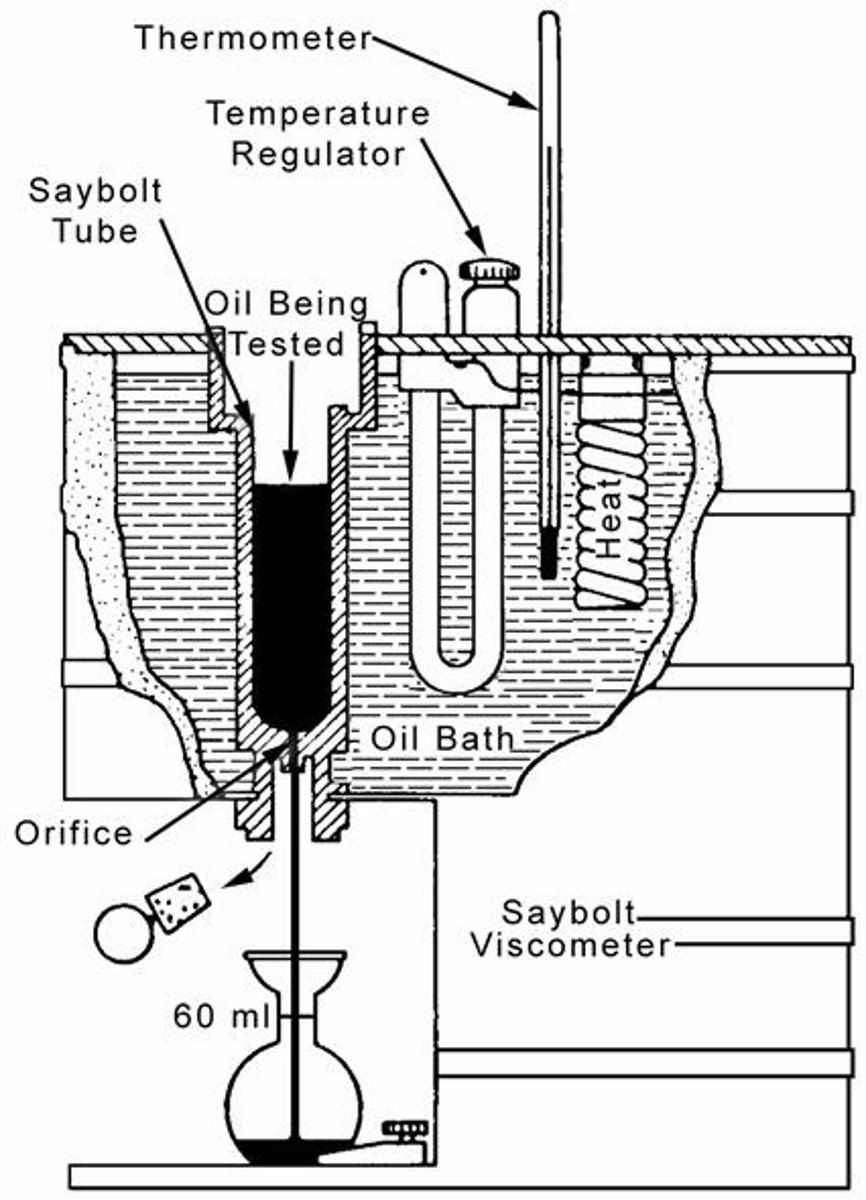
What is the significance of the Saybolt Universal Viscosimeter?
It measures kinematic viscosity by determining the time for a liquid to flow through an orifice.
How is pressure (p) defined in a fluid column?
Pressure is the difference in pressure between two elevations.
What is the formula to calculate pressure at a depth in a fluid?
p = h g ρ, where h is the depth, g is the acceleration due to gravity, and ρ is the density.
How do you calculate the density (ρ) of seawater using relative density (RD)?
ρ = RD × 1000 kg/m³.
What is the equation for calculating force (F) on a submerged surface?
F = pA, where p is the pressure and A is the area.
What is the average pressure on the sides of a tank filled with water?
It is half of the pressure at the bottom of the tank.
What is the coefficient of volumetric expansion (β) for fluids?
It is the change in volume per degree Celsius.
How is the change in volume (ΔV) calculated for thermal expansion?
ΔV = V1 β (T2 - T1), where V1 is the initial volume.
What happens to the volume of a fluid when heated?
It increases due to thermal expansion.
What is the relationship between the coefficients of volumetric and linear expansion?
β is three times α, the coefficient of linear expansion.
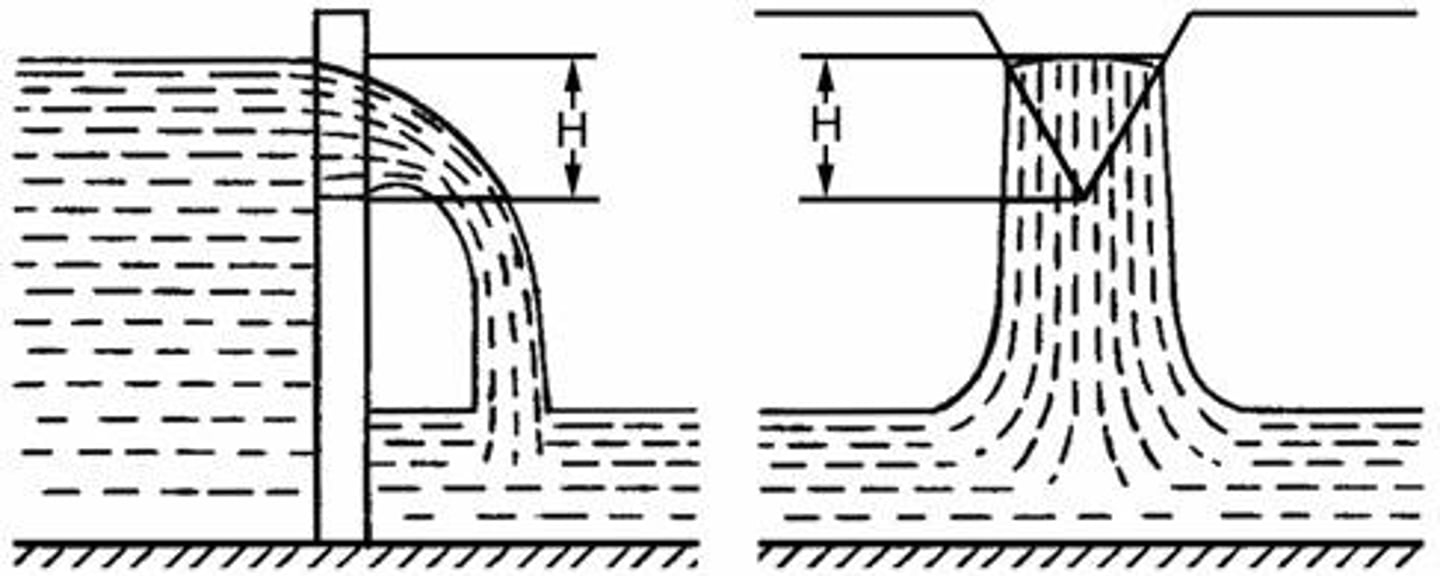
What is a weir in fluid mechanics?
It is an obstruction placed across a channel to control and measure flow.
What is the equation for maximum flow that a weir with a 90° notch can measure?
Q = 2.635 × H5/2, where H is the height of the fluid.
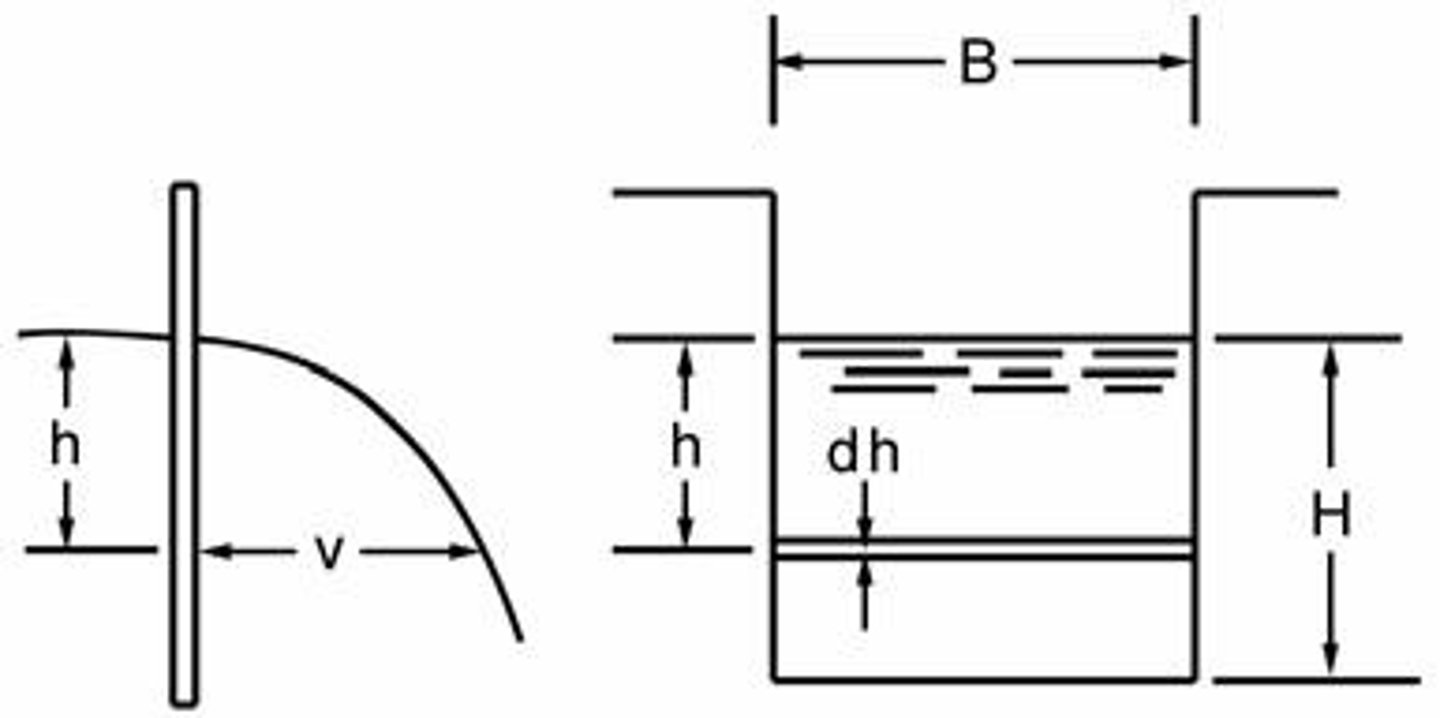
What is the formula for velocity of flow (v) through a rectangular notch?
v = √(2gh), where h is the depth of fluid.
How is the flow through an elemental strip of fluid area calculated?
Flow = Velocity × Area = v × Bdh.
What is the significance of the center of pressure in fluid mechanics?
It determines the direction and magnitude of motion of objects in a fluid.
What is the effect of temperature on the volume of fluids in a closed system?
Fluids expand and may overflow if the temperature increases.
What is the effect of pressure on a submerged surface?
Pressure increases with depth in a fluid.
What is the formula for calculating the change in volume of a tank of oil when heated?
ΔV = V1 × β × (T2 - T1)
What is the relationship between the height of fluid (H) and flow rate (Q) in a weir?
Flow rate increases with the height of fluid above the weir.
What is the effect of fluid density on pressure in a fluid column?
Higher density results in higher pressure at a given depth.
What is the principle of continuity in fluid mechanics?
It states that mass flow is the same at all points in a piping system, assuming no junctions.
What are the three methods to measure flow in fluids?
Volume, mass, and weight.
How is volume flow rate calculated?
Q = A v, where Q is flow rate (m³/s), A is cross-sectional area (m²), and v is average velocity (m/s).
What is the formula for mass flow rate?
M = Q × ρ, where M is mass flow rate (kg/s) and ρ is density (kg/m³).
What is the weight flow rate equation?
W = Q × γ, where W is weight flow rate (N/s) and γ is specific weight of the fluid (N/m³).
What is Bernoulli's principle?
It states that the total energy in a fluid system remains constant, assuming no energy is added or removed.
What are the three forms of energy in a fluid system?
Potential energy, kinetic energy, and flow energy.
How is potential energy (PE) calculated?
PE = mgh, where m is mass, g is acceleration due to gravity, and h is height.
What is the equation for kinetic energy (KE)?
KE = 1/2 mv², where m is mass and v is velocity.
What is flow energy expressed as?
Ef = pQ, where p is pressure and Q is flow rate.
What is the discharge coefficient in fluid flow?
It accounts for friction, contraction of flow, and approach velocity, typically around 0.59 to 0.62.
What is the formula for calculating the head over a notch?
H = (Q × C × B) / (g × d), where Q is discharge, C is discharge coefficient, B is width, g is gravity, and d is density.
What is the significance of a rectangular notch in fluid mechanics?
It is used to measure the flow rate of fluids based on the head of water above the notch.
What happens to laminar flow at higher velocities?
It begins to break down and becomes turbulent.
What is the relationship between area and velocity in a pipe according to the principle of continuity?
A1V1 = A2V2, meaning the product of area and velocity is constant along the pipe.
What is the effect of friction on fluid flow?
It reduces the flow rate and requires the use of a discharge coefficient.
What does the term 'steady flow' mean?
Flow that does not vary or fluctuate at a specific location over time.
What does 'laminar flow' refer to?
Flow that moves in layers (laminae) with straight parallel streamlines.
What is the formula for calculating the area of a circular pipe?
A = π r², where r is the radius of the pipe.
What is the significance of the conservation of energy in fluid mechanics?
It allows for the analysis of energy transformations within a fluid system.
What is the relationship between pressure and flow energy?
Flow energy is directly proportional to pressure in a fluid system.
What does Bernoulli's equation relate to?
It relates pressure, velocity, and elevation in fluid flow.
What are the three terms represented in Bernoulli's equation?
Elevation head, pressure head, and velocity head.
What does 'w' represent in Bernoulli's equation?
The force of gravity on 1 m³ of fluid (N).
What is the significance of 'h' in Bernoulli's equation?
Height above datum level (metres).
What does 'P' denote in Bernoulli's equation?
Pressure (N/m² or Pa).
What does 'v' stand for in Bernoulli's equation?
Velocity of water (metres/second).
What are the restrictions on Bernoulli's principle?
1. Applies only to incompressible fluids. 2. Flow must be steady. 3. No energy added or extracted. 4. No heat transfer. 5. No energy loss due to friction.
In a flow problem, when can pressure head be ignored?
When points are taken at a free surface where pressure is zero.
What is the coefficient of discharge?
A factor less than 1 used to correct for minor losses in flow.
What is a Venturi meter used for?
To measure flow rates based on pressure drop due to increased flow velocity.
What happens to velocity when the diameter of a pipe is reduced?
Velocity increases as per the principle of continuity.
What is the relationship between pressure and velocity in Bernoulli's principle?
As velocity increases, pressure decreases.
How do you calculate the volume of oil given its mass and relative density?
Volume = mass / (relative density * density of water).
What is the relationship between flow area and velocity in a venturi meter?
As the flow area decreases, the velocity increases.
What is the formula for calculating the flow rate through an orifice?
Q = Cd A sqrt(2gh), where h is the height of fluid above the orifice.
What principle allows flow rate to be derived in a venturi meter?
A combination of Bernoulli's equation and the equation of continuity.
What is the significance of the elevation head terms in Bernoulli's equation for a horizontal venturi meter?
The change in elevation is zero, making the elevation head terms negligible.
What happens to the pressure when the velocity of fluid increases in a venturi meter?
The pressure decreases according to Bernoulli's principle.
What is the formula for calculating the volume of oil given its mass and relative density?
Volume = mass / (relative density × density of water).
What is the total force on the bottom of a tank filled with water?
Total force = pressure × area, where pressure is due to the water depth.
What is the effect of a coefficient of discharge of 0.7 on flow from a hole in a tank?
It reduces the theoretical flow rate calculated from the hole's area and pressure head.