Chapter 2 - Methods to Study Proteins
 Call Kai
 Learn
Learn Practice Test
 Spaced Repetition
 Match
Match Flashcards
 Knowt Play
1/54

There's no tags or description
Looks like no tags are added yet.
Name | Mastery | Learn | Test | Matching | Spaced | Call with Kai | Chat |
|---|
No analytics yet
Send a link to your students to track their progress
55 Terms
Activation assay
monitoring blood sugar levels of rabbits following injection of each solution to identify the fractions that could lower the blood sugar
When do you need to isolate a protein?
to study the function of known protein
to recapitulate a cellular process in a test tube and to assemble the protein components
to isolate a protein in pure form for structure biology
to identify a novel protein responsible for a cellular function
What are the starting materials and final products for protein purification?
Starting materials: gram quantities of a complex mixture of protein, nucleic acids, glycine, lipids, etc.
Final product: milligram or microgram quantities of desired protein at high purity
What are the procedures of protein purification?
developing a specific assay
cell disruption
fractionation/purification
detect the presence of the protein of interest
assess the yield and purity of the final product
Specific assay
a test used to measure and quantify both the presence of your protein inside the sample and its activity/function
What unique characteristics can the specific assay based upon the protein of interest?
enzymatic activity (e.g., conversion of starch to glucose by amylase)
immunological activity (e.g., Western blotting)
physical characteristics (e.g., molecular mass and spectroscopic properties)
biological activity (e.g., lowering blood sugar levels by insulin)
What 4 things should a good assay have?
specific (don’t want a false positive)
rapid (don’t want to wait long periods of time for the results)
sensitive (don’t want to consume all of the sample in order to assay it)
quantitative (need an accurate way to measure the quantity of your protein at each step in the purification)
What is the goal of cell disruption?
to break open cells and release the target protein
Osmotic shock
lowering the ionic strength of the medium cells are kept in to make cells swell and burst
detergent-mediated lysis
detergents disrupt cells membranes and release intracellular contents
enzymatic lysis
enzymes such as lysozyme break down bacterial cell walls to facilitate cell lysis
mechanical agitation
high-speed collisions between small beads and cells physically break the cells open
sonication
high-frequency sound waves (20-50 kHz) disrupt cells but can generate heat that may damage sensitive proteins
pressure disruption
cells are subjected to very high pressure (up to 25,000 psi). When the pressure is released, the rapid pressure change causes dissolved gases in cells to be released as bubbles which, in turn, break open the cells
cryopulverization
samples are flash-frozen in liquid nitrogen and ground into a fine powder to facilitate extraction of cellular contents. Often employed for samples having a tough extracellular matrix, such as connective tissue or seeds.
Crude Extract /Homogenate/ Cell Lysate
the soupy mess obtained after cell disruption
Do all 3 of these terms have the same meaning: crude extract/ homogenate/ cell lysate?
yes, it is the soupy mess obtained after cell disruption
True or False: The crude cell lysates contain all of the molecules in the cell, and thus, must be further processed to separate the molecules into smaller, subsets, or fractions.
True
What occurs in fractionation/purification?
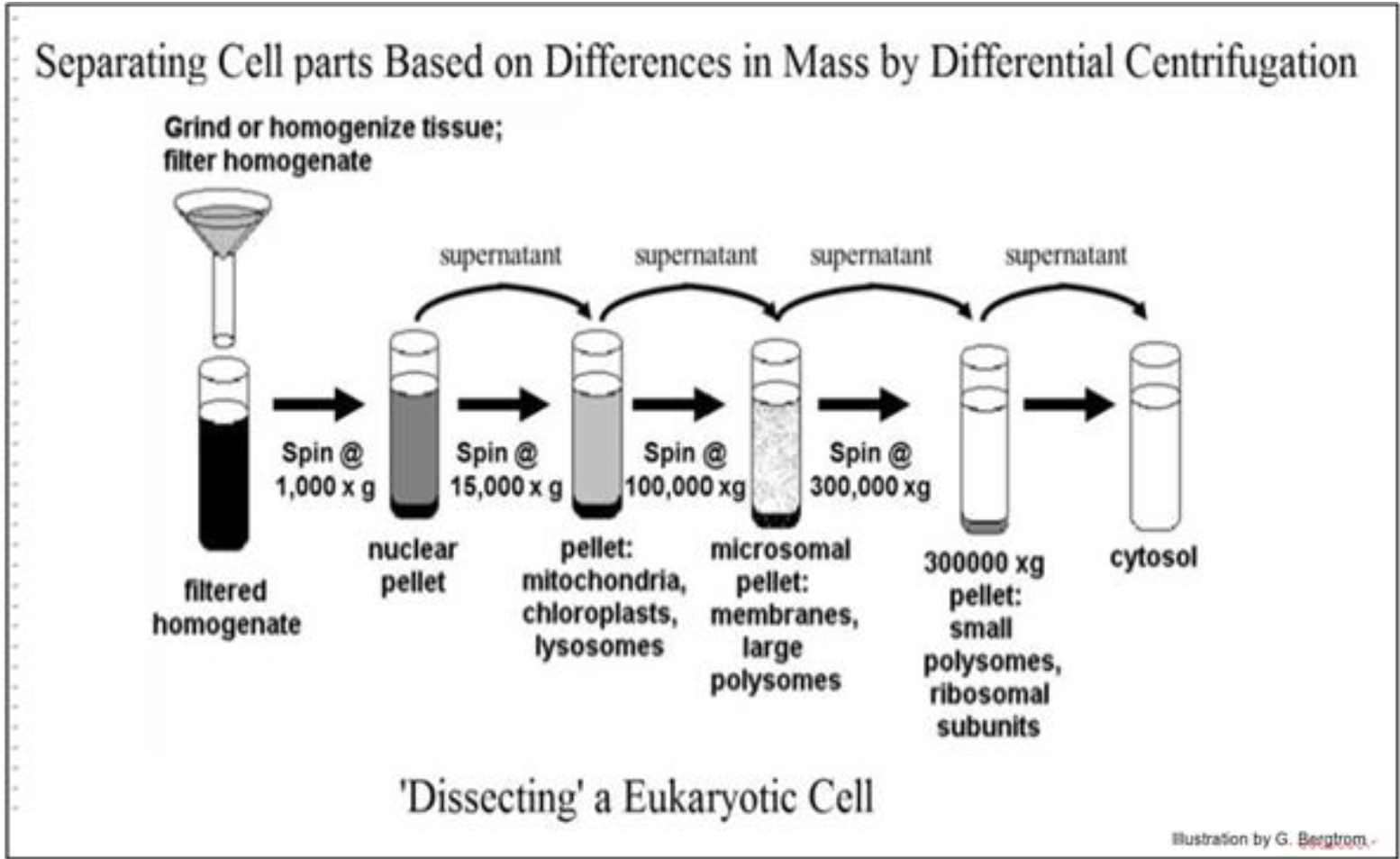
Fractionation of the crude extract begins with centrifugation, which separates insoluble cellular components from the soluble cell lysate (supernatant) based largely on differences in size and density
If the target protein is soluble, it remains in the supernatant and can be further purified using what?
column chromatography
Differential centrifugation
the stepwise separation of cellular components using increasing centrifugation speeds
Proteins differ in what properties and what do these differences allow for?
Size, charge, shape, and affinity. These differences can be exploited to separate a target protein from other proteins.
What is the most commonly used method for protein separation?
chromatography

What instrument is used to perform column chromatography?
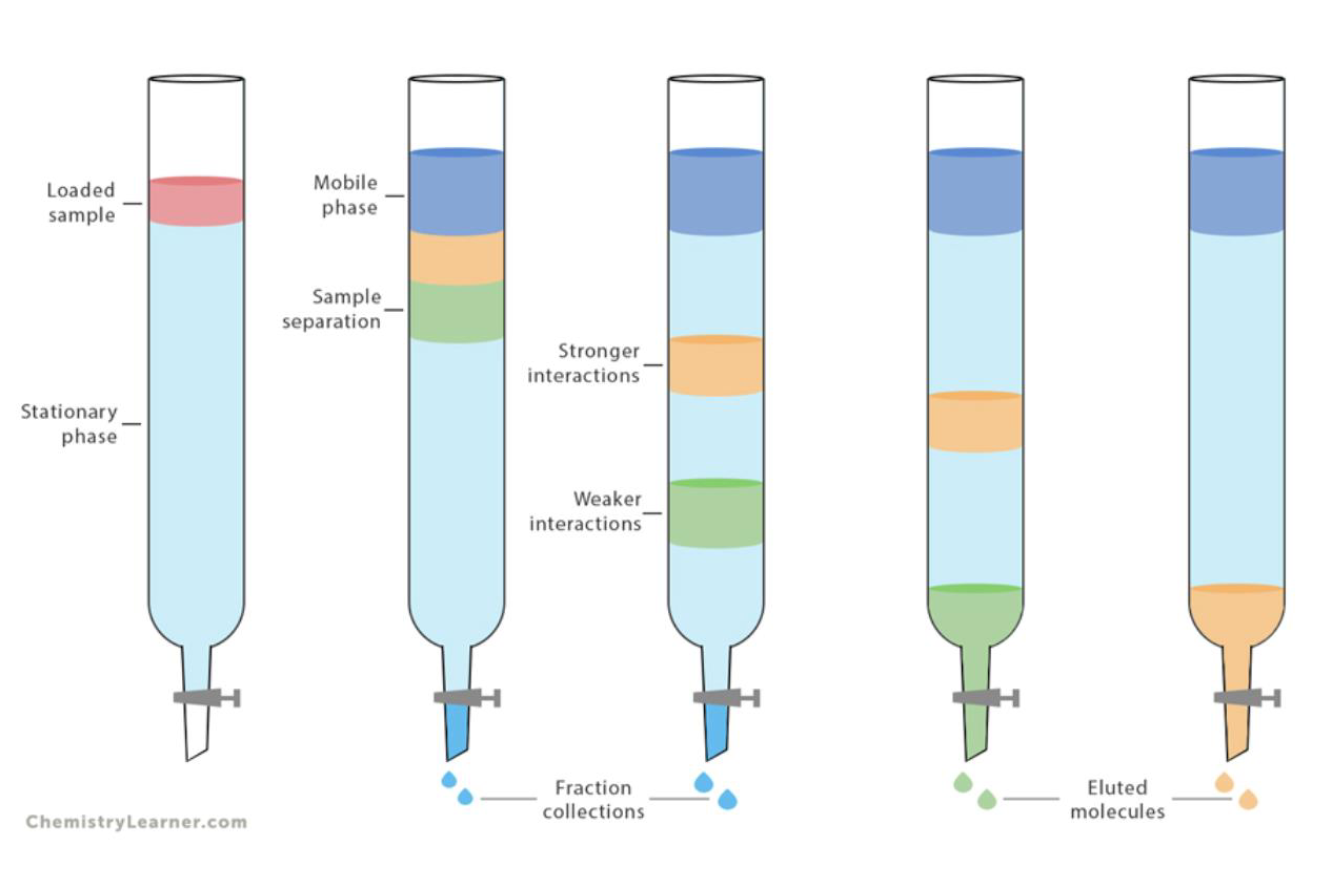
Long glass tubes filled with a specific solid/gel material which serves as the stationary phase

During chromatography, what is the mobile phase?
the buffer or other solvents

During chromatography, what is the stationary phase?
usually a solid matrix
What is the buffer in chromatography?
a specialized aqueous solution used in the mobile phase to keep the pH stable and control the electrical charge of sample molecules during separation

The mobile phase moves through which phase?
It moves through the stationary phase carrying components of the mixture

How are proteins separated in column chromatography?
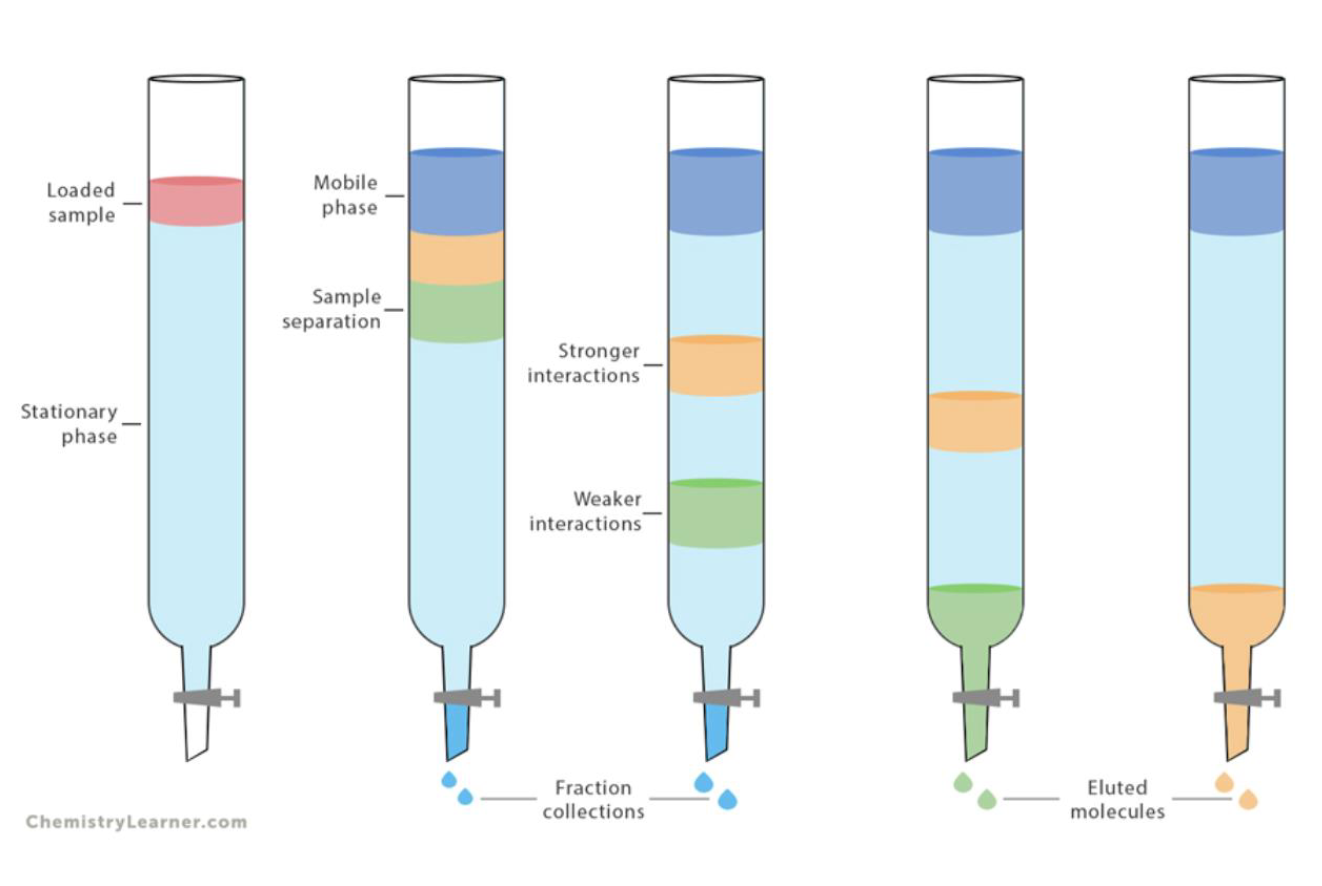
The proteins move through the stationary phase at different rates. Some proteins will interact with the stationary phase for longer than others, therefore separating the proteins.
The reason proteins have different migration rates in column chromatography depends on what?
the type of chromatography used
What are 3 types of column chromatography for protein separation?
ion exchange chromatography
gel exclusion chromatography
affinity chromatography
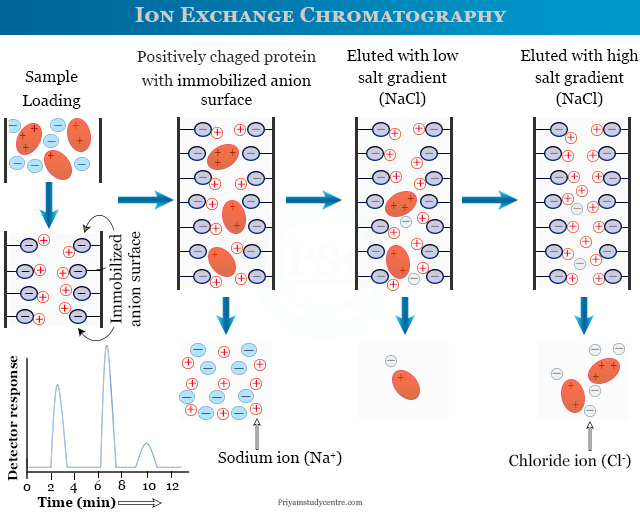
ion exchange chromatography
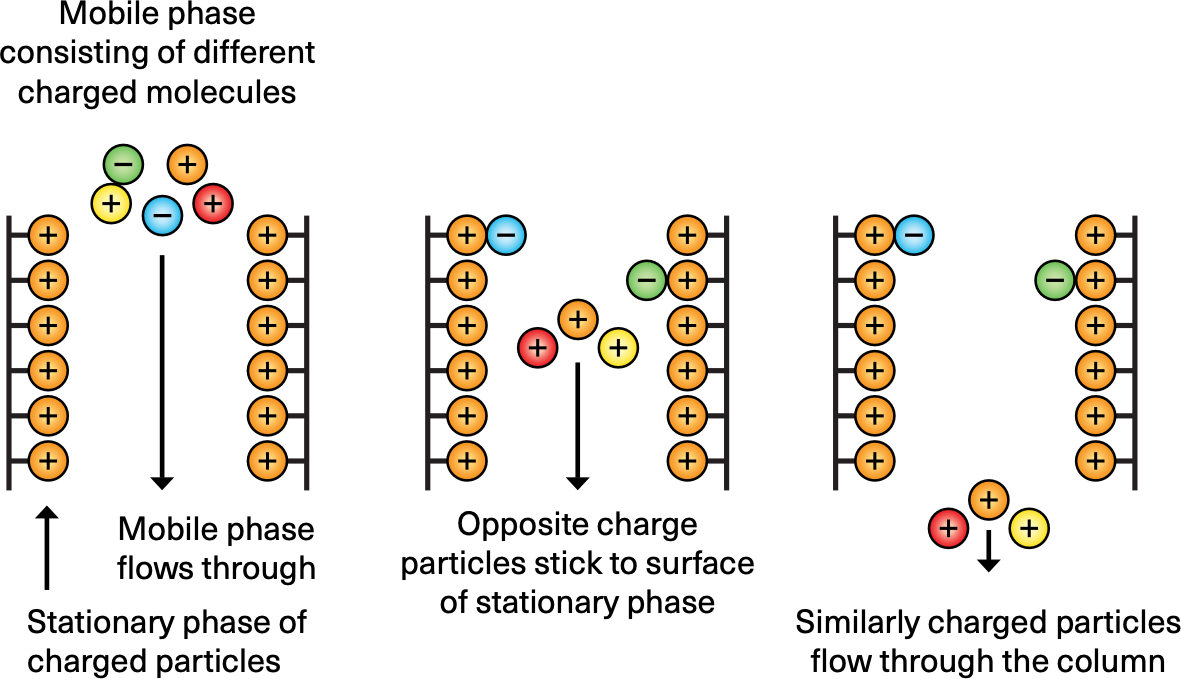
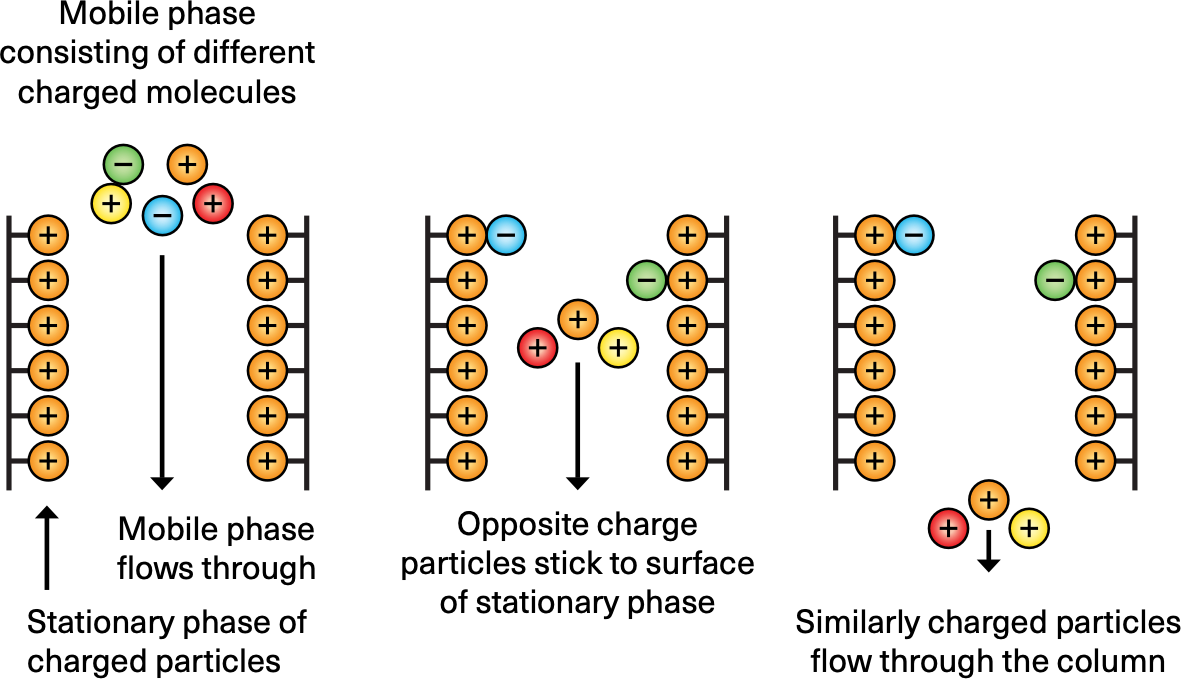
separates proteins based on their net charge by using a charged resin that binds oppositely charged proteins
In an ion exchange chromatography, how are bound proteins eluted?
by either adding salt to interfere with the electrostatics or changing the charge on the protein by altering the pH
cation-exchange column
matrix is negatively charged and proteins with a positive charge bind ionically to the matrix
anion-exchange column
matrix is positively charged and proteins with a negative charge bind ionically to the matrix
isoelectric point (pI) of a protein
the pH value at which the net charge on the protein is ZERO
how can the net protein charge be altered?
by changing pH or by adding salt to neutralize the charge
Why is it important to pick the appropriate pH of the sample buffer, the column and elution buffer?
It determines the charge of the protein, which in turn will determine which proteins ‘stick’ and which ones elute
How does knowing the isoelectric point (pI) of the protein help experimenters?
It helps determine the appropriate pH for the buffers and helps design a purification protocol using ion exchange chromatography
If the pH of a buffer is less than the pI of the protein then…
the protein/peptide will be positively charged
pH < pI
protein positive
If the pH of a buffer is greater than pI of the protein, then…
the protein/peptide will be negatively charged
gel exclusion chromatography
separation based on size

affinity chromatography
separation based on binding affinities of proteins for molecules covalent linked to the support beads
protein of interest is often genetically engineered to contain an affinity tag

His-tag consisting of 6 consecutive histidines (6xHis), which bind nickel Ni2+ ions held by NTA (nitrilotriacetic acid) groups on the resin.
What type of chromatography is this?
affinity chromatography

What is the first step of chromatography?
Column equilibration.
Column is filled with the beads and equilibrated with an appropriate buffer

What is the 2nd step of chromatography?
Lysate is added to the top of the column, and the same buffer is allowed to flow through the column.
As the buffer flows through the column, the mixture of proteins is drawn down the column and interacts with the resin.
Proteins not interacting with the resin flow through and come out of the column.
flow-through
the initial sample that flows through the column without interacting with the resin


What is the 3rd step of chromatography?
Proteins will be separated in multiple fractions, each containing different sets of proteins, which are collected sequentially from the bottom of the column.
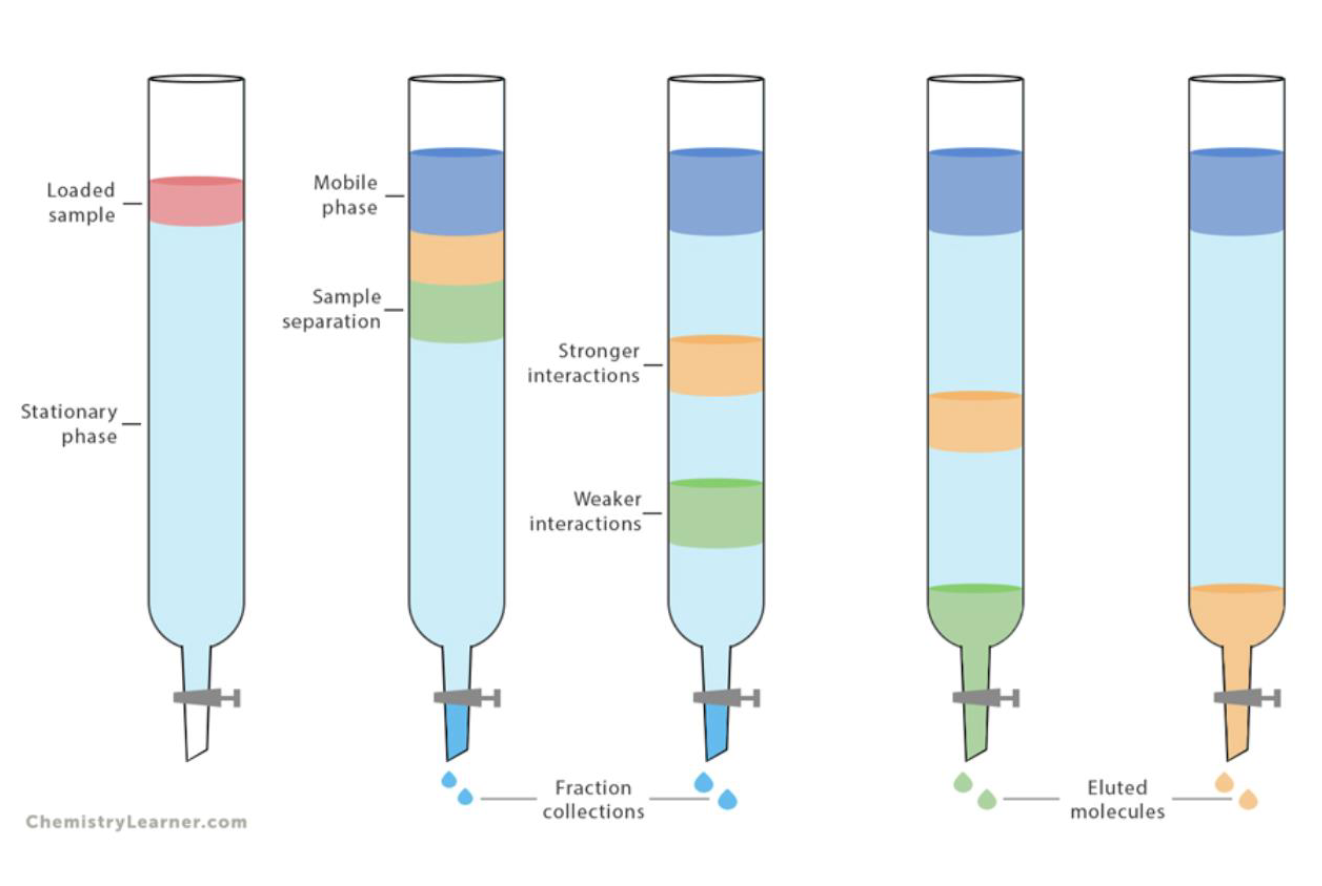
fractions
material that is collected from the bottom of the column in small volumes

What is the 4th step of chromatography?
Elution

Elution
the desired protein will eventually drip out or elute, from the column. This is often done by changing to elution buffers

elution buffers
a specialized aqueous solution used in the mobile phase to keep the pH stable and control the electrical charge of sample molecules during separation
eluates
the fraction in which the desired protein may be present