NBRC TMC Exam B
 Call Kai
 Learn
Learn Practice Test
 Spaced Repetition
 Match
Match Flashcards
 Knowt Play
1/139

There's no tags or description
Looks like no tags are added yet.
Name | Mastery | Learn | Test | Matching | Spaced | Call with Kai | Chat |
|---|
No analytics yet
Send a link to your students to track their progress
140 Terms
A patient with a PBW of 55 kg (121 lb) is receiving VC, A/C ventilation. Ventilator settings and blood gas analysis results are: FIO2 0.70 Mandatory rate 14 VT 350 mL PEEP 5 cm H2O pH 7.35 PaCO2 35 mm Hg PaO2 40 mm Hg HCO3- 19 mEq/L BE -6 mEq/L SO2 (calc) 74% A respiratory therapist should recommend
A. changing to SIMV mode.
B. increasing to 10 cm H2O PEEP.
C. changing to 5 cm H2O CPAP.
D. increasing to 400 mL VT.
B. increasing to 10 cm H2O PEEP.
When instructing a patient on the administration of umeclidinium/vilanterol (Anoro Ellipta), which of the following is most important to emphasize?
A. Gargle immediately after use.
B. Inhale slowly with a breath hold.
C. Breathe in fast and deep.
D. Shake medication vigorously before use.
C. Breathe in fast and deep.
Following placement of a tracheostomy tube for long-term mechanical ventilation, which of the following patient positions best prevents ventilator-associated pneumonia?
A. prone
B. Trendelenburg
C. supine
D. semi-Fowler
D. semi-Fowler
Which of the following is used to monitor the partial pressure of transcutaneous carbon dioxide?
A. red-light absorption sensor
B. electromechanical transducer
C. infrared analyzer
D. Stow-Severinghaus electrode
D. Stow-Severinghaus electrode
An adult patient requires frequent blood sampling and medication administrations through an IV for 1 month. The preferred vascular access is a
A. peripherally inserted central catheter.
B. subclavian central vascular line.
C. standard peripheral IV line.
D. internal jugular catheter.
A. peripherally inserted central catheter.
A 170-cm (5-ft 7-in), 69-kg (152-lb) male with ARDS has the following ABG analysis results:
pH 7.37
PCO2 43 mm Hg
PO2 95 mm Hg
HCO3- 25 mEq/L
BE -1 mEq/L
SO2 (calc) 97%
The patient is receiving VC, A/C ventilation with the following settings:
FIO2 0.70
Mandatory rate 12
VT 450 mL
PEEP 8 cm H2O
Which of the following is most appropriate?
A. Decrease the FIO2 to 0.60.
B. Change the PEEP to 5 cm H2O.
C. Increase the minute ventilation.
D. Maintain the current settings.
A. Decrease the FIO2 to 0.60.
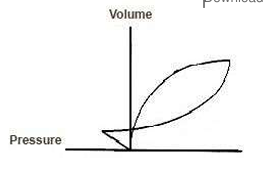
Following an emergent C-section, a 35-year-old is receiving VC, A/C ventilation. The following pressure-volume loop is observed: Which of the following ventilator settings should be adjusted?
A. PEEP
B. flow rate
C. tidal volume
D. trigger sensitivity
D. trigger sensitivity
Which of the following techniques is preferred for a quadriplegic patient having difficulty expectorating secretions?
A. pursed lip breathing
B. abdominal thrust
C. PEP therapy
D. inspiratory muscle training
B. abdominal thrust
A patient with a history of hypertension was awakened by cough and shortness of breath. He has fine inspiratory crackles bilaterally. Which of the following should a respiratory therapist recommend?
A. prednisone
B. albuterol
C. furosemide (Lasix)
D. guaifenesin (Mucinex)
C. furosemide (Lasix)
The preferred suction device to remove large amounts of secretions from the oral cavity of an adult patient is a
A. Yankauer device.
B. DeLee suction trap.
C. whistle-tip catheter.
D. Coudé catheter.
A. Yankauer device.
A respiratory therapist examines a patient and notes coarse crackles over both lung fields. Which of the following does this most likely indicate?
A. subcutaneous emphysema
B. pleurisy
C. bronchospasm
D. secretions
D. secretions
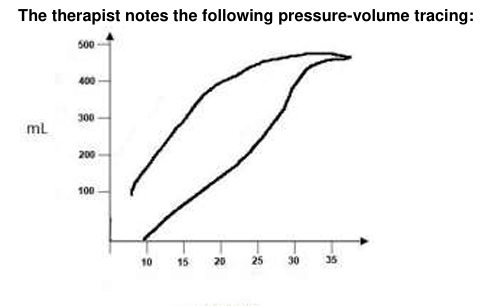
A 28-year-old patient is being evaluated by a respiratory therapist after a trauma. The patient is receiving VC ventilation with the following settings:
FIO2 0.65
Mandatory rate 14
VT 450 mL
PEEP 8 cm H2O
The therapist notes the following pressure-volume tracing:
The therapist should recommend decreasing the
A. mandatory rate.
B. PEEP.
C. VT.
D. expiratory time.
C. VT.
A 74-year-old female patient is admitted for management of community-acquired pneumonia. The patient's chest radiograph and CT scan show an RLL infiltrate with a nonloculated, significant pleural effusion on the right side. Which of the following should the therapist anticipate?
A. echocardiogram
B. thoracentesis
C. V ̇ /Q ̇ scan
D. bronchoscopy
B. thoracentesis
Which of the following is typically associated with bilateral, fluffy infiltrates on a chest radiograph?
A. pulmonary edema
B. neoplasm
C. pleural effusion
D. hemothorax
A. pulmonary edema
Which of the following should a respiratory therapist use to confirm the presence of auto-PEEP during VC ventilation?
A. square-wave inspiratory flow
B. end-expiratory hold
C. plateau pressure
D. PSV mode
B. end-expiratory hold
Which of the following best maintains airway patency during bag-mask ventilation in an unconscious patient?
A. cricoid pressure
B. oropharyngeal airway
C. Trendelenburg position
D. neck hyperflexion
B. oropharyngeal airway
Which of the following can result in an increase in PVR?
A. hyperoxia
B. hypovolemia
C. excessive PEEP
D. decreased cardiac output
D. decreased cardiac output
Which of the following is a characteristic of pulse-dose oxygen-conserving devices?
A. Flow is constant regardless of tubing length.
B. Gas delivery is synchronized with the beginning of exhalation.
C. It is preferred for patients who need more than 2 L/min of oxygen.
D. Most of the oxygen delivery occurs during the first quarter of inhalation.
D. Most of the oxygen delivery occurs during the first quarter of inhalation.
Which of the following best describes VC ventilation?
A. Inspiration ends after delivery of a preset volume.
B. Inspiration ends after the patient exhales a targeted volume.
C. Pressure is held constant during inspiration until a preset volume is delivered.
D. Pressure is held constant during inspiration until the patient exhales a targeted volume.
A. Inspiration ends after delivery of a preset volume.
A fixed-wing medical transport with an unpressurized cabin has ascended to 10,000 ft while transporting a patient with COPD. The patient is receiving nasal oxygen at 2 L/min and becomes agitated and confused. A respiratory therapist should
A. increase oxygen flow.
B. initiate mask CPAP.
C. recommend a diuretic.
D. recommend a sedative.
A. increase oxygen flow.
A gas is saturated with 100% relative humidity at 32º C (89.6º F). After the gas cools to 27º C (80.6º F), which of the following is the best estimate of the relative humidity?
A. 90%
B. 100%
C. 70%
D. 80%
B. 100%
The following data are obtained for an adult patient:
FIO2 1.00
VD/VT 0.45
Respiratory exchange rate 0.80
PB 747 mm Hg
PH 7.42
PaCO2 38 mm Hg
PaO2 152 mm Hg
HCO3 25 mEq/L
BE +1 mEq/L
SaO2 99%
What is the P(A-a)O2 (mm Hg)?
A. 550
B. 350
C. 500
D. 200
C. 500
A patient complaining of dyspnea has a heart rate of 112/min and a respiratory rate of 28/min. The following ABG analysis results are obtained while the patient is receiving oxygen at 5 L/min by nasal cannula:
pH 7.47
PCO2 33 mm Hg
PO2 48 mm Hg
HCO3- 24 mEq/L
BE +1 mEq/L
SO2 (calc) 83%
Which of the following should be done FIRST?
A. Increase the oxygen flow to 7 L/min.
B. Switch to a nonrebreathing mask.
C. Initiate mechanical ventilation.
D. Initiate 3 cm H2O CPAP.
B. Switch to a nonrebreathing mask.
A patient who is receiving mechanical ventilation is scheduled for a fiberoptic bronchoscopy. Which of the following is the primary threat to adequate ventilation during the procedure?
A. secretion production
B. elevated airway pressure
C. loss of consciousness
D. airway obstruction
D. airway obstruction
A 178-cm (5-ft 10-in), 80-kg (176-lb), 23-year-old male is admitted to an ICU following a drug overdose. VC, A/C ventilation is initiated with the following settings:
FIO2 0.30
Mandatory rate 16
Total rate 18
VT 550 mL
Inspiratory flow 25 L/min
Pressure limit 45 cm H2O
The high-pressure alarm is sounding frequently, and wide fluctuations in pressure are noted. A respiratory therapists most appropriate action is to
A. sedate the patient.
B. decrease the tidal volume.
C. increase the pressure limit.
D. increase the flow.
D. increase the flow.
A 168-cm (5-ft 6-in), 72-kg (159-lb), 26-year-old female was injured in a motor vehicle crash. She is intubated at the scene with a 6.0-mm ID endotracheal tube. On arrival to the ED, VC, A/C ventilation is initiated, and the following data are noted:
FIO2 0.40
Mandatory rate 12
VT 375 mL
Inspiratory flow 40 L/min
PEEP 5 cm H2O
PIP 40 cm H2O
Pplat 28 cm H2O
The patient is exhibiting increased work of breathing and is breathing dyssynchronously with the ventilator. A respiratory therapist should recommend
A. increasing the set inspiratory flow.
B. raising the tidal volume.
C. performing a bronchoscopy.
D. reintubating with a larger endotracheal tube.
D. reintubating with a larger endotracheal tube.
A patient who is morbidly obese is receiving aerosol by tracheostomy collar 48-hours post-tracheotomy. A respiratory therapist notices the patient is experiencing acute respiratory distress after being turned to the right side for a bath. Which of the following should the therapist do NEXT?
A. Place the patient supine before assessing tube position.
B. Remove and replace the tracheostomy tube.
C. Irrigate the airway with normal saline.
D. Attempt to suction the airway.
A. Place the patient supine before assessing tube position.
An adult patient's heart rate drops from 82 to 40/min immediately after a suction catheter is inserted into the trachea and before suction is applied to the airway. Which of the following is the most probable cause?
A. hypoxemia
B. vagal reflex
C. mucosal trauma
D. hypercapnia
B. vagal reflex
A 31-year-old female who is a victim of a residential fire is brought to the ED and is receiving oxygen by nasal cannula
at 8 L/min. SpO2 is 100%. The following data are observed:
pH 7.31
PCO2 32 mm Hg
PO2 205 mm Hg
HCO3- 16 mEq/L
BE -9 mEq/L
SO2 (meas) 99%
O2Hb 78%
COHb 21%
Hb 14.5 g/dL
A respiratory therapist should recommend
A. changing to 0.50 with an air-entrainment mask system.
B. administering an FIO2 of 0.60 with an HHFNC.
C. maintaining current oxygen therapy.
D. switching to a nonrebreathing mask at 15 L/min.
D. switching to a nonrebreathing mask at 15 L/min.
The major component of pulmonary surfactant is
A. protein.
B. glucose.
C. phospholipid.
D. polysaccharide
C. phospholipid.
A patient's V ̇ /Q ̇ scan indicates an excess of ventilation compared to perfusion in the left lower lobe. These results suggest
A. right-to-left shunt.
D. pulmonary embolism.
C. pneumonia.
D. hemothorax.
D. pulmonary embolism.
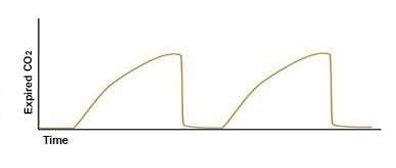
The following capnography tracing is observed following intubation:
This waveform is consistent with
A. cardiac arrest.
B. normal exhalation.
C. air leak.
D. airflow obstruction.
D. airflow obstruction.
A physician will be sedating a patient for a procedure and asks a respiratory therapist to monitor the patient's ventilation.
The therapist should select a
A. pulse oximeter.
B. colorimetric CO2 detector.
C. capnometer.
D. transcutaneous oxygen monitor.
C. capnometer.
A 35-year-old patient with asthma is being evaluated 1 week after discharge for an acute exacerbation. The patient's home regimen is albuterol MDI 2 puffs q.i.d. The patient continues to have wheezing throughout the day. A respiratory therapist should recommend changing to
A. levalbuterol (Xopenex).
B. umeclidinium/vilanterol (Anoro Ellipta).
C. fluticasone/salmeterol (Advair Diskus).
D. azithromycin (Zithromax).
C. fluticasone/salmeterol (Advair Diskus).
While administering an IPV treatment at 20 cm H2O to a patient with cystic fibrosis, a respiratory therapist notes the patient has suddenly become very short of breath and cyanotic. The therapist's most appropriate action is to
A. suction the patient.
B. terminate the treatment.
C. decrease the peak pressure to 10 cm H2O.
D. stop the treatment for 10 to 20 minutes.
B. terminate the treatment.
A 28-year-old female patient with a burn injury is being monitored in the ICU. She is 165 cm (5 ft 5 in) tall and weighs 61 kg (134 lb). A respiratory therapist notes the following data:
Pv̄ O2 43 mm Hg
PCWP 4 mm Hg
PPA 11 mm Hg
CVP 4 cm H2O
Urine output 6 mL/hr.
The therapist should conclude the patient is
A. hypovolemic
B. fluid overloaded.
C. clinically stable.
D. acidotic.
A. hypovolemic
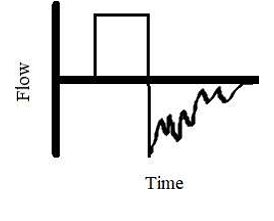
A respiratory therapist is caring for a patient receiving mechanical ventilation and observes the following waveform:
The therapist should conclude the waveform shows
A. evidence of auto-PEEP.
B. the presence of airway secretions.
C. a leak in the system.
D. inadequate inspiratory flow rate.
B. the presence of airway secretions.
A respiratory therapist is evaluating a 43-year-old female who reports a history of nausea and insomnia since she started using 21 mg nicotine (Nicoderm CQ) patches 1 week ago. The most appropriate action for a respiratory therapist is to
A. suggest the patient try an equivalent dose of oral nicotine replacement.
B. explain these effects are expected for nicotine replacement therapy.
C. suggest switching to a lower-dose nicotine patch.
D. recommend the patient begin taking an antiemetic.
C. suggest switching to a lower-dose nicotine patch.
A patient's blood pressure is monitored by an appropriately positioned arterial catheter transducer. The transducer is mounted on an IV pole that is not attached to the bed. The bed is lowered to permit routine patient care. How will this affect the measured blood pressure?
1. increased systolic
2. decreased systolic
3. increased diastolic
4. decreased diastolic
A. 1 and 3 only
B. 1 and 4 only
C. 2 and 4 only
D. 2 and 3 only
C. 2 and 4 only
The primary purpose of cleaning and sterilizing nondisposable respiratory care equipment after each use is to
A. extend the life of the equipment.
B. prevent patient infections.
C. prevent contamination of other equipment.
D. protect the personnel handling the equipment.
B. prevent patient infections.
Extreme weather conditions have caused extended and widespread power outages. Many patients who depend on respiratory devices at home are seeking care in the ED. The hospital is overwhelmed with patients who ran out of supplemental oxygen at home or have depleted ventilator batteries. According to CDC guidelines, a respiratory therapist should FIRST
A. prioritize patients showing signs of acute respiratory distress.
B. refer patients with a chronic disease to other facilities.
C. set up oxygen tanks and regulators in the waiting room.
D. centralize a charging station for medical devices.
A. prioritize patients showing signs of acute respiratory
A male patient who is 180 cm (5 ft 11 in) tall and weighs 80 kg (176 lb) is orally intubated with a 7.0-mm ID endotracheal tube. Mechanical ventilation was initiated with an HME in the circuit. After 7 days, the patient's secretions are more difficult to suction. A respiratory therapist should FIRST
A. use a smaller suction catheter.
B. recommend changing to a larger endotracheal tube.
C. replace the HME with a heated humidifier.
D. administer dornase alfa (Pulmozyme).
C. replace the HME with a heated humidifier.
Which of the following should a respiratory therapist instruct a patient to use when cleaning the home CPAP mask and connecting tubing?
A. acetic acid
B. hydrogen peroxide
C. dishwashing soap
D. isopropyl alcohol
C. dishwashing soap
Which of the following values are needed to determine a patient's physiologic dead space?
A. expired PCO2 and Pv̄ CO2
B. arterial PCO2 and expired PCO2
C. Pv̄ CO2 and arterial PO2
D. arterial PO2 and arterial PCO2
B. arterial PCO2 and expired PCO2
Given a normal oxyhemoglobin dissociation curve, an SpO2 of 75% should be associated with a PaO2 of
A. 47 mm Hg.
B. 61 mm Hg.
C. 55 mm Hg.
D. 36 mm Hg.
A. 47 mm Hg.
A patient lost an unknown quantity of blood as a result of a motor vehicle crash. To fully assess oxygen delivery, a respiratory
therapist should recommend
A. a CBC.
B. exhaled nitric oxide.
C. crossmatch of the patient's blood type.
D. serial blood pressure assessment
A. a CBC.
A 168-cm (5-ft 6-in), 62-kg (136-lb) 39-year-old female is receiving PC, A/C ventilation. The following data are available:
FIO2 0.40
Mandatory rate 15
Total rate 15
Set inspiratory pressure 20 cm H2O
Exhaled VT 620 mL
I: E 1:4
PEEP 10 cm H2O
pH 7.52
PaCO2 26 mm Hg
PaO2 110 mm Hg
HCO3- 21 mEq/L
BE 0 mEq/L
SaO2 (calc) 98%
A respiratory therapist should recommend decreasing the
A. FIO2.
B. set inspiratory pressure.
C. mandatory rate.
D. inspiratory time.
B. set inspiratory pressure
A respiratory therapist is reviewing the plan of care for a patient diagnosed with cystic fibrosis. The patient uses an albuterol HFA as needed, inhales nebulized 7% NaCl- 2 times daily and uses an HFCWO vest 3 times daily. The patient was hospitalized 3 times in the past year due to pneumonia. Which of the following should the therapist recommend be added to the care plan for the patient?
A. postural drainage with percussion
B. n-acetylcysteine
C. PEP therapy
D. dornase alfa (Pulmozyme)
D. dornase alfa (Pulmozyme)
The following data is available for an adult male receiving VC, A/C ventilation:
Exhaled VT 500 mL
PEEP 5 cm H2O
PIP 25 cm H2O
Pplat 15 cm H2O
What is the static compliance in mL/cm H2O?
A. 25
B. 30
C. 50
D. 75
C. 50
An unconscious adult male with a reported head and neck injury is receiving bag-mask ventilation with a self-inflating resuscitation bag. The patient's airway becomes intermittently obstructed by the tongue. Which of the following should a respiratory therapist use to provide effective ventilation?
A. percutaneous tracheostomy kit
B. the head-tilt maneuver
C. an oropharyngeal airway
D. a flow-inflating resuscitator
C. an oropharyngeal airway
When performing a chest physical examination on a patient receiving mechanical ventilation, a respiratory therapist notes the right side of the patient's chest is not moving and the trachea is deviated to the left. These findings are most consistent with
A. left tension pneumothorax.
B. left mainstem intubation.
C. right-sided atelectasis.
D. right tension pneumothorax.
D. right tension pneumothorax.
When administering dornase alfa (Pulmozyme) with a hand-held nebulizer, a respiratory therapist notes a patient is developing marked congestion with copious sputum production. The therapist's most appropriate action is to pause the treatment and
A. dilute dornase alfa (Pulmozyme) with saline.
B. allow the patient to clear secretions.
C. increase the dornase alfa (Pulmozyme) dose.
D. contact the physician.
B. allow the patient to clear secretions.
A 188-cm (6-ft 2-in), 87-kg (192-lb) male is receiving PC ventilation, and the following data are noted:
12:00 PM 12:08 PM
PIP 40 cm H2O 42 cm H2O
Exhaled VT 700 mL 300 mL
I: E 1.5:1.0 1.5:1.0
PEEP 10 cm H2O 10 cm H2O
HR 105/min 175/min
SpO2 96 79
The patient has become agitated, and a tympanic percussion note is heard on the left side. A respiratory therapist should recommend
A. initiating VC ventilation.
B. administering nitric oxide.
C. obtaining an ABG analysis.
D. performing needle decompression.
D. performing needle decompression.
A 52-year-old male with a history of CHF and generalized weakness is returned to his hospital room from radiology. Five minutes later, he is observed in the supine position and experiencing severe shortness of breath. The medical emergency team is called. A respiratory therapist should place the patient in which of the following positions?
A. high Fowler
B. Trendelenburg
C. prone
D. left lateral
A. high Fowler
A 25-year-old, female patient in an ICU has been receiving mechanical ventilation for the past 4 days. She has severe anxiety issues regarding ventilatory support. She panics each time an SBT is initiated despite a respiratory therapist providing reassurance and coaching. The patient requires maximal doses of anxiolytics and VC, A/C ventilation is reinitiated. Which of the following should the therapist recommend?
A. Increase PS and perform a percutaneous tracheostomy.
B. Maintain current settings and transfer the patient to long-term acute care.
C. Discontinue SBTs and administer an IV infusion of midazolam HCl (Versed).
D. Administer dexmedetomidine (Precedex) and repeat an SBT.
D. Administer dexmedetomidine (Precedex) and repeat an SBT.
Apnea testing is ordered to determine brain death for a 75-year-old patient. An ABG analysis prior to the apnea testing reveals a PaCO2 of 42 mm Hg. After 8 minutes of 100% oxygen administered to the carina and no respiratory movements observed, the patient's PaCO2 is 64 mm Hg. A respiratory therapist should conclude the test
A. is not supportive of a diagnosis of brain death.
B. is supportive of a diagnosis of brain death.
C. should be extended.
D. is inconclusive.
B. is supportive of a diagnosis of brain death.
When reviewing progress notes for a patient, a respiratory therapist observes that a provider has recommended changes to the patient's treatment plan. Which of the following should the therapist do NEXT?
A. Initiate the changes immediately.
B. Confer with the patient's nurse about when to implement the changes.
C. Check for new respiratory care orders.
D. Review the planned changes with the shift supervisor.
C. Check for new respiratory care orders.
In addition to chest tightness and nausea, an adult male who is experiencing an acute myocardial infarction will most likely have which of the following clinical findings?
A. hypotension
B. pedal edema
C. elevated ST interval
D. cardiac murmur
C. elevated ST interval
A respiratory therapist is assisting a physician who will perform a percutaneous tracheotomy on a patient who is receiving PC ventilation. Following placement of a tracheostomy tube, the therapist observes increasing heart rate, decreasing exhaled tidal volume, and increasingly distant breath sounds over the right chest. The therapist should anticipate treatment for
A. cardiac tamponade.
B. a pneumothorax.
C. a lacerated blood vessel.
D. an anteriorly displaced tube.
B. a pneumothorax.
A 26-year-old male with a PBW of 60 kg is admitted to the hospital for treatment of a heroin overdose. A chest radiograph reveals bibasilar infiltrates. The patient is intubated and receiving VC, A/C ventilation with the following settings:
FIO2 1.0
Mandatory rate 16/min
VT 400 mL
PEEP 14 cm H2O
Peak inspiratory pressure is 39 cm H2O, and plateau pressure is 33 cm H2O. An ABG analysis shows the following:
pH 7.37
PCO2 43 mm Hg
PO2 44 mm Hg
HCO3- 25 mEq/L
BE -1 mEq/L
SO2 (meas) 79%
A respiratory therapist should recommend which of the following FIRST?
A. Initiate high-frequency oscillatory ventilation.
B. Decrease PEEP to 12 cm H2O.
C. Obtain a new ABG sample for analysis.
D. Perform a lung recruitment maneuver
D. Perform a lung recruitment maneuver
A 58-year-old male presents to the ED with a chief complaint of acute chest pain. Which of the following diagnostic tests should be done FIRST?
A. electrocardiography
B. chest radiograph
C. CT scan of the chest
D. cardiac ultrasound
A. electrocardiography
A respiratory therapist is administering an aerosol treatment by small-volume nebulizer to a 46-year-old patient with bacterial pneumonia. The nebulizer solution contains 2.5 mg albuterol with 0.5 mg ipratropium (Atrovent). The following data are obtained:
Pre-treatment 5 minutes into treatment
HR 78/min 130/min
RR 22/min 24/min
SpO2 97% 94%
The patient is receiving O2 at 2 L/min by nasal cannula. The therapist's best response is to
A. finish and document the treatment.
B. increase the FIO2 delivery to the patient.
C. encourage the patient to take slower breaths.
D. terminate the treatment, and report these results
D. terminate the treatment, and report these results
A 26-year-old female is brought to the ED with a flail chest injury following a motor vehicle crash. Mechanical ventilation is initiated. The patient exhibits hypotension, worsening tachycardia, and increased work of breathing. Breath sounds on the right side are virtually absent. A respiratory therapist should FIRST recommend
A. a needle decompression.
B. an echocardiogram.
C. an increase in analgesia.
D. a chest CT scan.
A. a needle decompression.
A patient receiving continuous mechanical ventilation needs a 7.0-mm ID endotracheal tube replaced with an 8.0-mm ID tube. To reduce the risk of losing airway access, a respiratory therapist should change the tube using
A. an LMA.
B. a fiberoptic bronchoscope.
C. Magill forceps.
D. an airway exchange catheter.
D. an airway exchange catheter.
A respiratory therapist is performing oxygen titration with exercise for a patient with interstitial lung disease. At the beginning of the test, the patient is receiving oxygen through a nasal cannula at 2 L/min and has an SpO2 of 92%. Three minutes after exercise begins, the patient’s SpO2 is 87%. The patient has not complained of dyspnea. The therapist should
A. increase the oxygen to 3 L/min.
B. let the patient rest for 5 minutes.
C. switch to a simple mask.
D. stop the test.
A. increase the oxygen to 3 L/min
A 59-year-old man who is 170 cm (5 ft 7 in) tall and weighs 65 kg (143 lb.) is receiving VC ventilation after abdominal surgery. Ventilator settings and blood gas analysis results are:
FIO2 0.40
Mandatory rate 14
Total rate 14
VT 500 mL
pH 7.47
PaCO2 31 mm Hg
PaO2 117 mm Hg
HCO3- 23 mEq/L
BE 0 mEq/L
SaO2 (calc) 98%
A respiratory therapist should:
A. decrease the tidal volume.
B. change to PC ventilation.
C. increase the peak flow setting.
D. administer bicarbonate IV
A. decrease the tidal volume.
Common complications associated with arterial punctures include
A. fistula formation and hematoma formation.
B. pulmonary embolism and fistula formation.
C. hematoma formation and spasm of the vessel.
D. spasm of the vessel and pulmonary embolism.
C. hematoma formation and spasm of the vessel.
An ABG analysis shows the following:
pH 7.32
PCO2 49 mm Hg
PO2 56 mm Hg
HCO3- 25 mEq/L
BE -2 mEq/L
SO2 (calc) 89%
Which of the following best describes these results?
A. acute respiratory acidosis with moderate hypoxemia
B. acute respiratory alkalosis with mild hypoxemia
C. compensated metabolic acidosis with mild hypoxemia
D. compensated metabolic alkalosis with moderate hypoxemia
A. acute respiratory acidosis with moderate hypoxemia
PEEP is increased from 5 cm H2O to 15 cm H2O for an adult patient receiving VC, A/C ventilation. Which of the following is a potential adverse effect of this change?
A. increased peripheral perfusion
B. bradycardia
C. increased FRC
D. hypotension
D. hypotension
A 54-year-old woman who is 165 cm (5 ft 5 in) tall and weighs 65 kg (143 lb) is brought to the ED following a motor vehicle crash. VC, A/C ventilation is initiated. Eight days later, ventilator settings are:
FIO2 0.40
Mandatory rate 10
VT 350 mL
PEEP 5 cm H2O
ABG analysis reveals the following:
pH 7.37
PCO2 39 mm Hg
PO2 86 mm Hg
HCO3- 23 mEq/L
BE -2 mEq/L
SaO2 (calc) 96%
The patient is alert and oriented. She is hemodynamically stable and initiating inspiratory efforts. Which of the following should a respiratory therapist recommend FIRST?
A. Initiate a spontaneous breathing trial.
B. Extubate the patient.
C. Decrease the mandatory rate to 8.
D. Decrease to 3 cm H2O PEEP.
A. Initiate a spontaneous breathing trial.
A patient with multiple traumatic injuries is receiving VC ventilation. The following data are documented:
1000 1200 1400
BP (mm Hg) 130/76 124/70 116/62
Sp02 (%) 96 91 89
PIP (cm H20) 29 33 38
Breath sounds over the right thorax are diminished and the trachea is deviated to the left. A respiratory therapist should
recommend obtaining a
A. chest radiograph.
B. fiberoptic bronchoscopy.
C. CT scan of the chest with contrast.
D. ventilation/perfusion scan.
A. chest radiograph.
A male patient who is 175 cm (5 ft 9 in) tall and weighs 82 kg (180 lb) was receiving VC, A/C ventilation with a tidal volume of 600 mL. The patient's pH was normal. The patient was switched to PC, A/C ventilation at the same mandatory rate. Exhaled tidal volume is averaging 750 mL. A respiratory therapist should conclude the patient is most at risk for
A. desaturation.
B. dyssynchrony.
C. atelectasis.
D. alkalosis.
D. alkalosis.
Which of the following indicates a physical conditioning program has been effective for a patient with COPD after 2 months of therapy?
A. Resting pulse rate is unchanged.
B. The 6-minute walk distance is increased by 60 meters.
C. Vital capacity has increased by 5%.
D. FEV1 has improved by 10%
B. The 6-minute walk distance is increased by 60 meters.
A premature neonate with RDS receives the first dose of surfactant replacement therapy. Two hours later, the neonate's FIO2 requirement has increased from 0.35 to 0.70. Which of the following should a respiratory therapist recommend FIRST?
A. chest radiograph
B. second dose of surfactant
C. high-frequency ventilation
D. inhaled nitric oxide
A. chest radiograph
A patient with neuromuscular disease has been receiving ventilatory support for 4 months through a tracheostomy. The patient uses a speaking valve during the day, but receives VC, A/C ventilation at night. Which of the following should be used?
A. tracheostomy button
B. foam cuff tracheostomy tube
C. cuffed tracheostomy tube
D. cuffless tracheostomy tube
C. cuffed tracheostomy tube
A 79-year-old female in the hospice care unit of a hospital is experiencing an acute exacerbation of COPD. The patient has an advance directive including a DNI order. She is assessed and appears to be near the end of life. The family members who are present would like care to continue until the rest of the patient's family arrives in 4 hours. Which of the following should a respiratory therapist recommend?
A. invasive mechanical ventilation
B. continuous nebulized albuterol
C. NPPV
D. nutritional supplementation
C. NPPV
An HME is most appropriate for a patient
A. who is receiving NPPV.
B. with ARDS who is receiving mechanical ventilation.
C. who is receiving mechanical ventilation in the PACU.
D. with a bronchopleural fistula who is receiving mechanical ventilation.
C. who is receiving mechanical ventilation in the PACU.
An adult patient who requires mechanical ventilation will be transported to another hospital in a helicopter. Prior to transport, a respiratory therapist should
A. estimate the duration of the oxygen supply.
B. ensure the endotracheal tube cuff is deflated.
C. set the FIO2 to 1.0.
D. attach a heated humidifier to the ventilator circuit.
A. estimate the duration of the oxygen supply.
A respiratory therapist is doing a home evaluation for an 11-month-old infant with congenital central hypoventilation syndrome. The infant has a 3.5-mm ID, cuffed tracheostomy tube and requires PC, A/C ventilation during sleep. The therapist observes water pooled in the ventilator circuit. Ventilator parameters are:
Mandatory rate 25
Total rate 44
Set inspiratory pressure 18 cm H2O
Inspiratory time 0.5 sec
PEEP 5 cm H2O
Sensitivity 2 L/min
The therapist should
A. decrease the mandatory rate.
B. adjust the sensitivity.
C. modify the humidifier output.
D. deflate the tracheostomy tube cuff
C. modify the humidifier output
A 175-cm (5-ft 9-in) tall, 65-kg (143-lb) male with COPD and pneumonia is receiving VC, SIMV with the following settings:
FIO2 0.28
Mandatory rate 8
Total rate 16
VT 500 mL
Spontaneous VT 275 mL
Pressure support 5 cm H2O
PEEP 4 cm H2O
Vital signs have been stable for 48 hours and the following ABG analysis results are available:
pH 7.35
PCO2 52 mm Hg
PO2 82 mm Hg
HCO3- 29 mEq/L
BE +2 mEq/L
SO2 (calc) 96%
Which of the following should a respiratory therapist recommend?
A. Change to PC ventilation.
B. Titrate PS to achieve VT of 500 mL.
C. Extubate to an FIO2 of 0.40 with an aerosol mask.
D. Initiate a spontaneous breathing trial.
D. Initiate a spontaneous breathing trial.
A 56-year-old male with a recent diagnosis of OSA presents for CPAP titration. CPAP of 5 cm H2O is initiated with a nasal
mask. Fifteen minutes after the patient falls asleep, a respiratory therapist observes the patient snoring, decreased
inspiratory flow measurement, and an AHI of 15. Which of the following should the therapist do NEXT?
A. Terminate CPAP titration.
B. Continue to monitor for another 15 minutes.
C. Add 2 L/min of supplemental oxygen.
D. Increase the CPAP level to 8 cm H2O.
D. Increase the CPAP level to 8 cm H2O.
A respiratory therapist is assisting a physician in performing cardioversion on a 61-year-old patient. Which of the following
should the therapist have available?
A. nasogastric tube bag-valve-mask
B. resuscitator
C. end-tidal CO2 monitor
D. point-of-care blood gas analyzer
B. resuscitator
In a patient with postoperative atelectasis, PEP therapy is likely to
A. increase arterial carbon dioxide tension.
B. increase functional residual capacity.
C. decrease airway resistance.
D. decrease ventilation-perfusion matching.
B. increase functional residual capacity.
A respiratory therapist is calibrating a helium analyzer. What should the analyzer read when calibrated in air?
A. 0%
B. 79%
C. 100%
D. 21%
A. 0%
A 19-year-old patient with muscular dystrophy is seen in the ED following a 2-day history of increasing shortness of breath.
Blood gas analysis results obtained while the patient is breathing air are:
pH 7.32
PaCO2 62 mm Hg
PaO2 56 mm Hg
HCO3- 32 mEq/L
BE +4 mEq/L
SaO2 (calc) 89%
A respiratory therapist should recommend
A. initiating invasive mechanical ventilation.
B. measuring vital capacity.
C. performing airway clearance.
D. initiating noninvasive ventilation.
D. initiating noninvasive ventilation.
Rapid assessment of the oxygenation status of a new patient is best achieved by
A. CBG analysis.
B. pulse oximetry.
C. ABG analysis.
D. transcutaneous monitoring.
B. pulse oximetry.
A patient presents with a history of loud snoring and daytime sleepiness. Which of the following is most important for a
respiratory therapist to evaluate while the patient is sleeping?
A. breathing pattern
B. peripheral perfusion
C. breath sounds
D. cardiac rate
A. breathing pattern
A respiratory therapist is asked to review a newborn's history. The following information is available:
1 minute 5 minutes
Color central cyanosis, central cyanosis
Pulse 105/min, 80/min
Reflex sneeze, grimace
Tone some flexion, limp
Respiratory rate irregular, slow
Which of the following APGAR scores should the therapist expect to see for this neonate?
1. 6, 3
2. 5, 3
3. 4, 2
4. 3, 2
A. 1
B. 2
C. 3
D. 4
A. 1
Which of the following is the most effective aerosolized bronchodilator for a patient with an acute asthma exacerbation?
A. albuterol ipratropium
B. (Atrovent)
C. salmeterol (Serevent)
D. tiotropium (Spiriva)
A. albuterol ipratropium
An oxygen titration with exercise is performed for a 62-year-old female with COPD. The baseline SpO2 is 92% while breathing
air. The results of the trials are:
Trial, O2 (L/min), SpO2, HR (/min)
1 0 84% 94
2 1 86% 100
3 2 93% 98
A respiratory therapist should recommend orders for
A. continuous oxygen at 1 L/min.
B. oxygen at 1 L/min with exercise.
C. continuous oxygen at 2 L/min.
D. oxygen at 2 L/min with exercise.
D. oxygen at 2 L/min with exercise.
A new blood gas analyzer was calibrated by the manufacturer at sea level. On receiving the analyzer at a higher altitude, a
respiratory therapist should
A. proceed to quality control assessment.
B. set the barometric pressure at sea level.
C. replace the electrodes.
D. recalibrate the blood gas analyzer.
D. recalibrate the blood gas analyzer.
An ABG sample is requested for a 62-year-old female who is undergoing dialysis. The patient has a surgical shunt in her
left arm. Blood flow through the right ulnar artery is absent. A respiratory therapist should obtain the sample from which
of the following arteries?
A. right radial
B. left radial
C. right brachial
D. left brachial
C. right brachial
Which of the following factors will influence the oxygen concentration delivered by a self-inflating manual resuscitator?
A. oxygen flow and reservoir size
B. PEEP setting and oxygen flow
C. bag size and PEEP setting
D. reservoir size and bag size
A. oxygen flow and reservoir size
A respiratory therapist determined a patient receiving mechanical ventilation developed auto-PEEP due to dynamic airflow
obstruction. Which of the following should the therapist do?
A. Add an inspiratory plateau.
B. Add mechanical deadspace.
C. Decrease the mandatory rate.
D. Decrease the inspiratory flow.
C. Decrease the mandatory rate.
An adult patient is receiving an FIO2 of 0.28 and PS of 5 cm H2O with a PEEP of 5 cm H2O. The patient is alert and oriented.
Vital signs and ABG analysis results are:
HR 86/min
RR 24/min
pH 7.43
PCO2 32 mm Hg
PO2 91 mm Hg
HCO3- 21 mEq/L
BE -2 mEq/L
SO2 (meas) 97%
Which of the following is a respiratory therapists most appropriate action?
A. Recommend extubation of the patient.
B. Assess pulmonary mechanics.
C. Titrate the FIO2 to an SO2 of 93%
D. Maintain current settings.
A. Recommend extubation of the patient.
The following data are obtained while a 48-year-old patient receives VC ventilation with an FIO2 of 0.50:
1300 1315 1330 1345
PEEP (cm H2O) 5 10 15 20
BP (mm Hg) 140/90 130/90 120/80 110/80
SpO2 (%) 75 90 94 95
Static compliance (mL/cm H2O) 20 40 60 55
Which of the following levels of PEEP should a respiratory therapist choose?
A. 5 cm H2O
B. 10 cm H2O
C. 15 cm H2O
D. 20 cm H2O
C. 15 cm H2O
A 19-year-old female with a history of moderate, persistent allergic asthma is adherent to a home regimen of
budesonide/formoterol (Symbicort) and albuterol prn. She presents to an outpatient clinic with increases in frequency
and severity of asthma symptoms over the last several months. She reports daily asthma symptoms with nighttime
awakenings 3 times in the last week. Her daily activities are limited by her symptoms, even though she uses an
albuterol inhaler several times per day. According to NAEPP, which of the following should be added to her regimen
NEXT?
A. a leukotriene modifier
B. short-acting anticholinergic
C. an antibiotic
D. systemic corticosteroid
A. a leukotriene modifier
Which of the following drugs is most appropriate to paralyze a sedated 30-year-old patient in status asthmaticus who
is receiving continuous mechanical ventilation?
A. cisatracurium (Nimbex)
B. morphine
C. midazolam HCl (Versed)
D. succinylcholine chloride (Anectine)
A. cisatracurium (Nimbex)
A patient with recently diagnosed cystic fibrosis is admitted due to an exacerbation. A respiratory therapist reviews
the home care plan:
albuterol q.i.d. HFCWO t.i.d.
dornase alfa (Pulmozyme) b.i.d.
A sputum culture was positive for mucoid pseudomonas. Which of the following inhaled medications should the
therapists recommend?
A. hypertonic saline
B. Tobramycin (TOBI)
C. budesonide (Pulmicort)
D. n-acetylcysteine
B. Tobramycin (TOBI)
A 37-year-old male with a BMI of 43 kg/m2 is admitted to the ED with fever, productive cough, and shortness of breath.
The patient's vital signs are stable, and he is awake and alert. After initiation of bronchodilator therapy and
antibiotics, results for serial ABG analyses reveal:
1 PM 2 PM
FIO2 0.21 0.50
pH 7.28 7.23
PCO2 76 mm Hg 85 mm Hg
PO2 43 mm Hg 53 mm Hg
HCO3- 36 mEq/L 36 mEq/L
BE +6 mEq/L +5 mEq/L
SO2 (% 87%
The patient's clinical condition remains unchanged. Which of the following should a respiratory therapist do NEXT?
A. Maintain current therapy.
B. Recommend NPPV.
C. Decrease the FIO2 to 0.45.
D. Administer vibratory PEP.
B. Recommend NPPV.