APHUG Simester 2 Vocab Final
 Call Kai
 Learn
Learn Practice Test
 Spaced Repetition
 Match
Match Flashcards
 Knowt Play
1/71

There's no tags or description
Looks like no tags are added yet.
Name | Mastery | Learn | Test | Matching | Spaced | Call with Kai | Chat |
|---|
No analytics yet
Send a link to your students to track their progress
72 Terms
Human Geography
The branch of geography that studies how human activity affects or is influenced by Earth’s surface
Cultural landscape
The built forms that cultural groups create in inhabiting Earth — farm fields, cities, houses, and so on — and the meaning, values, representations, and experiences associated with those forms
Hierarchical diffusion
Occurs when ideas leapfrog from one important person, community, or city to another, bypassing other persons, communities, or rural areas
Stimulus diffusion
Occurs when a specific trait is rejected, but the underlying idea is accepted
Contagious diffusion
The wavelike spread of ideas in the manner of a contagious disease or forest fire, moving throughout space without regard for hierarchy
Relocation diffusion
Occurs when individuals or groups with a particular idea or practice migrate from one location to another, thereby bringing the idea or practice to their new homeland
Cultural hearth
A focused geographic area where important innovations are born and from which they spread
Population density
The average number of people per unit of land area
Demographic transition model
How crude birth rate (CBR) and crude death rate (CDR) as well as the resulting rate of natural increase (RNI) change over time as countries go through industrialization and urbanization
Population pyramid
A very useful graphic device for comparing age and sex structure
Total fertility rate
The average number of children born per woman during her reproductive lifetime, considered to be from 15 to 49 years of age
Migration
The long-term or permanent relocation of individuals, families, or entire communities from one place to another
Push factor
Factors that cause people to be dissatisfied with their present locales and want to move somewhere else
Pull factor
The attributes of other places that make them appealing to potential migrants
Distance decay
Also known as the “first law of geography”; the idea that near things are more related than distant things, and interaction between two places decreases the farther apart they are
Guest worker
A person with temporary permission to work in another country
Genocide
The systematic killing of members of a racial, ethnic, or linguistic group
Pop Culture
Heterogeneous culture that is more influenced by key urban areas and quick to adopt new technologies; the opposite of a local culture
Folk Culture
A local culture that is no longer the dominant ethnic group within its traditional homeland because of migration, colonization, or political marginalization
Toponym
The names given to places
Lingua Franca
A language of communication and commerce spoken across a wide area where it is not a mother tongue
Universalizing religion
A religion that actively seeks new members and believes its message has universal importance and application
Ethnicity
A people of common ancestry and cultural tradition; characterized by a strong feeling of group identity
Cultural trait
A single aspect of a given culture or society
Placelessness
The feeling resulting from the standardization of the built environment; occurs where local distinctiveness is erased and many places end up with similar cultural landscapes
Isogloss
a geographic boundary line on a map marking the limit of a specific linguistic feature, such as a particular pronunciation, word usage, or grammatical structure
Sacred sites
Natural or human-made sites that possess religious meaning and are recognized as worthy of devotion, loyalty, fear, or esteem
Ethnic religion
A religion identified with a particular ethnic or tribal group that does not seek converts
Race
Historically defined by the physical characteristics of a group, especially skin color
Dialect
A regional variation of a language that is understood by people who speak other variations of that language
State
An independent political unit with a centralized authority that makes claim to sole legal, political, and economic jurisdiction over a region with defined boundaries
Nation-state
The ideal political geographical unit; one in which the nation’s geographic boundaries (a people and its culture) exactly match the state’s territorial boundaries (governance and authority)
Stateless nation
An ethnic group or nation that does not possess its own state and is not the majority population in any nation-state
World-systems theory
Wallerstein’s theory of economic development that regards world history as moving through a series of socioeconomic systems, culminating in the modern world system by about the year 1900
Core
States that have the most advanced industrial and military technologies, complex manufacturing systems, external political power, and the highest levels of wealth and mass consumption
Periphery
States that have relatively little industrial development, simple production systems focused mostly on agriculture and raw materials, and low levels of consumption of manufactured goods
Centripetal
A force that brings people together and unifies a neighborhood, society, or country
Centrifugal
A force that threatens the cohesion of a neighborhood, society, or country
Devolution
The movement of power from the central government to regional governments within the state
Supranational organization
International political body that nation-states establish in cooperation with their neighbors for mutual political, military, economic, or cultural gain
Primary economic activity
Industries that extract natural resources from the environment
Secondary economic activity
Industries that process the raw materials extracted by primary industries, transforming them into finished, usable forms
Tertiary economic activity
Industries that provide services to businesses and consumers, including all the different types of work necessary to transport and deliver goods and resources
Quaternary economic activity
The portion of the economy dedicated to intellectual and informational services, such as scientific research and development
Quinary economic activity
The portion of the economy where the highest-level management decisions are made in the areas of business, government, education, and science
First Agricultural Revolution
Period during which the early domestication and diffusion of plants and animals and the cultivation of seed crops led to the development of agriculture
Second Agricultural Revolution
Period that brought improved methods of cultivation, harvesting, and storage of farm produce that began in the late 1600s and continued through the 1930s
Von Thunen model
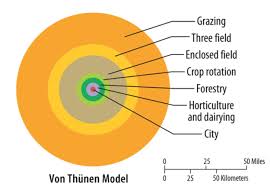
Green Revolution
The U.S.-supported development of high-yield seed varieties that increased the productivity of cereal crops and accompanying agricultural technologies for transfer to less developed countries
Commercial agriculture
Farming oriented exclusively toward the production of agricultural commodities for sale in the market
Food desert
Area with limited access to fresh, nutritious foods
GDP
A country’s GDP divided by its total population
Formal economy
The part of the economy that is officially recorded with the government
Informal economy
The part of any economy that is not officially recorded, monitored, or taxed by the government
EPZs
Industrial zone with special incentives to attract foreign investment to places where imported materials undergo processing or assembly before being re-exported
Maquiladoras
foreign-owned factories in Mexico, often located near the U.S. border, that import raw materials or components duty-free for assembly, processing, or manufacturing
NAFTA
A 1994 trade agreement between Canada, the United States, and Mexico; revised as the United States-Mexico-Canada Agreement (USMCA) in 2020
Agglomeration
Occur where firms cluster spatially in order to take advantage of geographic concentrations of skilled labor and industry suppliers, specialized infrastructure, and ease of face-to-face contact with industry participants
Time-Space compression
The decreasing distance between places, as measured by travel time or cost; often summarized by the phrase “the world is shrinking”
Outsourcing
The transfer of part of a firm’s internal operations to a third party
Growth pole
Geographically pinpointed center of economic activity organized around a designated industry, commonly in the high-tech sector
Technopole
a center of high-tech manufacturing and information-based quaternary industry
CBDs
A dense cluster of offices and shops located at a city’s most accessible point, usually its center
Suburbanization
The movement of people from urban core areas to the surrounding outskirts of a city
Megacities
A city with more than 10 million residents
Redlining
The practice of identifying high-risk neighborhoods on a city map and refusing to lend money to people who want to buy property in those neighborhoods
Blockbusting
A practice in which realtors persuade white homeowners in a neighborhood to sell their homes by convincing them that the neighborhood is declining due to black families moving in
New Urbanism
An approach to city planning that focuses on fostering European-style cities of dense settlements, attractive architecture, and housing of different types and prices within walking distance to shopping, restaurants, jobs, and public transportation
Primate City
A city that is much larger than any other city in the country and that dominates the country’s economic, political, and cultural life
Concentric Zone Model
A model of a city’s internal organization developed by E. W. Burgess that shows rings of factory production and different residential zones radiating outward from a central business district
Sector Model
A model of a city’s internal organization, developed by Homer Hoyt, that focuses on transportation and communication as the drivers of the city’s layout
Multiple Nuclei Model
A model of a city’s internal organization, developed by Chauncy Harris and Edward Ullman, showing residential districts organized around several nodes (nuclei) rather than one central business district