Intro to Supply Chain Chapter 03: Supply Chain Planning
 Call Kai
 Learn
Learn Practice Test
 Spaced Repetition
 Match
Match Flashcards
 Knowt Play
1/48

There's no tags or description
Looks like no tags are added yet.
Name | Mastery | Learn | Test | Matching | Spaced | Call with Kai | Chat |
|---|
No analytics yet
Send a link to your students to track their progress
49 Terms
Supply Chain Planning
element of supply chain management responsible for determining how best to satisfy the requirements created by the Demand Plan
balance supply and demand and understand company goals
Long Range Top Management Responsibilities
Research and Development
New Product Plans
Capital Expenses
Facility Expansion
Immediate Range Operations Middle-Management Responsibilities
Sales Planning
Production Planning
Setting employment, inventory, and subcontracting levels
Analyze operation plans
Short Range Operations Responsibilities (Managers, Supervisors)
Job assignment
Job scheduling
Dispatching
Ordering
Aggregate Production Planning (APP)
Hierarchical planning process that translates annual business plans, marketing plans, and demand forecasts into a production plan for a product family in a plant or facility.
Once a year and is usually rolled forward by 3 months every quarter.
Inventory, set up, machine operation
Hiring, Firing, Training
Purpose of APP
to establish production rates that will achieve management’s objective of satisfying customer demand by maintaining, raising, or lowering inventories while attempting to keep the workforce relatively stable.
Meet demand
Use capacity efficiently
Inventory policy
Minimize costs
APP impacts on customer’s demand (Influencing Demand)
changing demand to align with production capacity
airline and hotel weekend discounts
weekend rates, happy hour
advertising, promotional planning, pricing
Backordering
During high demand period, accept the fact that demand is greater than supply capabilities… temporary shortage
Counter-seasonal product mixing
Develop a product with seasonal trends that level production capacity (snowblowers and lawnmowers produced by same ppl)
Changing Inventory Levels (APP Supply Strat)
Increase inventories, build stock in advance of demand
Decrease inventories, temporarily reduce inventory below during peak to only maintain customer requirements. (just enough for customers)
Changing Capacity Levels (APP Supply Strat)
Vary production over-time
Hire more or lay off
part-time workers
sub-contracting (third-party does the work)
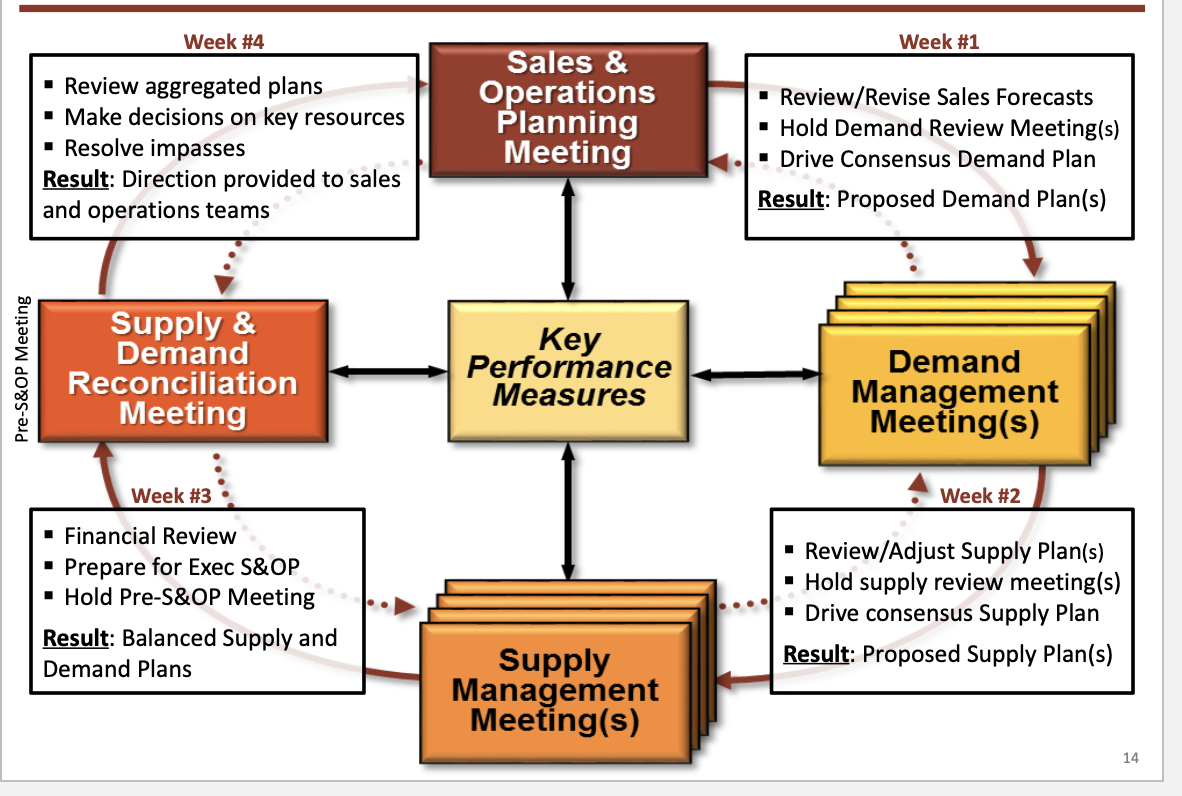
Monthly S&OP Cycle
S&OP Meeting, Demand Management Meeting, Supply Management Meeting, Supply and Demand Reconciliation Meeting
Master Production Schedule
MPS represents what the company plans to produce (3-18 months), expressed in specific product configurations, quantities, and dates often through an appointment book.
plan
detailed break down of APP
planning numbers that provide input for material requirements
considers backlogging, inventory materials, capacity, and management goals/policies
updated regularly
planning horizon must exceed the time to produce the item.
Projected Available Balance Formula
Projected Available Balance (pervious) - Customer Orders/Forecast + MPS Quantity = Projected Available Balance
Total Capacity Hours Required Formula
Final Assembly Labor + Quality Inspection Labor + Packaging Labor
Total Capacity Hours Available Formula
Hours per shift x hours per day x days per week x # manufacturer lines
Firmed Time Period
Current date out several weeks into the future
Up front time period signifying that changes now cannot be made
changes must be approved by authorized ppl and on the MPS to change
Planned Time Period
From the end of the firmed time period to the end of the planning horizon
free to create or make changes to planned orders in this time period based on the data and planning by the company.
Level Production Strategy
Constant rate of production
allows inventory and backlog to vary according to the fluctuating demand
no increase or decrease in labor, materials, or resources
used when cost of terminating people is high (highly skilled work, hard to replace)
works well for make-to-stock items
Chase Production Strategy
Adjusts the production rate to match demand
company increases or decreases labor, materials, and resources as needed
no backlogs, productions cost fluctuate
works well for make-to-order items
Hybrid Production Stage
Baseline production rate
core workforce
short-term means
part time labor
overtime
subcontracting
minimize costs while meeting demand
no backlogs, productions cost fluctuate
all to manage short-term fluctuations
Material Requirements Planning (MRP)
calculates the exact quantities, need dates, and planned order releases for all the parts and materials required.
adv:
on-time availability of the right materials
lower inventory levels (still good on customer demand tho)
optimize the use of products and lowers costs
dis:
ignores capacity, focuses on what is needed
loss of visibility
works well for make-to-stock, but not as much for make-to-order
MRP Requirements
Finished plan of production from the MPS
Bill of Materials (BOM) data, including the parent-component relationships
Item master data for each of the components and materials
Inventory status of each component
planned or scheduled receipts for any components and materials needed.
Bill of Materials
A document that shows an inclusive list of raw materials, component parts, and assemblies making up the final product.
Single Level BOM
Display of components that are directly used in a parent item, together with the quantity required for each component.
just one component to part relationship
Multilevel BOM
A display of all the components directly or indirectly used in a parent, together with the quantity required for each component. If a competent is a subassembly, blend, intermediate, etc, all its components and all their components will also be exhibited, down to purchase parts and raw materials.
all component to parent relationships, even the components of the component.
Time Bucket
Unit of time/period used in MRP, e.g., days, weeks, months
Parent
Item generating demand for lower-level components.
Components
parts demanded by a parent.
Planning Factor
The number/quantity of each component or material needed to produce a single unit of the parent item
MRP Explosion
The process of converting a parent item’s planned order releases into component gross requirements
Pegging
Relates the gross requirements for a component part to the planned order releases of the parent item to identify the source(s) of the item’s gross requirements. Pegging can be thought of as active where-used information.
Lot Size
order size for MPR Logic (dozen of eggs, pair of shoes)
Safety Stock
a quantity of stock planned to be in inventory to protect against fluctuations in demand or supply. Over-planning supply versus demand can be used to create safety stock
backup
Capacity
maximum amount of work an organization can complete in a given time.
Capacity Planning
determine the production capacity needed by an organization to produce the goods or services its customers require.
organizations must balance the production plan.. effectively deploy its resources to produce goods
helps find the time frames and staff needed to handle demand and operational costs.
Resource Requirement Planning (RRP)
Long-range capacity planning module used to check whether aggregate resources (labor) are capable of satisfying the APP.
Rough Cut Capacity Planning (RCCP)
medium-range capacity planning module used to check the feasibility of the MPS..converts MPS from the production needed to the capacity required and then compares it to available capacity.
Capacity Requirement Planning (CRP)
short-range capacity planning module used to check the feasibility of the MRP.
Distribution Requirement Planning (DRP)
time phased finished good inventory replenishment plan in a distribution network.
process of determining how and where to deploy the finished goods inventory that is produced.
DRP is a logical extension of the MRP system an ties physical distribution to the manufacturing planning and control process.
Neccessities for DRP
forecasts by distribution center
current inventory level by distribution center
target safety stock by distribution center
recommended replenishment quantities
replenishment lead times
Enterprise Requirement Planning Systems (ERP)
info system connecting an organization’s functional areas and operations via a common software infrastructure.
real time integrated management of the central business processes necessary to plan and control the organization.
Accounting and Finance
Customer Relationship Management
Human Resource Management
Manufacturing
Supplier Relationship Management
Supply Chain Management
SAP
ORACLE
MICROSOFT
Best-of-breed
pick the best ERP application for each function
dis: software may not integrate together well, but this may not be significant in the future.
Single Integrator Solution
pick all the desired ERP applications from a single vendor, better connectivity.
Advantages of ERP
visibility
standardization
measures performance and communication
Disadvantages of ERP
time and capital investment
complex to implement and run
Data Management
provides the foundation for data analytics
collecting, storing, organizing, and securing data
accurate, complete, and accessible
Data Analytics
process of analyzing, exploring, and transforming data to find patterns and trends that can provide insight and help real-time decision making.
Supply Chain Digital Transformation
aligning all processes and data on one platform, automating key processes, and using technologies such as AI to collect and analyze massive amounts of data to identify, predict, and prevent problems.
Traditonal Supply Chains —> Linear Progress
Dependency, costs, and possible delays
Digital Supply Chains —> dynamic responses and high data