Marine Science Final Exam
 Studied by 1 person
 Call Kai
 Learn
Learn Practice Test
 Spaced Repetition
 Match
Match Flashcards
 Knowt Play
1/81

There's no tags or description
Looks like no tags are added yet.
Name | Mastery | Learn | Test | Matching | Spaced |
|---|
No study sessions yet.
82 Terms
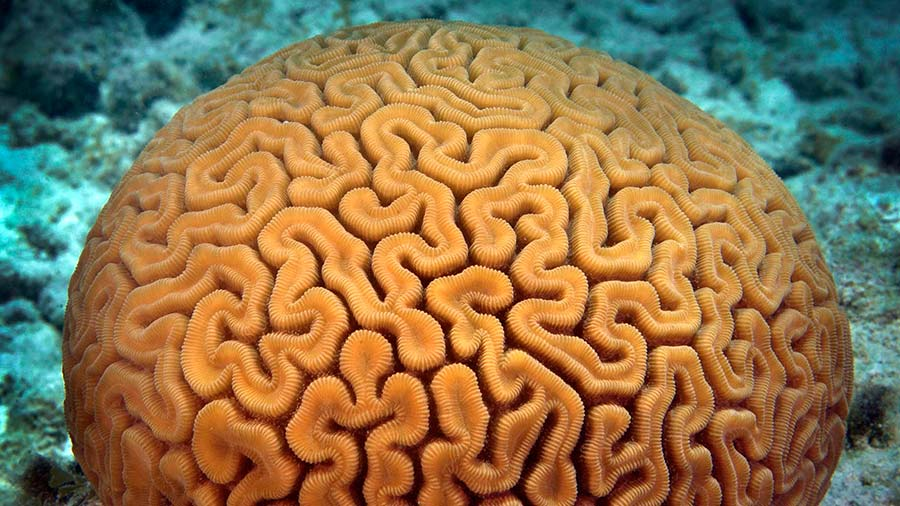
Which of the following corals has its modules most integrated?
Brain Coral
How are coral reefs similar to deserts ecologically?
Deserts and reefs both lack a crucial ingredient to productivity (water in deserts, nutrients in reefs)
At its seaward edge, the Great Barrier Reef is several hundred meters thick. How did it start to form since the corals at its base are now down in the deep dark ocean where they couldn’t have lived and started the reef.
the mantle has subsided because of the weight of the growing reef
Which of the following zones is exposed to the air for only part of each day?
intertidal
What are most deep sea bottoms like?
They are covered with mud
Why are classic coral reefs limited to the tropics?
this is where the water has sufficient super saturation of carbonate to make it easy for organisms to lay down carbonate skeleton.
Barnacles are primarily in the middle intertidal and are rare in the upper intertidal because
They cannot acquire enough food there
The deep ocean is generally thought to be very low in food, and yet we now have numerous areas with thriving organisms. What is their food source?
chemosynthesis
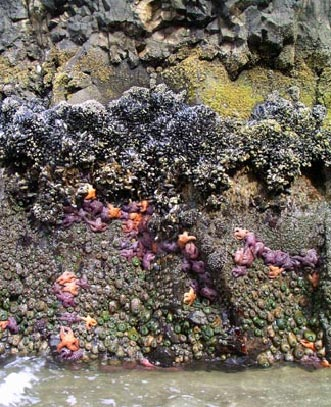
In this classic picture of typical intertidal zonation, what sets the boundary marked by the dotted line?
Mussels below the line get eaten by seastars during high tide
Do diverse thriving coral reefs require lots of food/nutrients in the water?
no, that is why they can thrive in areas with very deep stable thermoclines
Which is LEAST important to the evolution of animals in the deep sea?
high pressure
Which of the following would one NOT expect to find in an estuary?
stenotopic fish
Which is NOT a principle ecological character of reefs?
The main photosynthetic production on the reef comes from benthic algae
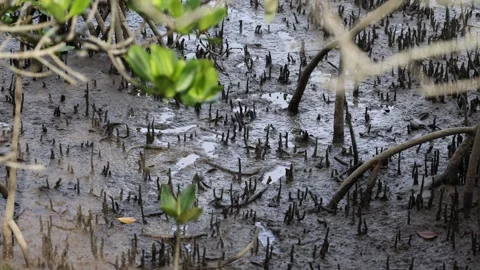
What is the function of these?
allow oxygen to roots
Which type of feeding is most common in the deep sea?
deposit feeding
Where might a salt wedge occur?
In an estuary
Which of the following is a benthic organisms that might occur on an average continental shelf?
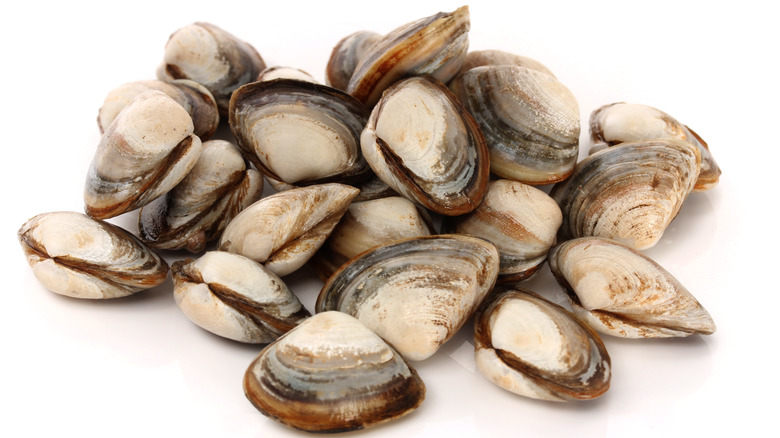
Mussels generally don't live in the subtidal because:
They are eaten by starfish
Which of the following is not primarily using food produced by chemosynthesis?
Sun Anemone
Which of the following is most accurate about how H2S is used to produce food in vent communities
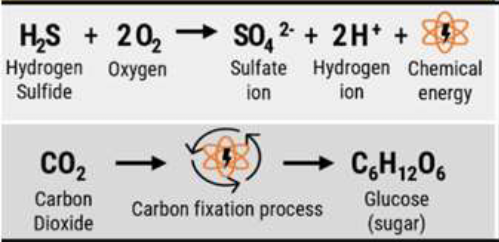
Bacteria use H2S as an Oxygen donor so that they can combine CO2 and H2O into organic molecules
How are rift tube worms and reef corals similar in the way they get their food in a very food limited environment?
Corals get their food/energy have symbiotic zooxanthellae, dinoflagellate algae, that photosynthesize to create sugar and pass on the energy to their host coral. Rifta tube worms have a red plume that sucks in oxygen, carbon dioxide and hydrogen sulphide into the ventral blood vessel where bacteria living inside them mixes the molecules together to produce chemical energy.
Rocky Intertidal areas around the world are very distinctive with similar zones of organisms in most places. What physical and biological factors determine the upper and lower ranges of these organisms?
BIO factors: The upper or top range of organisms is often set by the organisms ability to get food, how hard it is, what method of feeding—does the organism have enough time to feed? The lower range is set by other organisms like predators, how long would it take for one to feed on the organism. Competition, out competed by other organisms for food/space.
Physical factors: is the organisms adapted for big waves, flexible like seaweed or having strong hold on the rocks. Adapted to deal with desiccation, clam-up/close up to avoid drying out or run and hide, move higher up during high tide and take refuge in shady spots or tide pools as tide falls.
Would you expect coral reefs to thrive in tropical areas of upwelling? Why or why not? How does this relate to the prevalence of reefs on the east and west sides of continents?
No, coral reefs are found in areas of low nutrients. Upwellings are nutrient rich zones where algae and phytoplankton thrive but would overgrow corals. Most reefs stay within the 20 degree C isotherm because it is warm enough to have a stable thermocline that does not have lots of mixing of nutrients in the water. As a result reefs are often found on the eastern sides of continents as opposed to the western side where there are areas of upwelling.
How is the physical structure of the coral reef related to the diversity of the organisms that live there?
The dominant organism on reefs are ones with/that make mineralized skeletons, these organisms are able to withstand waves and create their own topography due to the abundance of carbonate. Modular organisms also thrive on reefs which allow quick replacement and to occupy space. Modules can be highly integrated or not. Organisms are able to create complex 3D structures by building up carbonate skeletons make the topography change: ex cavities and chasms creating hiding spaces. This physical structure gives way to high diversity. Coral triangle that larva species flow to.
How do atolls and barrier reefs form?
Atolls- doughnut shaped, circle with reef at the edge. Fringing reefs growing on the sides of a active volcano that when activity stops it begins to sink, but coral keeps growing on it. The lagoon gets filled in and the reef is left on edge.
Barrier Reefs- grow along continental shelfs that push down the plate as it builds up. Go very deep and are slowly sinking as the weight keeps increasing pushing it down.
What are some adaptations that organisms live in the deep sea have evolved?
Low Light-Bioluminescence in organisms and small/no eyes because there are no need for them.
Low Food- all production based on photosynthesis that falls, expect vent communities that rely on chemosynthesis. Many organisms are deposit or filter feeders if living on a rock or where currents go over hills.
High Pressure- proteins have evolved to have opposite charges and open structures so they compress at the depth. Pressure has little importance to organisms living in the depth
How are vent communities different from other deep sea communities?
Based around volcanically active areas, chemosynthesis is the source of energy as a result, vent communities are not reliant on surface production. Nearly independent of all other life on Earth due to chemosynthesis. They are full ecosystems with bacterial producers that live inside animal hosts or are living on rocks, with grazers, scavengers, and predators as well. Production only occurs by the vent but the food produced gets dispersed across the sea floor up to 1 km away from the vent.
What is chemosynthesis?
process by which food is made by bacteria or other living things using chemicals as the energy source, typically in the absence of sunlight. Common in vent communities. Bacteria take reduced Sulfur (H2S) and combine it with oxygen to make SO4 which releases energy that can be used to join CO2 and H2O into sugar.
Compare and contrast two organisms with mutualistic relationship with chemosynthesizers
Calyptogena- a giant mussel that has Symbionese in their digestive track with bacteria that produce energy as sugar through chemosynthesis. Inside they have a lot of hemoglobin to move the different gasses,(Sulfur H2S and oxygen) through their body and mix them together to feed the bacteria.
Rimicaris (Vent Shrimp)- Have padded flippers with lots of surface area for bacteria to grow on. The shrimp stays by the vent and eats the bacteria that grow on the padded plumes. Have heat seeking eyes so they can see the vent heat to figure out where the best spot is.
Which of the following does not typically eat shellfish?
Leatherback turtle
Which of the following DOES NOT feed on benthic invertebrates?
Bull sharks
Which of the following is not an herbivore?
nurse shark
How do whales dive for such a long period of time?
they have lots of hemoglobin within their muscles providing oxygen
Whale meat (muscle) is:
Very dark from all the hemoglobin in it
Which of the following reptiles is fully marine?
sea snakes
Which of the following is a kleptoparasite (it's a parasite by way of stealing)
frigate bird
How do many toothed whales navigate and find food down where it is dark?
They use echolocation much like bats
Which of the following marine mammals is fully marine?
Manatees
Which of the following birds is fully marine?
None of the above
What type of sea turtle eats seagrass?
Green sea turtles
Where is one most likely to see a Caribbean Monk Seal
In a museum
Longer wavelength sounds travel further in the ocean than short wavelengths, and are thought to be chosen for this reason by most whales for communication. Why do toothed whales use very short wavelengths then?
Short wavelengths can bounce off of small things, providing them with a way to use sound to create a map of the area
Which of the following is a fully marine organism?
Sea snake
Which of the following does not have adaptations to keep them warm in the cold water?
sea turtles
Why are seals and whales common in polar waters but sea turtles are absent?
Sea Turtles cannot regulate their temperature and the water is too cold
Which of the following is the most important economic use of marine birds?
Guano (Poop)
Which of the following uses baleen to catch food?
Humpback whale
Which of the following has been documented to use tools in nature?
Sea otters
What is a vaquita?
A small endangered dolphin
Marine animals that have returned to the sea have many adaptations to the ocean. Explain why some are considered fully marine and some aren’t, and why even those that are fully marine aren’t really (ie still need to breath air at the surface)
Animals considered “fully marine,” like sea snakes, whales, and manatees, live their entire life in the ocean without having to leave. They can reproduce, sleep, eat, and grow all without leaving the water, even if they have to come up for air. Other animals like sea turtles, seals , sea otters, or sea lions, live most of their life in the ocean but still leave the ocean to give birth or sometimes sleep. They are not considered fully marine because part of their life cycle still requires/depends on going on land.
How do sea turtles, sea otters, and sea cows all deal with the cold ocean temperature differently?
Sea Turtles- Are restricted to the tropics because they cannot regulate their own body temperature like mammals/bird can.
Sea Otters- Have very thick fur to trap air and insolate their body to stay warm. It is a million strands per square inch and very fine.
Sea Cows- Have a thick layer of blubber, fat that doesn’t have blood flow through it and have low density so it does not cool and instead acts as an insolate.
How are marine mammals adapted to dive deeply?
Marine Mammals have lots of hemoglobin to absorb more O2 and disperse it around the body which allows them to stay under water for longer without being deprived of oxygen. They exhale before diving deep and allow their lungs to collapse to prevent remaining oxygen from getting into alveoli and absorb nitrogen. Marine mammals keep small pocket under the sternum doesn’t allow blood flow to with a little bit of air.
How do baleen whales and toothed whales communicate very differently? Why might they have evolved these very different strategies.
Baleen whales have also adapted to communicate by using their larynx to make long waves and deep tones that travel farthest. They take advantage of the deep sound channel to communicate over great distances.
Toothed whales have developed a series of short click at higher frequencies as well as a navigational sonar through echolocation over very short distances. They use a fatty patch with air sacks called the melon that generate waves out of the forehead that goes out and bounces back, hitting the fat chamber in their jaw and can listen to the soundwaves.
Compare and contrast the diets of three different marine reptiles
Sea Snakes- Different species go after different foods. Many have microcephaly and have small heads to burrow into sea grasses or narrow hiding places. EX: The Blue lipped sea krait feeds on eels in soft surfaces and chases them down into their burrows. The elegant sea snake hunts moray eels and goes after them in their dens.
Marine Iguanas- Herbivorous and feed on red and green algae. They dive down into the water to feed on the algae growing on rocks near the Galapagos islands where they live.
Green Sea Turtles- Herbivorous and feed on seagrass (turtle grass). they swim and crop the sea grass meadows and break down the cellulose in them through gut rumination, similar to sea cows.
What does guano tell us about the importance of seabirds in marine foodchains?
Seabirds catch a huge number of fish and as a result produce huge amounts of guano that sometimes covers whole isolated islands. The guano is mined for high phosphate fertilizer by humans, but also when guano enters the ocean the high content of nutrients, phosphate, can be used by phytoplankton to produce energy which supports the base of the food web.
Why is a sea otter considered a keystone species?
Sea Otters eat benthic invertebrates like sea urchins which graze on the kelp. The Otters eat enough of them to keep the population of urchins low enough that the kelp can grow at a normal healthy rate. Without sea otters the urchins become too common that they over feed on the kelp, weakening it so that it stops growing, eventually getting lost to storms. Animals that live in the kelp then loose their habitat.
Explain how marine mammals don’t just eat plankton and fish but also can have a large impact on benthic communities
Some Marine Mammals feed on benthic invertebrates. Walruses in the polar area have large tusks which they use to rake the bottom and using their lips to suck clams out of the bottom of the seafloor. Grey Whales also hunt clams and use their lips to suck out clams. Monk Seals of the tropics eat fish, but they also feed on octopus, lobsters, and clams. For example, they dive down deep and flip up rocks to find octopus hiding beneath them. Often other fish, like sharks, follow monk seals to try and steal the ones they find. Some other seal species like the Harbor seal eat crabs as well.
Discuss the ecology of A. live whale communities and B. dead whale communities.
Live Whales- Two types, Mysticetes and Odontoceti. Mysticetes are filter feeder hunters that swallow prey and keep them inside using their baleen teeth. Some species like the Right whale skim the surface for prey, others take large gulps of water that prey is in then pushes it out leaving just the food. They are active hunters not just passive. EX: Humpback whales use bubble nets to catch food. Odontoceti tend to be smaller. Use their teeth to hunt fish sometimes seals, use echolocation. This group is divided into porpoise, flat spade-shaped teeth, and dolphins, sharp and pointed teeth. Many species extinct.
Dead Whales- Whale is a huge carcass that attracts scavengers, hagfish, who as they eat up the tissue use up the oxygen leaving it close to 0. Polychaetae and crustations then come in and eat some of the whale and colonize the bone to get lipids, leaving the area anoxic and sulfur becomes dominant. chemosynthetic organisms then move in and live on bones and sediment making energy from the sulfphide. Its a stepping stone for organisms to move to new places on the bottom.
A cod can have 6-10 million offspring each year. How is it possible then, that even after leaving cod unfished for almost a decade the populations have not rebounded?
The populations have not rebounded because they were harvest unsustainably for a while and almost the entire population was taken out. People fished them beyond the maximum sustainable yield and even though they have many offspring, not all make it to adulthood. Each year the larger cod are harvested and the population hasn’t been able to recover as the smaller fish that are left do not produce as many offspring that can survive to reproduce.
What is the tragedy of the commons and how does it apply to fishing in the ocean?
Each person acting in their own rational best interest will collectively lead to the over consumption of the commons, the fish in the ocean. Each fisher takes more fish for themselves than what the sustainable yield is which benefits that individual but as each person takes more, the result is the global fish population gets lower and lower. There could be sustainable fisheries if overharvesting did not occur. What’s good for one person is not beneficial to others.
How can you practice green consumerism in terms of seafood?
By making an effort to purchase fish that was purchased/ caught sustainably and is not from a population that is crashing. For some species, like cod, where and how its caught can determine if it is sustainable and green consumerism. Sometimes it is difficult because not every store or restaurant knows where the fish is caught exactly.
EX of sustainable fish: Alaska Salmon, wild caught
What is the maximum sustainable yield? How close are more fisheries stocks to this level?
The highest number of fish that can be taken out each year without decreasing the amount of the population. On a graph it is the steepest slope = fastest rate of reproduction. Most of our fisheries are very far down on the graph. People have overfished many of the world fish populations, like Cod.
Why are oil spills really bad for shorelines and airbreathers, but not terrible for most other marine communities?
Oil floats and creates a lay on the surface of the water. Crude oil naturally seeps from the rocks and can get broken down by bacteria. Airbreathers like sea birds that land in the oil which then try to preen it off and end up swallowing the oil destroying their lungs. Marine airbreathers like turtles and whales also have to come up to breathe and instead get a gulp of oil instead of air. Shoreline communities often have to shut down due to oil spills. Seafood farmers of shrimp and clams can no longer catch and sell food, and tourist spots as well as jobs close down.
How did pumping sewage onto reefs change the community? What was done to combat this change?
It is a form of Nutrient Pollution in the water. Pumping sewage causes algae to grow really fast allowing some oxygen near the surface but as it dies and goes deeper bacteria breakdown the algae. The algae also over grow corals blocking them from photosynthesizing and leading to their death. Bacteria have an animal metabolism and use up much of the oxygen (levels go down). The oxygen goes down until nothing can live on the bottom, becoming an anoxic zone. To combat this change the sewage outfalls are moved to deeper water where there is already not a ton of oxygen and the nutrients can’t come back up due to the stable thermocline around coral reefs. Introducing algae grazers like sea urchins is another way to combat algal growth.
What is ghost fishing?
Old nests that have been lost at sea end up as passive "killer" devices, ensnaring, drowning, or starving wildlife. They can also be nets that have been discarded by fishermen. Marine mammals like the vaquita are especially susceptible to ghost fishing nets.
Where does plastic pollution accumulate and how does it impact specific types of organisms?
Plastic pollution gets concentrated in central gyres and creates floating plastic islands, like the great pacific garbage patch. Plastic trash left on beaches can get washed out to sea by the waves contributing to these patches. Old fishing nets that have been discarded or left behind by fishers area form of plastic pollutions. They often ensnare and strangle marine mammals and fish. Seabirds ingest floating plastics in the ocean and feed them to their young which results in the death of chicks. Plastic bags that float on the surface are often eaten by sea turtles who mistake them for jellyfish.
What are the 4 main ways that global warming/change is impacting oceans?
Elevated Temperatures-leading to coral bleaching in the tropics and the reefs are dying/diminishing. Over long term, if bleaching becomes too frequent the coral populations do not have time to recover.
Chemical Effects- More CO2 in the atmosphere is being absorbed by the ocean which raises the ph. level to be more acidic than it should. Organisms cannot lay down carbonate skeletons or shells as easily and they get deformed by the acidity. Ocean has so much in it that it prevents carbonate from forming.
Storm effect- Increasing number of hurricanes/cyclones with higher storm energy. Hurricane energy is correlated to sea temperature, as temperature increases so does the storm’s power. Coral reefs get smashed and water gets mixed up. In some places there is too much surf for the reefs to recover.
Sea-level effect-Sea level is rising from the melting of the glaciers and the rising of temperature. Each degree C adds 8cm to the sea level. As sea level rises corals can grow up a level too, but currently coral can’t keep up and storm waves are able to get into the lagoons around islands, smashing onto shorelines. This increases costal erosion and stirred up marine sediments.
What is the greenhouse effect?
Sunlight entering the atmosphere in short wavelengths is absorbed by the earth and get reradiated as longer wavelengths. Some light hits the ocean r a glacier and gets reflected out but when it gets reradiated out as long wavelengths, if there are molecules in its path they will absorb the energy and keep the heat in the atmosphere. We get heating from the bottom up and the more gas molecules to absorb, the more heating and more heat is kept inside.
What is bleaching? When does it happen?
Bleaching is when corals expel their photosynthetic symbionts. This leads to them loosing their color and getting a white (skeleton) appearance. Bleaching does not mean death they can recover, but they will slowly starve to death if they do not get the symbionts back. It is a form of natural selection. Bleaching occurs when the symbionts produce too much oxygen through photosynthesis which becomes toxic to the coral. It primarily happens in warm areas, such as the northern hemisphere.
As we emit CO2 into the atmosphere, much of it is buffered by the oceans which absorb 1/3-1/2 of the CO2 we emit. How is this good for the land communities but bad for the marine communities?
As ocean absorbs more CO2 it also absorbs 2/3 of the heat in the atmosphere as well. However, it also makes bicarbonate which disassociate to make two Hydrogen which makes the ocean more acidic. This makes it difficult for sea creatures to lay down shells or a skeleton. The carbonate they use break down and results in them being deformed. As things get acidic it makes it more difficult for calcifying organisms like sea urchins, snails, limpets, and barnacles to survive.
Will rising sea-level cause tropical islands to go underwater? Why or why not?
Yes, rising sea-level causes tropical islands to go underwater. During storms the waves crash against surrounding reefs so by the time they hit the shoreline they have less wav energy. However rising sea level/decreasing corals lead to storm waves going above the reef and crashing onto the shore. This increases coastal erosion slowly shrinking the island. EX: the Maldives highest point is 2.4 m above sea level while most is under and rising level threatens their agriculture. Tuvalu neat Papa New Guinea.
Explain why people on remote islands think that it is proper for developed countries such as the US to provide the financial support for them to deal with rising sea-level. Do you agree with their stance? (Why or why not?)
Remote islands like Tuvalu, don’t have as much money as developed countries. Many of these islands are low lying and as the level rises the salt water gets into the soil, salt water incursion. The water can kill crops and trees as they have no freshwater to grow. These islands also do not have/contribute to the rise in CO2 in the atmosphere like larger more developed countries. They feel these developed countries are responsible for the rise in sea-level that is taking their country.
Which is a bigger problem to the oceans: pollution (ex oil spills, plastic, and sewage) or global change (sometimes called global warming)?
Global change
How can technological advancements in fishing gear help marine populations?
Updating fishing gear can help eliminate accidentally catching a species that is not wanted or is endangered. EX; using bite through leaders or restricting the length of long-lines can prevent killing sharks. New nets like the turtle exclusion device is designed to catch fish, but if a sea turtle enters it can escape through the flap at the bottom. These technologies allow anglers to fish for the species they want while also making it easier for non target species to escape lines and nets.
Why do Right Whales get entangled? How can this be diminished and why aren’t we doing it.
They get entangled in lines hanging off of buoys attached to lobster pots because they swim/skim along the surface of the water to feed and accidentally run into the lines. To diminish the number of whales people are pushing for lobster trappers to use sonar powered buoys that float to surface as the boat approaches to then be pulled up, eliminating the hazard of lines. This method isn’t used often because it is 3,000$ as opposed to 180$ and large cost for fishermen. It also increases the price of a lobster and fewer people could buy it.
What is ecotourism and how is it different from just “nature based” tourism?
Tourism that does not negatively impact the natural and cultural resources that people are coming to visit. It generally has a low impact on the environment and takes into account conservation practices. It is low consumption, not built in most fragile places, and aims to educate tourists. It contributes to the conservation effort to balance out the negative, i.e. contributions to local economy/school and is locally based, tourists help protect reefs, provide political will to save resource.
How has tourism helped to preserve sharks and other fish in Palau?
When surveyed it was found that many tourists, 21%, came to dive with and see the sharks. The cost of these dives were about 18 million dollars a year making each shark work 179,000 per year or 1.9 million over its lifetime. The amount of money that shark tourism was bringing in for Palau led to them banning commercial fishing, leaving the area preserved.
What are MPAs and what are their strengths and weakness in ocean conservation?
MPAs are Marine Protected Areas, areas were fishing isn’t allowed, allowing the area to recover and become healthier. They can act as a place for fish to breed and grow in, creating adult spill-over (fish from this area leave and travel to new location), larva can also be dispersed from this area helping populations grow. Some MPAs can be a “good” tourist spot. However some people argue using them for tourist spots gives an artificial feeling that the reefs are okay and doing well, when it just that one spot. They’re small and if bleaching event/disease occurs it could very bad.
What aspects of MPA structure is important for them to be successful?
Large MPAs that are stable work better than smaller ones. They provide more range for organisms living in the area and more insulated from impacts. To work MPAs need 5 features: Rules, enforcement, big/large area, old (greater than 10 years), and isolated.
Given an ethical explanation for saving oceans from each viewpoint: anthropocentric, biocentric, and ecocentric.
Anthropocentric-Most good for people, people have standing. Anthropocentric Environmental Argument is that a healthy environment is good for people. The earth provides us the resources and services that we need to survive. Therefore we should protect/preserve nature for our own good. Oceans and reefs should be preserved for our own good
Biocentric-Other life forms have standing, value to other living things. We should protect the environment because the animals should have a place to live, even if this has no direct benefit to us.
Ecocentric-The environment has a standing on its own right and it would be wrong to destroy it, even if it doesn’t help people in some way.
Why is it difficult for people to react to and work to solve large environmental problems such as those approaching our oceans?
Our brains look for certain signs to determine things that are dangerous to us and tells us to pay attention to it or whether we can safely ignore them. Our brains prefer to pay immediate attention to things that are happening in the present and have an identifiable enemy/threat. Climate change lacks these qualities because it appears to be in future and has no clear “enemy” with intention to harm. There is no defined answer to solve climate change either which makes it hard for people to react to the problem. We are responsible for it and this realization adds more anxiety and makes people want to put the problem off. (Dec 3 27:46 )
What can you do as someone residing in Ohio to help conserve and protect our oceans?
Try to practice green consumerism when it comes to choosing what types of seafood to buy, EX: avoiding purchase of species like grouper or redfish that are in low numbers or not farmed and caught ethically. Participating in ecotourism when planning a vacation or trip.