Chapter 13 - REDUCING THE CHANCE OF PREGNANCY AND STIs
 Call Kai
 Learn
Learn Practice Test
 Spaced Repetition
 Match
Match Flashcards
 Knowt Play
1/20

There's no tags or description
Looks like no tags are added yet.
Name | Mastery | Learn | Test | Matching | Spaced | Call with Kai | Chat |
|---|
No analytics yet
Send a link to your students to track their progress
21 Terms
Abstinence
Abstinence is not having sexual intercourse at all. This is the only option that has no risk of either pregnancy or side effects.
Spermicides
• They contain a substance that immobilises and destroys sperm.
• They react with moisture in the vagina to form bubbles of carbon dioxide gas, which present a physical barrier to the sperm.
Chlamydia
Chlamydia is caused by the bacterium Chlamydia trachomatis. Those who show symptoms may develop infections of the urethra, epididymis or pelvic organs. In females, chlamydia may lead to infertility or an ectopic pregnancy. There is also the chance that it will be passed on to a foetus during birth. Chlamydia is diagnosed by a urine test or a swab of the affected areas. It can then be treated with antibiotics.
Gonorrhoe
Gonorrhoea is caused by the bacterium Neisseria gonorrhoeae. In males, it causes inammation of the urethra, but this may spread to other organs if not treated. In females, it infects the urethra or cervix, and may spread to the uterine tubes and other organs. The inammation may damage the oviduct to the point of infertility. Gonorrhoea can be treated with antibiotics.
Syphilis
Syphilis is caused by the bacterium Treponema pallidum. The primary stage shows as chancres, usually on the sex organs. The secondary stage follows a few weeks to a year after the primary stage and shows as skin rashes, ulcerated mouth, fevers, and bone or eye disorders. The latent stage has no noticeable symptoms. The tertiary stage occurs between 5 years and 40 years after the initial infection.
Genital herpes
Genital herpes is caused by the herpes simplex virus, which produces blisters on the genital organs. Once a person is infected, the virus remains in the body for life. Therefore, the blisters can recur at any time
Genital warts
Genital warts are caused by the human papillomavirus (HPV). Some of the warts may be internal, and therefore it is possible for someone to pass the virus on unknowingly.
Human immunodeciency virus (HIV)
Human immunodeciency virus (HIV) is a retrovirus that infects T-lymphocytes. The infection goes through the stages of acute infection, chronic infection and then acquired immune deciency syndrome (AIDS). The virus is transmitted through body uids such as blood, seminal fluid and breast milk. HIV is diagnosed by a blood test to determine the antibody levels present or the viral load.
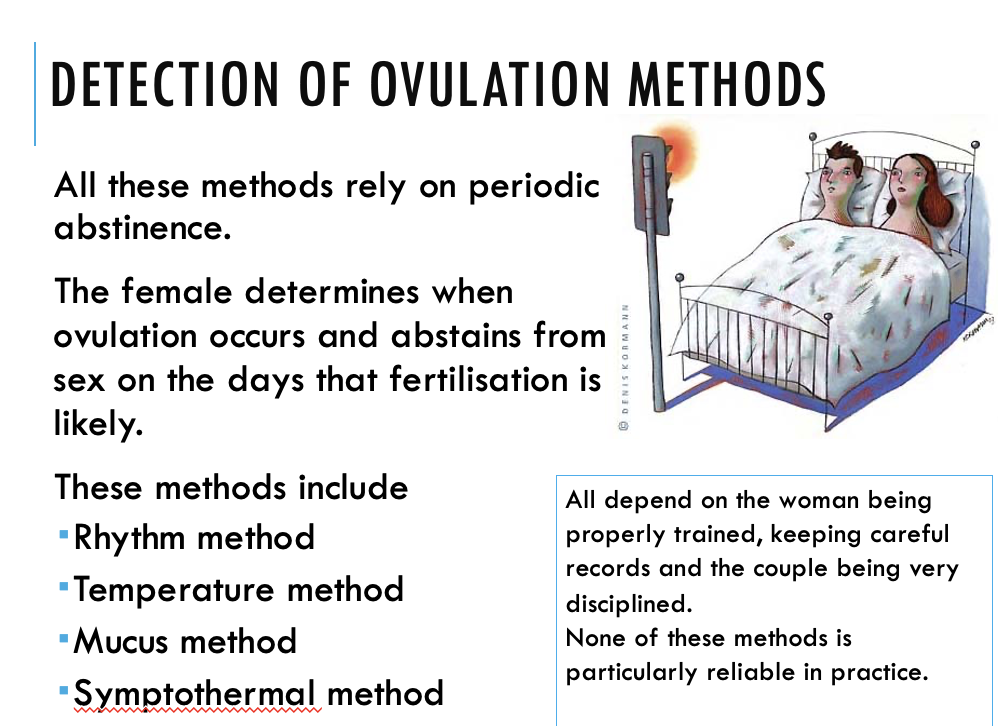
DETECTION OF OVULATION METHODS
The rhythm method depends on predicting the time of ovulation based on the length of the menstrual cycle.
The temperature method predicts ovulation by body temperature. Ovulation is accompanied by a drop in body temperature, followed by a rise (progesterone).
The mucus method predicts ovulation by cervical mucus.
As ovulation approaches,
cervical mucus can be
detected as clear, slippery strands that stretch without breaking.
The symptothermal method
is a combination of all the
above methods.
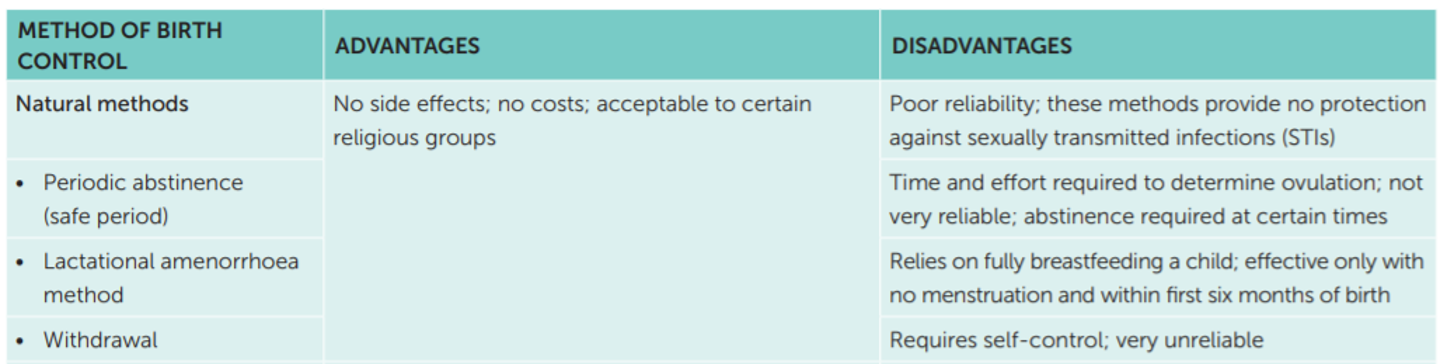
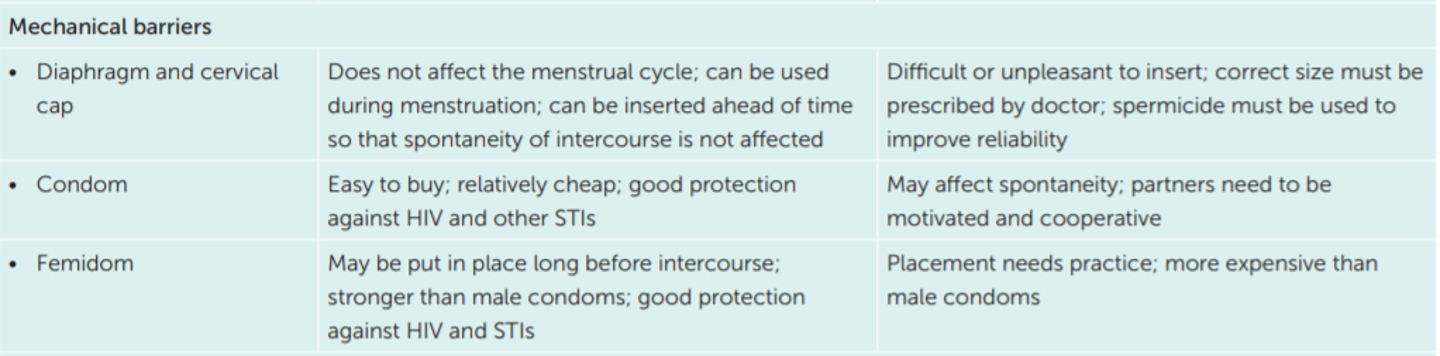
Condom: covers the penis during intercourse.
Diaphragm: covers the top of the vagina during intercourse.
Cervical cap: covers the cervix during intercourse.
Female condom: lines the vagina during intercourse.
SPERMICIDES AND FOAMS
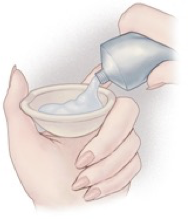
Spermicides & foams are usually used together with a mechanical barrier.
They are very unreliable when used alone.
The spermicide immobilises the sperm.
The foam reacts with moisture in the vagina to form bubbles of carbon dioxide gas.
The gas provides a physical barrier to the sperm.
No protection against STIs
HORMONAL CONTRACEPTIVES FOR WOMEN
These change the hormone levels in the female body.
Oral contraceptives are taken by mouth every day.
Depo-Provera is injected every 12-14 weeks.
Implanon is implanted under the skin every 3 years.
The vaginal ring is inserted in the vagina for 3 weeks & removed for the fourth.
HORMONAL CONTRACEPTIVES FOR WOMEN
The combined pill & vaginal ring contain progesterone & oestrogen substitutes. This is the most reliable contraceptive type available.
The hormones have 3 effects:
Prevent ovulation
Make the cervical mucus thick & sticky: a better sperm barrier
Make the endometrium of the uterus less receptive to implantation.
The oestrogen component can cause thrombosis, especially in smokers.
The dose in the vaginal ring is lower.
EMERGENCY FEMALE CONTRACEPTION
This attempts to prevent pregnancy after unprotected sex.
It consists of 2 tablets of progesterone substitute available from pharmacies.
The hormone prevents or delays ovulation, prevents the sperm from reaching the egg and prevents implantation.
Side effects can occur but are not common.
The effectiveness decreases with time after intercourse, especially after 3 days.
INTRAUTERINE DEVICES (IUDs)
IUDs are devices of plastic & copper inserted into the uterus.
Side effects include bleeding & pain.
They work as follows:
Irritation of the uterus prevents implantation
Copper alters the levels of enzymes & trace elements in the endometrium.
Copper acts as a spermicide.
They last for 5 years.
STERILISATION:
PERMANENT CONTRACEPTION
Vasectomy
Removal of part of each vas deferens in the male and sealing the cut ends.
STERILISATION:
PERMANENT CONTRACEPTION
Tubal ligation
Removal of part of each uterine tube in the female and sealing the cut ends.
STERILISATION:
PERMANENT CONTRACEPTION:
essure
Essure:
Inserting a device into the uterine tubes. The uterine tubes grow around the device, causing a blockage.