Biochem Exam 1
 Call Kai
 Learn
Learn Practice Test
 Spaced Repetition
 Match
Match Flashcards
 Knowt Play
1/170

There's no tags or description
Looks like no tags are added yet.
Name | Mastery | Learn | Test | Matching | Spaced | Call with Kai | Chat |
|---|
No analytics yet
Send a link to your students to track their progress
171 Terms
Covalent bond
atoms share pairs of electrons to become stable
very strong
ex: polar (unequal sharing) + nonpolar (equal sharing)
Noncovalent bond
no sharing of electron pairs; relies on electrostatic attractions
weak
ex: Ionic bonds, hydrogen bonds, and van der Waals forces
Intermolecular forces
attractive forces that act between separate neighboring molecules
weak
reversible
determine physical properties e.g. melting point

Intramolecular forces
strong chemical bonds that hold atoms together inside a single molecule
strong (involve shared or transferred electrons)
reversible
determine chemical properties + identity
Examples of intermolecular forces
ion ion attractions
dipole dipole interactions
vander waals forces
Examples of intramolecular forces
covalent bonds
ionic bonds
metallic bonds
F= (intermolecular force)
F= < -1 or > +1
Negative (less than −1) → the interaction is attractive
Positive (greater than +1) → the interaction is repulsive
F= (intramolecular force)
F= -1 ——> +1
−1 = strong attraction
Between −1 and 0 = attraction
0 = no net force
Between 0 and +1 = repulsion
+1 = strong repulsion
Ion ion attractions
the force of an electrostatic interaction between two distinct charges on atoms
usually take place between atoms bearing a completely negative charge and positive charge
energy of interaction is given by Coulomb’s law
Coulomb’s law
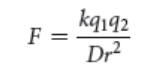
F
the force
k
proportionality constant
q1 and q2
charges on the two atoms
D
dielectric constant (counts for the effects of the intervening medium)
r
the distance between the two atoms (in angstroms)
What does Coulomb’s law mean?
Two atoms with opposite charges attract each other. The farther apart they are, the weaker that attraction becomes
ex. If the distance doubles, the attraction becomes 1/4 as strong. If the distance triples, it becomes 1/9 as strong
The material between them also affects how strong the attraction is (ex. Water)
Dielectric constant in a vacuum
D=1
electrostatic interactions are strongest
Dielectric constant in polar environment (water)
D=80
electrostatic interactions are weakened
Electrostatic interactions are stronger in…
nonpolar (uncharged) environment
Why does water weaken electrostatic interactions
Water can dissolve virtually any molecule that has sufficient partial or complete charges on the molecule to interact with water
ex: NaCl is added to water → water molecules surround the ions and reduce how strongly they attract each other → ions bond to water molecules instead of each other → ionic bond is broken
rate of decrease in force for ion ion attractions
1/r2
an ion has a full charge on it so it is still “felt” with distance → force decreases slowly
Dipole dipole interactions
attractive forces that occur when the partial positive end of one polar molecule is electrostatically attracted to the partial negative end of another polar molecule
ex: H-bonding
Hydrogen bonding
a bond formed when two relatively e-neg atoms (O or N) unequally share a H atom that is covalently bonded to one of the electronegative atoms
need highly e-neg atom (N, O, F)
hydroxyl + amino groups can H-bond
Fluorine
most e-neg atom
not common (in lab not naturally occurring)
used in drugs → chemotherapy
How is H bonding affected by water?
hydrogen bonding between two molecules is stronger in the absence of water
rate of decrease in force for dipole dipole interactions
1/r3
two opposite partial charges partially cancel each other out at greater distances → force decreases faster
Hydrogen bonds in DNA double helix
bonds are weak enough to be broken by the enzymes of DNA metabolism → allowing access to the genetic information
Van der Waals Forces
electrostatic attractions between nonpolar + uncharged molecules caused by temporary shifts in electron density → at any instant charge distribution is not perfectly symmetric: regions of partial positive + negative charge
rate of decrease in force for van der waals
1/r6
temporary dipoles are extremely short range so a greater distance → rapidly decreases force
Rank intermolecular forces from strongest to weakest
ion ion → dipole dipole (H-bonds) → van der waals
Entropy
measure of randomness
What happens when one benzene molecule is added to water?
benzene is nonpolar so can’t H bond with water → creates cavity in water → cavity temporarily disrupts some H bonds between water molecules → displaced water molecules reorient themselves around benzene to form max # of new H bonds → water molecules are more ordered → decreases entropy of water
What happens when two benzene molecules are added to water?
coalesce into a single large cavity → reduces amount of water that needs to be organized around benzenes → water molecules are freer to move around + have more arrangements → increases entropy
Hydrophobic effect
nonpolar molecules in aqueous solutions are driven together because of the resulting increase in entropy of water molecules
form spontaneously → no input of energy required
How is membrane formation powered by hydrophobic effect?
phospholipid: head is hydrophilic (polar + charged), tail is hydrophobic
→ when exposed to water, molecules orient themselves such that the hydrophilic head groups interact with the aqueous medium and hydrophobic tails are sequestered away from water and interact only with one another → can form membranes stabilized by van der waals interactions
Metabolism
oxidative breakdown → break down organic molecules using oxygen to release energy
Catabolism
breakdown → release energy
oxidation
lose electrons
Anabolism
synthesis → consume energy
reduction
gain electrons
What are the 8 common functional groups?
hydrophobic
hydroxyl
aldehyde
keto
carboxyl
amino
phosphate
sulfhydryl
Hydrophobic functional group
Class of compound:
hydrocarbon chains (aliphatic)
aromatic
Characteristics:
nonpolar
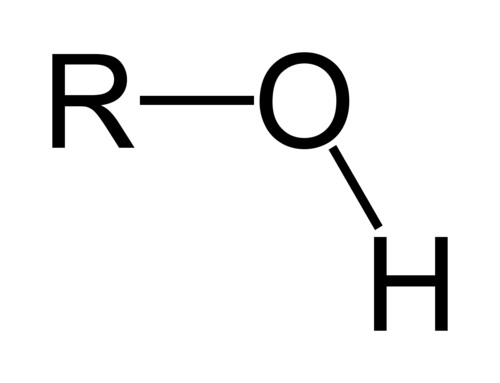
Hydroxyl functional group
Class of compound:
alcohols
Characteristics:
polar
Aldehyde functional group
Class of compound:
aldehydes
Characteristics:
polar
metabolizes sugars

Keto functional group
Class of compound:
ketones
Characteristics:
polar
metabolizes sugars

Carboxyl functional group
Class of compound:
carboxylic acid
Characteristics:
polar

Amino functional group
Class of compound:
amines
Characteristics:
polar

Phosphate functional group
Class of compound:
organic phosphates
Characteristics:
polar

Sulfhydryl functional group
Class of compound:
thiols
Characteristics:
polar (not as polar as hydroxyl group)

least oxidized form of carbon
hydrocarbon chains and aromatic rings
most oxidized form of carbon
CO2
Oxidized
More oxygens
Increase CO bonds, decrease CH bonds
Reduced
More hydrogens
Increase CH bonds, decrease CO bonds
Nonmetal oxides in water are…
acidic
ex: CO2 + H2O → H2CO3
carbonic acid releases H → more H in water = acidic
Metal oxides in water are…
basic
ex: MgO + H2O → Mg(OH)2
magnesium hydroxide can dissociate in water producing OH → more OH in water = basic
Water ionizes to a small extent
H2O → H+ + OH-
The equilibrium constant (Keq)
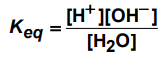
Equilibrium constant of water
Keq= 10-7 M
Ion constant (Kw)

Ion constant of water
Kw= 1.0 × 10⁻¹⁴ M2
pH
[log][H+]
[H+]10^-7
Acid
proton (H) donor
Base
proton (H) acceptor
Conjugate base
chemical formed upon ionization of an acid
Conjugate acid
acid formed when a base binds a proton
Strong acid
donates all of its protons in an aqueous solution
Strong base
A base that dissociates completely into ions in solution
Weak acid
<1% dissolution in an aqueous solution
Weak base
a base that does not dissociate completely into ions in solution
Buffer
acid-base conjugate pair resists changes in the pH of a solution
effective at a pH near its pKa
weak base + conjugate acid
weak acid + conjugate base
Henderson-Hasselbalch equation

Acids at physiological pH
base form will predominate
Bases at physiological pH
acid form will predominate
Ionizable groups
a specific part of a molecule that can gain or lose a hydrogen ion depending on the pH of the surrounding environment
use pKa to determine change
Examples of ionizable groups
Carboxyl group (-COOH)
Amino group (-NH₂)
Aspirin
acetylsalicylic acid
can deprotonate into acetylsalicylate
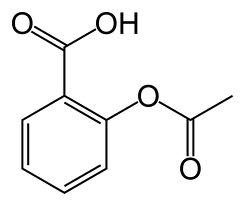
Role of acids and esterases in case study
catalyze the hydrolysis of esters → ester splits apart forming a carboxylic acid + alcohol
Environment of stomach in case study
highly acidic conditions (lots of H+)
acetylsalicylic acid is predominant
Bicarbonate lavage
basic and forms acetylsalicylate from acetylsalicylic acid
better lavage for acids
Saline lavage
salt water → neutral and will not change state of acetylsalicylic acid
poor lavage for acids
What is the more soluble form in the case study?
the ionized form (removes as solution in the body)
Why is sodium bicarbonate lavage more effective?
sodium bicarb solution has a pH of 8.5 → more basic than stomach → causes salicylate to ionize into deprotonated/charged form → ionized form is more soluble & has a harder time crossing stomach membrane to return to bloodstream → salicylate stays dissolved in watery contents of GI tract
How does salicylate end up in blood?
acidic conditions in the stomach and esterase enzymes promote ester hydrolysis (forming salicylate)
salicylate enters the blood, which has a neutral pH (more basic), promoting deprotonation of salicylate
How does acetylsalicylic acid poisoning increase blood pH?
salicylate formation causes hyperventilation → more CO2 exhaled → drop of CO2 in blood → shifts reaction to the left → less H in the blood → more basic → higher pH → respiratory alkalosis
When would you use a saline solution?
if the injected chemical of concern was already in its ionic form and just needs to be flushed out
note that stomach acid can protonate bases
Acidosis
body conditions are too acidic
respiratory
metabolic
Acidotic
patient affected by condition
Alkalosis
body conditions are too basic
respiratory
metabolic
Respiratory acidosis
not breathing properly → CO2 retention → extra CO2 reacts with H2O → will become carbonic acid → dissociates → more H → lower pH
chronic obstructive airway disease
severe asthma
depression of respiratory center
weakness of respiratory muscles
airway obstruction
hypoventillation
Metabolic acidosis
Lactic acidosis
Severe diarrhea
Surgical drainage of intestine
Diabetis mellitis
Renal problems
Lactic acidosis
low O2 → rely on glycolysis to produce ATP → glycolysis produces pyruvate → converted to lactate → rise of H due to increased production of lactate → lowers pH
lactate is nonvolatile → will sit in blood
Diabetes
glucose in blood but cells can’t access for energy→ body starts breaking down fat → produces ketone bodies → build up of ketone bodies → ketoacids → more H → lower pH
can cause coma/death
can get rid of by liver but takes a while
Respiratory alkalosis
Hyperventilation
Lung disease
Anemia
Salicylate poisoning
Metabolic alkalosis
Vomiting- H+ in stomach
Intravenous administration of bicarb
Hypokalemia (low k+)
Amino acid
compound with an amino group on one end and a carboxyl group on the other end

R group
a functional group that defines a particular amino acid and gives it special properties
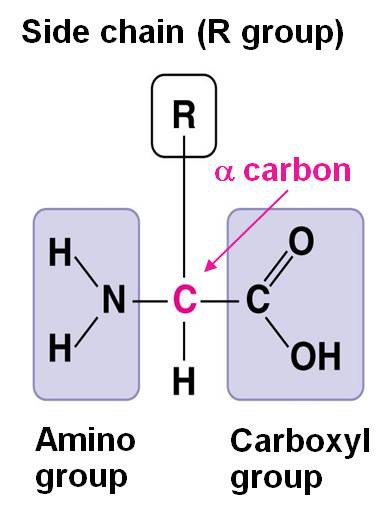
Amino acid central carbon
chiral
forms L and D isomers
L isomer
found in our bodies, our proteins and consumed in our diet
only L isomers are in proteins
D isomer
taken in from external sources
Essential amino acid
amino acids that we need to consume → can’t synthesize into proteins
Nonessential amino acid
amino acids that we can naturally synthesize into proteins
pKa of terminal alpha-carboxyl group
3.1