Ecology Exam 1
 Call Kai
 Learn
Learn Practice Test
 Spaced Repetition
 Match
Match Flashcards
 Knowt Play
1/92

There's no tags or description
Looks like no tags are added yet.
Name | Mastery | Learn | Test | Matching | Spaced | Call with Kai | Chat |
|---|
No analytics yet
Send a link to your students to track their progress
93 Terms
What are the key factors that affect the physiology of terrestrial organisms?
precipitation and temperature
also can look at pH, salinity, etc. but not as important
What are the key factors that affect the physiology of aquatic organisms?
temperature, salinity, oxygen content
What factors influence climate and precipitation patterns globally?
tilt and orbit of the earth in relation to how sun hits it and temperature, Hadley cells & other circulation cells in relation to atmosphere and wind patterns, trade winds, water patterns
How does the tilt and orbit of the Earth affect its surface heat?
at the equator, sunlight hits earth at a direct angle which allows for direct penetration of rays through the atmosphere and hotter areas
closer to regions of the poles, sun rays hit earth at an angle which means they are spread over a larger area surface and how to travel through more atmosphere,
means less sun reaches the surface of earth in these regions and are less hot
How does earth’s orbit and tilt cause seasonal changes?
as the north or southern hemisphere is tilted toward the sun, seasonality occurs since the other side isn’t point in direct sunlight
How is air circulated in the atmosphere?
through atmospheric circulation cells
What is a Hadley cell?
largest circulation cell that determines large-scale patterns of precipitation and moisture, creates bands of desert at 30 degrees N and S of the equator
How do atmospheric circulation cells work?
air warms due to solar heating and rises, it then cools and rain falls, as more air rises it pushes dry air toward the poles, dry air then cools and sinks, the dry air flows toward the equator and the cell cycles once more
What are ferrel cells?
atmospheric circulation cell below the equator but above the poles, driven by connective forces of both ferrel and polar cells
What are polar cells?
atmospheric circulation cell close toward the poles that are similar to Hadley cells but are less intense since less sunlight is hitting them therefore there’s less heat to drive evaporation
What is the inter-tropical convergence zone?
area that lies between where the 2 Hadley cells converge, between the bands of desert formed at 30 degrees north and south
What is the Coriolis effect?
phenomenon in which the rotation of earth causes winds to be deflected right in the northern hemisphere and left in the southern hemisphere
What are trade winds?
winds that blow from east to west at 30 degrees latitude and along the equator, occur due to the deflection in atmospheric circulation cells in response to the Coriolis effect
What are westerlies
winds that blow from west to east at 60 degrees latitude, occur due to the deflection in atmospheric circulation cells in response to the Coriolis effect
What are biomes?
communities based on life forms of species that tend to dominate in a given climate
What is lake turnover?
mixing of warm and cold waters, helps oxygenate water and disperse nutrients, occurs usually in fall and spring
What happens when lake turnover is infrequent?
can result in dead zones/areas of depleted oxygen
What are communities?
species found in a defined area that interact with each other
What is a Whittaker biome diagram?
diagram that shows categorized ecosystem types according to precipitation and temperature, suggests a locations average temperature and precipitation have a large impact on types of vegetation
What is evaporation?
conversion of liquid water to water vapor, drives the global hydrologic cycle
What is the global hydrologic cycle?
continuous movement of water on earth
What are the two ways in which water can be lost from terrestrial ecosystems?
evaporation from soil surface and transpiration
What is transpiration?
process in which water vapor exits the leaves of a plant after water is pulled up from the soil into the plant
What is an evapotranspiration rate?
combination of evaporation and transpiration, total rate at which an ecosystem loses water to the atmosphere
What is potential evapotranspiration (PET)?
max evapotranspiration rate if/when a system has abundant water, driven primarily by temperature, indicative of evaporative demand
What is evaporative demand?
how much energy is available to do work of converting water to vapor
What is the equation for PET?
PET (mm/month) ~ 2 T (in celsius)
What is actual evapotranspiration (AET)?
rate at which water actually evapotranspires
What are climate diagrams?
diagrams that overlay precipitation and temperatures and can be used to estimate AET and PET
When precipitation is greater than or equal to PET, what is the rate of AET?
AET is equal to the PET
When precipitation is less than PET, what is the AET?
AET is equal to the amount of precipitation
What is physiologic tolerance?
range of environment parameters over which an organism can survive
What is a niche?
constellation of environmental conditions under which a species can survive
What is Liebig’s Law of the Minimum?
states that growth and reproduction is limited by the most scarce resources, this is specific to each species in each environment at a particular time
What is an optimal environment?
set of conditions for which growth and reproduction is greatest
What are the two ways in which physiological changes occur?
individual level and population level
What would happen if Earth’s axis rotation were tilted at a greater angle toward/away from the sun? Why?
seasons would be more pronounced since the Earth would have less area that is being directly hit by sunrays
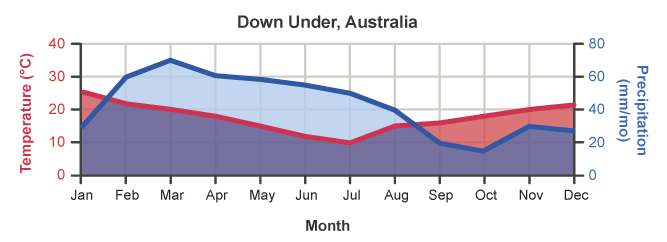
What is the best estimate for PET in Down Under during August, when the temperature is 15 C and precipitation is 40mm? Why?
30mm, this is because precipitation at 15 C is 30mm and since precipitation is less than the PET, AET equal amount of precipitation
What are the 3 ways in which species respond to a changing environment?
range shift, acclimation, adaptation
What is range shift?
when a population shifts in response to environmental changes, move to new locations that match their physiological tolerances
What is acclimation?
change in morphology or physiology in response to environmental change, occurs at the individual level, DNA doesn’t change
What is adaptation?
occurs on the population level, genetically determined trait that increases and individuals fitness, improves the chances of surviving and reproducing when an environment changes
How does enzyme activity reflect physiology?
since proteins respond to temperature in different ways, we can look at an organisms proteins to see how they respond to temperature
How does acclimation work?
an organism may have more than one gene in a genome to code for different enzymes optimized for different environments, organisms may also be able to vary the cellular environment within itself by creating proteins to help with environmental change
How can adaptation be confirmed?
difficult, need to know that a populations average phenotype[e changed in response to environment and is driven by genetic change
What is irreversible acclimation?
permanent acclimation, not reversible, changes usually occur during early development and become fixed once mature
What is a common garden experiment?
allows researchers to ascribe differences in phenotype to determine whether a change is due to acclimation or adaptation, individuals or a population is collected from distinct geographic locations and reared under controlled conditions
What is a water budget?
tracks state of water by comparing inputs and outputs
What is a net water balance?
inputs-outputs in amount of water in an organism, Wnet = Wing - Wmet ± Wosm - Wevap - Wsec
If Wnet = 0, what is happening?
an organism is maintaining homeostasis in relation to water
If Wnet > 0, what is happening?
organism is gaining water
If Wnet is < 0, what is happening?
organism is losing water
What is ingestion?
input to water budget, water is ingested through drinking or from free water in food
What is metabolic water?
form of ingestion of water, water is produced when macromolecules are broken down by an organism, this is important for organisms in arid or salty areas
What is osmotic exchange?
input and output of water budget, water is gained or lost via osmosis with the environment, common in aquatic organisms
How does osmotic exchange occur in aquatic organisms?
through skin or gills, due to differences in solute concentration in water and within the organism osmosis differs in freshwater and saltwater orgnaisms
What is secretion?
output of water budget, water is lost as an organism secretes urine, feces, or mucus, can be problematic to both terrestrial and aquatic organisms
What is evaporative loss?
output of water budget, terrestrial organisms lose water to evaporation by moistening air through inhalation or through panting/sweating
What is the surface trend for salinity?
at the equator, near poles, and near coastlines there is less salinity, this is due to rain, ice, and river runoff proving freshwater
everywhere else is salty because in dry areas evaporation has removed freshwater, more solutes in water

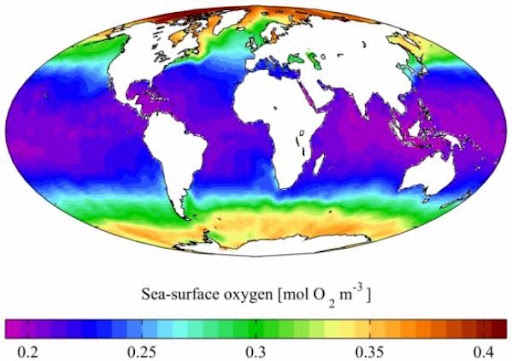
What is the surface trend for oxygen?
lower oxygen at the equator and higher oxygen at the poles, this is because colder water holds more oxygen since the solubility of oxygen increases at decreased temperatures
What is heat balance?
rate at which an organism accumulates or loses heat
What is a poikilotherm?
organism whose body temperature fluctuates
What is a homeotherm?
organism that maintains a relatively stable, constant body temperature
What is an ectotherm?
organism who’s body temperature is primarily determined from the heat in the environment, depend on external sources of heat, many are poikilotherms
What are endotherms?
organism whose body temperature is primarily determined by internally-generated metabolic heat, rely on internal heat production, energetically expensive but allows for high performance across a variety of conditions
What is behavioral thermoregulation?
process in which an organism chooses locations with favorable thermal properties
What is the surface trend for temperature?
hotter at the equator due to direct sunlight, the closer we get to the poles the colder it is due to less direct sunlight/sun is spread over larger surface area
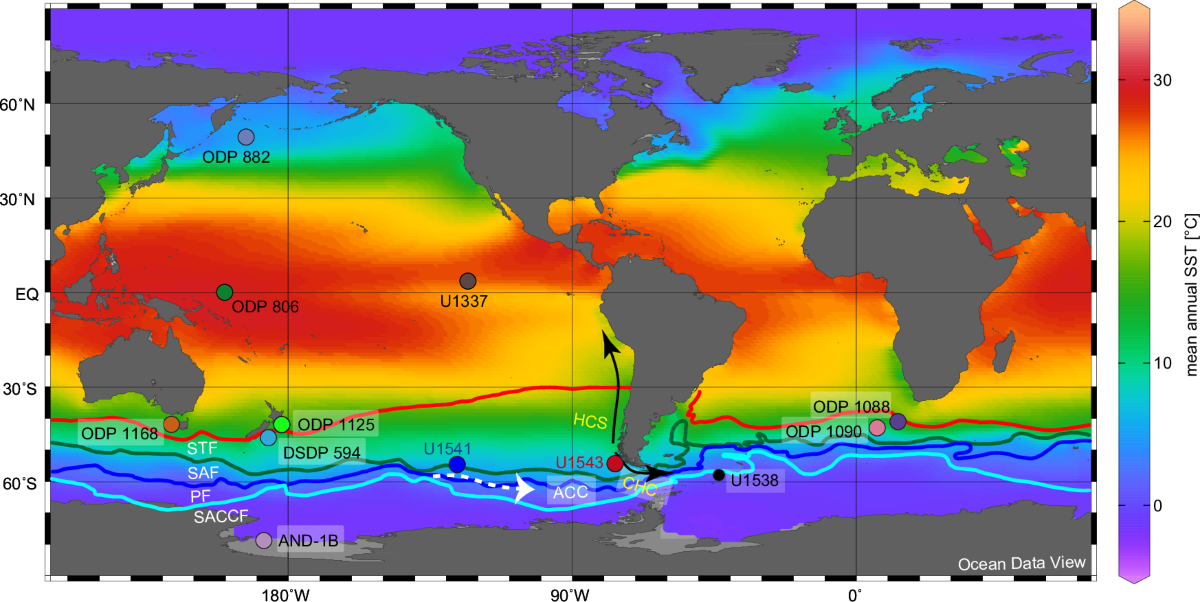
What is the pattern of water movements?
upwelling, hot water moves around to mix with colder water, also moves around nutrients, differs depending on the seasons

What is upwelling?
movement of water, drives the circulation of water, there’s a density difference between hot and cold water, mixing of water temp., nutrients, etc.
What is the depth trend for oxygen levels in oceans?
higher oxygen near the surface as we go down there is an oxygen minimum layer, there’s more oxygen as we go back dow

What is an oxygen minimum layer?
layer in depth of water that has the least amount of oxygen, this is due to the presence of organisms that take up oxygen
What is the depth trend of oxygen in lakes?
same as oceans, during winter there’s less of an oxygen minimum layer, during summer more of an oxygen minimum layer, fall and spring there’s the same amount of oxygen throughout due to lake turnover
What is the depth trend for temperature in oceans?
hotter at the surface, then encounter a thermocline due to upwelling, eventually colder at as we go deeper; hotter at top as there’s more sunlight reaching the surface

What is a thermocline?
stratification between hot and cold water (hot on top and cold on bottom), as water heats up kinetic energy increases and hot water mixes with cold to move to the top, creates a transition layer
What is the depth trend for temperature in lakes?
same as oceans, have a thermocline, less drastic than oceans
in spring and fall temperature isn’t really deviated because of lake turnover
in winter colder on top and warmer deeper, due to insulation
in summer hotter on top and colder deeper
What is the depth trend of salinity in oceans?
more salinity up top due to surface evaporation, reach a halocline, get saltier as we go deeper due to density of solutes

What is a halocline?
area where top and deeper layers of salinity in water mix, usually very salty area
What is the depth trend of salinity in lakes?
lower salinity because of fresh water
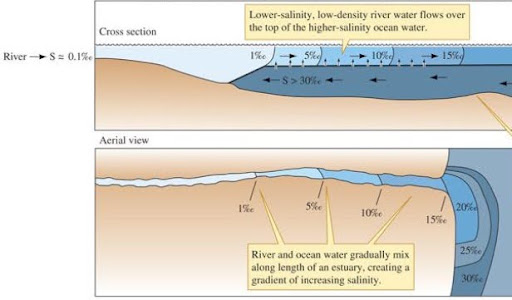
What is the depth trend of salinity in rivers?
as rivers meet oceans we get more salinity as the two bodies of water mix, closer to the ocean the saltier
What are heat budgets?
rate at which an organism accumulates or loses heat, Hnet = Hsr + Hmet ± Htr ± Hcond ± Hconv - Hevap
If Hnet = 0, what is happening?
organism is maintaining homeostasis
If Hnet > 0, what is happening?
organism is too warm
If Hnet < 0, what is happening?
organism is too cold
What is absorbed solar radiation?
input of heat budget, radiation acts as a source of heat based on the exposed surface area of the organism, also depends on amount of radiation absorbed versus reflected
What is metabolic heat?
input of heat budget, heat that’s released when some energy from muscle use, digestion, thinking, metabolized, etc. and released as heat
What is thermal radiation?
input and output of heat budget, how readily an object radiates heat
What is conduction?
heat budget input and output, heat transferred from a hot region, object, or substance to a cooler one through direct contact
What is convection?
heat budget input and output, heat is transferred among moving fluids (water or air)
What is countercurrent heat exchange?
exchange of heat between hot and cold fluids moving in opposite directions, think of an artery of warm blood sandwiched between veins carrying cool blood, forms a temperatures gradient and maintains temperature
What is evaporative cooling?
heat budget output, heat lost from a system when heat is used to evaporate water
What do water budgets in plants look like?
inputs are water from roots and air, outputs are transpiration and secretions
What do water budgets in aquatic organisms look like?
inputs are water from drinking, food, and osmosis, outputs are from osmosis and secretions
What do water budgets looks like in terrestrial organisms?
inputs are water from drinking, food, and air, outputs are from evaporation and secretions