Chapter 2.1: Elements, Compounds, and Mixtures
 Call Kai
 Learn
Learn Practice Test
 Spaced Repetition
 Match
Match Flashcards
 Knowt Play
1/14

Name | Mastery | Learn | Test | Matching | Spaced | Call with Kai | Chat |
|---|
No analytics yet
Send a link to your students to track their progress
15 Terms
Substance
Matter with a fixed composition; includes:
Elements (the simplest type of matter with one type of atom)
Compounds (two or more different elements that are bonded chemically)
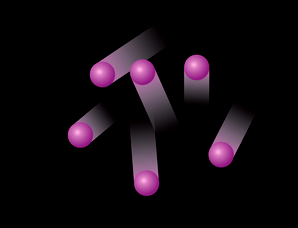
Element
The simplest type of matter with unique physical and chemical properties
Has only one kind of atom
Visible properties are unique due to submicroscopic differences
Some exist as molecules, like oxygen as O2

Molecule
An independent structure of two or more atoms bound together
Atom
The smallest unit of an element that retains its chemical nature
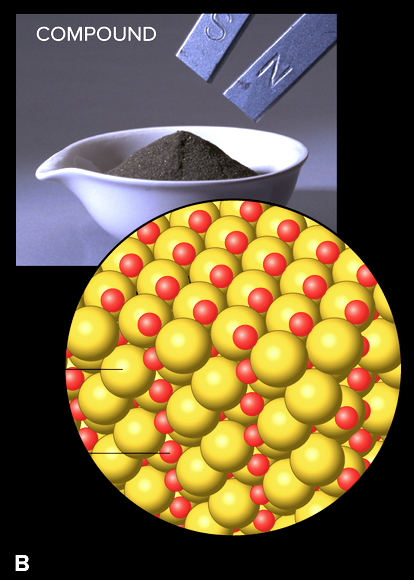
Compound
Two or more different elements that are bonded chemically, with atoms joined in a chemical reaction; can be seen with water or sodium chloride
Defined by:
A fixed mass ratio of each element per compound unit (like NH3)
Properties different from that of the individual elements (like NaCl not inheriting many properties of Na or Cl)
Simple substance possibilities via chemical changes (like NaCl being broken by electric current)
Fixed mass ratio
Property of compounds where elements are present in fixed parts by mass
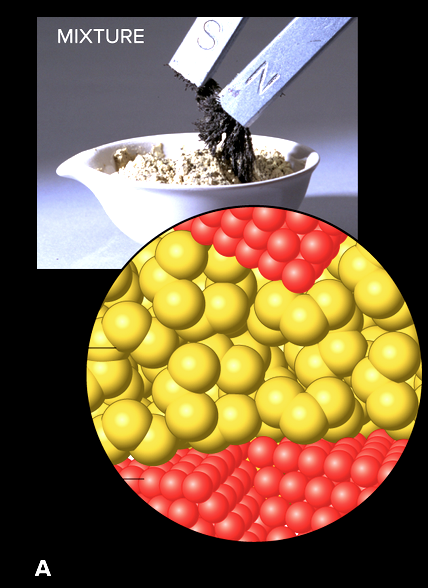
Mixtures
Two or more substances that are physically intermingled, but not chemically combined; some properties include:
Potential variation in mass parts, like concentration in salt and water
Component-level retention
Can be separated by physical changes if needed
Examples include air, oceans, and milk

Hetrogenous mixtures
Mixtures with one more visible boundaries among the components
Variation is distributed from one region to another
Boundaries may only be seen with microscopes at times
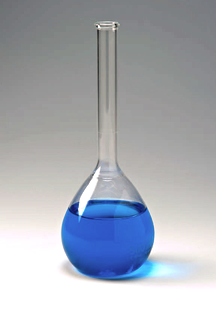
Homogenous mixtures (solutions)
Mixtures with no visible boundaries
Uniform composition and uniformly intermingled (not attached)
Cannot visually tell whether homogenous or an element or compound
Filtration
The separation of a mixture based on particle size, used to separate solids from liquids
Crystallization
Based on solubility; impure solids can be dissolved and then re-crystallized
Solubility
Of a substance, the amount that dissolves in a fixed volume of solvent at a given temperature
Distillation
Based on volatility, where:
In simple procedures, more volatile contents are vaporized first and collected
In fractional procedures, many steps are used to separate components with small differences, like with petroleum
Volatility
The tendency of a substance to become a gas
Chromatography
Also based on solubility; components flow through a solid or viscous liquid with the lowest soluble elements moving faster